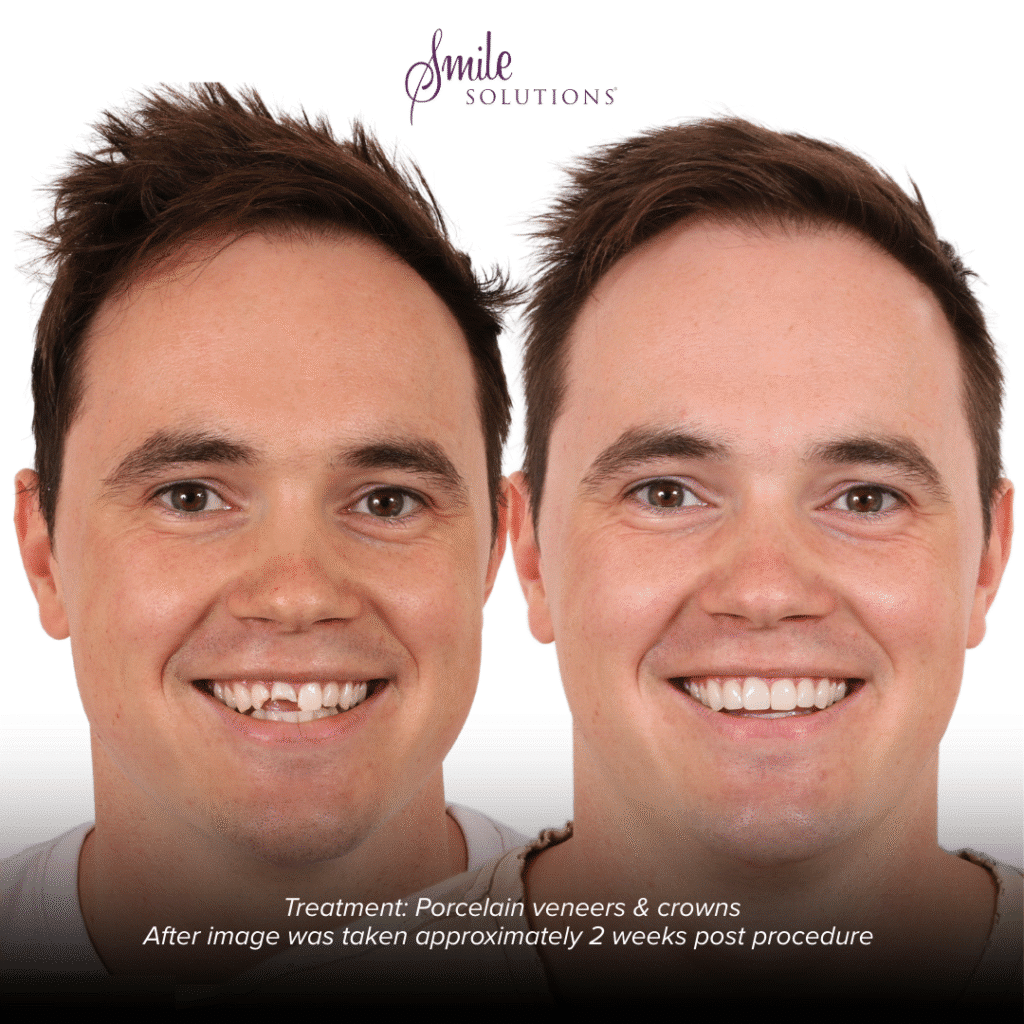
Chipped or Cracked Teeth
I've chipped a tooth — how urgently do I need to be seen?
That depends on how it happened, and the distinction is worth getting right.
If the chip or crack came from a blow to the mouth or any trauma, it should be assessed by a dentist as soon as possible — not for the chip itself, but to check for damage to the surrounding teeth, lips and cheeks that may not be obvious to you. Smile Solutions makes emergency appointments available daily for exactly this.
If the chip happened any other way, it should still be assessed fairly quickly — within a day or two — so that the underlying cause is treated straight away.
Call 13 13 96. We are at Level 1, 220 Collins Street, Manchester Unity Building, Melbourne CBD.
Some situations are not a dental appointment at all. A blow to the head with loss of consciousness, confusion, vomiting or a suspected jaw fracture, or an injury with bleeding that will not stop, needs a hospital emergency department — call 000. Dental work can follow once the more serious injury has been excluded.
What to do in the meantime
- Rinse gently with warm water to clear debris.
- Keep the fragment if you have it, moist in milk or saliva — not dry, and not in tap water for long periods. A fragment that has not dried out can sometimes be bonded back on, which matches colour and shape better than any material.
- Cover a sharp edge with orthodontic wax or a piece of sugar-free chewing gum so it does not cut your tongue or cheek.
- Ordinary analgesia as you would for any pain, following the packet.
- Do not chew on that side.
- If a whole tooth has been knocked out, that is a different and far more time-critical emergency — put it straight back in the socket if you can, or store it in milk, and phone immediately. The detail that decides the outcome is set out under What should I do if an adult tooth is knocked out? below, and it is not quite what most people have been told. See Emergency Dentistry.
Why enamel chips at all
The enamel covering our teeth is the hardest, most mineralised tissue in the human body. It is also brittle, and it does not repair itself.
Despite its hardness, abnormal wear and tear or traumatic injury can chip or break a tooth.
The five kinds of cracked tooth
“Cracked tooth” covers several quite different problems with very different outlooks. This is the classification dentists work from, and it is the most useful thing on this page. It follows the one set out by the European Society of Endodontology in its 2024 position statement on longitudinal cracks and fractures of teeth (International Endodontic Journal), which notes that the incidence of cracked teeth and vertical root fractures is increasing.
1. Craze lines. Fine vertical lines in the enamel only, with, in the ESE's words, “no compromise of the integrity of the tooth”. Extremely common in adults, harmless, and need no treatment. The ESE describes them as naturally occurring through mastication and becoming more prominent with age, and says treatment “is not indicated, except for aesthetic reasons” where a craze line has stained.
2. Fractured cusp. A piece of the biting surface breaks away, usually beside a large filling. The nerve is often unaffected, and the usual answer is an onlay or a crown. Prognosis is generally good — and the ESE notes that at the advanced stage symptoms may actually be relieved once the cusp breaks off, which is why people sometimes stop worrying at precisely the wrong moment.
3. Cracked tooth. A crack running from the biting surface downwards, still in one piece. This is the one that causes the classic symptoms below, and the one whose outcome is genuinely uncertain — it depends how far the crack extends.
4. Split tooth. A cracked tooth that has separated into distinct segments. Usually one segment cannot be saved; sometimes the tooth cannot. The ESE describes it as the end point of a coronal crack progressing to complete longitudinal separation, and notes that the literature on how often it happens is sparse.
5. Vertical root fracture. A crack starting in the root and travelling upward — an incomplete longitudinal fracture involving the cementum, dentine and root canal space. Often silent until the surrounding gum and bone become infected. Usually ends in extraction, and it is more common in root-treated teeth, particularly those with posts.
Cracked tooth syndrome, and why it is hard to diagnose
The symptom pattern is distinctive once you know it:
- Sharp pain on releasing a bite, more than on biting down
- Pain that comes and goes, often for months
- Sensitivity to cold, and sometimes to sweet
- You cannot reliably say which tooth it is
That last point is not vagueness on your part — it is characteristic, because the nerve supply makes cracked teeth genuinely hard to localise.
Nor does a cracked tooth reliably hurt at all. A practice-based study of 2,858 cracked teeth seen by 209 dentists in the USA, cited in the ESE position statement, found 45% were symptomatic — the commonest complaints being pain to cold (37%), pain on biting (16%) and spontaneous pain (11%). Which means the majority were causing no symptoms when they were found.
Cracks are also hard to find. A crack that has not separated is usually invisible on a radiograph, because an x-ray cannot show a gap with no width. The ESE puts a figure on it: only 2% of cracked teeth with living pulps had any evidence of a crack on a radiograph. It also states that CBCT “is not predictable in detecting cracks”, though it may reveal subtle bone loss associated with one — so a scan is not the answer either. Dentists instead use a bite test on individual cusps, shining a light through the tooth, staining with dye, and magnification: the ESE considers fibre-optic transillumination and stains such as methylene blue recommended, and a dental operating microscope or loupes “critical” for telling a real dentinal crack from a harmless craze line. Sometimes an existing filling has to come out to look underneath.
A dentist saying “I think there is a crack but I cannot prove it yet” is being accurate rather than evasive. Cracked teeth sometimes need to be watched, or explored, before the answer is clear.
How deep is the damage?
Fractures range across a spectrum, and the depth determines everything about treatment:
Minor — involving only the outer enamel layer. The tooth may look damaged but the living tissue is untouched.
Moderate — reaching the inner dentine beneath the enamel. Dentine is softer, more porous and connected to the nerve, which is why damage at this depth often produces sensitivity to hot, cold and sweet.
Severe — involving the nerve tissue. This usually causes pain and needs prompt treatment.
You cannot reliably judge the depth by looking. A small visible chip can expose dentine; a large-looking one can be confined to enamel. Absence of pain is not evidence that the damage is shallow — a fractured tooth can be numb and still be seriously damaged, and the 45% figure above is the measured version of that point.
What happens if you leave it
An untreated chip does not stay as it is. It can:
- fracture further — the chipped edge is a stress point, and the next fracture is usually larger than the first
- cause sensitivity or pain as dentine becomes exposed
- increase the risk of dental caries — the rough surface holds plaque
- allow bacteria into the nerve chamber of the tooth
That last one is the reason for the urgency. Once bacteria reach the nerve, the treatment escalates from a filling to root canal therapy or extraction.
Treatment options
Treatment follows depth:
| Damage | Usual treatment |
|---|---|
| Craze lines | None needed |
| Shallow enamel chip | Bonding or a filling |
| Chip reaching dentine | Filling, or a CEREC porcelain restoration |
| Fractured cusp | Onlay or crown |
| Large loss of structure | Crown |
| Fracture reaching the nerve | Root canal treatment, then a crown |
| Split tooth | Sometimes partial salvage; often extraction |
| Vertical root fracture | Usually extraction |
| Tooth not restorable | Extraction, then replacement options |
This table is the usual mapping, not a quote or a plan. What is actually possible depends on where the fracture runs, how much sound tooth is left, and whether the nerve has survived — which sometimes only becomes clear over the following weeks. A cracked tooth in particular can need more than one visit before the outcome is known.
There is also no settled answer in the literature about which restoration is best. The ESE states plainly that “there is no clear evidence on the most suitable restorative treatment approach to manage” a cracked tooth, and that the decision “must be tailored to each patient's unique characteristics, rather than taking a ‘one fits all’ approach”. The factors it lists as pointing towards cuspal coverage rather than a plain filling are worth knowing, because they are the things to ask about: how far the crack extends, a history of spontaneous pain, significant decay, existing fillings, pain on biting, how much sound tooth is left, and the contacts with neighbouring teeth.
If you have kept the broken fragment, bring it. Keep it moist in milk or water — a fragment that has not dried out can sometimes be bonded back on, which gives a better colour and shape match than any restorative material.
Why covering the tooth is usually the answer for a crack
A crack propagates because the cusps flex apart under load. A conventional filling sits between the cusps and does nothing to stop that — in a large cavity it can even act as a wedge.
An onlay or crown works by binding the cusps together so they cannot separate, which is why cuspal coverage is the standard response to a cracked tooth rather than simply replacing the filling.
The evidence points the same way, with a caveat. The ESE reports that cracked teeth managed with direct bonded composite restorations may be more likely to require root canal treatment, or repair of a fractured restoration, than those managed with cuspal coverage — and that across the literature, the incidence of endodontic intervention after restorative management runs between 7.7% and 20%. Its overall reading is that “current evidence suggests encouraging outcomes” for cracked teeth restored with cuspal coverage, whether or not the nerve has been treated, and that early management, cuspal coverage and the absence of deep periodontal probing of non-periodontal origin all increase survival. One reported approach — composite placed apical to the crack after root canal treatment, combined with cuspal coverage and careful management of the bite — had a 4-year survival rate of 96.6%.
What worsens the outlook, in the same statement: a probing depth of 5 mm or more beside the tooth, multiple cracks, a crack extending into the root, and being the last tooth in the arch. That 5 mm figure is about the prognosis of a cracked tooth — it is not the same thing as a threshold for diagnosing gum disease, and the two are easily confused.
The honest limitation: covering the tooth stops the crack widening; it does not remove it. If the crack already extends deep toward the root, symptoms can persist afterwards and the tooth may still be lost. A clinician who explains the outcome as uncertain before doing the crown is giving you the accurate picture — and the ESE stresses that careful occlusal assessment and management of grinding habits is essential to the result.
If it happened in an accident
See a dentist as soon as you can, and be aware that the visible chip may not be the whole injury:
- adjacent teeth can be cracked, loosened or displaced without looking damaged
- lips and cheeks may have lacerations, sometimes with tooth fragments embedded in them
- a tooth that survives the impact can still lose vitality and discolour months later
This is why follow-up appointments after dental trauma matter, and why they are worth attending even when the tooth feels fine. A tooth that darkens months after a knock is usually painless, and the change is easy to miss without comparison photographs.
Check whether the injury is covered. Sports injuries, workplace accidents and motor vehicle accidents may attract cover from a club, employer or insurer, and that is far easier to arrange at the time than years later.
Reducing the risk
- Wear a custom-fitted mouthguard for contact sport. Australian Dental Association Policy Statement 2.2.5 states that “the most effective protection against oral damage is a custom fitted mouthguard, where precision fit and quality materials offer maximum comfort & injury prevention”, and that while over-the-counter guards “provide better protection than no mouthguard”, their protection varies with design, adaptation and thickness, and “quality control of at-home custom adaptation is not achievable”. No mouthguard prevents every injury. See Sports Mouthguards.
- Have grinding and clenching (bruxism) assessed and managed; it produces the crack lines that later become fractures, and the ESE lists chronic parafunctional habits among the situations calling for active treatment of a crack rather than watching it. See TMD & Teeth Grinding.
- Do not use teeth to open packaging or bite non-food objects
- Be careful with ice, popcorn kernels, olive and cherry stones, and crusty bread — these account for a large share of fractured cusps in heavily filled teeth
- Treat large existing fillings before they fail; heavily restored teeth fracture more readily. The ESE specifically flags an extensively restored tooth, the last standing molar or premolar, and the distal marginal ridge of those teeth as sites where a crack warrants active treatment.
Common questions
How urgently should a chipped tooth be examined?
A small non-traumatic chip without pain can often be assessed within a day or two. A tooth injured in an accident, severe pain, swelling, bleeding, a loose tooth or a tooth that has been knocked out needs urgent assessment. If uncertain, call and describe what happened.
What should I do with a broken tooth fragment?
Keep it, handle it gently and store it moist, ideally in milk, while arranging care. Do not scrub it or try to glue it back yourself. A clinician can determine whether it can be rebonded or is useful for planning the repair.
How can a dentist tell how deep a crack goes?
Assessment may combine the history, bite tests, magnification, light, vitality testing and radiographs. Some cracks remain difficult to map until a restoration is removed, which is why the prognosis may remain uncertain even after careful examination. The European Society of Endodontology figures above explain why: only 2% of cracked teeth with living pulps showed anything on a radiograph, and CBCT “is not predictable in detecting cracks”. So a clinician who cannot give you a definite answer from the images is describing the state of the evidence, not being evasive.
Does a crack reaching the nerve always need root-canal treatment?
Not every crack reaches or irreversibly damages the nerve. Symptoms and vitality testing help guide the decision. If the pulp is irreversibly inflamed or infected, root-canal treatment may be needed before the tooth is protected. Across the literature the ESE reviewed, 7.7% to 20% of cracked teeth needed endodontic intervention after restorative management — so it is a real possibility rather than the usual outcome.
Will a crown fix a cracked tooth?
A crown or onlay can brace the tooth and reduce movement, but it does not erase the crack. Outcome depends on the crack's depth and direction. Cracks extending down the root or far below the gum can make the tooth unrestorable. The ESE's summary is that outcomes with cuspal coverage are encouraging, and that early management and the absence of a deep periodontal pocket beside the tooth improve survival — which is an argument for dealing with it sooner rather than watching it for another year.
How long can a cracked tooth be expected to last?
There is no reliable universal lifespan, and no authority publishes one. Remaining tooth structure, crack extent, nerve health, bite forces, grinding and the restoration all affect prognosis. The nearest thing to a figure in the literature is a single reported series in which composite placed apical to the crack, plus cuspal coverage and occlusal management, reached 96.6% survival at 4 years — one approach, one study, four years. Ask the clinician to explain whether the outlook in your case is favourable, guarded or poor.
Should my other teeth be protected too?
If grinding, clenching or a heavily restored bite contributed, the other teeth should be assessed for similar risks. Treatment may include repairing vulnerable teeth, changing habits and using a custom protective appliance.
What should I do if an adult tooth is knocked out?
Treat it as an immediate emergency — but the variable that decides the outcome is not the total time elapsed. It is how long the root surface spends DRY. The International Association of Dental Traumatology guidelines are explicit that minimising dry time is critical for survival of the ligament cells on the root, and that after about 30 minutes of dry time most of those cells are no longer viable.
So:
- Handle the tooth by the crown, not the root.
- Putting it straight back in the socket at the scene is the best thing you can do. The IADT calls immediate replantation “the best treatment at the place of the accident”.
- If you cannot, get it into a storage medium quickly rather than carrying it dry. The IADT's order of preference is milk, then Hank's Balanced Salt Solution, then the person's own saliva (spat into a container), then saline. Water is a poor medium — but it is still better than letting the tooth air-dry.
- If it is dirty, rinse it gently in milk, saline or saliva. Do not scrub it.
- Do not give up because time has passed. The IADT's position is that “the decision to replant a permanent tooth is almost always the correct decision even if the extra-oral dry time is more than 60 minutes” — replanting keeps future options open, and the tooth can always be removed later if it has to be.
- Tell the dentist how long the tooth was dry, separately from how long ago the accident was. The IADT treats that as important history, and nobody else can supply it.
A baby tooth is different: never put it back. The IADT is unambiguous that primary teeth should not be replanted — reinserting one can damage the permanent tooth developing above it. Control the bleeding and see a dentist.
Practical details
| Address | Level 1, 220 Collins Street, Manchester Unity Building, Melbourne VIC 3000 |
| Phone | 13 13 96 |
| theteam@smilesolutions.com.au | |
| Monday – Friday | 8.00am – 6.00pm |
| Saturday | 8.30am – 1.30pm |
| Sunday | By appointment |
| After hours | Emergency service for existing patients |
| Trauma | Same-day assessment; daily emergency appointments |
| Non-trauma chip | Within a day or two |
| Knocked-out tooth | Immediate — and keep it wet; dry time is what counts |
| Keep the fragment | Moist, in milk |
| Crack visible on x-ray | Only 2% of cases (European Society of Endodontology) |
| Parking | Wilsons Parking, Flinders Lane (between Swanston and Russell) |
General information only — it is not a diagnosis, a treatment plan, a quote or a promise of any particular clinical outcome, and it does not replace advice from your treating practitioner. The depth of a fracture, whether the nerve survives and which restoration is appropriate can only be established by examination, usually with radiographs, and outcomes vary between individuals. Cracked teeth in particular carry an uncertain prognosis that cannot be settled from a description, and the European Society of Endodontology states that there is no clear evidence on which restorative approach is best. Figures quoted here belong to the studies named alongside them. If you are in doubt about how urgent your situation is, call 13 13 96 and describe it rather than deciding from this page.
Smile Solutions trades under ABN 28 193 514 103.
Images on This Page
-
https://www.facebook.com/tr?id=800557773428361&ev=PageView&noscript=1
(no alt text)
-
https://www.smilesolutions.com.au/wp-content/uploads/2025/10/calendar_month.svg
(no alt text)
-
https://www.smilesolutions.com.au/wp-content/themes/arcadian-wordpress-theme/assets/images/smile_solutions_logo_white.png
Smile Solutions Logo
-
https://www.smilesolutions.com.au/wp-content/themes/arcadian-wordpress-theme/assets/images/smile_solutions_logo_purple.png
Smile Solutions Logo
-
https://www.smilesolutions.com.au/wp-content/uploads/2025/11/Smile-Solutions-4.png
Smile Solutions 4
-
https://www.smilesolutions.com.au/wp-content/uploads/2025/11/Smile-11-1024x1024.png
Chipped Tooth
-
https://www.smilesolutions.com.au/wp-content/uploads/2025/11/Payment-Plans-at-Smile-Solutions.png
Smile Solutions Dentist Melbourne
-
https://www.smilesolutions.com.au/wp-content/uploads/2025/08/69a44c30c93ce196d539cc5520080df52a5f3f88-scaled.jpg
69a44c30c93ce196d539cc5520080df52a5f3f88 scaled
-
https://www.smilesolutions.com.au/wp-content/themes/arcadian-wordpress-theme/assets/images/family_owned_bussiness.png
Family Owned Business
-
https://www.smilesolutions.com.au/wp-content/themes/arcadian-wordpress-theme/assets/icons/icon--phone.svg
Smile Solutions Contact
-
https://www.facebook.com/tr? id=800557773428361&ev=PageView&noscript=1
(no alt text)