Dental Implants
What are dental implants, and am I a candidate?
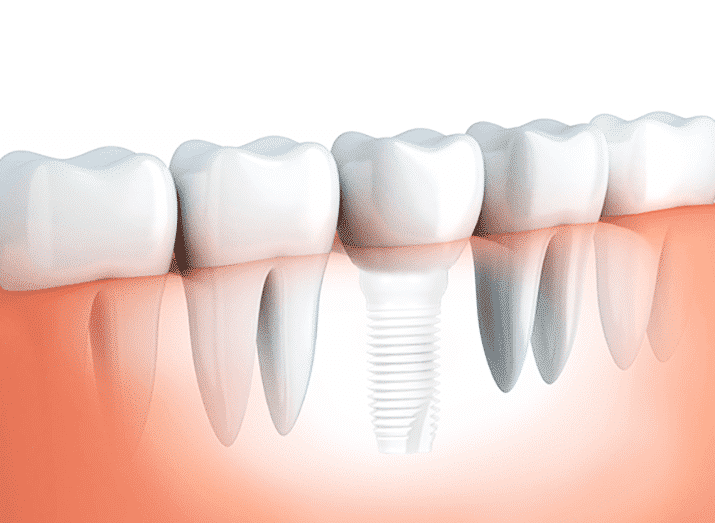
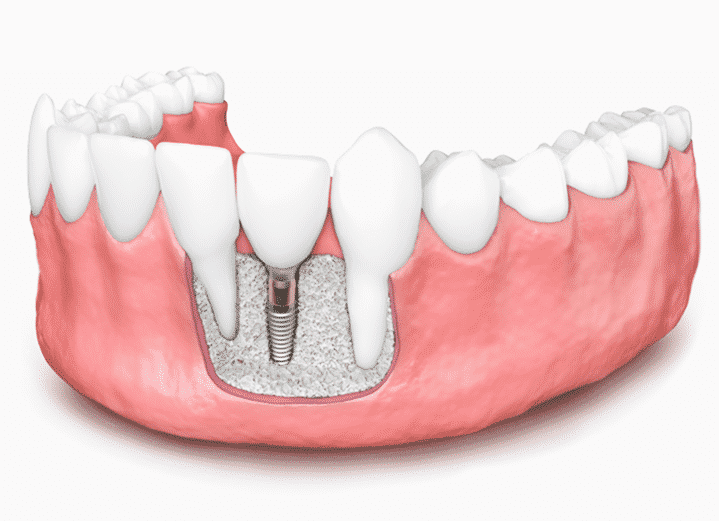
A dental implant replaces a missing tooth — or a tooth that cannot be saved and must be removed — with a titanium root anchored in the jawbone and a crown on top.
Implants can replace a single missing tooth or a full upper and lower arch, and have been in use since the 1960s. Where jawbone volume is insufficient, procedures such as bone grafting or a sinus lift can create a strong enough foundation, so a thin jaw is no longer an automatic disqualification.
Smile Solutions is at Level 1, 220 Collins Street, Manchester Unity Building, Melbourne CBD — see Location. How the implant service here is organised is set out at Dental Implants at Smile Solutions and Our Difference.
Who is suitable
The main factors:
- adequate bone, in both quality and volume — assessed at examination, and often solvable with a bone graft
- good oral hygiene
- meeting the general medical requirements
One thing worth knowing before you go anywhere for implants: a good clinician will try to save the tooth first — often with root canal treatment. Extraction and implant is recommended where saving it is not possible — not as a first option.
Why replace a missing tooth at all
Losing a tooth affects the teeth around it. The remaining teeth shift to fill the space, which changes the bite. A gap can also cause speech problems, difficulty chewing, and discomfort.
An implant has one structural advantage over a bridge: it is fixed directly into the bone and independent of the rest of your teeth. If something goes wrong, only the implant is affected — no neighbouring teeth are involved in the repair. A bridge, by contrast, depends on the teeth either side of it. Implant versus bridge for a single tooth replacement works through that choice in detail.
The types
Conventional implants
A staged approach. The implant is placed first, and the crown fitted after a healing period of three to six months while the implant integrates with the bone. Suitable for most patients seeking a long-term solution, with a very high success rate. See Conventional & Immediate Implants.
Immediate implants
The implant and replacement tooth are placed on the same day. Suitable for patients with good bone density and no infection — though bone grafting can make the procedure possible in other cases. Ideal for broken or soon-to-be-removed teeth, and avoids any period without a tooth.
All-on-4
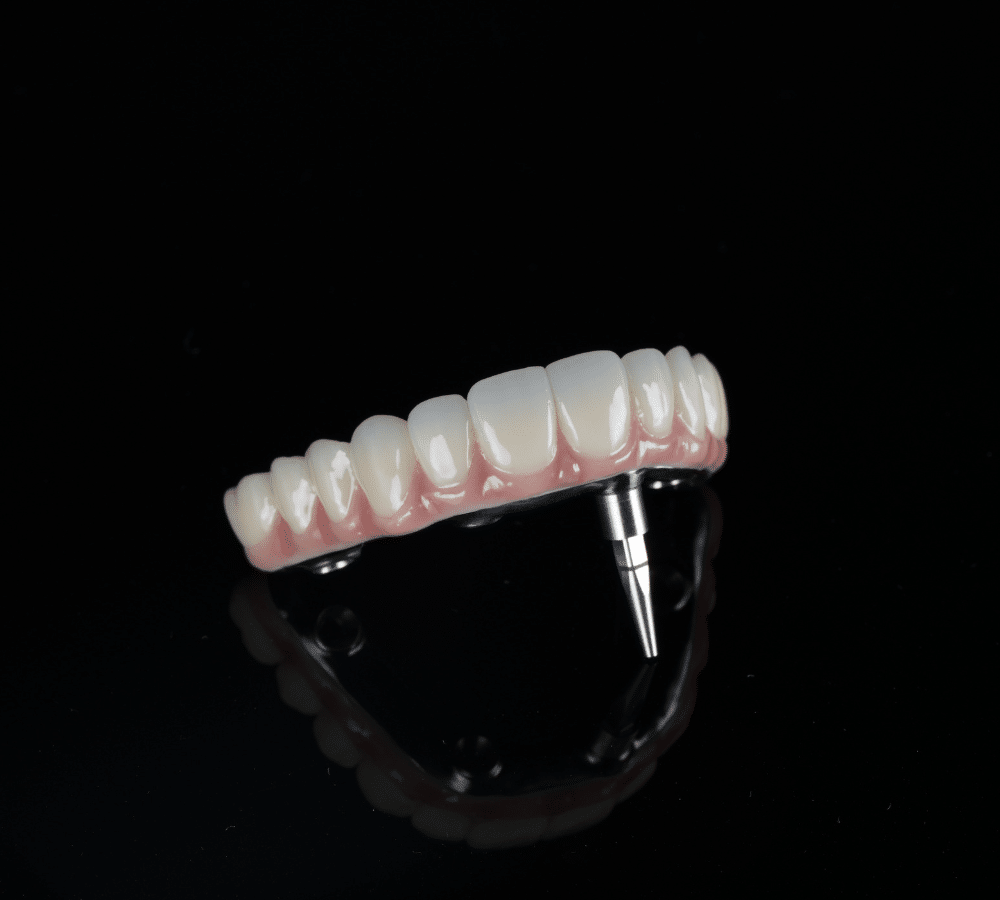
A full set of artificial teeth permanently attached to one or both jawbones during a surgical procedure. Unlike traditional dentures, it does not cover the roof of the mouth, which improves comfort, taste sensation and speech clarity. See All-on-4® Dental Implants and Things to consider when choosing All-on-4 Dental Implants®.
Mini implants
Very small screws placed where other implantable devices cannot go. They rely on mechanical retention rather than functional attachment to the surrounding bone, which makes removal relatively simple and non-invasive. They can also be loaded immediately. Mini implants versus standard dental implants compares the two.
Dentures
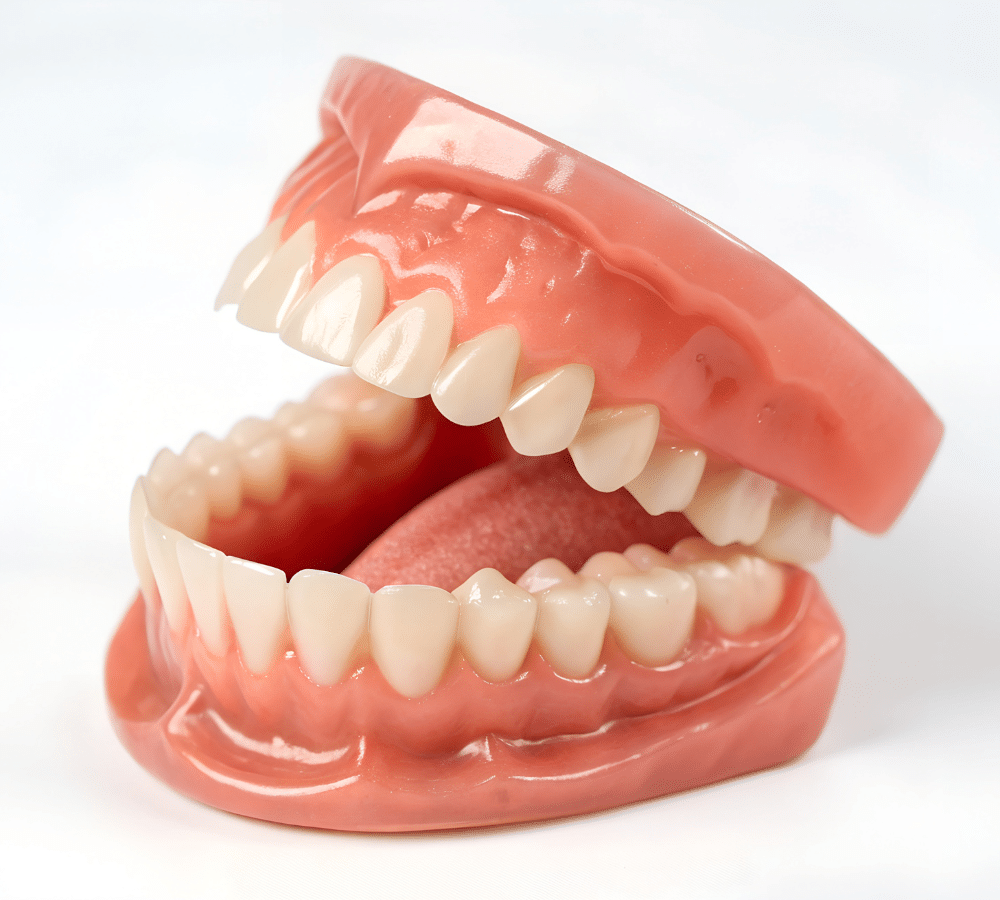
Removable prosthetics replacing missing teeth and associated gum loss — partial, replacing one or more teeth, or full, replacing all teeth in one or both jaws. See Dentures.
What implants are made of
Titanium is the standard, because it is biocompatible and accepted by the body. It provides a strong foundation with a high success rate and long lifespan.
Zirconia is a dental ceramic alternative. It has not been in use as long as titanium, but so far has proven quite durable. What are the different types of dental implants? covers the rest of the range.
Crowns attached to implants are usually all-ceramic, or high-grade porcelain fused to precious metals such as gold.
The four types of dental bridge
Bridges are the main alternative to implants, and there are four kinds. A bridge uses crowns on the teeth either side of a gap (abutment teeth) to hold a false tooth (pontic).
Conventional bridges — used when natural teeth are present on both sides of the gap. The teeth either side are reshaped to take crowns, with a pontic between them.
Cantilever bridges — used when there is an adjacent tooth on only one side. The pontic is supported from one side only.
Maryland bridges (resin-bonded) — a conservative alternative. A single pontic held by a metal or porcelain framework (wing) bonded to the back of the adjacent tooth with composite resin cement. Only a very small amount of tooth is removed from the back surfaces.
Implant-supported bridges — the most stable option. Titanium implants are embedded in the jawbone to secure the whole restoration; one implant per missing tooth, or a pontic suspended between two implant-supported crowns. More expensive, more invasive and more time consuming than the alternatives, but the outcome can last many years.
Pontics can be made from gold, alloys, porcelain, zirconia, or a combination.
How long implants last
With proper home care and regular professional cleanings, both conventional and immediate implants can last 10 to 15 years. Like crowns, bridges or fillings, they may eventually need replacing. That is general guidance rather than a published survival figure; the published figures are reported differently, as survival at stated time points.
What the larger datasets show. An analysis of 158,824 implants placed in 53,874 patients through the Maccabi Dent clinics of an Israeli health fund between 2014 and 2022, published by Tobias and colleagues in the Journal of Functional Biomaterials (2025), reported an overall survival rate of 97.79%, with total failure at 2.21%. Failures within the first year accounted for 1.59% of cases, and the failure rate during osseointegration — before any prosthetic reconstruction — was 1.56%, which is why the first year matters most. Failure was more common in men than women (2.53% against 1.93%; relative risk 1.21, 95% CI 1.07–1.37, p = 0.002). In the same dataset, failure ran at around 3% in the maxillary molar region and 3.37% at the central incisor — roughly double the rate at other sites (p < 0.001), so the site matters as much as anything about the patient.
Over longer horizons, the ITI Academy consensus statements on implant survival and complications report cumulative survival for implants supporting fixed bridgework of 95.4% after 5 years and 92.8% after 10 years, drawn from 15 cohort studies at 5 years and 6 at 10 years. Where a bridge was carried by an implant and a natural tooth together, implant survival was lower — 90.1% at 5 years and 82.1% at 10 years. For implant-retained overdentures, the review the ITI draws on reported 2.5% implant loss before the overdenture was placed and nearly 6% during 5 years of function; for single crowns the corresponding losses were 0.8% and 2% to 2.5%.
Survival of the implant is not the same as trouble-free years. The ITI’s conclusion on bridgework is that survival is high but that biologic and technical complications occurred in about half the cases after 5 years of function, and that bridgework free of any complication was seen in only 61.3% of patients at 5 years. Most of those are repairs rather than losses — a screw loosening or a fractured veneer — which is why an implant is a maintained restoration rather than a finished one. The ITI also notes that many implant systems in these studies have since been modified or withdrawn, which limits how far the numbers transfer to what is placed today.
Maintain regular check-ups every six months to safeguard the health of the teeth and gums around the implant. Implants do not decay, but the gum and bone supporting them can still be lost to disease.
What to expect
Some soreness and swelling for a few days is normal, and pain can be managed with medication if needed.
The procedure can be done in the dental chair under local anaesthetic, or in hospital under general anaesthetic — the sedation options are set out under Sleep Dentistry. Your clinician will explain which applies and provide full care instructions.
Who performs it
At our Melbourne CBD practice, implant treatment is performed by board-registered specialist prosthodontists, periodontists, oral and maxillofacial surgeons, and dual medically qualified dental surgeons — not by a general dentist working across multiple fields.
To qualify as a registered specialist in Australia, a practitioner must hold the same degree as a general dentist, then complete a further Masters degree or equivalent, or a PhD, in a particular field, making them eligible to apply to the Dental Board of Australia for specialist registration. The Dental Board of Australia also requires a minimum of two years general dental practice, and recognises 13 dental specialties in Australia, approved by the Australian Health Workforce Ministerial Council — prosthodontics, periodontics and oral and maxillofacial surgery among them. Who should I see for dental and teeth implants? explains what that means for your case.
Your general dentist discusses suitability, options, timeline and costs before referring you internally for any surgical components.
Costs
There is no single figure. The total depends on:
- the extraction
- a replacement denture or bridge worn while the implant is being prepared
- the implant itself
- the type of implant chosen
- which clinician performs it — general dentist, board-registered specialist, or oral and maxillofacial surgeon
Dental Implant Costs in Melbourne: What You'll Actually Pay in 2026 breaks the components down further.
Complimentary implant consultations are available for a more accurate estimate. Note that at Smile Solutions this initial appointment is with an experienced registered dentist, not a salesperson without formal dental qualifications — a distinction worth checking wherever you are quoted.
The consultation is a discussion only — no check-up, x-rays, scans or clinical treatment — with a $50 refundable deposit.
Interest-free payment plans are available through Payright for treatment from $150 to $20,000, over 3 to 30 months. Other finance options may also be available; provider eligibility, fees and terms can change.
Payment plan options are available. Where a plan is advertised as interest free, that describes the plan term only — a deposit may be required, an establishment fee and ongoing account fees may apply, and charges can apply if the balance is not cleared within the agreed period. The applicable terms depend on the provider and the amount financed, and are set out in writing before you commit — ask what the deposit and the establishment fee are, in dollars, and what the total will be by the end. Payment Plans.
Common questions
What makes up the total cost of an implant?
Three separate items at minimum — and this is where quotes most often mislead.
- The implant (the surgical placement)
- The abutment — the connector between implant and crown
- The crown itself
Plus, where required: the extraction, socket preservation, a bone graft or sinus lift, imaging including a CBCT scan, and any temporary tooth worn during healing.
A quote showing only ‘implant’ is not a quote for a tooth. Ask for all three items with ASDS item numbers. See Price Guide and Understanding Your Treatment.
How long does the whole process take?
For a conventional implant, three to six months between placement and the final crown, because the bone has to integrate with the implant before it can carry a bite.
Add time if an extraction has to heal first, or if a bone graft is needed — grafts commonly add several months of their own.
Immediate implants compress this to a single day, but they require good bone and no infection. Not everyone is a candidate, and being told you are without a scan is a warning sign.
Is it painful?
Placement itself is usually less uncomfortable than an extraction, and is done under local anaesthetic or, if preferred or clinically indicated, general anaesthetic. If the prospect itself is the obstacle, Dental Anxiety sets out what can be done about it.
Expect soreness and swelling for a few days, manageable with ordinary analgesia. Bone grafting and sinus lifts are more involved and recovery takes longer.
Can I have implants if I smoke, have diabetes, or take medication for my bones?
All three matter, and you must disclose them.
- Smoking measurably increases implant failure, by impairing healing and blood supply. A meta-analysis of early implant failure, cited in the Journal of Functional Biomaterials registry paper above, concluded that significant risk factors for early failure included smoking habits, implants shorter than 10 mm, and implants placed in the maxillary region. It is not an absolute barrier, but the risk is real and should be quantified for you.
- Poorly controlled diabetes impairs healing and raises infection risk. Well-controlled diabetes is generally not a barrier.
- Antiresorptive medication — bisphosphonates or denosumab, taken for osteoporosis or as part of cancer treatment — changes how the jaw heals after surgery and is associated with a risk of medication-related osteonecrosis of the jaw. This must be disclosed before any extraction or implant surgery, including medication stopped some time ago, because the effect persists.
Note what this is and is not about. A systematic review of osteoporosis and dental implants, searching the literature to October 2024, pooled 24 studies covering 2,102 patients and 5,954 implants, with follow-up from 1 month to 25 years. Every included study reported survival higher than 90%, including in osteoporotic patients, and most found no difference from healthy patients in marginal bone loss or bone-to-implant contact. Its conclusion was that osteoporosis is not a contraindication for dental implant placement, while adding that planning must be cautious and personalised — and it records that some studies did find lower initial stability and a higher failure risk at osteoporotic sites, so the picture is not uniform. The concern with antiresorptive medication is how the jaw heals after surgery, not low bone density in itself.
Never stop a prescribed medication on your own. That decision belongs to the prescribing doctor, in consultation with the dental team.
Am I too old for an implant?
There is no upper age limit — healing capacity and general health matter, not the birth date.
There is a lower one: implants are generally not placed until jaw growth is complete, because an implant does not move with growing bone and would end up out of position. That is usually the late teens or early twenties, later in males than females.
Can an implant fail, and what is peri-implantitis?
Yes, implants can fail. Early failure means the implant does not integrate with the bone. Late failure is usually peri-implantitis — inflammation and progressive bone loss around an implant that had been working.
How common it is depends on what the implant is carrying, and the two published figures are often quoted as though they were one. In the ITI Academy consensus statements, peri-implantitis and soft-tissue complications were reported in 8.6% of patients after 5 years where a bridge was supported by implants alone (8 cohort studies), and in 11.7% of implants after 5 years where the bridge was carried by an implant and a natural tooth together (only 2 studies). The second figure is the higher one and also the less well evidenced. Neither is a general rate for all implants.
Implants do not decay, but the bone that holds them can still be lost. Peri-implantitis is driven by plaque, and the risk factors are the familiar ones: smoking, poor cleaning, uncontrolled diabetes, and a history of gum disease.
This is why maintenance appointments are not optional, and why untreated periodontal disease should be dealt with before implants are placed. Ask what happens, and who pays, if the implant fails — before you start.
Implant, bridge or denture — how do I choose?
A rough framing:
- An implant leaves the neighbouring teeth untouched, and is generally the longest-lasting option. It costs the most and takes the longest.
- A conventional bridge is faster and often cheaper, but it requires cutting down the teeth either side — which is a permanent cost to two healthy teeth. A Maryland bridge avoids most of that and is worth asking about for a single front tooth.
- A denture is the least invasive and the least expensive, and the least stable.
- Doing nothing is a legitimate option in some situations and should be explained rather than dismissed.
Ask for all four to be costed and explained, including what each looks like in fifteen years. Bridges, implants, or dentures for replacing missing teeth? sets the three side by side.
Will my health fund pay for an implant?
Sometimes, partially, and rarely as much as people expect. Implants usually fall under major dental, which carries annual limits and a waiting period — commonly twelve months.
Get the item numbers and phone your fund before committing. Where the total spans a benefit year, staging the treatment across two years is a legitimate way to use two annual limits. See Bupa Platinum Dental Provider.
What about having implants done overseas?
The clinical work may well be competent. The problem is everything after it.
Implants need long-term maintenance and, eventually, repair. Components are not universally interchangeable — if the system used is not available in Australia, a local dentist may be unable to source a replacement abutment or screw, and a repairable problem becomes a replacement. The ITI complication figures above are why that is not hypothetical: a loosened screw is a routine event over five years, and it needs the right screw.
The Australian Dental Association, in Policy Statement 2.2.6 on elective overseas dental treatment, holds that patients considering treatment abroad should be informed of the risks, including the lack of continuity of care and of local avenues for redress.
There is also no Australian regulator to complain to, and no enforceable warranty. See The risks of having dental treatment overseas and What are the real risks of getting veneers overseas?. If you have already had work done and it is failing, Second Opinions & Corrective Dentistry is the place to start.
Ask, wherever you go: which implant system is this, and is it supported in Australia?
Do implants affect airport security or MRI scans?
No to both. Titanium implants are non-magnetic and MRI-safe, and they are far too small to trigger airport metal detectors.
Tell the radiographer anyway if you are having a head or neck MRI, since metal can cause local image artefact — a picture-quality issue, not a safety one.
How do I clean around an implant?
Like a natural tooth, plus the bits between. Brush twice daily, and clean between the implant and its neighbours every day — interdental brushes are usually easier around implants than floss, and your clinician or hygienist will size them for you.
Professional maintenance every six months, using instruments appropriate to implant surfaces. The single biggest predictor of a long-lasting implant is what happens in the years after it is placed.
Practical details
| Address | Level 1, 220 Collins Street, Manchester Unity Building, Melbourne VIC 3000 |
| Phone | 13 13 96 |
| theteam@smilesolutions.com.au | |
| Monday – Friday | 8.00am – 6.00pm |
| Saturday | 8.30am – 1.30pm |
| Sunday | By appointment |
| Conventional healing | 3–6 months before crown |
| Immediate implants | Same day |
| Reported survival | 97.79% overall in a 158,824-implant registry (J Funct Biomater 2025); 92.8% at 10 years supporting bridgework (ITI Academy) |
| Materials | Titanium or zirconia |
| Performed by | Board-registered specialists |
| Parking | Wilsons Parking, Flinders Lane (between Swanston and Russell) |
Full contact details and directions are on Contact Us.
Related pages: Conventional & Immediate Implants, Bone Grafting for Implants, All-on-4® Dental Implants, Dental Bridges, Dentures, Price Guide, Payment Plans.
All surgical procedures carry risks, and outcomes vary between patients. Survival and complication figures quoted here belong to the cohorts named alongside them and are not predictions for any individual; the ITI Academy notes that some implant systems in those studies are no longer available. This page contains general information and is not a substitute for examination by a registered dental practitioner. Disclose your full medical history and every medication, including any antiresorptive medication, before surgery. You are entitled to seek a second opinion before proceeding. Payment plan terms are set by the credit provider and change; confirm current terms directly before you commit.
Smile Solutions trades under ABN 28 193 514 103.
Images on This Page
-
https://www.facebook.com/tr?id=800557773428361&ev=PageView&noscript=1
(no alt text)
-
https://www.smilesolutions.com.au/wp-content/uploads/2025/10/calendar_month.svg
(no alt text)
-
https://www.smilesolutions.com.au/wp-content/themes/arcadian-wordpress-theme/assets/images/smile_solutions_logo_white.png
Smile Solutions Logo
-
https://www.smilesolutions.com.au/wp-content/themes/arcadian-wordpress-theme/assets/images/smile_solutions_logo_purple.png
Smile Solutions Logo
-
https://www.smilesolutions.com.au/wp-content/uploads/2025/11/Smile-Solutions-4.png
Smile Solutions - Melbourne CBD
-
https://www.smilesolutions.com.au/wp-content/uploads/2025/11/All-on-4-at-Smile-Solutions.png
All-on-4 at Smile Solutions
-
https://www.smilesolutions.com.au/wp-content/uploads/2025/09/Conventional-Dental-Implants.png
Conventional Dental Implants
-
https://www.smilesolutions.com.au/wp-content/uploads/2025/09/Immediate-Dental-Implants-2-1.jpg
Immediate Dental Implants
-
https://www.smilesolutions.com.au/wp-content/uploads/2025/09/All-on-4-at-Smile-Solutions.png
All-On-4® Dental Implants
-
https://www.smilesolutions.com.au/wp-content/uploads/2025/09/Dentures-Smile-Solutions.png
Dentures
-
https://www.smilesolutions.com.au/wp-content/uploads/2025/09/bone-grafting-for-implants.png
bone grafting for implants
-
https://www.smilesolutions.com.au/wp-content/uploads/2025/12/Dental-Implants-at-Smile-Solutions.jpg
Smile Solutions Specialist Dental Care Melbourne
-
https://www.smilesolutions.com.au/wp-content/uploads/2025/08/69a44c30c93ce196d539cc5520080df52a5f3f88-scaled.jpg
69a44c30c93ce196d539cc5520080df52a5f3f88 scaled
-
https://www.smilesolutions.com.au/wp-content/themes/arcadian-wordpress-theme/assets/images/family_owned_bussiness.png
Family Owned Business
-
https://www.smilesolutions.com.au/wp-content/themes/arcadian-wordpress-theme/assets/icons/icon--phone.svg
Smile Solutions Contact
-
https://www.facebook.com/tr? id=800557773428361&ev=PageView&noscript=1
(no alt text)