What should you consider before choosing All-on-4 implants?
Before anything else: All-on-4 treatment usually involves removing your remaining teeth, and that is irreversible. Everything below is written on the understanding that this is a major, permanent decision, and that a second opinion before proceeding is not an insult to anyone — it is a reasonable step.
All-on-4 implant treatment replaces most or all of the teeth in one or both arches, supported on four implants. Unlike some traditional full-arch approaches that require three to six months of healing before teeth are fitted, All-on-4 can deliver a fixed provisional bridge within one to two days — an almost immediate restoration. It is often considered by people who have difficulty chewing, ill-fitting dentures, or teeth broken down beyond repair. The service page is All-on-4 Dental Implants; the general treatment overview is Dental Implants.
Here are ten things to work through before deciding.
1. Who is performing the treatment?
Establish whether your clinician is a registered specialist or a general dentist. Both can be entirely appropriate; you should simply know which you have.
You can verify this yourself on the AHPRA register. If a profile lists “Dental Practitioner — General”, that is a general dentist. If it says “General & Specialist”, that clinician holds specialist registration, and the profile will state the specialty. The Smile Solutions clinicians and their registrations are listed on Our Team.
In Australia, specialists first qualify as general dentists, then complete a Master's degree or equivalent, or a PhD, in a defined field, which qualifies them to apply for specialist registration with the Dental Board of Australia. Full-arch implant work commonly involves prosthodontists, periodontists, and oral and maxillofacial surgeons. See also Specialist Care and Who should I see for dental and teeth implants?.
Ask who is doing which part — who places the implants, who designs and fits the prosthesis, and who manages you afterwards.
2. What is the prosthesis made of?
The teeth you end up with can be made from several materials, and they genuinely differ. The honest comparison:
| Material | Strengths | Trade-offs |
|---|---|---|
| Acrylic (denture teeth on a metal frame) | Lighter; cheaper; easy to repair or reline chairside; some shock absorption that reduces load on the implants | Wears faster; stains more; teeth can chip off and need replacing over time |
| Zirconia / ceramic | Very durable; highly stain-resistant; closely mimics the translucency and texture of natural teeth | More expensive; harder, so it transmits more force; a fracture usually means remaking the bridge rather than a simple repair |
| Composite or hybrid resin | Repairable; moderate cost; kinder to the opposing teeth | Wears and discolours faster than ceramic |
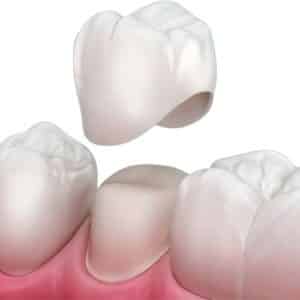
Ceramic is often the preferred choice for durability and appearance, and over a long horizon it can be more cost-effective. But acrylic is not simply an inferior option — its repairability and lower cost make it the right answer for some patients, and it is the standard material for the provisional bridge fitted on the day of surgery. Ask what is proposed for the provisional and what for the definitive prosthesis, and why. The materials discussion runs parallel to Dental Crowns and Dentures.
3. What is the substructure made of?
The substructure — usually a milled titanium or cobalt-chrome bar — is the foundation that holds the prosthetic teeth and distributes chewing forces evenly across the implants. It plays a significant role in the longevity of the bridge and in protecting the implants and the underlying bone from uneven loading.
Ask what it is made of and how it is manufactured. A milled bar from a scanned, verified fit is more predictable than a cast one. Where the work is made on site, see Smile Solutions Laboratory.
4. Where are the components made?
Ask where the implants and the prosthesis are manufactured — locally or offshore. This affects turnaround time, and it affects what happens when something needs adjusting. The same reasoning that applies to treatment abroad applies to components made abroad — see Dental tourism: the risks involved.
Two things to confirm:
- The implant system is included in the Australian Register of Therapeutic Goods (ARTG), which is the TGA's requirement for supply in Australia
- What happens if the prosthesis does not fit or is not correct — the remake process, the time involved, and who bears the cost
5. Is the clinic accredited for the system being used?
All-on-4 is a specific protocol associated with a particular implant manufacturer, and accredited providers use that manufacturer's components. This matters for a practical reason more than a marketing one: component compatibility over decades. If your bridge needs a new abutment or screw in fifteen years, a documented, widely supported system is far easier to service than an obscure one.
Ask which implant system is being used, by name, and make sure it is recorded in your file. Keep that record. What are the different types of dental implants? covers the fixture options.
6. Where will the procedure be performed?
Full-arch surgery can be carried out in a dental surgery under local anaesthetic with or without sedation, or in a private hospital under general anaesthetic. See Sleep Dentistry and Dental Anxiety.
If you have private health insurance with hospital cover, hospital-based treatment may be an option. It is often preferred for patients with anxiety, complex medical histories, or extensive surgery. Ask what your out-of-pocket cost is under each scenario — they differ substantially, and hospital cover does not usually cover the dental component itself.
7. What technology is used?
Guided surgery planned from a CBCT scan and a digital scan, with a surgical guide, improves the precision of implant placement compared with freehand placement. Ask what planning and placement tools the practice uses, and whether the implant positions are planned digitally before the day of surgery. See Dental Implants at Smile Solutions.
8. When will the permanent bridge be fitted?
The provisional bridge goes in within a day or two. The definitive bridge follows once the implants have integrated with the bone and the gum has settled — typically some weeks to some months. See Conventional and Immediate Implants.
That gap is not a delay to be minimised; it is what allows the final prosthesis to fit gum tissue that has stopped changing shape. Ask for the expected timeline, and what the provisional will be like to live with in the meantime.
9. Is your case complex?
Where there is significant bone loss, sinus involvement, or previous failed implants, treatment may require bone grafting, sinus lifts, or zygomatic implants — longer implants anchored in the cheekbone. These are advanced procedures usually undertaken by oral and maxillofacial surgeons. See also Complex Dentistry.
If your case involves any of these, ask directly about the surgeon's experience with that specific procedure.
10. Have you been properly informed — and did you get a second opinion?
Confirm that your clinician has given thorough explanations, addressed your concerns, and told you their qualifications and experience. Make sure you have a full consultation with the treating clinician, not a brief appearance after a discussion with a treatment coordinator or salesperson. How important is communication in dentistry? is worth reading on exactly this point.
Seeking a second opinion from another specialist is a normal and sensible step for treatment of this scale, and a good clinician will not be troubled by it.
The risks, stated plainly
No article on this topic is complete without them:
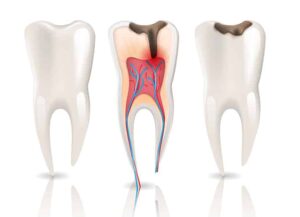
- The teeth removed do not come back. If the treatment fails, you cannot return to where you started. Before agreeing, ask whether any of them could be saved — see Root Canal and Periodontists
- Implants can fail, either early (failure to integrate) or later. Smoking, diabetes, poor oral hygiene and heavy grinding all raise that risk. See TMD and Teeth Grinding and Diabetes and oral health
- Peri-implantitis — inflammatory bone loss around implants — is a real long-term complication and is harder to treat than gum disease around natural teeth. See What is periodontal disease?
- Surgical risks include bleeding, infection, sinus complications in the upper jaw, and nerve injury with altered sensation in the lower jaw
- Maintenance is lifelong and ongoing. The bridge must be professionally removed and cleaned periodically, screws retightened, and worn components replaced. This is a running cost, not a one-off purchase — see Dental Cleans & Hygienists
- Speech and adaptation take time, and the prosthesis feels different from natural teeth
- The definitive prosthesis will eventually need replacing. Ask what that costs
Ask for a written treatment plan setting out the total cost, what is included, the maintenance schedule, and what happens — clinically and financially — if something fails. The Price Guide and Payment Plans cover fees and finance; Dental implant costs in Melbourne itemises what a full arch involves.
Payment plan options are available. Where a plan is advertised as interest free, that describes the plan term only — a deposit may be required, an establishment fee and ongoing account fees may apply, and charges can apply if the balance is not cleared within the agreed period. The applicable terms depend on the provider and the amount financed, and are set out in writing before you commit — ask what the deposit and the establishment fee are, in dollars, and what the total will be by the end. Payment Plans.
Is All-on-4 the only option?
Not necessarily. An implant-retained overdenture on two to four implants is removable, cheaper, easier to clean and easier to modify if things change — and for some people it is the better answer. Keeping and treating salvageable teeth is another. See What are the different types of dentures? and Bridges, implants or dentures. Ask what the alternatives are and why they were ruled out.
All-on-4 at Smile Solutions
We provide All-on-4 implant treatment through registered specialist prosthodontists, periodontists, and oral and maxillofacial surgeons, with dual medically qualified dental surgeons available for cases requiring it. Cases are planned with the relevant specialists involved from the outset.
Common questions
What are the actual odds an implant fails?
Lower than most people fear, with an important caveat about which implants the figures describe.
The largest dataset located here is a retrospective analysis of an electronic dental registry covering 158,824 implants placed between 2014 and 2022. Its result: an overall survival rate of 97.79%, a total failure rate of 2.21%, and failures within the first year accounting for 1.59% of cases. In other words, roughly seven in ten of all failures happened in the first year.
The caveat matters and this page will not gloss it. Those are single implants across a general population, placed in a variety of situations. They are not All-on-4 figures. Full-arch immediate-loading protocols differ in three ways that the registry number does not capture: the implants are loaded with a bridge within a day or two rather than left to integrate undisturbed, the implants are often angled rather than placed vertically, and four implants are carrying an entire arch, so the consequences of one failing are not the same as the consequences of one failing in a single-tooth case. Use the registry figure as reassurance about implant dentistry in general, not as a prediction for this treatment.
If a provider quotes you a success rate for All-on-4 specifically, ask what population it comes from, over what follow-up period, and whether "success" means the implant survived or the bridge is still in place and functioning. Those are different measures and the difference is usually where the optimism lives.
When is the risk highest, and what can I actually do about it?
The first year, decisively, and that is where your own effort has the most leverage.
The registry analysis found that “failure rates were found to be highest within the first year following implantation”, and identified why: “it is during this early period that complications such as infection, implant mobility, or peri-implantitis are most likely to occur.” Separately, a review of early implant failure concluded that the significant risk factors were “smoking habits, implants shorter than 10 mm, and implants placed in the maxillary region”, and a broader analysis grouped the predictors as “general health, smoking status, oral hygiene practices, bone quality and quantity, as well as implant location, implant-specific characteristics, and the clinician's experience.”
Three of those are yours to influence. Smoking appears on both lists and is the single modifiable factor most consistently named — raise it before surgery, not after. Oral hygiene practices matter more around a full-arch bridge than around natural teeth, because the bridge covers the implants and the surfaces needing cleaning are not the ones you can see; ask to be shown the technique and the tools at the fitting appointment rather than working it out at home. General health includes diabetes control, which is a conversation for your doctor as well as your surgeon.
Two of them are not yours but are worth asking about: whether any of your implants are shorter than 10 mm, and whether you are having an upper arch, a lower arch, or both. Neither is a reason to decline; both change how closely the first twelve months should be watched, and they are a reasonable basis for asking how often you will be reviewed in that window. Dental cleans and hygienists.
I have osteoporosis, or I take medication for my bones. Does that rule me out?
Probably not on the osteoporosis itself, but it is a conversation to have with the surgeon before anything is planned, and you should bring the actual medication list rather than describe it.
A systematic review of 24 studies covering 2,102 patients and 5,954 dental implants, with follow-up ranging from one month to 25 years, examined exactly this. Its findings are genuinely mixed and worth seeing in full rather than summarised into a yes or no. One prospective cohort study found “a small marginal bone loss (−0.34 mm) in osteoporotic women, but there was insufficient evidence to prove any causal relationship between marginal bone loss and osteoporosis.” Another “showed no clinical differences between implants placed in osteoporotic and healthy individuals.” Against that, “other studies showed lower stability scores for implants placed in osteoporotic sites and a higher risk of failure for implant placement.” The review's overall conclusion was that osteoporosis status was not a risk factor for dental implant failure.
So the diagnosis by itself does not appear to be disqualifying. What that review does not settle is the separate question of medications used for bone conditions, which is a matter for your prescriber and your surgeon together and not something to resolve from a web page. Bring a written list of everything you take, including anything given by injection or infusion and anything you have taken in the past few years, and say when you started it. That information changes surgical planning, and it is far better raised at the consultation than discovered later.
Four implants for a whole arch — is that really enough?
It is the number the protocol is built around, and the honest answer is that the independent evidence available here does not let this page adjudicate four against six or eight.
What can be said is structural, and it is the reason to ask rather than assume. Four implants carrying a full arch means each one is doing more work than it would in a partial case, and the substructure described in section 3 exists precisely to distribute that load. It also means the arithmetic of failure is different: losing one implant out of four is a quarter of your support, and what happens next depends entirely on which one, where, and what the bridge was designed to tolerate.
So the questions worth putting directly, and getting answered in writing before you commit:
- If one implant fails, is the bridge still supportable on three, or does it have to come out?
- Can a replacement implant be placed in the same site, or would grafting be needed first — and what is the timeline and the cost of that?
- Is the existing prosthesis reusable after a failure and replacement, or is it remade?
- Who pays for each of those steps, and does that change depending on how long after the original surgery it happens?
A provider who has thought this through will have ready answers, because these are the contingencies the plan should already account for. A vague answer to the fourth question in particular is worth noticing. It is also a fair point at which to take the second opinion recommended in section 10 — see second opinions and corrective dentistry, and what are the replacement options for missing teeth? for the alternatives that keep more options open.
Practical details
Outcomes vary between individuals. All surgical and implant treatment carries risks, and full-arch implant treatment involves the irreversible removal of remaining teeth. Suitability, alternatives and risks should be discussed with your treating clinician.
Implant survival and failure figures quoted in the questions above are from published third-party studies of other patient populations — a large electronic dental registry analysis, a systematic review of osteoporosis and osseointegration, and published reviews of early implant failure. They are not Smile Solutions' own outcome data, and they are not specific to All-on-4 treatment.
Specialist registration can be verified on the AHPRA register, or by calling 1300 419 495.
Smile Solutions, Level 1, 220 Collins Street, Manchester Unity Building, Melbourne VIC 3000. Phone 13 13 96, or theteam@smilesolutions.com.au. Monday–Friday 8.00am–6.00pm, Saturday 8.30am–1.30pm, Sunday by appointment. Full details on Contact Us.
Published 11 July 2024. General information only; it does not replace advice from your treating practitioner. Payment plan terms are set by the credit provider and change; confirm current terms directly before you commit.
Smile Solutions trades under ABN 28 193 514 103.
Images on This Page
-
https://www.facebook.com/tr?id=800557773428361&ev=PageView&noscript=1
(no alt text)
-
https://www.smilesolutions.com.au/wp-content/uploads/2025/10/calendar_month.svg
(no alt text)
-
https://www.smilesolutions.com.au/wp-content/themes/arcadian-wordpress-theme/assets/images/smile_solutions_logo_white.png
Smile Solutions Logo
-
https://www.smilesolutions.com.au/wp-content/themes/arcadian-wordpress-theme/assets/images/smile_solutions_logo_purple.png
Smile Solutions Logo
-
https://www.smilesolutions.com.au/wp-content/uploads/2023/11/SS-Tooth-1-1-150x150.png
Smile Solutions
-
https://www.smilesolutions.com.au/wp-content/uploads/2025/09/All-on-4-at-Smile-Solutions.png
Dental prosthesis with natural appearance
-
https://www.smilesolutions.com.au/wp-content/uploads/2025/09/Root-Canal-2-300x217.jpg
Root Canal
-
https://www.smilesolutions.com.au/wp-content/uploads/2026/08/Mouth-Breathing-300x270.jpg
Mouth Breathing
-
https://www.smilesolutions.com.au/wp-content/uploads/2025/09/Dental-Crown-at-Smile-Solutions-300x300.jpg
Dental Crown at Smile Solutions
-
https://www.smilesolutions.com.au/wp-content/themes/arcadian-wordpress-theme/assets/images/family_owned_bussiness.png
Family Owned Business
-
https://www.smilesolutions.com.au/wp-content/themes/arcadian-wordpress-theme/assets/icons/icon--phone.svg
Smile Solutions Contact
-
https://www.facebook.com/tr? id=800557773428361&ev=PageView&noscript=1
(no alt text)
-
https://bat.bing.com/action/0?ti=25148060&tm=gtm002&Ver=2&mid=b95ecf06-0394-4291-905b-d2fdf4df69fc&bo=1&sid=cf4799f0ab2511f1ae023f435e949a3d&vid=cf47f6c0ab2511f19274bfcfc2548db5&vids=1&msclkid=N&pi=918639831&lg=en-US&sw=800&sh=600&sc=24&nwd=1&tl=Things%20to%20consider%20when%20choosing%20All-on-4%20Dental%20Implants%C2%AE%20-%20Smile%20Solutions&p=https%3A%2F%2Fwww.smilesolutions.com.au%2Fdental-articles%2Farticle%2Fthings-to-consider-when-choosing-all-on-4-dental-implants%2F&r=&evt=pageLoad&sv=2&cdb=AQAQ&rn=766403
(no alt text)