What are the different types of denture?
Dentures divide first into partial (replacing one or more teeth) and full (replacing all the teeth in one or both jaws). Partial dentures then divide by material into acrylic, metal and flexible resin, and there are three further categories worth knowing: over-dentures, immediate dentures, and implant-retained dentures. The service page is Dentures.
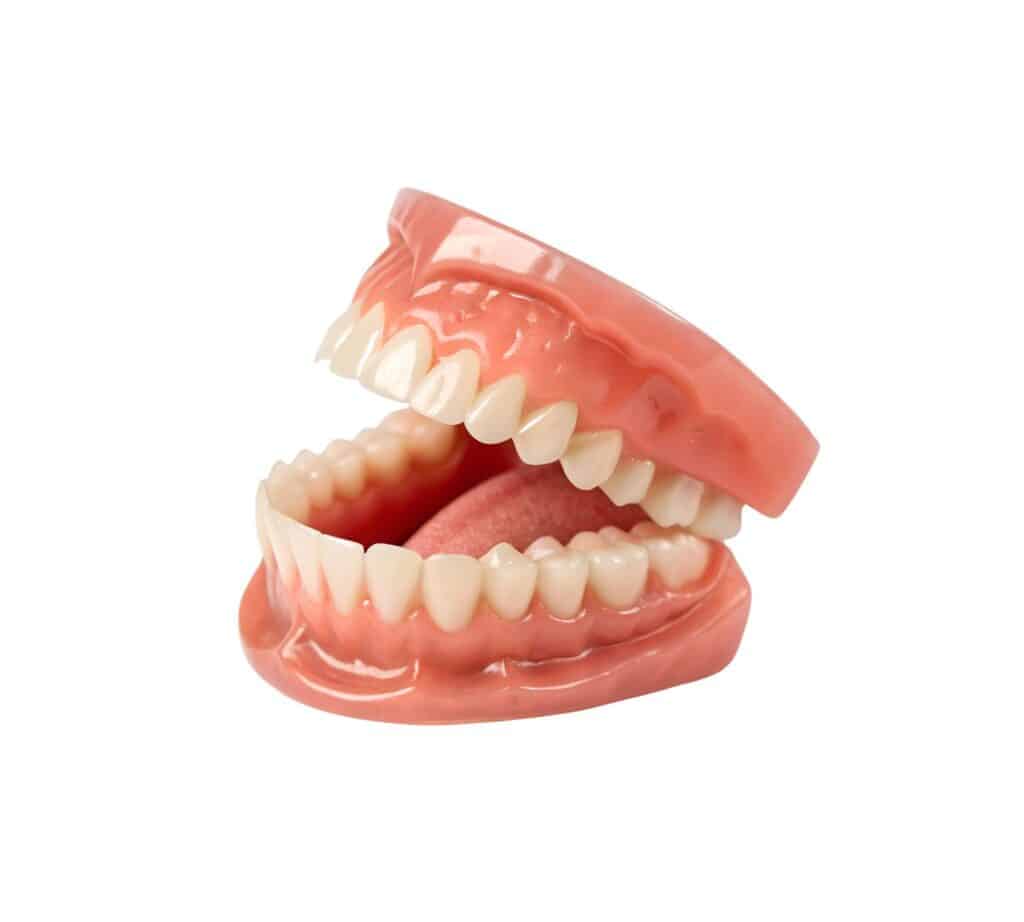
A denture is a removable prosthetic device that replaces missing teeth and the associated gum loss. They are also called false teeth, plates, or flippers.
The short version of the choice: metal-based partials are the most durable and kindest to your remaining teeth; acrylic is cheaper and easier to add to; flexible resin suits particular situations but wears out sooner.
One piece of framing before the detail, from ADA Policy Statement 2.2.3 on oral hygiene: a daily routine "is a basic health requirement at all ages independent of the presence of teeth", and "Daily regular cleaning of teeth, dental implants, gums, and dental prostheses forms part of a good oral hygiene routine." Losing teeth does not reduce the amount of daily care needed. It changes what the care is directed at.
Partial dentures
Acrylic
Acrylic is a rigid resin — pink for the base and gum areas, tooth-coloured for the replacement teeth. The denture is usually held in place by metal clasps gripping the surrounding natural teeth; when it is in, the metal is partially or fully hidden by your lips.
- Cheapest of the three
- Easy to add teeth to if you lose another one, which makes it a sensible transitional denture
- Bulkier, because acrylic needs thickness to be strong
- Rests largely on the gum, so it transmits more load to the soft tissue
Metal
A metal base, usually a cobalt-chrome alloy, with pink acrylic replacing the gum and tooth-coloured material for the teeth. Metal clasps attach to the metal base.
Two genuine advantages:
- The metal can be made thin and strong, so the denture is far less bulky and much more comfortable
- It provides greater support, which minimises the impact on your existing teeth — load is transferred through rests onto the teeth rather than pressing into the gum
That second point matters more than it sounds. A poorly supported partial denture accelerates the loss of the teeth it clasps onto. A well-designed metal partial protects them.
Metal partials cost more and take longer to make. For a long-term denture, they are generally the better investment.
Flexible resin
Pink, made from a flexible resin that eases insertion, often with clasps made from the same flexible pink material — so no metal shows.
- Most discreet, with no visible metal clasps
- Comfortable, and useful where undercuts make a rigid denture hard to seat
- Do not last as long as acrylic or metal dentures
- Difficult to adjust, reline or repair — which limits them where further tooth loss is likely
A useful option for some patients, particularly where appearance of the clasps is the deciding factor.
Comparing the three
| Acrylic | Metal | Flexible | |
|---|---|---|---|
| Cost | Lowest | Highest | Middle |
| Bulk | Most | Least | Moderate |
| Support for remaining teeth | Least | Best | Limited |
| Visible clasps | Yes | Yes | No |
| Longevity | Moderate | Longest | Shortest |
| Easy to add to / repair | Yes | Sometimes | Difficult |
A note on that longevity row, in the interests of not overstating what is known: the comparison reflects the properties of the materials and clinical experience with them. We have not found an independent published figure for how long a conventional partial or full denture lasts in years, and we are not going to invent one. Ask your clinician what they expect in your case and why, and expect the answer to depend on how fast your ridge resorbs rather than on the denture itself.
Where the denture is made on site, see Smile Solutions Laboratory. Fees are on the Price Guide, and understanding your treatment covers what is quoted before work starts.
Payment plan options are available. Where a plan is advertised as interest free, that describes the plan term only — a deposit may be required, an establishment fee and ongoing account fees may apply, and charges can apply if the balance is not cleared within the agreed period. The applicable terms depend on the provider and the amount financed, and are set out in writing before you commit — ask what the deposit and the establishment fee are, in dollars, and what the total will be by the end. Payment Plans.
Other types
Full dentures
A pink acrylic denture replacing all the teeth in one or both jaws. It rests directly on the gums and uses no clasps; for some patients an adhesive is needed to hold it in place.
Full dentures can be made to look like an idealised set of teeth, or to mimic your own natural teeth — that is a genuine choice, and worth raising before the teeth are set.
Expect an adjustment period. Eating and speaking with a full denture takes time to learn, and adjustment appointments in the first weeks are normal rather than a sign something is wrong. Lower full dentures are harder to stabilise than upper ones, because there is less surface area and the tongue is in the way. See 5 things to know about new dentures.
A dry mouth makes all of this harder, because saliva contributes to the seal that holds an upper denture up and protects the tissue underneath it. It is also common, and commonly caused by medication. The Better Health Channel reports that "About 10% of the general population and 25% of older people have dry mouth, which means they don't have enough saliva", that dry mouth "is a symptom of an underlying problem, rather than a condition in itself", and that "about 600 drugs and medications, both legal and illegal, are known to cause dry mouth", including antihistamines and blood pressure medications. Its advice includes avoiding "alcohol-containing mouthwashes, as these products tend to aggravate dry mouth tissue". If your mouth is persistently dry, say so — my mouth is always dry: why is this and does it affect my teeth? and my mouth always feels dry! What can I do?
Over-dentures
A denture made to fit over existing teeth or roots, or over dental implants. The advantage over a conventional full denture is that those teeth or implants act as a secure anchor, giving stability a gum-borne denture cannot.
Retaining even a couple of roots also preserves the bone around them, which slows the ridge resorption that otherwise makes dentures progressively harder to fit over the years. Those retained roots still decay, and root surfaces decay readily — which is why fluoride and a kept cleaning appointment matter more, not less, once most of the teeth are gone.
Implant-retained dentures
A specific form of over-denture, clipping onto two or more implants. This is often the single most transformative option for someone struggling with a loose lower full denture: two implants in the lower jaw make an enormous difference to stability, at a fraction of the cost of a full fixed implant bridge. See Dental Implants, Dental implant costs in Melbourne and, where bone width is limited, mini implants versus standard dental implants.
This is the one category here with published outcome data, and it is data about the implants, not about the denture clipped to them. Consensus statements from the International Team for Implantology cite a systematic review reporting "2.5% implant loss prior to the placement of overdentures and nearly 6% implant loss during 5 years of function". For comparison, the same review reported "an early loss of 0.8% before prosthetic placement and an incidence of 2% to 2.5% loss during 5 years of function" for implants supporting single crowns. Implants carrying an overdenture are worked harder than that, and the figures reflect it — worth knowing before you choose, and worth keeping in mind at every review appointment afterwards.
It remains removable — you take it out to clean it — which distinguishes it from a fixed implant bridge such as All-on-4. Before committing to the fixed option, Things to consider when choosing All-on-4 is worth reading, because an overdenture is cheaper, easier to clean and easier to change later.
Immediate dentures
Prepared in advance of extractions and fitted on the same day the teeth are removed, so there is no period without teeth.
The honest trade-off: an immediate denture cannot fit as accurately as one made after the teeth have been removed and the gums have healed, because it is made to a prediction of the shape the ridge will take. It can sometimes be adjusted to fit well, but in most cases it serves as a temporary, with a definitive denture made several months later. Relines during the healing period are usual. See Caring for immediate dentures.
Budget for the replacement from the outset; being surprised by it later is a common complaint.
Living with a denture
- Clean it daily with a denture brush and a denture cleaner — not ordinary toothpaste, which is too abrasive. A "denture brush" is on the ADA's own list of "proven aids to oral hygiene"
- Leave it out overnight where advised, and store it in water so it does not dry and distort
- Clean your remaining teeth and gums thoroughly. Partial denture wearers have a higher risk of decay and gum disease on the teeth the clasps contact — see Bleeding Gums, what is gum disease?, periodontal (gum) disease, Dental Cleans & Hygienists and, where a routine clean is not enough, when do you need deeper cleaning?. The daily part is in what is the ideal daily routine for oral hygiene? and is flossing really that important?
- Keep attending for review. The ridge continues to resorb after teeth are lost, so dentures loosen over time. Relines and eventual remakes are expected, not failures
- Denture adhesive used to compensate for a poor fit masks a problem rather than solving it — have the fit assessed
- A sore spot that does not settle, or any ulcer lasting beyond two to three weeks, should be examined. That interval is the published one: the RACGP advises that "patients reporting any unexplained and/or non-healing changes or symptoms in the mouth for more than two to three weeks (eg a persistent ulcer, red patches, lumps, a sore throat, or erythematous or speckled lesions) should have an oral cancer screen", and warns that "Initial lesions of oral cancer are generally painless" — so waiting for it to hurt is the wrong test. Its red-flag list also includes "Unexplained tooth mobility or non-healing extraction site". See General Dentistry, the cause of mouth ulcers and their usual treatments and oral cancer: how your dentist can help with early detection
- If it breaks, do not glue it — My denture is broken: can it be fixed on the spot?
The alternatives
Dentures are one way of replacing teeth. Others exist — bridges and implants — and each has different costs, longevity and requirements. A comparison of all three, for your particular situation, is a reasonable thing to ask for before deciding: Bridges, implants or dentures, what are the replacement options for missing teeth? and Implant versus bridge for a single tooth replacement.
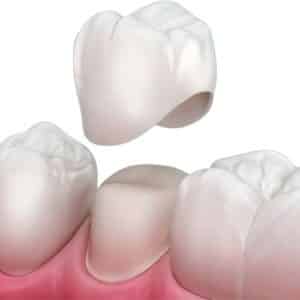
Where some teeth can still be saved and rebuilt rather than replaced, that conversation comes first: what does restorative dentistry mean? and what types of dental crowns are available?
Common questions
Why will nobody quote me a price over the phone?
Because three variables do most of the work and none of them can be assessed down a telephone line: which material, whether implants are involved, and how much preparatory treatment sits in front of the definitive denture — extractions, healing time, an immediate denture, and the relines that follow.
Australia also has no national dental fee schedule, which is why quoted figures vary so much between practices and between states. The ADA's own Dental Fees Survey 2022 found ‘considerable variation in the fees charged within and between states', so a price a relative paid interstate tells you very little about yours. A submission to the Senate inquiry into private health insurance and out-of-pocket costs argued that ‘The absence of a national dental fee schedule may have contributed to the comparatively high cost of dental care in Australia', and cited an Australian Institute of Health and Welfare survey finding that ‘nearly a third of people aged 5 or older (32%) avoided or delayed visiting a dentist due to cost'.
What to ask for, once you have been examined: an itemised quote in writing, and specifically whether a reline or a replacement denture is anticipated within the first year and whether that is included in the figure. See the Price Guide and understanding your treatment.
Will Medicare or my health fund pay for it?
Not Medicare, if you are an adult. The Child Dental Benefits Schedule is the dental benefit most Australian families encounter, and it is for children only. Services Australia lists what it covers as check-ups, x-rays, cleaning, fissure sealing, fillings, root canals and extractions, capped at ‘up to $1,158 for each eligible child over 2 consecutive calendar years', and excludes ‘orthodontic dental work', ‘cosmetic dental work' and ‘any dental services in a hospital'. Dentures are not on the covered list and adults are not eligible at all.
Two things worth doing rather than assuming. If you hold a concession card, ask whether you qualify for public dental care — those rules are set by your state scheme, not by Medicare. If you have extras cover, ask your fund which item numbers it pays on for dentures, what your annual limit is and what waiting period applies, before the work is booked rather than after the invoice arrives.
My breath has been worse since I started wearing a denture. Is the denture the cause?
It can be, and it is one of the more fixable causes. Healthdirect lists dentures among the oral causes of halitosis: ‘bacteria on your dentures can cause halitosis if you don't clean them regularly'. Its advice for denture wearers comes down to three specific things — that ‘they fit well', that ‘you clean them regularly', and that ‘you take them out before you go to sleep'.
A review in the International Journal of Oral Science describes ‘unclean acrylic dentures (worn at night or not regularly cleaned or with rough surfaces)' as a contributor, and reports a study in older people in which ‘overnight denture wear' was among the factors significantly related to oral malodour.
Two cautions. The same review states that gingivitis and periodontitis ‘are the main causes of the problem', so if you wear a partial and your gums bleed, there is a second cause to deal with. And do not reach for a tongue scraper as the fix: the ADA's own consumer material states that a 2019 review of the evidence ‘found no evidence that cleaning your tongue, using several different methods including mouthwash or chewing gum, were effective for managing the cause of halitosis'. See Bad Breath and what causes bad breath and how can I fix it?
Do I really have to take it out at night?
Where your clinician has advised it, yes — and the reasons run in both directions. Healthdirect's denture advice includes taking them out before sleep, and the International Journal of Oral Science review links overnight denture wear with oral malodour in older people. The tissue underneath needs time without a plate pressed on it, and the denture itself needs storing in water so the acrylic does not dry out and distort.
The exception is the first days after extractions, where you may be told to leave an immediate denture in, including overnight. That instruction is deliberate, it is about controlling swelling and bleeding while the socket settles, and it is temporary. Ask at the time when it stops applying, because people commonly carry it on for years by accident.
An implant-retained denture needs less looking after, doesn't it?
It needs different looking after, and more attention at review rather than less. Implants develop their own inflammatory problems. The International Team for Implantology defines mucositis as a ‘Localized lesion without bone loss around an osseointegrated implant' and peri-implantitis as a ‘Localized lesion including bone loss around an osseointegrated implant'. The first is the reversible one; the second means losing the bone that was the entire reason for placing the implant.
That is also the context for the loss figures quoted above: implants carrying an overdenture showed higher losses over five years than implants supporting single crowns, because they are worked harder. None of that is an argument against the treatment — for a loose lower denture it changes daily life more than almost anything else in dentistry — but it is an argument for keeping the review appointments and for cleaning around the attachments properly every day.
I have diabetes. Does that change anything about wearing a denture?
It changes several things, and none of them is on the standard denture instruction sheet. Diabetes Australia lists the oral complications associated with diabetes as periodontitis, tooth decay, ‘A decrease in saliva production causing a dry mouth (xerostomia)', ‘Oral thrush (fungal infection)' and ‘Delayed or poor healing of wounds in the mouth, such as mouth ulcers'. Every one of those bears directly on a denture.
Less saliva means less of the seal that holds an upper denture in place, and more friction against the tissue. Thrush matters because, as Diabetes Australia puts it, ‘High blood glucose levels cause increased glucose in saliva which can cause more Candida bacteria to live and grow' — and a denture worn continuously gives that organism a warm surface to sit on. Slower wound healing means a sore spot that a different patient would shrug off deserves an earlier appointment, not a later one. And where a partial denture clasps onto natural teeth, gum disease is the complication that most often costs those teeth: Diabetes Australia notes that the risk of periodontitis is greater when blood glucose is outside the recommended 4–7 mmol/L range, but that ‘with optimum blood glucose management the risk of developing periodontitis is the same as for a person without diabetes'.
Tell whoever makes and reviews your denture that you have diabetes, and tell them how your glucose has been running. See diabetes and oral health and diabetes and dental health: the two-way street.
Related reading
- 5 things you should know about your new dentures
- Caring for yourself and your immediate dentures
- I am in my late 60s — how can I keep my teeth in top condition now that I am older?
- I'm looking to get a dental bridge: what are the different types?
- What do I need to know about dental implants?
Practical details
For further information, call Smile Solutions on 13 13 96.
Prosthodontics is a recognised dental specialty — see Prosthodontists. Specialist registration can be verified on the AHPRA register, or by calling 1300 419 495; the clinicians are listed on Our Team.
Smile Solutions, Level 1, 220 Collins Street, Manchester Unity Building, Melbourne VIC 3000 — getting here. Phone 13 13 96, or theteam@smilesolutions.com.au. Monday–Friday 8.00am–6.00pm, Saturday 8.30am–1.30pm, Sunday by appointment. Full details on Contact Us.
Published 23 January 2017. General information only; it does not replace advice from your treating practitioner. Outcomes vary between individuals. Payment plan terms are set by the credit provider and change; confirm current terms directly before you commit.
Smile Solutions trades under ABN 28 193 514 103.
Images on This Page
-
https://www.facebook.com/tr?id=800557773428361&ev=PageView&noscript=1
(no alt text)
-
https://www.smilesolutions.com.au/wp-content/uploads/2025/10/calendar_month.svg
(no alt text)
-
https://www.smilesolutions.com.au/wp-content/themes/arcadian-wordpress-theme/assets/images/smile_solutions_logo_white.png
Smile Solutions Logo
-
https://www.smilesolutions.com.au/wp-content/themes/arcadian-wordpress-theme/assets/images/smile_solutions_logo_purple.png
Smile Solutions Logo
-
https://www.smilesolutions.com.au/wp-content/uploads/2023/11/SS-Tooth-1-1-150x150.png
Smile Solutions
-
https://www.smilesolutions.com.au/wp-content/uploads/2025/09/Dentures-1024x922.jpg
What are the different types of dentures (partial vs full vs implant retained, metal vs plastic)?
-
https://www.smilesolutions.com.au/wp-content/uploads/2025/09/Root-Canal-2-300x217.jpg
Root Canal
-
https://www.smilesolutions.com.au/wp-content/uploads/2026/08/Mouth-Breathing-300x270.jpg
Mouth Breathing
-
https://www.smilesolutions.com.au/wp-content/uploads/2025/09/Dental-Crown-at-Smile-Solutions-300x300.jpg
Dental Crown at Smile Solutions
-
https://www.smilesolutions.com.au/wp-content/themes/arcadian-wordpress-theme/assets/images/family_owned_bussiness.png
Family Owned Business
-
https://www.smilesolutions.com.au/wp-content/themes/arcadian-wordpress-theme/assets/icons/icon--phone.svg
Smile Solutions Contact
-
https://www.facebook.com/tr? id=800557773428361&ev=PageView&noscript=1
(no alt text)