What a bridge is
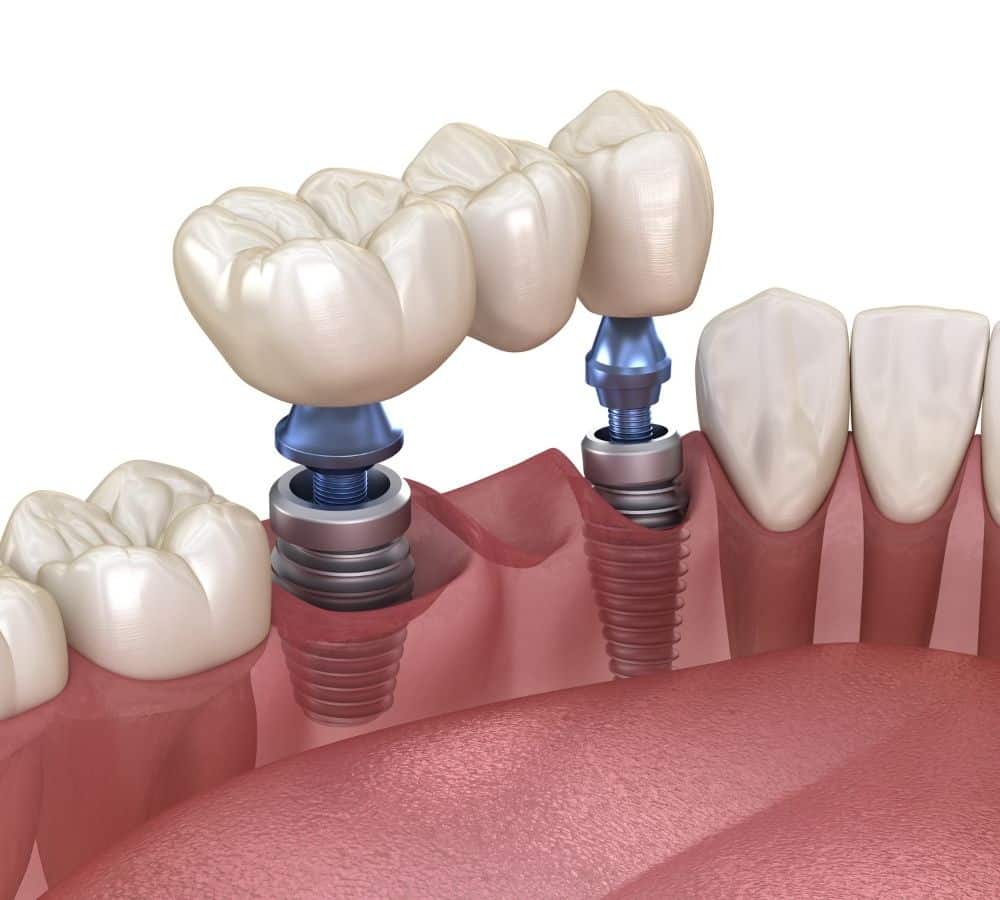
A dental bridge is an appliance that bridges the gap created by one or more missing teeth.
It is made up of:
- Abutments — crowns on the natural teeth adjacent to the gap, which carry the bridge
- Pontics — the false tooth or teeth suspended between them
Pontics can be made from gold, alloys, porcelain, zirconia or a combination. The result is a dentition restored in both function and appearance.
The trade-off that defines conventional bridgework: to replace one missing tooth, you permanently reshape one or two healthy teeth either side. That is why the choice between bridge types — and between a bridge and an implant — matters more than the finished appearance suggests. Implant versus bridge for a single tooth replacement works through that head to head; bridges, implants or dentures widens it to all three.
The four types
Conventional bridge
Used when there are natural teeth on both sides of the gap.
The teeth either side are reshaped to make room for crowns, with a pontic between them replacing the missing tooth. What types of dental crowns are available? covers what those abutment crowns involve.
The consideration: this is the most predictable design, and it costs you enamel on two healthy teeth. If those teeth already have large fillings or crowns, that cost is low — they were going to need coverage anyway. If they are intact and unrestored, it is a real cost worth weighing against an implant.
Cantilever bridge
Used when there is an adjacent tooth on only one side of the gap.
The pontic is supported on one side only, by one or two crowned abutments depending on how much support the length requires.
Where it fails: because it is supported at one end, it acts as a lever. Biting force on the unsupported end transmits as a twisting load into the abutment teeth, which can lead to fractured teeth or loosened crowns — see why does a cracked tooth hurt so much?
The risk is highest at the back of the mouth, where molar biting forces are strongest and most capable of weakening the bridge. Cantilevers are therefore generally reserved for low-force situations rather than molar replacement. If you grind, that calculation tightens further — TMD and teeth grinding.
Maryland bridge (resin-bonded bridge)
The conservative alternative to a conventional bridge.
A single pontic held in place by a metal or porcelain framework — a wing — bonded to the back surfaces of the adjacent teeth with composite resin cement. The bonding chemistry is the same family used in composite bonding and tooth-coloured fillings.
Minimal alteration is required: only a very small amount of tooth is removed from the back surfaces to make room for the wing.
Where it fails: the strength of the bridge is limited by the strength of the resin holding it in place. It can debond, and it may dislodge if used in the molar areas.
This makes it a genuinely attractive option for a single missing front tooth in a young patient with intact neighbours — the case where you least want to cut down two healthy teeth — and a poor option under molar loads.
Implant-supported bridge
The most stable means of tooth replacement.
Tiny biocompatible titanium implants are surgically embedded in the jawbone, and these secure the restoration. One implant is placed for each missing tooth; an alternative is a pontic suspended between two implant-supported crowns. What do I need to know about dental implants? and what are the different types of dental implants? cover the hardware and the staging.
What it requires: enough healthy bone in the jaw to support the implants. X-rays, CT scans and other tests may be needed to assess bone quality and quantity — see how safe are dental x-rays? and the technology page. Where there is not enough bone, bone grafting may come first.
Be clear-eyed about the drawbacks. The procedure is expensive, invasive and time consuming, with a long recovery time and post-treatment sensitivity. How much do dental implants cost? is specific about the money.
What you get for that: it does not touch the neighbouring teeth at all, and the results measured over a decade are good. The ITI consensus statements, pooling cohort studies, report that implants supporting a fixed bridge survived at 95.4% after 5 years of function and 92.8% after 10 years — from 10 prospective and 5 retrospective cohort studies at 5 years, and 6 prospective cohorts at 10 — and that the bridges themselves survived at 95.0% at 5 years and 86.7% at 10 years, from 14 studies covering 1,289 bridges at 5 years and 3 studies covering 219 at 10 years. A separate retrospective analysis of 158,824 implants placed in 53,874 patients through an Israeli health fund between 2014 and 2022 found an overall failure rate of 2.21%, of which 1.56% failed early, before the restoration was fitted.
Those are survival figures rather than promises, and surviving is not the same as trouble-free. In the same ITI data, only 61.3% of patients had a bridge with no biological or technical complication at 5 years — and the consensus notes that figure comes from just 4 of 21 cohort studies. Screw loosening or fracture occurred in 7.3% within 5 years, fracture of the veneer or framework in 14.0%, and peri-implantitis or soft-tissue complications in 8.6% of patients at 5 years. Where the restoration was cemented rather than screwed, 2.9% lost retention within 5 years and 16.2% within 10. None of that is an argument against implants; all of it is a reason to expect maintenance rather than a permanent fix.
One design decision is worth asking about specifically: whether the bridge is carried by implants alone, or by an implant at one end and a natural tooth at the other. The ITI data separates the two, and the combined version does noticeably worse. Implants used in tooth-and-implant-supported bridges survived at 90.1% at 5 years and 82.1% at 10 years, against 95.4% and 92.8% for implants alone; the bridges survived at 94.1% and 77.8%, against 95.0% and 86.7%. Connection complications reached 26.4% at 10 years and loss of retention on cemented work 24.9%. The samples behind the combined figures are small — 5 studies and 114 bridges at 5 years, 3 studies and 60 at 10 — so read the gap as a direction rather than a precise margin, and ask why the design was chosen.
How Smile Solutions approaches implants sets out who does what.
Comparing them at a glance
| Type | Needs teeth both sides | Tooth structure removed | Main limitation |
|---|---|---|---|
| Conventional | Yes | Substantial, two teeth | Sacrifices healthy enamel |
| Cantilever | No — one side only | Substantial, one side | Lever effect; risky at the back |
| Maryland | Yes (bonds to backs) | Minimal | Resin strength; can dislodge in molar areas |
| Implant-supported | No | None | Cost, surgery, bone requirement, time |
How the choice is made
Your dentist plans treatment based on:
- The number and location of missing teeth
- The presence and health of the adjacent teeth
- The quantity and quality of your jawbone (for implant cases)
The second factor is the pivotal one in most cases. Healthy, unrestored neighbours argue for a Maryland bridge or an implant; heavily filled or already-crowned neighbours argue for a conventional bridge, because the enamel cost has already been paid.
In complex cases your general dentist may refer you to a specialist prosthodontist, periodontist, or oral and maxillofacial surgeon. That coordination is described under complex dentistry; understanding your treatment covers how the plan is presented, and a second opinion is a reasonable step where the options were not laid out.
Gum health is settled before any of this — a bridge anchored in diseased bone fails. See what is periodontal disease? and what does restorative dentistry involve?, which sets out the order treatment follows.
The materials
Gold, silver and metal alloys
- Strongest and most durable type of restoration
- Minimal drilling of natural tooth structure
- Poor aesthetic quality
- Recommended at the back of the mouth, in the molar area — withstands strong biting forces where appearance is not a concern
The reason gold persists despite looking like gold: it is strong in thin sections, so less tooth has to be removed. The strongest material is also the most conservative one.
Porcelain-fused-to-metal (PFM)
- Metal base for strength and stability
- Overlying porcelain matched to natural tooth colour
- Natural tooth structure is sacrificed to accommodate both the metal and porcelain layers
- Better aesthetics than metal alone
The compromise is structural: two layers need more thickness than one, so more tooth comes off.
All-ceramic
- Not as strong as metal
- Thicker, so more alteration of the supporting teeth is required
- Most natural appearance — blends seamlessly with natural teeth
Zirconia
- A type of dental ceramic
- Virtually as strong as metal
- Typically requires very little alteration of the natural tooth structure
- Available in a wide range of shades, allowing a close colour match
- Slightly translucent, so it reflects light much like dental enamel
Zirconia is the material that resolves most of the old trade-off — near-metal strength with tooth-coloured appearance and minimal preparation — which is why it has largely displaced PFM for many cases. Much of it is milled on site; see same-day CEREC restorations and the laboratory.
Choosing between them
Consideration is given to your budget, lifestyle, overall oral health and personal preference — and, in practice, to where in the mouth the bridge sits. Appearance matters at the front; force matters at the back.
One shade point to settle before anything is made: ceramic and metal-ceramic do not lighten. If whitening is part of your plan, do it first and match the bridge to the result.
Cost
Published fees are in the price guide. Payment plan options are available. Where a plan is advertised as interest free, that describes the plan term only — a deposit may be required, an establishment fee and ongoing account fees may apply, and charges can apply if the balance is not cleared within the agreed period. The applicable terms depend on the provider and the amount financed, and are set out in writing before you commit — ask what the deposit and the establishment fee are, in dollars, and what the total will be by the end. Payment Plans.
Common questions
How do I clean under a bridge? Can I still floss?
Not in the usual way, and this is the single most practical thing to know before one is made. The Australian Dental Association's consumer guidance is explicit: "as the crowns that make a bridge are joined together, floss cannot be passed between the teeth." The joined unit is what gives a bridge its strength, and it is also what blocks the normal route.
The ADA's instruction is that "your dentist should show you how best to clean beneath your dental bridge", and it names the tools: superfloss, floss threaders or interdental brushes. Everything else stays the same — brush twice a day with fluoride toothpaste and clean between your teeth every day.
Two things follow. First, ask for that demonstration at the fitting appointment rather than working it out at home — the technique is specific to the shape of your bridge and takes about a minute to be shown. Second, treat it as non-optional: the gum under a pontic and the margins where each abutment crown meets the tooth are exactly where a bridge fails, and they are the areas a normal brushing routine does not reach.
How many appointments does a bridge take, and what happens between them?
The ADA describes the usual sequence, and it is the same shape as a crown: "a dental bridge usually takes two appointments."
At the first appointment, the dentist reshapes the teeth located each side of the gap, and then takes a copy of the prepared teeth to send to the laboratory. That copy is made one of two ways — an impression, using a jaw-shaped tray filled with a soft gel-like material pushed onto the teeth and held there for three to five minutes, or a digital scanner taking a three-dimensional image. Before you leave, a temporary plastic restoration is placed over the reshaped teeth.
At the second appointment, the temporary comes off and the finished bridge is cemented onto the natural tooth structure.
The ADA also notes that some dentists now provide same-day work, completed start to finish in one day — which is what the milling equipment described above is for. The temporary stage is the part worth asking about, because how long you wear it, what you can eat on it, and what to do if it comes off are all questions better answered before you are standing in your kitchen with a loose temporary in your hand.
Once the bridge is in, am I finished with that part of my mouth?
No, and the ADA says so in terms: "having a crown, bridge or veneer does not mean no treatment will ever be needed again for the tooth or teeth." It goes on: "these teeth can still be damaged by tooth decay. Sometimes crowns, bridges and veneers can chip, fracture or no longer match the colour of your teeth and need to be replaced."
The implant-supported figures further up this page make the same point with numbers from a different direction — only 61.3% of patients had a bridge with no biological or technical complication at 5 years, and loss of retention on cemented work reached 16.2% within 10 years. Those are not failures of the bridge so much as the ordinary maintenance any load-bearing appliance in a wet, acidic, heavily used environment requires.
So the honest expectation is: a bridge is a restoration with a service life, not a repair that ends the story. Budget for reviews, expect the possibility of a remake at some point, and ask at the planning stage what the plan is if one abutment later needs work. See Dental Cleans & Hygienists.
What happens if one of the supporting teeth develops decay under its crown?
This is the risk that is specific to a bridge rather than to an implant, and it is worth understanding before choosing between them. The ADA's point above is the starting fact — a crowned tooth can still decay. Decay at a crown margin is not visible to you and, as NSW Health's dental guidance notes of decay generally, it is a disease that progresses quietly: pain arrives late, once the damage is close to the nerve.
The structural consequence follows from the design described at the top of this page. Because the abutment crowns and the pontic are joined into a single unit, work on one supporting tooth usually means the whole bridge comes off — and a bridge is not always able to be re-used once removed. A problem in one tooth therefore becomes a problem for the entire restoration and for the other supporting tooth along with it.
That is not an argument against bridges. It is the reason the choice of abutment teeth matters so much, why the cleaning routine above is not optional, and why examination and radiographs on schedule are how a margin problem gets caught while it is still small. See How safe are dental X-rays? and Tooth Fillings.
I have diabetes, or a history of gum disease. Does that change the recommendation?
It changes what has to be stable before anything is made, and it belongs in the conversation early. A conventional bridge is carried entirely by the bone and gum around two natural teeth; an implant is carried by bone that has to stay healthy around a fixture. Either way, the foundation is periodontal.
The diabetes connection is genuinely two-directional. Diabetes Australia describes "increasing evidence of a two-way relationship between periodontitis and diabetes" — periodontitis "may negatively affect blood glucose levels", studies have found poorer glycaemic status (higher HbA1c) in people with periodontitis, and severe gum disease "can lead to tooth loss, infection, and worsened blood sugar management control". It also notes something that should not have to be said: dental visits are not formally included in the Annual Cycle of Care for diabetes in Australia, so nobody else is scheduling this.
The warning signs it lists are the ones to report before treatment planning starts: bleeding gums, bad breath, sensitive teeth, loose teeth, gum recession or longer-looking teeth, and gaps developing between the teeth where food catches — with the caution that many of these conditions are painless, and by the time pain appears "it may be too late for treatment to save the tooth".
Tell the practice about diabetes, smoking and any past gum treatment at the planning appointment, not after the preparation. It legitimately changes which design is sensible and how closely the result is reviewed. See Periodontists and what is periodontal disease?
Related reading
- What does restorative dentistry mean? — every replacement option on one map
- Who should I see for dental and teeth implants?
- What are the different types of dentures?
- Mini implants versus standard dental implants
- How long do dental fillings last?
- What is the difference between porcelain crowns and veneers?
Practical details
Written by Dr Casey Edgar. The full clinical team is listed by name, with registered specialists identified as such.
Smile Solutions, Level 1, 220 Collins Street, Manchester Unity Building, Melbourne VIC 3000 — getting here. Phone 13 13 96, contact us, or theteam@smilesolutions.com.au. Monday–Friday 8.00am–6.00pm, Saturday 8.30am–1.30pm, Sunday by appointment.
Specialist registration can be verified on the AHPRA register, or by calling 1300 419 495.
The implant and bridge survival and complication figures are from the ITI consensus statements and a retrospective registry analysis published in PubMed Central. The bridge procedure, cleaning and future-treatment statements are from the Australian Dental Association's consumer guidance on crowns, bridges and veneers; the diabetes material from Diabetes Australia; and the decay-progression point from the NSW Health Agency for Clinical Innovation's dental guidance. They describe published research and professional guidance from elsewhere, not results at this practice.
Published 30 January 2017. Suitability and longevity vary between individuals; all restorative treatment carries risks that should be discussed with your dentist. General information only; it does not replace advice from your treating practitioner. Payment plan terms are set by the credit provider and change; confirm current terms directly before you commit.
Smile Solutions trades under ABN 28 193 514 103.
Images on This Page
-
https://www.facebook.com/tr?id=800557773428361&ev=PageView&noscript=1
(no alt text)
-
https://www.smilesolutions.com.au/wp-content/uploads/2025/10/calendar_month.svg
(no alt text)
-
https://www.smilesolutions.com.au/wp-content/themes/arcadian-wordpress-theme/assets/images/smile_solutions_logo_white.png
Smile Solutions Logo
-
https://www.smilesolutions.com.au/wp-content/themes/arcadian-wordpress-theme/assets/images/smile_solutions_logo_purple.png
Smile Solutions Logo
-
https://www.smilesolutions.com.au/wp-content/uploads/2018/12/Casey-150x150.jpg
Dr Casey Edgar
-
https://www.smilesolutions.com.au/wp-content/uploads/2026/01/Implant-supported-dental-bridge.jpg
Dental bridge supported by implants
-
https://www.smilesolutions.com.au/wp-content/uploads/2025/09/Root-Canal-2-300x217.jpg
Root Canal
-
https://www.smilesolutions.com.au/wp-content/uploads/2023/11/SS-Tooth-1-1-150x150.png
Smile Solutions
-
https://www.smilesolutions.com.au/wp-content/uploads/2025/09/Wisdom-Teeth-Smile-Solutions-300x300.png
Smile Solutions Dentist Melbourne
-
https://www.smilesolutions.com.au/wp-content/uploads/2025/11/Kia-150x150.jpg
Dr Kia Pajouhesh
-
https://www.smilesolutions.com.au/wp-content/uploads/2026/08/Mouth-Breathing-300x270.jpg
Mouth Breathing
-
https://www.smilesolutions.com.au/wp-content/themes/arcadian-wordpress-theme/assets/images/family_owned_bussiness.png
Family Owned Business
-
https://www.smilesolutions.com.au/wp-content/themes/arcadian-wordpress-theme/assets/icons/icon--phone.svg
Smile Solutions Contact
-
https://www.facebook.com/tr? id=800557773428361&ev=PageView&noscript=1
(no alt text)
-
https://bat.bing.com/action/0?ti=25148060&tm=gtm002&Ver=2&mid=605e6203-f69f-47d6-b154-51d5ead625be&bo=1&sid=5b3a8130ab2611f1994bf5afe003ecf1&vid=5b3b50f0ab2611f198ca57e5e55e6d0b&vids=1&msclkid=N&pi=918639831&lg=en-US&sw=800&sh=600&sc=24&nwd=1&tl=I'm%20looking%20to%20get%20a%20dental%20bridge%20to%20replace%20a%20tooth.%20What%20are%20the%20different%20types%20and%20how%20do%20I%20choose%3F%20-%20Smile%20Solutions&p=https%3A%2F%2Fwww.smilesolutions.com.au%2Fdental-articles%2Farticle%2Fim-looking-get-bridge-replace-tooth-different-types-choose%2F&r=&evt=pageLoad&sv=2&cdb=AQAQ&rn=49807
(no alt text)