What a dental implant is
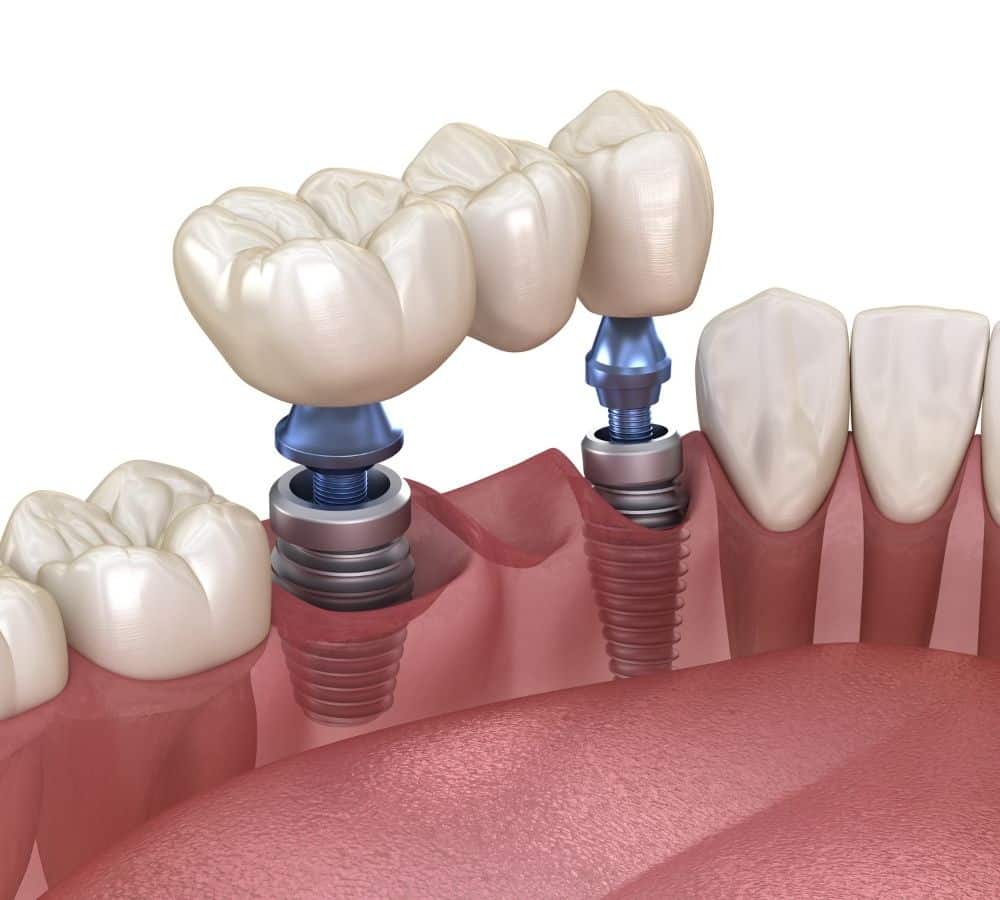
A dental implant is a titanium post that replaces your tooth root. It is surgically inserted into the jawbone beneath the gum line, allowing a replacement tooth (crown) or bridge to be mounted on it. See Dental Implants for the treatment overview, and what are the replacement options for missing teeth? for how it sits against the alternatives.
Two advantages follow from the fact that implants fuse with the jawbone:
They do not need to be removed daily and do not come loose like a denture. See Dentures and what are the different types of dentures? — which also covers implant-retained dentures, one of the commonest uses of mini implants.
They do not need to be anchored to other teeth, as bridges do, so they do not compromise the oral health of neighbouring teeth. See Dental Bridges and Implant versus bridge for a single tooth replacement.
That second point is the strongest structural argument for an implant over a bridge: nothing is done to the healthy teeth either side.
Standard dental implants
Standard implants range from about 3mm to 6mm in width and about 6mm to 15mm in length.
Before implants are considered you must have healthy gums and adequate bone. If your bone is too thin, a bone graft may be required to support the implant — see Bone Grafting. On the gum side, see Bleeding Gums, what is gum disease?, periodontal (gum) disease and Periodontists. Gum disease that took the bone in the first place will take it from around an implant too, so it is stabilised before anything is placed — when do you need deeper cleaning?
The procedure
A periodontist performs the surgery to place the titanium fixture into the jawbone.
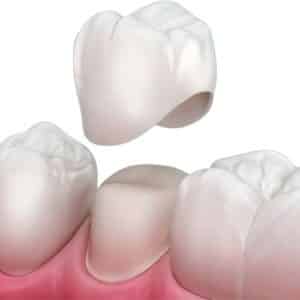
Once the fixture has fused with the bone — a process taking about three months — a small abutment is attached to the implant, acting as an anchor for the crown. See Conventional and Immediate Implants, Dental Crowns and what types of dental crowns are available?
That three-month wait is not a scheduling inconvenience. It is osseointegration — bone growing into direct contact with the implant surface — and it is what makes the implant load-bearing. Loading it before that happens is how implants fail.
Anything that impairs healing matters here, which is why smoking status and diabetes control are asked about before surgery rather than after — diabetes and dental health: the two-way street that most people don’t know about and health problems linked to poor oral hygiene.
Mini dental implants
Mini implants have the same structure as standard implants but are much smaller: about 1.8mm to 2.9mm in diameter and 10mm to 18mm long.
They suit patients who have lost too much bone width in the jaws to receive regular-sized implants.
Note what that means: the mini implant exists to solve a bone width problem. It is narrower because there is less bone to put it in — which is a genuine solution to a genuine constraint, and also the source of every limitation below.
What the published evidence covers — and what it does not
Before the comparison, one piece of honesty that most pages on this subject skip.
The large outcome studies are about standard-diameter implants. The independent literature on implant survival — the multi-study consensus reviews, the large database analyses — reports on conventional fixtures. We could not find comparable independent long-term outcome data specific to mini implants in the reference sources used to write this page.
So read what follows for what it is: the standard-implant figures are evidence; the mini-implant comparison is engineering reasoning and clinical judgement. Both are legitimate. They are not the same thing, and a page that blurs them is doing you a disservice.
The standard-implant baseline, for context
A 2025 retrospective analysis of 158,824 implants placed in 53,874 patients over nine years found an overall survival rate of 97.79%, a total failure rate of 2.21%, and an early failure rate of 1.56% during osseointegration.
The ITI consensus statements report cumulative implant survival of 95.4% at five years and 92.8% at ten years for implants supporting fixed bridgework, and — the figure most relevant here — an incidence of implant fracture of 0.4% after five years and 1.8% after ten years.
Fracture of a standard implant is rare. That is the number against which “mini implants are more prone to fracture” should be read: it is a comparison against a very low base rate, not a warning that minis routinely snap.
One more figure worth knowing if a mini is being proposed to retain a denture, because it is the closest independent evidence to that situation. In the same 2025 dataset, implants supporting removable restorations failed at 9.32%, against 3.74% for permanent restorations such as crowns and fixed bridges — removable cases were under 4% of the cohort, but the difference was statistically significant. The ITI review similarly reports 2.5% implant loss before overdentures were fitted and nearly 6% loss during five years of function. Denture-retaining implants of any diameter are a harder job than a single crown, which is worth knowing before the diameter question is even reached. See what are the different types of dentures? and All-on-4 dental implants.
Where the difference shows
Supporting the gum
Standard implants are designed to mimic the natural root form, so the crown sitting on the gum resembles a natural tooth.
A mini implant, by virtue of its smaller diameter, may not support the gum tissue as well.
The geometry explains it. A natural tooth emerges from the gum at roughly the width of the tooth itself. A narrow post carrying a full-width crown does not, and the tissue has less to sit against.
Bearing the load
Standard implants are designed to support the load placed on the crown during chewing.
Smaller-diameter implants may not be strong enough for that load, especially in patients with a strong bite. Mini implants are therefore more prone to break or fracture.
To compensate, multiple mini implants may need to be placed to support some attachments, such as bridges.
The strength of a post does not scale linearly with its width — it falls away sharply as diameter reduces. That is why a 2mm implant is not two-thirds as strong as a 3mm one, and why several may be needed to do one implant's work.
Worth noting which dimension the evidence actually implicates: a meta-analysis of early implant failure identified smoking, implants shorter than 10mm, and placement in the upper jaw as the significant risk factors. Length is the dimension that has been studied; diameter is the one at issue with minis. The absence of that study is not evidence of safety — it is absence of evidence.
If you grind or clench, raise it before the plan is settled: the load a narrow fixture has to survive is materially higher. See TMD and Teeth Grinding, night time tooth grinding and clenching and what is bruxism and how is it managed?
Keeping them clean
“New teeth” need to be kept clean, just like natural teeth — studies are consistent on this.
Standard implants, being extensively researched and designed to resemble a natural tooth, are easier to keep clean.
Mini implants have a relatively large crown sitting on a narrower “root”, creating areas where plaque or food can accumulate — areas that are difficult to reach when brushing.
This is the most consequential difference over a long time frame. Peri-implantitis — inflammation and bone loss around an implant — is driven by plaque accumulation, and it is the main cause of late implant failure. The ITI defines it as “a localized lesion including bone loss around an osseointegrated implant”, and reports that peri-implantitis and soft tissue complications occurred in 8.6% of patients after five years — with standard implants, in cases followed properly. A shape that traps plaque and resists cleaning is working against the implant's lifespan every day.
And because an implant has no nerve, there is no toothache to warn you it is happening. The ITI’s recommended monitoring is bleeding on probing, recorded periodically with a light probing force, because absence of bleeding indicates stable peri-implant tissue much as it does around a natural tooth. That is what the hygienist is doing at an implant review, and it is why the review is not optional — Dental Cleans & Hygienists and your Smile Solutions dental hygienist visit: what to expect. At home, what is the ideal daily routine for oral hygiene?, is flossing really that important? and which toothbrushes do dentists recommend?
Which one
| Standard | Mini | |
|---|---|---|
| Width | 3–6mm | 1.8–2.9mm |
| Bone width required | More | Less |
| Load bearing | Designed for chewing load | May be insufficient; more prone to fracture |
| Gum support | Mimics natural root form | May support tissue less well |
| Cleanability | Easier | Harder — plaque traps at the crown junction |
| Independent long-term outcome data | Extensive | Not found in our reference sources |
On long-term cost–benefit, standard implants may be the first line of choice for replacing missing teeth, particularly where there is sufficient bone volume.
Where bone width is lacking and the patient is not a candidate for bone grafting to rebuild it, mini implants may be considered.
That is the honest positioning. A mini implant is not a cheaper version of a standard implant — it is the option for a mouth that cannot accommodate a standard one. If you have the bone, or can have it grafted, the standard implant is generally the better long-term proposition. If you do not, and grafting is not possible, a mini implant is a real solution rather than no solution.
The question to ask, in one line: is a mini being proposed because my bone genuinely cannot take a standard implant, or because it is quicker and cheaper today? Those are different answers and they have different consequences in ten years. A second view is a reasonable thing to seek before committing — Second Opinions & Corrective Dentistry.
Cost
The itemised breakdown is on Dental implant costs in Melbourne; see also How much do dental implants cost? and the Price Guide. Where several minis are needed to do one standard implant's work, the saving is smaller than the per-fixture price suggests — ask for the total, not the unit, and see understanding your treatment for what should be in writing before you start.
Common questions
What would rule me out, and is any of it within my control?
Most of what decides this is assessed before anything is booked, and two of the larger items are things you can act on.
Smoking is the one with the clearest evidence. The meta-analysis of early implant failure cited above names smoking first among the significant risk factors, alongside implants shorter than 10 mm and placement in the upper jaw. It is also, unlike jaw anatomy, modifiable — which makes it worth raising early rather than at the consent form. Quitline is 13 7848.
Gum disease is the second. As set out above, the disease process that removed the bone around your natural teeth behaves the same way around an implant, so it is stabilised first rather than worked around.
The remaining factors are assessed rather than changed: how much bone there is and in which dimension, the quality of that bone, general health and healing, and how heavily you load your teeth. On that last one, the same registry study observed that late failures — those after integration — were “frequently associated with factors such as the quality of cancellous bone in older adults”, while early failures were more often surgical and biological. Different stages, different causes.
The practical version: ask which of the constraints in your case are fixed and which are not, and what changes if you deal with the ones that are not. That is a more useful conversation than a yes or no.
Is a shorter implant the same kind of compromise as a narrower one?
It is the compromise with actual evidence behind it, which is the useful distinction.
The risk-factor analysis quoted above identifies implants shorter than 10 mm as significantly associated with early failure. That is a measured finding about length. The concerns about narrow-diameter implants set out on this page are mechanical reasoning rather than an equivalent body of outcome data — which is why this page says so explicitly rather than presenting them as equally established.
The reason it matters to you is that bone is limited in two directions independently. A jaw can be wide enough but shallow — with a nerve or a sinus limiting how long an implant can be — or tall enough but knife-edged, which is the situation minis were designed for. Those constrain different dimensions and have different answers, and grafting can sometimes relieve one without touching the other.
So the question to ask is specific: which dimension is short in my case, by how much, and would a graft change it? A plan that answers that is a plan someone has actually measured.
What does failure actually look like — will I get any warning?
Often less than you would get from a natural tooth, which is the single most important thing to understand about living with an implant.
An implant has no nerve. The early-warning system a natural tooth gives you — sensitivity, an ache on biting — does not exist here. What replaces it is measurement, which is why the ITI's recommended monitoring is bleeding on probing, recorded periodically with a light probing force, and why it treats the absence of bleeding as the marker of stable tissue.
The things you can notice yourself, and should report rather than watch:
- Bleeding or soreness of the gum around the implant, especially if it is new or one-sided
- A bad taste or persistent odour from one site
- Any movement of the crown, or of the implant itself — a crown loosening on its screw and an implant losing its integration are different problems with the same first symptom
- The gum receding around it, so that more of the metal or the join shows
- Food packing in a spot that used to be tight
For scale on how common trouble is with standard implants in properly followed cases: the ITI reports peri-implantitis and soft tissue complications in 8.6 per cent of patients after five years, and implant fracture in 0.4 per cent at five years and 1.8 per cent at ten. Most implants do not fail. The point is that the ones heading that way announce it quietly.
I already have mini implants. Should I be worried?
No — and there is no reason to have anything removed on the strength of a web page.
The comparison above is about choosing between two options where both are available. If a mini implant was placed because the bone could not take a standard one, it was answering the question it exists to answer, and an implant that has integrated and is functioning is doing its job.
What it does earn is attention to the two things this page identifies as its weaker points, both of which are manageable:
- Cleaning. The junction between a narrow fixture and a wider crown is the plaque trap. Ask specifically at your next visit to be shown how to clean that junction, and what interdental brush size fits it — that is a five-minute demonstration that materially changes the long-run outcome.
- Load. If you grind or clench, or if you notice a crown has loosened more than once, say so. Repeated loosening is a mechanical message rather than a nuisance.
And keep the review interval you were given. As set out above, peri-implant problems are detected by probing and radiographs, not by symptoms — so the appointment where nothing hurts is exactly the one that catches things early.
Related reading
- What are the different types of dental implants?
- What do I need to know about dental implants?
- Who should I see for dental and teeth implants?
- Bridges, implants or dentures
- Things to consider when choosing All-on-4
- Dental Implants at Smile Solutions
Practical details
Smile Solutions, Level 1, 220 Collins Street, Manchester Unity Building, Melbourne VIC 3000 — getting here. Phone 13 13 96, or theteam@smilesolutions.com.au. Monday–Friday 8.00am–6.00pm, Saturday 8.30am–1.30pm, Sunday by appointment. Full details on Contact Us.
Specialist registration can be verified on the AHPRA register, or by calling 1300 419 495; the clinicians are listed on Our Team.
Survival, failure and complication figures are from independent published sources — a 2025 retrospective cohort study of 158,824 implants (PMC) and the ITI consensus statements on implant survival and complications — and describe standard-diameter implants. Neither publisher is connected with us. The dimensions quoted for both implant types are the practice’s own description and are not drawn from those sources.
Published 19 October 2017. Suitability and outcomes vary between individuals; implant surgery carries risks that should be discussed with your clinician. General information only; it does not replace advice from your treating practitioner.
Smile Solutions trades under ABN 28 193 514 103.
Images on This Page
-
https://www.facebook.com/tr?id=800557773428361&ev=PageView&noscript=1
(no alt text)
-
https://www.smilesolutions.com.au/wp-content/uploads/2025/10/calendar_month.svg
(no alt text)
-
https://www.smilesolutions.com.au/wp-content/themes/arcadian-wordpress-theme/assets/images/smile_solutions_logo_white.png
Smile Solutions Logo
-
https://www.smilesolutions.com.au/wp-content/themes/arcadian-wordpress-theme/assets/images/smile_solutions_logo_purple.png
Smile Solutions Logo
-
https://www.smilesolutions.com.au/wp-content/uploads/2023/11/SS-Tooth-1-1-150x150.png
Smile Solutions
-
https://www.smilesolutions.com.au/wp-content/uploads/2026/01/Implant-supported-dental-bridge.jpg
Dental bridge supported by implants
-
https://www.smilesolutions.com.au/wp-content/uploads/2025/09/Root-Canal-2-300x217.jpg
Root Canal
-
https://www.smilesolutions.com.au/wp-content/uploads/2026/08/Mouth-Breathing-300x270.jpg
Mouth Breathing
-
https://www.smilesolutions.com.au/wp-content/uploads/2025/09/Dental-Crown-at-Smile-Solutions-300x300.jpg
Dental Crown at Smile Solutions
-
https://www.smilesolutions.com.au/wp-content/themes/arcadian-wordpress-theme/assets/images/family_owned_bussiness.png
Family Owned Business
-
https://www.smilesolutions.com.au/wp-content/themes/arcadian-wordpress-theme/assets/icons/icon--phone.svg
Smile Solutions Contact
-
https://www.facebook.com/tr? id=800557773428361&ev=PageView&noscript=1
(no alt text)