Is flossing really that important?
The 40 per cent nobody brushes
Every check-up brings the same question: have you been flossing? For a lot of people the honest answer is no. Most of us brush twice a day as recommended. Far fewer floss once a day, as also recommended. What is the ideal daily routine for oral hygiene? sets out the whole routine, including the flossing technique — the C shape around each tooth is the part most people skip, and it is where the benefit is.
Here is the number that makes the case.
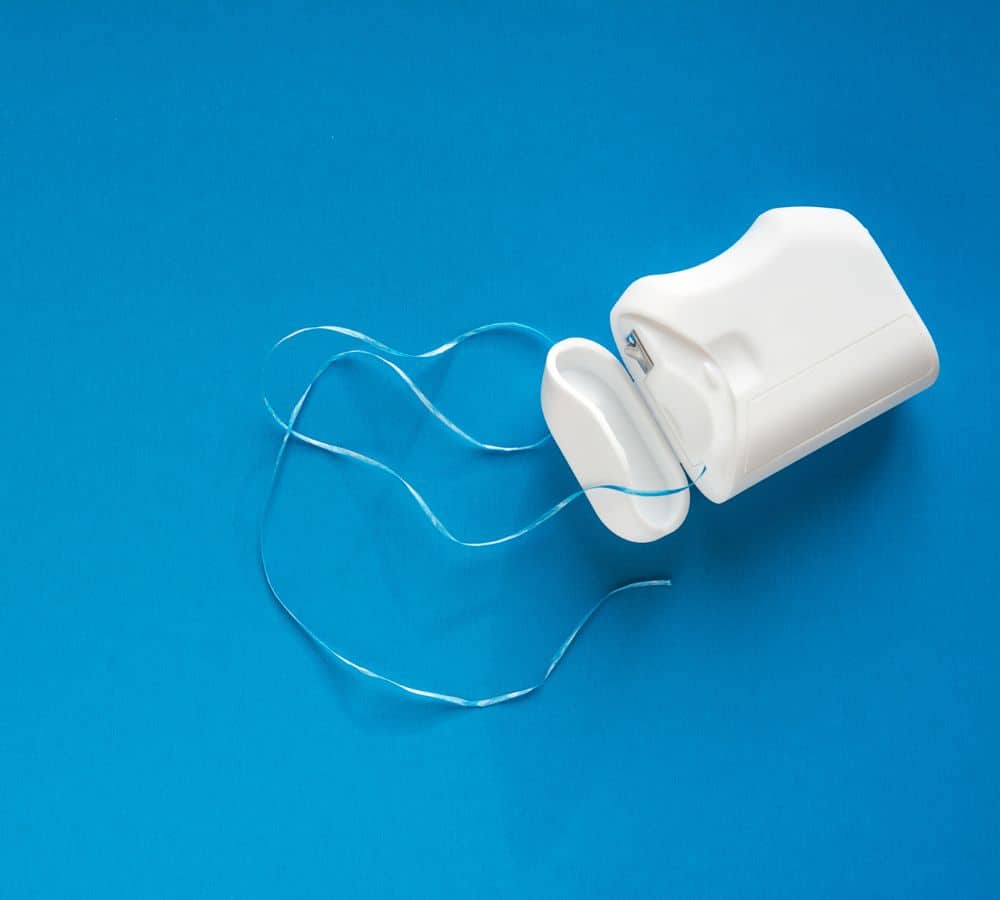
A toothbrush cleans the tops and outer surfaces of the teeth and gums. Floss cleans a completely different area — the tight spaces between the teeth, and the gap where the gums meet the teeth. A toothbrush cannot reach these places.
If you are not flossing, you are failing to clean up to 40 per cent of the surface area of your teeth. That is this practice’s own figure, offered as an estimate rather than a measurement.
That reframes the habit. Flossing is not an optional extra on top of brushing. It is the part of the job the brush structurally cannot do — and brushing more, or harder, or longer does not compensate, because the bristles do not go there. Brushing harder makes things worse rather than better: see over-brushing and which toothbrushes do dentists recommend?
Why mouthwash does not fill the gap
A common substitution, and it does not work.
Antimicrobial mouthwash can kill the bacteria that forms plaque. It cannot remove plaque from the tooth surface.
That distinction is the whole point. Plaque is a physical film, and dead bacteria in a film are still a film. Left in place it hardens into tartar (calculus), which cannot be brushed or rinsed off at all — it needs professional removal. And tartar attracts more bacteria to the area, so the problem compounds.
Mouthwash is an adjunct. Floss is mechanical removal. They are not interchangeable. The truth and myths about mouthwashes and should I be using mouthwash as well as brushing and flossing? go further into what a rinse can and cannot do. The same logic applies to oil pulling.
What happens if you do not
This is the part worth understanding properly, because there is a threshold in it.
Gingivitis — reversible
Without regular, thorough flossing, plaque and tartar build up where the teeth meet the gums. This leads to gingivitis — a puffy, reddish inflammation. The gums bleed very easily and may feel tender to touch. What is gum disease? and bleeding gums describe that stage.
Gingivitis is common and it is completely reversible. It resolves with:
- Thorough brushing
- Daily flossing
- Regular visits to your dental hygienist — what to expect at a hygienist visit and what do dental hygienists do?
The bleeding is worth commenting on, because it drives the wrong response. Gums that bleed when flossed are inflamed gums, not damaged gums. Most people stop flossing because it bleeds. Continuing is what makes the bleeding stop.
Periodontitis — not reversible
If poor oral hygiene continues, the condition can worsen into periodontitis, which is not reversible. What is periodontal disease? covers it in full, and periodontists are the specialists who treat it.
In this state, the gum and the bone surrounding the teeth begin to break down. The consequences:
- Longer-looking teeth — as the gum recedes and more root is exposed. That exposed root is also what produces sensitivity, and it is one of the changes that most reliably ages a smile: teeth and ageing
- Loose teeth
- Complete loss of teeth — and then the conversation becomes bridges, implants or dentures
That threshold is the reason this article exists. Everything before it can be undone by a change of habit. Everything after it can only be managed. Bone that has been lost does not come back. Where calculus has already gone below the gumline, do I need a deeper cleaning? explains what is involved in removing it.
The reason the threshold is easy to miss
The uncomfortable part of that sequence is that the disease does not announce when it crosses the line.
A review of periodontitis and diabetes published in Diabetologia describes periodontal diseases as “collectively the most common diseases known to mankind”, and is blunt about how quietly periodontitis advances: “In the early stages, the condition is typically asymptomatic; it is not usually painful, and many patients are unaware until the condition has progressed enough to result in tooth mobility.” By the time a tooth feels loose, the bone that held it has already gone.
The same review explains why a hygienist appointment involves measuring rather than just cleaning. Tissue destruction in periodontitis produces a periodontal pocket between the gingiva and the tooth, and “‘Pocketing’ is not evident on simple visual inspection, and assessment using a periodontal probe is essential.” That is the small ruler being walked around each tooth and called out in numbers — it is the only way the pocket depth is known, and it is why the check is not something you can do at home with a mirror.
Diabetes Australia lists the signs that are visible to you as “bleeding from gums, bad breath, sensitive teeth, loose teeth, recession of the gums (or longer looking teeth) and gaps developing between the teeth which may lead to food becoming stuck”. Persistent bad breath belongs on that list and is often the symptom people act on first.
Decay between teeth
Separately from gum disease, failing to floss leads to decay forming between your teeth, because your toothbrush cannot remove the harmful microbes from that area — only floss can.
This is also why interproximal decay is so often found on X-ray rather than by looking — how safe are dental x-rays? It develops exactly where nothing cleans and nothing sees. How does tooth decay develop? and the stages of dental decay trace it; can you reverse tooth decay? explains how narrow the window is before it needs a filling.
One diagnostic worth knowing: floss that keeps shredding in the same gap is usually catching on a rough filling margin or early decay at the contact point. Mention it rather than changing brands.
What the gums have to do with the rest of you
The two-way relationship between gum disease and diabetes is the best-evidenced version of this, and the numbers are worth seeing rather than being told there is “a link”.
The Diabetologia review reports that “the risk of periodontitis is increased by approximately threefold in diabetic individuals compared with non-diabetic individuals”, and that glycaemic control is what drives it: in the US National Health and Nutrition Examination Survey (NHANES) III, adults with an HbA1c level above 9% had a significantly higher prevalence of severe periodontitis than those without diabetes (OR 2.90; 95% CI 1.40, 6.03), after controlling for age, ethnicity, education, sex and smoking. A meta-analysis in the same review found a significant association between periodontitis and obesity (OR 1.35; 95% CI 1.23, 1.47).
The traffic runs the other way too, but more modestly than it is usually sold. The review notes that “resolution of periodontal inflammation can improve metabolic control (with reported HbA1c reductions of approximately 0.4%)” while adding that “large, multi-centre, randomised controlled trials are needed to further validate these findings.” Diabetes Australia puts the limitation plainly: professional periodontal treatment “has been shown to create a mild improvement in blood glucose levels”, but “these results lasted for only a short three-month period of time”, with longer-term studies ongoing.
So the honest claim is not that flossing manages diabetes. It is that poorly controlled diabetes makes gum disease considerably more likely, and treating gum disease appears to help blood glucose a little, for a while. Diabetes and dental health is the fuller treatment; health problems linked to poor oral hygiene and the importance of dental hygiene: a window onto overall health set out what the wider evidence does and does not support.
The habit starts earlier than most people think
An Australian Dental Association survey of 25,000 Australian adults, released for Dental Health Week in July 2025, found that “76% of children never floss themselves, nor have their parents do it” — and that many respondents “thought it not worthwhile while baby teeth are in place”.
The ADA’s position is the opposite: “once a child has two or more baby teeth side-by-side, dentists recommend parents floss daily.” In practice, “the majority (61%) of families have introduced their child to the concept at between ages six and 13” — years after the contacts that need cleaning have closed up.
If you are starting that habit at home, kids teeth cleaning tips and children’s dentistry are the practical end of it, and a child’s first visit to the dentist covers when to begin.
The economics of it
Professional dental tools and procedures are highly advanced and can treat even severe problems. But good oral hygiene is a cost-effective and easy way to avoid needing that kind of care.
Ask any dentist or hygienist what the most effective, affordable tools are for protecting oral health, and you will be pointed at a toothbrush and a box of floss.
A box of floss costs a few dollars and lasts months. Treating the periodontal disease it prevents costs considerably more, indefinitely, and does not restore what has already been lost. Published fees are in the price guide if you want to compare the two.
Once a day is the recommendation. Which time of day matters far less than doing it at all. Interdental brushes are often easier where the gaps are big enough to take one, and the best tool is the one you will actually use every day.
Common questions
Should I floss before or after brushing, and how much floss do I actually need?
Before, on the Australian government's advice. healthdirect states plainly: "It's best to floss before brushing your teeth."
On the technique, the same source gives the measurement most people get wrong: "pull off about 40–50 cm of floss or tape", and "leave 5 cm to work with" between your hands. That sounds like a lot until you realise the point — a fresh section for each gap, so you are not carrying plaque from one contact to the next. Most people use a fraction of that and reuse the same short piece throughout.
Two more instructions from healthdirect that belong in the same routine: brush twice a day, ideally in the morning after breakfast and before bed, and wait 30 minutes after eating and drinking before brushing — which matters after anything acidic, because acid-softened enamel is worn away by brushing rather than cleaned. It also advises replacing your toothbrush or brush head every 3 months, or when it looks worn.
And finish the way the ADA describes: spit out the excess toothpaste but do not rinse your mouth with water, so the fluoride stays on the teeth and keeps working. See what is the ideal daily routine for oral hygiene?
Are interdental brushes or a water flosser just as good?
Interdental brushes, yes — on the profession's own account. Water flossers are a different matter, and the honest answer is that our reference material does not settle it.
The ADA's oral hygiene policy lists the main oral hygiene strategies as brushing for two minutes twice a day, an age-appropriate fluoride toothpaste, cleaning between the teeth once a day using floss or interdental brushes, and regular professional check-ups and cleaning. Its separate list of "proven aids to oral hygiene" names "interdental aids including floss & interdental brushes", along with a toothbrush, fluoride toothpaste, sugar-free chewing gum and mouthrinse. Floss and interdental brushes appear side by side in both places, so where a brush fits the gap, it is a recognised equivalent rather than a compromise.
What is not named anywhere in that policy is a water flosser. That is not evidence it does not work — it is the absence of evidence in the sources this page is built on, and it would be dishonest to present it either way. If you use one and your hygienist finds your gums healthy at review, that is the measurement that matters.
The principle underneath all of it is in Australian Prescriber: "mechanical removal of plaque through frequent and efficacious brushing and flossing is the principal means of preventing periodontal diseases and diminishing the risk of caries." Mechanical removal is the requirement; the implement is a detail. Ask your hygienist which tool suits the gaps you actually have — they differ from tooth to tooth in the same mouth.
I have a bridge, an implant or braces. How am I meant to floss around those?
Differently in each case, and it is worth being shown once rather than guessing.
Around a bridge, the ADA is explicit that the usual method will not work: "as the crowns that make a bridge are joined together, floss cannot be passed between the teeth." Its instruction is that "your dentist should show you how best to clean beneath your dental bridge", which "may involve using superfloss, floss threaders or interdental brushes".
Around fixed braces, the ADA notes that string floss is tricky, and points to floss threaders made for braces, or interdental brushes — the interdental brush having the advantage that it cleans between the brackets as well as between the teeth. It also recommends brushing after every meal while in braces, because food lodges around the brackets.
Around implants, the requirement is the same as around teeth and no less important. The ITI consensus material on implant maintenance states that implant surfaces are subject to biofilm formation, and that "patients should be instructed and motivated to regularly perform an adequate level of plaque control around both teeth and implants" — with plaque made visible using disclosing solutions at maintenance visits and the technique re-taught where needed.
With clear aligners, uniquely, nothing changes: the ADA says "your teeth can be brushed and flossed as normal" — you simply take the trays out first.
Does flossing help bad breath?
It is part of the answer, and it is a better-supported part than the thing most people try first.
The Better Health Channel, produced in consultation with and approved by the Victorian Department of Health and the ADA Victorian Branch, describes halitosis as mostly caused by sulphur-producing bacteria and lists the major causes as including poor oral hygiene, gum disease and a dry mouth. Its advice is direct: "avoiding dehydration and good oral hygiene, including brushing and flossing, are important".
Where the evidence is weaker than the marketing is tongue cleaning. The ADA's own consumer page — written by a specialist periodontist — reports that "a review of the scientific evidence in 2019 found no evidence that cleaning your tongue, using several different methods including mouthwash or chewing gum, were effective for managing the cause of halitosis", and adds that "bad breath can actually be caused by other areas of the body including the lungs and the nose". The same page elsewhere says cleaning your tongue can help reduce bad breath, so the ADA's own material is not fully consistent on this — which is itself worth knowing before spending money on a scraper. If you do clean your tongue, its instruction is to be gentle: start at the back and brush or pull forward, using water to lubricate so the brush does not drag.
The practical order, then: clean between the teeth properly, deal with dry mouth, and have the gums checked — because persistent bad breath is on Diabetes Australia's list of gum-disease signs quoted above. Tongue cleaning is optional and unproven for this purpose. Bad breath that persists despite all of it should be investigated rather than masked; the Better Health Channel's advice is to see a dentist, doctor or chemist to identify the cause. See Bad Breath.
Does flossing actually prevent gum disease, or is that just what dentists say?
The mechanism is not in dispute, and the source that says so most plainly is a medical one rather than a dental one. Australian Prescriber states: "Plaque is the primary aetiologic agent in the development of dental caries, gingivitis and periodontal disease. Mechanical removal of plaque through frequent and efficacious brushing and flossing is the principal means of preventing periodontal diseases and diminishing the risk of caries."
It also acknowledges the obvious objection — "some individuals lack the dexterity, skill or motivation for mechanical plaque removal" — and answers it without letting the rinse take over: mouth-rinsing is easier and "may aid in controlling supragingival plaque and gingivitis, but it should always be used in conjunction with mechanical hygiene", and "should never be the sole means of oral hygiene".
What that does not establish is a percentage. No source behind this page quantifies how much gum disease flossing prevents in a given person, and the "40 per cent of the tooth surface" figure at the top is this practice's own estimate rather than a published measurement. So the defensible claim is a mechanical one: plaque causes the disease, brushing does not reach between the teeth, and something has to.
The check that settles it for you specifically is the probing described above. Pocket depths recorded at successive visits are a measurement of whether what you are doing at home is working — which is a far more useful answer than any general figure. Ask for your numbers, and ask whether they have changed.
Sources for the figures on this page
- Preshaw et al., Periodontitis and diabetes: a two-way relationship, Diabetologia (PubMed Central) — the threefold risk figure, the NHANES III odds ratio, the obesity meta-analysis, the HbA1c reduction, and the descriptions of asymptomatic progression and periodontal probing.
- Diabetes Australia, Dental health — the list of visible signs and the three-month limitation on glycaemic improvement.
- Australian Dental Association, Open wide: the oral habits of Aussie families revealed (Dental Health Week, 30 July 2025) — the children’s flossing figures.
- Australian Dental Association, Policy Statement 2.2.3 — Oral Hygiene (October 2025) — the main oral hygiene strategies and the list of proven aids; and its consumer articles on teeth straightening, on crowns, bridges and veneers, and on tongue cleaning.
- healthdirect Australia — the flossing order, the 40–50 cm measurement, the brushing times and the toothbrush replacement interval.
- Better Health Channel (Victorian Department of Health, approved by the ADA Victorian Branch) — the causes of halitosis and the advice on oral hygiene and dehydration.
- Australian Prescriber — plaque as the primary aetiologic agent, and mouthwash as an adjunct rather than a substitute.
- ITI consensus statements on implant maintenance — the plaque-control instruction around implants.
The “up to 40 per cent of the surface area” figure at the top of this page is Smile Solutions’ own estimate and is not drawn from any of the above.
Related reading
- Three oral hygiene tips you need to know
- How often should I brush my teeth?
- Selecting a toothpaste: fluoride or non-fluoride
- The benefits of fluoride
- Preventing dental decay
- Kids teeth cleaning tips
- Good oral hygiene can increase your lifespan
Practical details
Smile Solutions, Level 1, 220 Collins Street, Manchester Unity Building, Melbourne VIC 3000 — getting here. Phone 13 13 96, contact us, or theteam@smilesolutions.com.au. Monday–Friday 8.00am–6.00pm, Saturday 8.30am–1.30pm, Sunday by appointment. The clinical team is listed by name.
Published 15 March 2018. General information only; it does not replace advice from your treating practitioner.
Smile Solutions trades under ABN 28 193 514 103.
Images on This Page
-
https://www.facebook.com/tr?id=800557773428361&ev=PageView&noscript=1
(no alt text)
-
https://www.smilesolutions.com.au/wp-content/uploads/2025/10/calendar_month.svg
(no alt text)
-
https://www.smilesolutions.com.au/wp-content/themes/arcadian-wordpress-theme/assets/images/smile_solutions_logo_white.png
Smile Solutions Logo
-
https://www.smilesolutions.com.au/wp-content/themes/arcadian-wordpress-theme/assets/images/smile_solutions_logo_purple.png
Smile Solutions Logo
-
https://www.smilesolutions.com.au/wp-content/uploads/2023/11/SS-Tooth-1-1-150x150.png
Smile Solutions
-
https://www.smilesolutions.com.au/wp-content/uploads/2018/03/Dental-Floss.jpg
Dental Floss
-
https://www.smilesolutions.com.au/wp-content/uploads/2025/09/Root-Canal-2-300x217.jpg
Root Canal
-
https://www.smilesolutions.com.au/wp-content/uploads/2026/08/Mouth-Breathing-300x270.jpg
Mouth Breathing
-
https://www.smilesolutions.com.au/wp-content/uploads/2025/09/Dental-Crown-at-Smile-Solutions-300x300.jpg
Dental Crown at Smile Solutions
-
https://www.smilesolutions.com.au/wp-content/themes/arcadian-wordpress-theme/assets/images/family_owned_bussiness.png
Family Owned Business
-
https://www.smilesolutions.com.au/wp-content/themes/arcadian-wordpress-theme/assets/icons/icon--phone.svg
Smile Solutions Contact
-
https://www.facebook.com/tr? id=800557773428361&ev=PageView&noscript=1
(no alt text)