How do teeth make a smile look older?
Four changes do most of the work, and they are separate problems with separate solutions: the teeth darken, they wear shorter, they drift out of alignment, and the gums recede. Whitening fixes only the first. Treating the wrong one is the most common reason people spend money on a cosmetic result they are not happy with.
When we think about what gives away our age we usually picture skin and hair. Teeth do it too — and unlike skin, the changes are largely mechanical and largely preventable if caught early. Keeping your teeth in top condition in your late sixties and beyond covers the health side of the same period, and the three layers of dental wellness and longevity the longer view.
The old phrase long in the tooth is not about teeth growing. It refers to gum recession exposing more of the root, which makes teeth look longer with age — and exposed root surface is also what produces sensitivity and decay at the gumline.
Why teeth darken
There are two mechanisms, and they respond very differently to treatment.
Intrinsic — the tooth itself changes. As we age the outer layer of enamel becomes thinner. Enamel is translucent, so as it thins it reveals more of the dentine underneath, which is naturally yellow. At the same time the dentine layer itself thickens and darkens over a lifetime, as the tooth lays down secondary dentine internally. So an older tooth is a thinner, more transparent shell over a thicker, yellower core.
Extrinsic — surface staining. This comes from smoking and from beverages such as coffee, tea, red wine and dark soft drinks. It sits on and just within the enamel surface.
The practical distinction:
| Intrinsic | Extrinsic | |
|---|---|---|
| Cause | Thinning enamel, thickening dentine | Smoking, coffee, tea, wine, dark drinks |
| Responds to a professional clean? | No | Substantially |
| Responds to whitening? | Partially — less predictably with age | Well |
| Prevention | Limit acid wear and grinding | Reduce staining exposure, regular cleans |
How can I improve the whiteness of my teeth? and what should I know about teeth whitening? cover the options; how long do teeth whitening effects last? is realistic about the upkeep.
One honest caveat: whitening becomes less predictable as the enamel thins, because there is less enamel to lighten and more dentine showing through. Whitening on a very worn tooth can produce only a modest change. That is not a failure of the technique; it is a limit of what bleaching can do, and it is worth knowing before starting rather than after.
Whitening
Professional in-chair whitening is typically a single appointment of around an hour, sometimes with take-home trays to follow. Take-home kits supervised by a dentist work over one to three weeks and often produce a comparable result with less sensitivity — the difference between in-chair and take-home whitening sets the two side by side, and why should I go to a dentist for whitening? covers what separates both from a pharmacy kit.
Why the concentration is regulated
This is a legal distinction rather than a marketing one. Schedule 10 of the Poisons Standard — the schedule the Therapeutic Goods Administration describes as listing "substances of such danger to health as to warrant prohibition of their sale, supply and use other than in specified exempt circumstances" — states that teeth whitening products containing more than 6% hydrogen peroxide or 18% carbamide peroxide "may only be sold, supplied and used by registered dental practitioners as part of their dental practise," and those provisions are "formalised in all state and territory poisons legislation." The two figures describe the same strength: 18% carbamide peroxide approximates 6% hydrogen peroxide.
The Australian Dental Association's position statement matches it — that "only registered dental practitioners who are educated, trained and competent in teeth whitening (bleaching) procedures should use or supply teeth bleaching products containing more than 6% hydrogen peroxide or equivalent." healthdirect puts the practical consequence to consumers: "at-home tooth whitening kits do not contain the same concentration of bleaching agents as those dental practitioners use."
That cap is also why over-the-counter whitening products under-deliver, and a systematic review in Frontiers in Dental Medicine is unsparing about which of them do anything at all. Whitening toothpastes combine abrasives that "can induce damage to the tooth surface without evidence of promoting real bleaching"; the same was found for rinses, "which might present a low pH, with an erosive potential"; charcoal has been added to these products to improve whitening "but there is no evidence supporting it"; and strips are "the only OTC products able to promote bleaching." Most, the review concludes, are "effective only in removing extrinsic stains or preventing their formation over enamel", and "there is no sound evidence that any of the described OTC products promote a better bleaching effect than the products indicated for a professional."
What matters more than the technique
- Have the assessment first. Whitening will not lighten crowns, veneers or composite fillings, so an existing restoration on a front tooth will stand out once the natural teeth around it lighten. That may mean replacing it afterwards — a cost worth knowing about in advance. I want to whiten my teeth but one of my front teeth has a porcelain crown sets out exactly what that costs.
- Untreated decay or gum disease should be dealt with first. Whitening an inflamed mouth is uncomfortable and can be harmful — see what is periodontal disease? and bleeding gums.
- Sensitivity during and after treatment is common and usually temporary, but it is more likely if you already have recession or erosion.
- Results are not permanent. Expect to top up periodically, depending on diet and smoking.
Wear and shortening
This is the change most people overlook, and the one that most reliably ages a smile.
Young front teeth have gently rounded, slightly translucent edges with subtle variation between them. Decades of chewing, and particularly of clenching and grinding, wear those edges flat. A flat, even, shortened front-tooth edge reads as older even to someone who could not say why.
Wear also has knock-on effects. Over the years chewing and clenching wear the teeth down and cause them to move around more — shortened teeth alter how the bite meets, and altered contacts allow further drift.
Wear is irreversible — enamel does not regrow. That makes prevention disproportionately valuable:
- If you grind or clench, an occlusal splint (night guard) is the single highest-value intervention available. It costs a fraction of what restoring worn teeth costs later. TMD and teeth grinding, night-time tooth grinding and clenching, and how can I stop grinding my teeth when I sleep?
- Manage acid erosion, which accelerates mechanical wear — reflux, acidic drinks, frequent vomiting. The ADA's diet policy names the combination directly: "the combination of sugar and food acid can be particularly destructive." How dental erosion is addressed, how does your diet affect your teeth?, and sugar-free soft drinks and teeth
- Once significant length has been lost, restoring it is a bite-level problem, not a single-tooth one, and is properly planned rather than done piecemeal. Complex dentistry and prosthodontists describe how that is handled; what does restorative dentistry involve? sets out the order the work follows.
Drifting and crowding
Teeth continue to move throughout life. Lower front-tooth crowding that appears in the thirties and forties is extremely common, even in people who had braces as teenagers.
Straightening does not require conventional braces. Invisalign — a series of clear, removable aligner trays — applies pressure at planned points to move teeth into a predetermined position. Points worth being accurate about:
- Aligners are worn 20 to 22 hours a day, removed only for eating, drinking anything other than water, brushing and flossing. Compliance below that materially slows or derails treatment.
- Treatment length varies widely with the complexity of the case — minor front-tooth alignment can be months, while significant correction takes considerably longer. How long does orthodontic treatment take?
- Aligners are not suitable for every case. Some tooth movements are handled more predictably with fixed appliances. An assessment establishes which applies — orthodontics is the service page, and a complimentary orthodontic consultation is the usual starting point. Confirm the current terms when you book — what the appointment includes, whether records such as scans or radiographs are part of it or charged separately, and whether any deposit applies.
- Retention is permanent. Whatever moved teeth once, teeth will drift again without a retainer. Anyone who had braces as a teenager and now has crowding is the proof.
Complex orthodontic cases can be referred to a specialist orthodontist — a registered dental specialist who has completed additional postgraduate training in tooth movement and jaw growth.
Restoring damaged or missing teeth
Missing or broken teeth age an appearance quickly, and a missing back tooth does more than it looks — the teeth either side tilt into the gap, the opposing tooth over-erupts, and the bite collapses slightly, which shortens the lower face.
One framing point from the ADA's consumer site before the list: "crown, bridge and veneer treatments are elective treatments", and "having a crown, bridge or veneer does not mean no treatment will ever be required again for the tooth or teeth." Every option below is the start of a maintenance commitment, not the end of one.
- Porcelain veneers are thin shells bonded to the front of the teeth to correct shape, size and colour. They suit teeth that are structurally sound but uneven, worn at the edges, or discoloured beyond what whitening reaches. They require some irreversible preparation in most cases — measured in the Journal of Prosthetic Dentistry at roughly 3% to 30% of the coronal tooth structure by weight, against 63% to 72% for a conventional crown. How much enamel survives that preparation matters more than the brand of ceramic: a 2025 meta-analysis in the same journal found survival of 99% (range 98% to 100%) for veneers bonded to enamel, falling to 91% (range 84% to 98%) where dentin exposure was severe, with the proportion needing no clinical intervention dropping to 74% (range 64% to 85%). On longevity, a systematic review of 25 studies and 6,500 porcelain veneers estimated 10-year cumulative survival of 95.5%. healthdirect adds the plain-English version: "veneers may need to be replaced due to chips, fractures or changes in colour over time." See how long do porcelain veneers last? and composite bonding as the reversible alternative. A mock-up before any preparation lets you see the result while you can still change your mind.
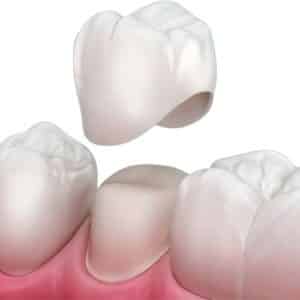
- Crowns are used where a tooth is too broken down for a veneer to be supported — what is the difference between porcelain crowns and veneers? and what types of dental crown are available?
- Dental implants replace teeth that are missing or beyond restoring. An implant is a titanium fixture placed in the jawbone, restored with a custom crown matched to the neighbouring teeth. Implants also preserve the bone in that site, which resists the sunken look that follows long-term tooth loss. Bridges, implants or dentures compares the alternatives, and how much do dental implants cost? is specific about the money.
Each of these carries its own risks, costs and maintenance, and none is permanent maintenance-free work. A written treatment plan setting out what is involved, the alternatives, and what happens when the work eventually needs replacing is the right basis for deciding — see understanding your treatment, the price guide, and a second opinion where a proposal seems larger than the problem. I want a smile makeover — where should I start? works through the sequence from the patient's side.
One thing worth knowing when comparing providers: the ADA states that "a dentist cannot be registered as a Cosmetic Dentist in Australia." It is a description of the work being done, not a registration category. The recognised specialty in this area is prosthodontics, and registration in any specialty can be checked free on the AHPRA register.
The changes worth preventing rather than treating
If there is one thing to take from this: the cosmetic changes that are cheap to prevent and expensive to fix are wear and recession. Both are gradual, both are painless in their early stages, and both are picked up at a routine examination years before they become visible to the person who has them. Dental cleans and hygienists and what to expect at a hygienist visit cover the appointment that finds them.
Common questions
My gums have receded and my teeth look longer. Can I get that back?
The gum tissue that has already been lost does not grow back on its own, and no toothpaste or rinse will return it. That is the honest starting point, and it is the reason the emphasis above is on catching recession rather than reversing it.
What can change is whether it continues. Recession has more than one driver and they are managed differently. Periodontal disease is one: the destruction of the attachment between gum and tooth progresses alongside bone loss, and advanced periodontitis is characterised in the literature by "gingival erythema and oedema, gingival bleeding, gingival recession, tooth mobility, drifting of teeth, suppuration from periodontal pockets, and tooth loss". If that is the cause, stabilising the disease is the whole job, and the appearance follows from it — see what is periodontal disease? and periodontists. Mechanical causes are the other group: a hard brush used with force, an abrasive paste, or a heavy bite on a particular tooth. Those are correctable, and correcting them is free. Over brushing: what can it do to my teeth?
There is a third consequence that matters more than the look of it. Exposed root surface is not enamel, and it decays more readily and at lower acid challenge than a crown surface does. So recession quietly converts a cosmetic complaint into a decay-risk problem, and that is the reason to raise it at a check-up rather than live with it. What to do if you suffer from sensitive teeth covers the symptom most people notice first.
I take more medications than I used to. Does that change anything for my teeth?
It may, and this is the part of ageing and teeth that gets least attention. A great many common medications reduce saliva flow, and saliva is the mouth's main buffer against acid and its main delivery system for the minerals that repair early enamel damage. The Australian Dental Association's diet and caries policy identifies "individuals using medication(s) which lead to a reduction in salivary flow" as a specific higher-risk group, alongside "individuals with conditions which lead to a reduction in salivary flow".
The ADA is also explicit about the compounding effect in older people: "the elderly – reducing the dietary sugar and acid intake should be encouraged because of the increased risk of caries from reduced saliva flow and more exposed root surfaces." Those two factors arrive together, which is why decay can appear in someone's seventies who had no fillings for thirty years. There is a second trap in the same policy: "medications, including over-the-counter vitamin and mineral tablets, may include sugars (particularly those that are chewable and dissolved in the mouth) or contribute to dry mouth, both of which can contribute to tooth decay or softening and loss of tooth structure." Chewable and lozenge forms are worth checking.
What to do with that: bring the actual list of what you take to your next appointment rather than describing it from memory, and say if your mouth feels dry, because dry mouth is easy to normalise and easy to miss. Do not stop or change a prescribed medicine over a dental concern — that is a conversation for the prescriber, and there are usually ways to manage the dental side without touching the medication.
Am I too old for implants or braces?
Age by itself is not what the evidence identifies as the problem. A review of early implant failure concluded that the significant risk factors were "smoking habits, implants shorter than 10 mm, and implants placed in the maxillary region", and a separate analysis grouped the predictors of survival as "general health, smoking status, oral hygiene practices, bone quality and quantity, as well as implant location, implant-specific characteristics, and the clinician's experience". Chronological age is not on either list.
What does appear on both lists is general health, smoking and the bone you have to work with — and those do shift with age, which is why an assessment matters more, not less. Bone volume in particular is the thing that changes after a tooth has been missing for years, and it is often the deciding factor between a straightforward placement and a more involved one.
Orthodontics has the same shape of answer. Teeth move in response to force at any age; what changes is that an older mouth is more likely to have restorations, missing teeth, existing wear and periodontal history, all of which have to be factored into the plan. A mouth with active gum disease is not a mouth to start moving teeth in. Orthodontics and dental implants set out how each is assessed.
How would I know my teeth were wearing before it shows?
Often you would not, which is the difficulty. healthdirect is blunt about it: "if you grind your teeth while asleep, you may not be aware that you are doing it", and "some people do not get any symptoms from grinding their teeth."
Where there are symptoms, the ones listed are "cracked, chipped or loose teeth; damaged tooth fillings; painful jaw muscles, especially in the morning; headaches or toothaches; sensitive teeth; sleep disturbance; temporomandibular joint dysfunction." Two of those are worth underlining because people rarely connect them to teeth at all — morning jaw muscle ache, and headaches. healthdirect notes that "sometimes people see their doctor for headaches or a sore neck and find teeth grinding is the cause", and that "your bed partner could be the first one to notice the sound of teeth grinding." If someone has mentioned the noise, that is data.
The listed triggers are "emotional stress and anxiety; smoking; alcohol or caffeine use; snoring; taking particular medicines, such as certain antidepressants; using stimulants or drugs such as cocaine or ecstasy" — several of which change across a working life, which is why grinding can start in someone who never did it before.
The detection that does not rely on you noticing is the routine examination: "your dentist will check for signs of bruxism, such as tooth wear and damage, during regular dental check-ups." Flattening on the biting edges, notching at the gumline and cracks in fillings are visible to a clinician long before the change is visible in the mirror. Night-time tooth grinding and clenching and TMD and teeth grinding go further. Note also how the protective appliance is described: a custom-made occlusal splint is framed as protecting the teeth, not as stopping the behaviour or treating pain.
I can't afford all of this at once. What should I do first?
The ordering principle is not cosmetic, and any plan that starts with appearance is the wrong way round.
First, anything active. Decay and gum disease are progressive, and every month they run costs more to fix later. They also have to be resolved before most cosmetic work can proceed anyway — whitening an inflamed mouth is uncomfortable and can be harmful, and veneers or crowns placed over unstable foundations fail.
Second, anything protective. If you grind, a splint is the item with the widest gap between what it costs and what it prevents. Preventing wear is available at a fraction of the cost of restoring teeth that have already lost length, and unlike restoration it does not consume any tooth structure.
Third, the change that bothers you most — and it is worth being specific about which of the four changes that actually is, because people often describe wanting whiter teeth when what has changed is length or alignment. Whitening a worn, shortened tooth makes it a whiter worn tooth.
Last, the elective reconstruction, planned as a whole even if it is done in stages, so that each stage fits the eventual result rather than having to be redone. Ask for the plan in writing with the alternatives and the staging set out, and ask what happens if you stop after stage one. Understanding your treatment and the price guide cover how that is set out here, and a second opinion is reasonable on any large proposal.
Related reading
- Cosmetic dentistry options
- Is it time for a smile makeover?
- How can I improve my smile with porcelain veneers and crowns?
- What's new in cosmetic dentistry?
- Wellness and longevity
- Before and after gallery
Practical details
Specialist registration can be verified on the AHPRA register, or by calling 1300 419 495. The practice's registered specialists are identified as such within the full team.
Smile Solutions, Level 1, 220 Collins Street, Manchester Unity Building, Melbourne VIC 3000 — getting here. Phone 13 13 96, contact us, or theteam@smilesolutions.com.au. Monday–Friday 8.00am–6.00pm, Saturday 8.30am–1.30pm, Sunday by appointment.
Published 9 October 2015. Survival figures quoted are from published studies of other patient groups and are not a prediction for any individual tooth. Bruxism symptoms, triggers and detection are quoted from healthdirect Australia; saliva, medication and dietary risk statements are from the Australian Dental Association's diet and caries policy; implant risk-factor findings are from published reviews. General information only; it does not replace advice from your treating practitioner. All treatment carries risks; outcomes vary between individuals.
Smile Solutions trades under ABN 28 193 514 103.
Images on This Page
-
https://www.facebook.com/tr?id=800557773428361&ev=PageView&noscript=1
(no alt text)
-
https://www.smilesolutions.com.au/wp-content/uploads/2025/10/calendar_month.svg
(no alt text)
-
https://www.smilesolutions.com.au/wp-content/themes/arcadian-wordpress-theme/assets/images/smile_solutions_logo_white.png
Smile Solutions Logo
-
https://www.smilesolutions.com.au/wp-content/themes/arcadian-wordpress-theme/assets/images/smile_solutions_logo_purple.png
Smile Solutions Logo
-
https://www.smilesolutions.com.au/wp-content/uploads/2023/11/SS-Tooth-1-1-150x150.png
Smile Solutions
-
https://www.smilesolutions.com.au/wp-content/uploads/2025/09/Smile-Solutions-Level-10.png
Smile Solutions Level 10
-
https://www.smilesolutions.com.au/wp-content/uploads/2025/09/Root-Canal-2-300x217.jpg
Root Canal
-
https://www.smilesolutions.com.au/wp-content/uploads/2026/08/Mouth-Breathing-300x270.jpg
Mouth Breathing
-
https://www.smilesolutions.com.au/wp-content/uploads/2025/09/Dental-Crown-at-Smile-Solutions-300x300.jpg
Dental Crown at Smile Solutions
-
https://www.smilesolutions.com.au/wp-content/themes/arcadian-wordpress-theme/assets/images/family_owned_bussiness.png
Family Owned Business
-
https://www.smilesolutions.com.au/wp-content/themes/arcadian-wordpress-theme/assets/icons/icon--phone.svg
Smile Solutions Contact