How can I improve the whiteness of my teeth?
The answer depends entirely on what is causing the discolouration, and that is the question most whitening advice skips. See Teeth Whitening.
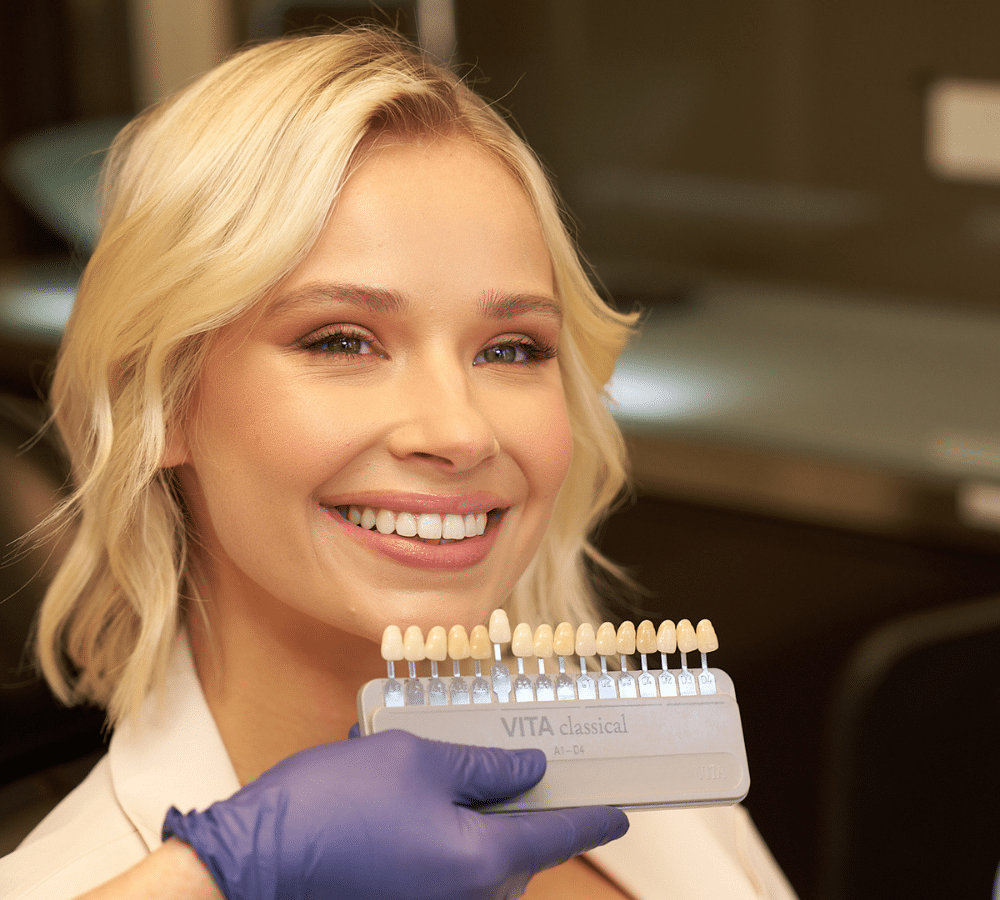
An improved smile is on most patients' priority list, and bright teeth are a significant part of what makes a smile appealing. Whitening at the dentist has become increasingly common, effective, affordable and — most importantly — safe. See Why should I go to a dentist for teeth whitening?.
Compared with products bought from a supermarket shelf or chemist, the products used at the dentist are of significantly higher strength and potency, and are designed to maximise contact with your teeth to achieve a more desirable shade. That contact time is the part supermarket products cannot replicate. See Difference between pharmacy whitening kits and dentist whitening.
After a thorough check-up and clean, the choice of approach depends on:
- the cause of your staining — smoking stains behave very differently from antibiotic stains
- your timeframe for achieving the result
- your budget — see the Price Guide
What “whitening” actually means
Two quite different things are sold under the same word, and the distinction decides what any given product can do for you.
The Australian Dental Association's Policy Statement 2.2.8 defines teeth whitening as “the use of teeth whitening products designed to penetrate the teeth and bleach intrinsic and/or extrinsic tooth discolourations, as opposed to products such as whitening toothpastes that are intended to remove surface staining.”
So a whitening toothpaste and a peroxide gel are not weaker and stronger versions of the same thing. One lifts stain off the surface. The other changes the colour of the tooth itself. If what you have is stain, the first will help. If the tooth has genuinely darkened, only the second addresses it — and that is why the rest of this page is organised around cause rather than product.
Why teeth discolour
The outermost layer of your teeth is enamel. Most of us start with thick, sparkling, porcelain-like enamel. See If enamel is the hardest substance in the body, why do teeth break?.
With age, enamel wears down and becomes more transparent, allowing the yellow colour of the inner tooth structure — dentine — to show through.
The two categories of staining
Extrinsic (external) staining — on the outer surface. Most commonly caused by:
- smoking
- heavy consumption of tea, coffee and red wine
- poor oral hygiene
Intrinsic (internal) staining — within the tooth structure. Caused by:
- trauma, such as a fall — see Chipped and Cracked Teeth
- excessive fluoride exposure while teeth are developing
- medication — tetracyclines can stain a child's teeth if taken by the mother during the second half of pregnancy, or by the child up to age 8
This distinction determines everything. Extrinsic staining can often be removed by a professional clean and polish. Intrinsic staining typically requires further treatment. See Dental Cleans & Hygienists.
Food and drink staining
Caused by highly pigmented foods and drinks — black and green tea, coffee, red wine. See How does your diet affect your teeth?.
To prevent and manage it
- Rinse your mouth with water after consuming any of these
- Chew sugar-free gum to stimulate natural saliva flow, which washes away some of the tannin stains
- Use a toothpaste containing small abrasive agents, which remove some surface staining — ask your dentist or hygienist which brand they recommend. Note what this is doing: on the ADA's own definition above, a whitening toothpaste is a stain remover, not a bleach, so judge it on that basis
- Reduce plaque-forming bacteria with daily flossing and twice-daily brushing — see Bleeding Gums
- Have your teeth professionally cleaned every six months. At these appointments your dentist or hygienist removes plaque, calculus (hardened tartar) and surface staining — General Dentistry
For heavy brown or black staining, a simple polish may not be enough. Smile Solutions offers prophyflex, which uses a high-pressure water jet with calcium carbonate crystals to lift surface staining that polishing leaves behind. See What to expect at your dental hygienist visit.
Age
Age alone does not make teeth yellow. That is a common misconception, and the real mechanism is more useful to know:
- As enamel thins, the less-white layer beneath shows through more
- Gum recession becomes more prevalent over time, exposing part of the tooth root — which is also more yellow than enamel
Neither process can be prevented, but both can be managed.
To manage it
Use a soft or extra-soft toothbrush and do not scrub. Harsh scrubbing hastens enamel thinning, which makes teeth appear yellower — the exact opposite of the intention. Brush with a gentle circular motion.
Grinding also wears enamel, and for the same reason darkens the teeth over time — see TMD and Teeth Grinding. So does acid erosion — see How is dental erosion addressed?.
There is a practical reason to take enamel loss seriously before considering whitening. The ADA notes that the potential for peroxide to reach the nerve tissue inside a tooth is “often accelerated by exposed dentine and enamel fractures”. Thin, worn or cracked enamel is therefore not just a cosmetic problem; it changes how a whitening agent behaves.
Trauma
Whitening does work on intrinsic staining. But where the discolouration comes from trauma, additional dental treatment is likely to be required — a traumatised tooth may have a non-vital pulp, which needs assessing before any cosmetic work. See Root Canal and Endodontists.
What has to happen before any whitening
This is not a queue-forming formality, and it is worth knowing that it is a professional requirement rather than a practice preference.
The ADA's position is that “only Dental Practitioners who have been educated, trained, and attained competence in teeth whitening can assess whether it is safe for individual patients to undergo teeth whitening”, and that whitening “should only be performed if the treatment can be justified, and after a comprehensive dental examination has been conducted by a Dental Practitioner.”
The same statement sets out what that examination is for: “Appropriate examination to diagnose and treat any dental or oral health problems is required to minimise any potential discomfort or health risks associated with exposure to bleaching agents.” In plain terms — untreated decay, gum infection and exposed dentine all change what peroxide does, so they are found and dealt with first. See Tooth Fillings and What to do if you suffer from sensitive teeth.
The ADA also expects that “risks and costs associated with the treatment should be explained to the patient and documented along with informed consent”, and that “practitioners should ensure that patients have realistic and reasonable expectations regarding the results of the bleaching treatment.” Costs sit inside that sentence deliberately. Ahpra's guidance for dental practitioners on teeth whitening products puts it the same way — consent must be documented “including financial consent”. See Understanding Your Treatment.
You can check that whoever is treating you holds current registration, free, on the Ahpra register — see Dentists & Registered Specialists.
Whitening options
Good oral hygiene and six-monthly check-ups and cleans are paramount in maintaining whiter teeth. Beyond that:
Professional whitening
Higher-strength peroxide products applied either in the chair or through custom-made take-home trays, chosen according to your staining, timeframe and budget.
The range involved is wide. The ADA records that the effective concentration of hydrogen peroxide in whitening products “varies greatly from concentrations as low as 3-6% for some products supplied to patients for home use to 35% in some office-based bleaching products” — which is the single clearest explanation of why a chemist kit and an in-chair treatment do not produce comparable results.
Where those lines fall is set by law rather than by preference. Under Schedule 10 of the Poisons Standard, as described in ADA Policy Statement 2.2.8, teeth whitening products containing more than 6% hydrogen peroxide or 18% carbamide peroxide “may only be sold, supplied and used by registered dental practitioners as part of their dental practise”, and those provisions are “formalised in all state and territory poisons legislation.” Below that line, the Poisons Standard treats hydrogen peroxide 3-6% and carbamide peroxide 9-18% as Schedule 5 substances requiring “Caution” — sellable direct to consumers if labelled with the stipulated safety warnings.
See The difference between in-chair and take-home whitening, What should I know about teeth whitening?, Home teeth whitening versus having your teeth whitened at the dentist and How long do the effects of teeth whitening last?.
On side effects, the ADA's summary of the peer-reviewed literature is that “the most common side-effects are transient tooth sensitivity and soft tissue irritation during or immediately following treatment.” Transient is the operative word, but it is not nothing, and it is a reason to have the treatment supervised by someone who can adjust it.
Porcelain veneers
Thin porcelain caps cemented over the front teeth. They are white and well-shaped while being made to blend with the look of your natural teeth. See Porcelain Veneers.
Veneers are the option for cases where the colour cannot be changed chemically — severe tetracycline staining, fluorosis, or a single dark traumatised tooth — and they also correct shape and alignment at the same time. They involve irreversible preparation of the tooth, so they are a considered decision rather than a first step. See How long do porcelain veneers last? and What is the difference between porcelain crowns and veneers?.
One sequencing rule worth knowing: whitening does not change the colour of existing crowns, veneers or fillings. Whiten first, then match any restorations to the new shade — see I want to whiten my teeth but one of my front teeth has a porcelain crown.
Realistic expectations, honestly stated
The ADA notes that the marketing of some directly available whitening products “encourages unrealistic expectations about whitening results and promotes regular ongoing use to maintain desired effects”, and that this “is a concern given the lack of clinical data supporting frequent home use of such products over long periods.”
That is worth carrying into any conversation about whitening, including one with us. No shade result can be promised in advance. What is achievable depends on the cause of the discolouration, the starting shade, the condition of the enamel and how your teeth respond — none of which is knowable from a photograph. The purpose of the consultation is to give you a realistic idea before you spend anything, not afterwards.
Common questions
There is a whitening place in the shopping centre for a third of the price. Is that legal?
It depends entirely on what is in the gel, and that is a question worth asking before you sit down.
The law is the Poisons Standard, quoted above: products containing more than 6% hydrogen peroxide or 18% carbamide peroxide “may only be sold, supplied and used by registered dental practitioners as part of their dental practise”, and those provisions are “formalised in all state and territory poisons legislation.” A non-dentist offering a product above those concentrations is outside that law; one working below them is using a consumer-strength product, which is a different proposition from the in-chair treatment being advertised.
The ADA addresses this arrangement directly. Its policy records that whitening “is now also increasingly offered by unregulated, unqualified non dental practitioners in settings such as beauty and hair salons, shopping mall kiosks, dedicated teeth whitening salons, or via mobile services”, and that “many non-dental practitioner teeth whitening services claim that their practitioners are ‘teeth whitening specialists’” — a phrase with no standing at all. It calls on regulators to “educate the public about the risks of teeth whitening procedures undertaken by persons other than dental practitioners” and to encourage people to report concerns.
Two practical questions, then. “What concentration is the gel, and are you a registered dental practitioner?” — registration can be checked free on the Ahpra register in under a minute. And “who examines my teeth before the gel goes on?”, because the examination described above is the step that finds the decay, gum infection or exposed dentine that changes what peroxide does.
Are the supermarket and chemist kits worth buying?
They are not a fraud, but the law guarantees they are weaker, and it is useful to know by how much.
Consumer-available products sit at hydrogen peroxide 3–6% or carbamide peroxide 9–18%, which the Poisons Standard classifies as Schedule 5, requiring the signal word “Caution” and the stipulated warnings on the label. Above that line the product is restricted to dental practitioners. The ADA notes the practical range: “as low as 3-6% for some products supplied to patients for home use to 35% in some office-based bleaching products.” So the strongest thing you can buy yourself is roughly a sixth the concentration of the strongest thing used in a chair.
The other half of the difference is contact, which is why custom trays exist. A strip or a one-size tray holds gel against the front of the teeth imperfectly and for a limited time; the gel is doing less work, less evenly.
Two further points from the same documents. Whitening toothpaste is not in this category at all — by the ADA's definition it removes surface stain rather than bleaching the tooth. And the consumer entries in the Poisons Standard are written for preparations labelled for the treatment of adults and children 12 years and over, which is a reminder that these are regulated products with age labelling, not cosmetics.
If your discolouration is surface stain from tea, coffee or smoking, a clean and a stain-removing toothpaste may get you most of the way for very little. If the tooth itself has darkened, a consumer kit is the wrong instrument for the job.
Does it hurt, and does it damage the enamel?
On discomfort, the honest and sourced answer is that sensitivity is common and usually temporary. The ADA's summary of the literature: “the most common side-effects are transient tooth sensitivity and soft tissue irritation during or immediately following treatment.” Some people get none; some find the first day or two uncomfortable; it settles.
Who gets it worse is partly predictable, which is the argument for supervision. The ADA notes that peroxide reaching the nerve tissue inside the tooth is “often accelerated by exposed dentine and enamel fractures” — so worn, cracked or recession-exposed surfaces raise the odds. That is exactly what the pre-whitening examination is looking for, and it can change the protocol: lower concentration, shorter wear time, desensitising measures first, or treating the cause of the wear before whitening at all.
On repeating it, the ADA is more cautious than most marketing. It criticises product promotion that “encourages unrealistic expectations about whitening results and promotes regular ongoing use to maintain desired effects”, noting “the lack of clinical data supporting frequent home use of such products over long periods.” Read plainly: an occasional supervised course is a different thing from a permanent habit, and the evidence for the habit is not there.
If sensitivity is severe, or lasts beyond a few days, stop and ring the practice rather than pushing through.
How long will it last?
Longer than a fortnight, shorter than forever — and anyone quoting you a precise number is guessing, because no independent authority publishes a reliable duration. What can be said is what makes it fade faster, and all of it is within your control.
Smoking is the fastest. Then the pigmented foods and drinks listed above — black and green tea, coffee, red wine — with frequency mattering more than quantity. Then hygiene: new surface stain lands on top of the result, which is why the six-monthly clean does as much for appearance as anything else on this page.
The practical measures are the same ones listed under food and drink staining: rinse with water afterwards, use a straw for the worst offenders, and keep the professional cleaning interval.
Two expectations worth setting. The change is gradual rather than sudden — most people notice the fade by comparing a photograph, not by looking in a mirror. And restorations do not fade, because they never whitened: if you have crowns, veneers or front fillings, they will hold their colour while the natural teeth drift, which is the sequencing point made above.
What should be agreed in writing before I pay for anything?
More than most people ask for, and the professional standards are explicit that this is not optional.
The ADA expects that “risks and costs associated with the treatment should be explained to the patient and documented along with informed consent”, and that practitioners “ensure that patients have realistic and reasonable expectations regarding the results.” Ahpra's guidance for dental practitioners on whitening products uses the same framing, requiring documented consent “including financial consent”.
So it is entirely reasonable to ask for a written plan covering: what is included — whether the examination and clean are part of the quoted fee or separate; which approach is being proposed and at what concentration; how many applications or how many weeks of tray wear are included; what replacement gel costs if you want to top up later; and what happens if the result falls short of what was discussed, which is the question nobody asks and everybody wants answered.
And hold on to the point above about expectations: no shade can be promised in advance. A consultation that tells you honestly that your particular staining will respond only partly — or that veneers are the realistic answer — has saved you money, not cost you a treatment. Published fees are in the price guide, and understanding your treatment covers how a plan is set out.
Related reading
- Cosmetic dentistry options
- The do's and don'ts of home teeth whitening
- Home whitening and charcoal whitening — does it work? Is it safe?
- What teeth whitening options are available at Smile Solutions?
- Cosmetic Dentistry
Practical details
Written by Cathy Huynh, Dental Hygienist at Smile Solutions.
Smile Solutions, Level 1, 220 Collins Street, Manchester Unity Building, Melbourne VIC 3000. Phone 13 13 96, or theteam@smilesolutions.com.au. Monday–Friday 8.00am–6.00pm, Saturday 8.30am–1.30pm, Sunday by appointment. Full details on Contact Us.
Registration can be verified free on the AHPRA register, or by calling 1300 419 495; the team is listed on Our Team.
Regulatory and safety statements on this page are quoted from ADA Policy Statement 2.2.8, Teeth Whitening (Bleaching) By Persons other than Dental Practitioners (Australian Dental Association, reviewed September 2025) and from the Dental Board of Australia and Ahpra guidance Using and supplying teeth whitening products. They describe the law and professional standards, not a Smile Solutions offer.
Published 13 December 2018. Whitening results vary between individuals and depend on the cause of discolouration. General information only; it does not replace advice from your treating practitioner.
Smile Solutions trades under ABN 28 193 514 103.
Images on This Page
-
https://www.facebook.com/tr?id=800557773428361&ev=PageView&noscript=1
(no alt text)
-
https://www.smilesolutions.com.au/wp-content/uploads/2025/10/calendar_month.svg
(no alt text)
-
https://www.smilesolutions.com.au/wp-content/themes/arcadian-wordpress-theme/assets/images/smile_solutions_logo_white.png
Smile Solutions Logo
-
https://www.smilesolutions.com.au/wp-content/themes/arcadian-wordpress-theme/assets/images/smile_solutions_logo_purple.png
Smile Solutions Logo
-
https://www.smilesolutions.com.au/wp-content/uploads/2019/04/Cathy-150x150.jpg
Cathy Huynh
-
https://www.smilesolutions.com.au/wp-content/uploads/2025/11/Teeth-Whitening-at-Smile-Solutions.png
Teeth Whitening at Smile Solutions
-
https://www.smilesolutions.com.au/wp-content/uploads/2013/01/Pregnancy-and-Dental-Care-300x270.jpg
Pregnancy-and-Dental-Care
-
https://www.smilesolutions.com.au/wp-content/uploads/2022/04/Bad-Breath-300x270.jpg
Bad Breath
-
https://www.smilesolutions.com.au/wp-content/uploads/2019/03/Soda-Water-300x270.jpg
Soda Water
-
https://www.smilesolutions.com.au/wp-content/themes/arcadian-wordpress-theme/assets/images/family_owned_bussiness.png
Family Owned Business
-
https://www.smilesolutions.com.au/wp-content/themes/arcadian-wordpress-theme/assets/icons/icon--phone.svg
Smile Solutions Contact
-
https://www.facebook.com/tr? id=800557773428361&ev=PageView&noscript=1
(no alt text)
-
https://bat.bing.com/action/0?ti=25148060&tm=gtm002&Ver=2&mid=58c04ced-88f3-48e7-a788-9921b477b2be&bo=1&sid=27de0360ab2711f183d2b90fcc1f9533&vid=27de4b60ab2711f181ffd7f34dc01a31&vids=1&msclkid=N&pi=918639831&lg=en-US&sw=800&sh=600&sc=24&nwd=1&tl=How%20can%20I%20improve%20the%20whiteness%20of%20my%20teeth%3F%20-%20Smile%20Solutions&p=https%3A%2F%2Fwww.smilesolutions.com.au%2Fdental-articles%2Farticle%2Fcan-improve-whiteness-teeth%2F&r=<=1522&evt=pageLoad&sv=2&cdb=AQAQ&rn=889088
(no alt text)