Off-the-shelf teeth whitening — why the results disappoint
Most of us have been drawn in by an advertisement for a DIY whitening product at some point — whitening toothpastes, strips, pens.
Studies have shown that DIY home whitening products, because of their low peroxide concentration and abrasive particle composition, may have some effect for patients with heavy superficial staining from smoking or coffee — but generally they do not achieve any significant change to the base shade of the teeth.
Two reasons, and they are structural
1. The strength is capped by law. Home-use products are not permitted to contain a high concentration of peroxide, so the whitening potency of these gels is necessarily limited. This is a regulatory ceiling, not a manufacturing shortcoming — no over-the-counter product can exceed it. The difference between pharmacy kits and dentist whitening sets out what that means in practice.
2. Contact time is lost. These products wash off, or are diluted by saliva and water, which reduces the essential contact time with your teeth.
Both of the variables that determine whitening results — concentration and contact — are working against an off-the-shelf product.
The result: minty fresh breath, and very limited change in tooth colour. If you are set on a home kit anyway, the do's and don'ts of home whitening is worth reading first.
What the law actually says in Australia
Worth knowing precisely, because it explains both the ceiling above and a consumer-safety point below.
Products containing more than 6% hydrogen peroxide, or more than 18% carbamide peroxide, are scheduled under the Poisons Standard and may only be supplied or used by a registered dental practitioner. Anything sold freely over the counter sits at or below that threshold — often far below.
The consequence people most need to hear: whitening performed in beauty salons, shopping-centre kiosks or at “whitening parties” by anyone who is not a registered dental practitioner is not lawful in Australia at those concentrations. Beyond the legality, nobody in that setting has examined your mouth. Whitening over untreated decay, a cracked tooth, exposed roots or inflamed gums can be genuinely painful and can do harm — and there is no clinician present to stop it or to manage it if something goes wrong. Why go to a dentist for whitening puts the rest of the argument.
Two products worth avoiding entirely
- Charcoal toothpastes. They work, where they work at all, by abrasion — physically scrubbing surface stain off. Abrasion removes enamel, which does not grow back, and thinner enamel lets the yellow dentine beneath show through. Over time they can make teeth look darker, not lighter. There is also no good evidence of a fluoride benefit in most of them.
- Anything involving lemon juice, vinegar or bicarbonate of soda from the internet. Acid dissolves enamel directly. These recipes do visible short-term damage for no lasting colour benefit — as does oil pulling, which does not whiten teeth either.
Why go to the dentist
Whitening supervised or performed by a dentist is increasingly popular, effective, affordable and — most importantly — safe.
The products used are of significantly higher strength, and are designed to maximise contact with your teeth. What options are available.
Where to start
Raise it with your dentist. Once your teeth have been thoroughly examined and cleaned, the approach depends on:
- the cause of your staining — smoking versus antibiotic staining, for instance
- your timeframe for results
- your budget — see the Price Guide
The examination matters: existing crowns, veneers and tooth-coloured fillings do not whiten, and decay or gum infection should be dealt with before any bleaching.
A clean alone changes more than people expect. Much of what looks like discolouration is surface stain from tea, coffee, wine and smoking, sitting on calculus. Removing it costs a fraction of whitening and removes no tooth — and it is worth seeing the result of that before deciding whether you want anything more. Dental Cleans and Hygienists
What whitening can and cannot change
This is the section that determines whether you will be pleased with the result.
Whitening works on the tooth itself, by peroxide breaking down pigment molecules within the enamel and dentine. So:
It generally works well on:
- Extrinsic staining from tea, coffee, red wine, smoking and some foods
- Age-related yellowing, which is the commonest reason people whiten
- Generalised, even discolouration
It works partially, slowly or unpredictably on:
- Tetracycline staining from antibiotics taken in childhood — often grey or banded, frequently needing many months of supervised whitening, and sometimes not responding adequately at all
- Fluorosis, the white flecking from swallowing fluoride during tooth development — whitening can reduce the contrast, but may not remove the marks. What causes white spots on teeth covers the other causes.
- A single dark tooth, usually from a nerve that died after trauma. This needs internal bleaching from inside the tooth, or a restoration — external whitening will not shift it. See whitening when a front tooth is crowned.
It does not work at all on:
- Crowns, veneers, bridges and tooth-coloured fillings. Their colour is fixed when they are made. If you whiten around them, they will no longer match, and the only way to correct that is to remake them — which is why whitening comes before any cosmetic work, never after. The difference between crowns and veneers, and what happens to teeth after veneers.
- Enamel thinning from erosion or over-brushing. Here the yellow is the dentine showing through a thin surface. The problem is thickness, not stain, and bleaching does not address it. What is dental erosion? and what acid wear looks like.
- Surface roughness and stubborn calculus — that is a cleaning matter.
There is also a natural limit. Everyone's teeth have an underlying shade, and whitening lightens from that baseline. It is not a paint. A realistic target is set by looking at your own teeth, not at a shade guide's whitest tab. What should I know about teeth whitening?
Supervised at-home whitening
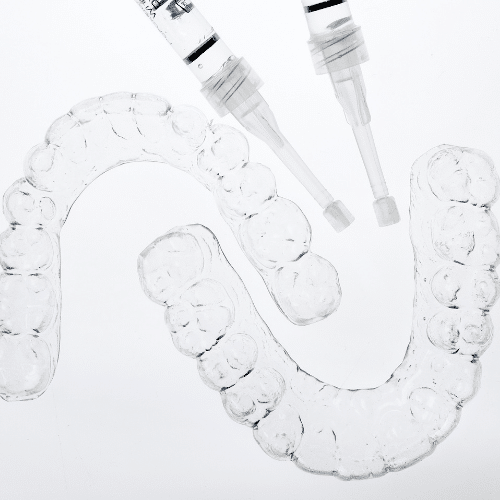
Your dentist takes moulds of your upper and lower teeth to make custom-fitted bleaching trays.
Once you have them, the procedure is simple: wear the trays with the gel provided, daily or nightly.
Duration ranges from one hour a day — while watching television or reading — to overnight while you sleep, repeated for a few weeks.
The custom tray is doing more work than people realise. It holds the gel against the tooth and keeps saliva off it — which is exactly the contact-time problem that defeats off-the-shelf products — and it keeps the gel off the gums, which is what causes most of the irritation with one-size-fits-all strips.
Its three advantages
Control. You decide how white your teeth become before moving to maintenance.
Maintenance. The same system lets you touch up the whiteness later, without starting from scratch. You keep the trays.
Comfort. More sensitive patients can tailor the procedure — shorter wear times, built up gradually.
In-chair whitening
Also called professional whitening or power bleaching. It typically uses a high-strength peroxide activated by a gentle blue-spectrum light.
Two options are offered:
- Zoom — a widely used in-chair whitening system
- Brite Smile — long established as an option for sensitive teeth
Both are carried out in a single visit, which suits time-poor patients.
Results can be enhanced and maintained either in conjunction with at-home whitening, or through annual or six-monthly visits.
On the light: the evidence that light activation adds much to the peroxide itself is mixed, and several reviews have found little additional benefit beyond the gel concentration. The gel does the work. What in-chair whitening reliably delivers is a high concentration applied under supervision, with the gums properly isolated, in one appointment — which is a real advantage in itself. How to choose between in-chair and take-home.
Sensitivity — what to expect
Temporary sensitivity is the most common side effect, and it is expected rather than a sign something has gone wrong. It affects a substantial proportion of people and typically settles within a day or two of stopping.
What causes it: peroxide passes through enamel into the dentine, and the tooth responds with short, sharp cold sensitivity — often described as “zingers”.
What helps:
- A desensitising toothpaste for a couple of weeks beforehand, and during
- Shorter wear times, or a day off between sessions
- A lower-concentration gel over a longer period
- Fluoride or desensitising gel in the trays between whitening sessions
- Avoiding very cold food and drink while it settles
Gum irritation — white patches or soreness where gel has contacted the gum — also resolves, and is much less likely with a properly fitted custom tray.
Tell your dentist if it is severe or does not settle. Sensitivity that persists, or pain in one specific tooth rather than generally, is worth examining.
Who should not whiten, or should wait
- Anyone with untreated decay, a cracked tooth, leaking fillings or gum disease — treat those first
- Pregnant or breastfeeding women — whitening is generally deferred, not because harm is established but because it is elective and there is no reason to take an unknown
- Children and adolescents, other than on specific clinical advice
- Anyone about to have veneers, crowns or bonding — whiten first, then match the restorations to the new shade
- People with extensive exposed root surfaces, which do not whiten and are more likely to be sensitive
Choosing between them
| Supervised at-home | In-chair | |
|---|---|---|
| Time to result | A few weeks | A single visit |
| Control over final shade | Yours | Determined in the session |
| Ongoing maintenance | Built in — you keep the trays | Requires return visits or a home kit |
| Suits sensitivity | Yes — adjustable | Depends on the system used |
Many patients end up using both: in-chair for the initial change, take-home trays to maintain it.
Making it last
Whitening is not permanent — the shade drifts back over months to years, faster in smokers and heavy coffee, tea and red wine drinkers. To slow it:
- Avoid strongly staining food and drink for the first 48 hours, when teeth are most porous and most likely to pick up new stain
- Use a straw for coffee, tea, cola and red wine afterwards
- Rinse with water after staining drinks — but do not brush for an hour after anything acidic
- Keep hygiene appointments, which remove the surface stain before it accumulates
- Top up with your trays occasionally rather than starting again from scratch
How long do teeth whitening effects last? and how long the effects last in practice.
Common questions
How do I read the peroxide number on a box, and which tier am I buying?
The Poisons Standard sets three tiers, and the number on the packet tells you which one you are in. The Australian Dental Association's policy explains the arithmetic: carbamide peroxide is roughly one third as strong as hydrogen peroxide, so “18% carbamide peroxide approximates 6% hydrogen peroxide”. That is why the rule is always quoted as two numbers.
- Up to 3% hydrogen peroxide, or up to 9% carbamide peroxide — exempt from scheduling. Sold freely. This is where most supermarket strips and pens sit, and it is the weakest tier.
- 3–6% hydrogen peroxide, or 9–18% carbamide peroxide — Schedule 5, “Caution”. The ADA notes these “can be sold direct to consumers if they are labelled with stipulated safety warnings”.
- Above 6% hydrogen peroxide, or above 18% carbamide peroxide — Schedule 10, which the ADA describes as covering substances “of such danger to health as to warrant prohibition of their sale, supply and use other than in specified exempt circumstances”. The exemption is a registered dental practitioner using them as part of dental practice, and the provisions are “formalised in all state and territory poisons legislation”.
In-chair gels sit well above that line — the ADA puts office-based concentrations as high as 35% hydrogen peroxide, against 3–6% for many products supplied for home use. That gap, not the brand or the lamp, is the main reason results differ.
Is the peroxide itself doing harm to my teeth?
The ADA's position, in its own words, is that “peroxide-containing teeth bleaching products are safe and effective when used by or under the supervision of a dentist and according to the professional directions for use”, and that “the most common side-effects are transient tooth sensitivity and soft tissue irritation during or immediately following treatment”. Both of those are temporary, and both are described above.
The qualifier is doing real work, though. The same policy records that WorkSafe Australia designates hydrogen peroxide above 5% as a hazardous substance, that direct contact with skin, eyes and mucous membranes “may cause severe irritation or burns”, and that “percolation of hydrogen peroxide into the nerve tissues — often accelerated by exposed dentine and enamel fractures — can lead to nerve inflammation”.
That last sentence is the clinical reason a cracked tooth, a worn surface or an exposed root has to be found and dealt with before bleaching, rather than a procedural formality. A high-strength gel on an intact, examined tooth and the same gel on a fractured one are not the same exposure.
What is a dentist actually required to do before handing me a take-home kit?
More than take an impression. The Dental Board of Australia states that whitening products may be supplied for home use “if the patient is assessed as suitable”, and lists what that assessment involves: “carrying out an appropriate assessment and examination”, “considering their history”, and “applying the principles of risk minimisation and management” under section 7 of the Board's Code of conduct.
Alongside that, the Board requires practitioners to comply with its Guidelines for non-surgical cosmetic procedures, with medicines and poisons and consumer laws, and with its Scope of practice registration standard — that is, to “only provide treatments in which they are educated, trained and competent”.
If a kit is offered without an examination, or you are not asked about your history, those steps have been skipped. It is reasonable to ask why.
The kit my dentist supplied did not work. Do I have any recourse?
Yes, and it is rarely mentioned. The Dental Board states that practitioners who supply or sell whitening products for home use must meet the Australian Consumer Law, which brings with it “consumer-guarantees that products are of acceptable quality”, an obligation covering “replacing, repairing or refunding a product in certain circumstances”, and liability for “compensating a patient for damages and loss”.
Two things are worth separating before you raise it. A product fault — a gel that had expired, separated, or was the wrong concentration — is squarely a consumer-guarantee matter. A result that fell short of what you hoped usually is not, because the cause of your discolouration may simply not respond to bleaching; tetracycline staining and fluorosis are the common examples, and neither is a defect in the gel. Ask which of the two you are dealing with — and ask at the outset what change is realistically expected for your particular staining, so the question can be settled later.
Is salon or kiosk whitening against the law, or merely discouraged?
Against the law, above the threshold. The Poisons Standard restriction on products over 6% hydrogen peroxide or 18% carbamide peroxide is, in the ADA's words, “formalised in all state and territory poisons legislation” — so it is enforceable everywhere in Australia, not a professional preference.
The ADA also records that whitening is “increasingly offered by unregulated, unqualified non dental practitioners in settings such as beauty and hair salons, shopping mall kiosks, dedicated teeth whitening salons, or via mobile services”, and that operators in those settings commonly claim to have the training to do it safely. Its position is that only registered dental practitioners have the expertise “to assess whether bleaching is safe for individual patients, to recommend the most appropriate technique and materials” and to work to regulated standards of care.
The practical version: a non-dental operator either uses a product weak enough to be sold to you anyway, in which case you are paying a premium for supermarket strength, or uses one they are not permitted to hold. Neither is a good trade, and nobody in the room has looked for the cracked tooth.
Is a whitening toothpaste the same kind of product, regulated the same way?
No — and the distinction is written into the definition. The ADA defines teeth whitening as “the use of teeth whitening products designed to penetrate the teeth and bleach intrinsic and/or extrinsic tooth discolourations, as opposed to products such as whitening toothpastes that are intended to remove surface staining”.
So a whitening toothpaste is a stain-removal product. It is not bleaching anything, which is why it cannot change the base shade of a tooth, and why the peroxide tiers above do not apply to it. What it does do is abrade, and the more aggressively it does that, the more it costs you in enamel — the charcoal problem described earlier in this article.
Advertising is regulated on both sides of that line. The Dental Board requires whitening advertising to comply with the National Law advertising requirements, the Guidelines for advertising a regulated health service, the Guidelines for advertising non-surgical cosmetic procedures, state and territory restrictions on advertising controlled substances, and TGA requirements. A before-and-after image or a shade-change promise that would breach those rules coming from a dentist does not become acceptable because a retailer made it instead.
Related reading
Professional Teeth Whitening · How can I improve the whiteness of my teeth? · Porcelain Veneers & Crowns · Is it time for a smile makeover? · Before and After Gallery · Complimentary Smile Consultation
Confirm the current terms when you book — what the appointment includes, whether records such as scans or radiographs are part of it or charged separately, and whether any deposit applies.
Practical details
Smile Solutions, Level 1, 220 Collins Street, Manchester Unity Building, Melbourne VIC 3000. Phone 13 13 96, or theteam@smilesolutions.com.au. Monday–Friday 8.00am–6.00pm, Saturday 8.30am–1.30pm, Sunday by appointment. See Contact Us and Our Team.
Registration for any practitioner can be verified free on the AHPRA public register at ahpra.gov.au.
Published 13 May 2018. Product names and the systems offered are as at that date and may have changed. Scheduling thresholds are as set out in the Poisons Standard and should be checked at their own source for the current wording.
General information only — it is not a diagnosis, a treatment plan, a quote or a promise of any particular clinical outcome, and it does not replace advice from your treating practitioner. Whitening results vary between individuals and depend on the cause of discolouration; some causes respond poorly or not at all, and no shade outcome can be guaranteed. Whitening carries risks, including tooth sensitivity and gum irritation, and it is not suitable for everyone. Whether it is appropriate for you can only be determined after examination. Fees are indicative and subject to change; confirm at your consultation.
Smile Solutions trades under ABN 28 193 514 103.
Images on This Page
-
https://www.facebook.com/tr?id=800557773428361&ev=PageView&noscript=1
(no alt text)
-
https://www.smilesolutions.com.au/wp-content/uploads/2025/10/calendar_month.svg
(no alt text)
-
https://www.smilesolutions.com.au/wp-content/themes/arcadian-wordpress-theme/assets/images/smile_solutions_logo_white.png
Smile Solutions Logo
-
https://www.smilesolutions.com.au/wp-content/themes/arcadian-wordpress-theme/assets/images/smile_solutions_logo_purple.png
Smile Solutions Logo
-
https://www.smilesolutions.com.au/wp-content/uploads/2023/11/SS-Tooth-1-1-150x150.png
Smile Solutions
-
https://www.smilesolutions.com.au/wp-content/uploads/2025/11/Smile-Solutions-Whitening-Trays.png
Professional Take-Home Whitening Trays
-
https://www.smilesolutions.com.au/wp-content/uploads/2025/09/Root-Canal-2-300x217.jpg
Root Canal
-
https://www.smilesolutions.com.au/wp-content/uploads/2026/08/Mouth-Breathing-300x270.jpg
Mouth Breathing
-
https://www.smilesolutions.com.au/wp-content/uploads/2025/09/Dental-Crown-at-Smile-Solutions-300x300.jpg
Dental Crown at Smile Solutions
-
https://www.smilesolutions.com.au/wp-content/themes/arcadian-wordpress-theme/assets/images/family_owned_bussiness.png
Family Owned Business
-
https://www.smilesolutions.com.au/wp-content/themes/arcadian-wordpress-theme/assets/icons/icon--phone.svg
Smile Solutions Contact
-
https://www.facebook.com/tr? id=800557773428361&ev=PageView&noscript=1
(no alt text)
-
https://bat.bing.com/action/0?ti=25148060&tm=gtm002&Ver=2&mid=dd1b0da5-27c5-458e-938d-3b401f00ee4e&bo=1&sid=20cd7420ab2711f1badc8d36c3005a07&vid=20cd8e60ab2711f180e34d43e845334b&vids=1&msclkid=N&pi=918639831&lg=en-US&sw=800&sh=600&sc=24&nwd=1&tl=Home%20Teeth%20Whitening%20vs%20Having%20Your%20Teeth%20Whitened%20at%20the%20Dentist%20-%20Smile%20Solutions&p=https%3A%2F%2Fwww.smilesolutions.com.au%2Fdental-articles%2Farticle%2Fhome-teeth-whitening-versus-having-your-teeth-whitened-at-the-dentist%2F&r=&evt=pageLoad&sv=2&cdb=AQAQ&rn=516023
(no alt text)