Is it time for a smile makeover?
Where to start
In the age of the selfie, unless you are prepared to pull the same practised face in every photograph, it might be time to think about a smile makeover.
Whatever your age, cosmetic dentists and specialists can help with crooked teeth, worn-down teeth, missing teeth and discoloured teeth — working with patients towards a whiter, brighter, straighter smile.
The useful preparation happens before the appointment.
One definition first. “Smile makeover” is a marketing term, not a procedure. It describes a combination of treatments drawn from restorative, prosthodontic and orthodontic dentistry, planned together. “Cosmetic dentistry” is not one of the thirteen registered dental specialties in Australia, and “cosmetic dentist” is not a protected title — any registered dentist may use it. That does not make the work poor; it means the words tell you nothing about training, and you should ask directly about it instead.
AHPRA's advertising guidance is precise about the wording. Where a practitioner does not hold specialist registration, the National Boards consider that advertising using words related to a specialty is likely to mislead — including “specialist”, “specialises in”, “specialty” and “specialised” — while “substantial experience in” and “working primarily in” are described as less likely to mislead. Those are the two phrases worth listening for.
Four questions to answer first
- What don't you like about your teeth?
- What do you like, and want to keep?
- How do you feel about their length — particularly your two middle front teeth?
- Do you want whiter teeth?
The second question is the one most people skip, and it is arguably the most useful. A makeover is not a blank slate. Knowing what you want preserved is as important to the plan as knowing what you want changed — and it prevents an outcome that is technically excellent and does not look like you.
The third question is asked specifically because the length of the central incisors sets the proportion of the whole smile. A millimetre either way changes how the result reads.
A fifth question worth adding: how much is this bothering you, and why now? There is no wrong answer, but the honest one shapes the plan. A specific complaint — one chipped tooth, one dark tooth, a gap — usually has a small, conservative solution. A general dissatisfaction with how you look in photographs is a different conversation, and it is the one where people most often end up having more done than they needed. Where should I start? and what is actually involved? take those two paths separately.
Look at other people's teeth
Start noticing smiles in magazines, books and on television.
Is there someone whose teeth you like? What in particular do you like about them?
This is a genuinely useful exercise rather than a filler suggestion. Most people know they are unhappy with their teeth and cannot articulate what they want instead — and “whiter and straighter” covers a very wide range of possible results.
Bringing images to a consultation converts a vague preference into something a dentist can plan against, and it also surfaces the mismatches early: a smile you admire may belong to a face shaped quite differently from yours.
Two cautions about reference images. Published and social-media photographs are lit, retouched and often filtered — the whiteness in them frequently does not exist in any mouth. And very white, very uniform, very square results date, in the way that a particular decade's haircut dates. Natural teeth are not one flat colour; they are lighter at the edge, slightly translucent, and subtly irregular. A result that photographs as “perfect” can read as obviously artificial in person. Turkey teeth: the real risks of getting veneers overseas is what that looks like when it goes wrong on a large scale.
What happens at the consultation
These are the questions a cosmetic dentist will ask.
After an examination and a discussion, they can tell you what is achievable and what is not.
That second half is the part worth valuing. Some things cannot be done with veneers alone — where teeth are tightly crowded there is no room to make them larger without creating space first, which means orthodontics. A practice that tells you that before you commit is describing a process built around the result. Cosmetic dentistry options lists what is usually on the table.
Every smile is different, so recommendations are specific to you.
What a thorough consultation includes
- A full examination first, not just of the teeth you dislike. Active decay and gum disease are treated before any cosmetic work — restorations built on untreated disease fail, and healthy gums are what make a cosmetic result look right at the margins.
- An assessment of your bite, and whether you grind. Grinding destroys cosmetic work, and if it is not identified and managed the new teeth will chip the way the old ones did.
- Photographs and often a digital scan.
- A discussion of all the options, including the least invasive and doing nothing.
- A written plan and estimate with item numbers, so you can check with your health fund.
- A mock-up or digital design before anything irreversible begins. Mock-up Reveal
The options, from least to most invasive
This order matters more than anything else on the page, because the conservative options are the ones that get skipped.
| Option | Tooth removed | Reversible? | Best for |
|---|---|---|---|
| Hygiene and stain removal | None | — | Surface staining from tea, coffee, wine, smoking Dental Cleans & Hygienists |
| Whitening | None | Effect fades | Teeth the right shape but too dark Professional Teeth Whitening |
| Enamel reshaping | A very small amount | No | Minor uneven edges |
| Composite bonding | Little or none | Largely | Chips, small gaps, minor shape changes Composite Bonding |
| Orthodontics | None | Teeth can move back without retainers | Crowding, gaps, bite problems Orthodontics |
| Porcelain veneers | Enamel from the front of each tooth | No | Shape, colour and minor position, where the above will not do it Porcelain Veneers & Crowns |
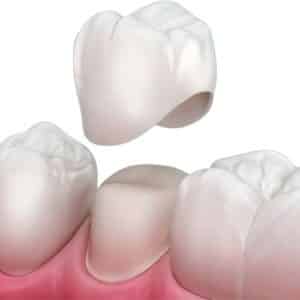
| Crowns | Substantial, all round | No | Teeth already heavily restored or structurally weak Dental Crowns |
| Implants or bridges | Bridge cuts down two teeth; implant none | No | Replacing missing teeth Dental Implants · Dental Bridges |
Whitening before anything else, if colour is part of the goal. Crowns and veneers do not whiten — their colour is fixed at the moment they are made. If you whiten afterwards, the natural teeth lighten and the restorations stay where they were, and the mismatch is permanent unless they are remade.
Orthodontics before veneers, where teeth are crooked. Moving a tooth into position costs no tooth structure. Cutting a crooked tooth down far enough to veneer it straight costs a great deal — and it is frequently the difference between a conservative result and a mouth committed to restorations for life.
The size of that gap has been measured. In a laboratory study of idealised preparations on artificial anterior teeth, Edelhoff and Sorensen found a traditional porcelain veneer covering the facial surface removed about 16.7 per cent of the crown of the tooth by weight, while all-ceramic and metal-ceramic crown preparations removed 64 to 71.9 per cent. Their conclusion was that veneer preparations required “approximately one-quarter to one-half the amount of tooth reduction of conventional complete-coverage crowns”. That was an in vitro study on typodont teeth, so it describes what each design requires rather than what any clinician removes from a real tooth — but the order of magnitude is the point.
Before you decide
There is a lot to take into account, and it is worth reading about the cosmetic options available before your appointment — whitening, composite and porcelain veneers, crowns, orthodontics, and implants or bridges for missing teeth.
One thing to hold onto through all of it: veneers and crowns require permanent removal of tooth structure. Ask to see a design or a mock-up before anything irreversible happens. That is the point at which changing your mind costs nothing.
What nobody tells you at the start
- It is a lifetime commitment, not a one-off purchase. Veneers and crowns chip, stain at the margins and eventually need replacing — and each replacement usually removes a little more tooth. Budget for maintenance and replacement, not only for the initial treatment. The published survival figures, and why they disagree with each other so widely, are in the questions below.
- Once prepared, a tooth always needs a restoration. There is no returning to the natural tooth.
- Gums move over decades. A margin that is invisible at thirty can show as a line at fifty.
- A night guard is usually part of the deal if you grind, and wearing it is not optional if you want the work to last.
- Sensitivity is common after preparation, and occasionally a prepared tooth loses its nerve later and needs root canal treatment through the new restoration.
- More teeth is not better. A plan for eight or ten veneers when the complaint is about two is worth a second opinion. Second Opinions & Corrective Dentistry
Questions worth asking before you agree
- What are the less invasive options, and why are you not recommending them?
- Exactly how much enamel comes off each tooth?
- Can I see a mock-up or trial smile in my own mouth first?
- Who is doing the laboratory work, and where?
- What happens if I don't like it?
- What will this need in ten and twenty years, and what will that cost?
- Do I have any gum disease, decay or grinding to deal with first?
- What is your training in this kind of work?
If the answer is “nothing”
Worth saying plainly. Not every smile someone dislikes needs treating, and a good practitioner will sometimes say so. Whitening and a hygiene appointment change more than people expect, and they cost almost nothing and remove no tooth. Starting there, and living with the result for a few months, is a legitimate plan — and it is often where the matter ends.
Common questions
How long do veneers actually last? The figures I find online contradict each other.
They do, and that is the honest answer rather than an evasion. It is also worth knowing at the outset that no authority publishes a lifespan in years for a veneer — so a confident “15 to 20 years” is a convention, not a finding. What exists is survival at stated time points, and the spread between studies is wide enough to matter.
The most-pooled figure comes from a systematic review in the Journal of Clinical Medicine covering 25 studies, 6,500 porcelain laminate veneers in 1,646 patients: a 10-year cumulative survival of 95.5 per cent, counting fracture, debonding, secondary decay and the need for root canal treatment as failure.
Beyond ten years the picture splits. A systematic review in the European Journal of Dentistry collects the long-running series side by side. Layton and Walton reported 73 per cent survival at 15 to 16 years in a 2007 series of 304 veneers in 100 patients; the same authors, in a 2012 series of 499 veneers in 155 patients, reported 91 per cent at both 15 and 20 years for the whole sample and 96 per cent in a randomly selected subsample. Beier and colleagues in Innsbruck reported 94.4 per cent at five years, 93.5 per cent at ten and 82.9 per cent at twenty.
Three things explain most of that disagreement, and they are the questions to ask about any figure you are quoted.
Who was included. In the 2012 series that produced the 91 to 96 per cent figures, patients with extensive tooth-structure loss from parafunction and with an unfavourable periodontal prognosis were excluded, and only teeth retaining at least 80 per cent enamel were veneered. That is a best case, from one operator, in near-ideal mouths. The Innsbruck cohort that reported 82.9 per cent at twenty years, by contrast, included 42 of its 84 patients with bruxism and 23 smokers.
How few teeth reach the end. In the 2012 series, 499 veneers were followed for five years, 239 to fifteen, only 82 to twenty years and five to twenty-one. The review's own conclusion is that “the most critical observation that was made in all three of the studies was the small number of restorations evaluated beyond 20 years”.
What counted as failure. Across the studies reviewed, failure was defined as “irreparable” in 13 studies and “reparable but counted as a failure” in nine, with five not stating it clearly. Slight marginal staining and marginal defects are commonly excluded, which means a high survival figure does not tell you the veneers still looked good — only that they were still attached and had not fractured or decayed underneath.
So the useful question at a consultation is not “how long will these last” but “what percentage of the veneers you have placed have you replaced, over what period, and what did you count as a failure”.
Composite or porcelain?
The trade-off is genuine and runs in both directions, which is why it is worth deciding deliberately rather than on price.
Composite is cheaper, can usually be added with little or no tooth removal, and can be repaired in the chair. Porcelain holds its colour and lasts longer. The cleanest head-to-head measurement is a 10-year practice-based evaluation by Mazzetti and colleagues published in Dental Materials in 2022: on survival analysis, composite veneers failed at an annual rate of 3.9 per cent at five years and 4.1 per cent at ten, against 1.4 per cent and 1.2 per cent for ceramic. On the stricter success analysis the gap was wider — 9.1 per cent and 10 per cent for composite against 2.9 per cent and 2.8 per cent for ceramic. The hazard ratio for composite compared with ceramic was 4.00 (95% CI 2.74 to 5.83) for survival.
Read that as roughly a threefold to fourfold difference in failure rate, not as a verdict. Composite failing is usually a repair; porcelain failing is usually a remake, and a remake removes more tooth. For a chipped edge or a small gap on an otherwise sound tooth, composite is frequently the better answer precisely because it is reversible and repairable.
How much of my tooth actually comes off for a veneer?
More than the phrase “just a thin layer” suggests, and this is worth knowing before you consent.
A 2022 laboratory study published in Materials prepared 20 intact upper central incisors for laminate veneers to a depth of 0.6 mm, with a 0.3 mm chamfer at the gum line — a conventional, conservative preparation. On average that exposed about 30 per cent dentine, leaving roughly 70 per cent enamel; the figure was much the same whether a window or a butt-joint design was used. The authors noted that 70 per cent remaining enamel is comfortably above the 40 per cent enamel exposure they describe as the minimum acceptable for efficient bond strength — so a standard preparation does leave enough enamel to bond to. But 30 per cent of the front of the tooth reaching dentine is not “barely touched”.
There is a second finding in that study worth carrying into the conversation: three observers with different levels of training — an undergraduate, a general practitioner and a prosthodontist — disagreed substantially about how much dentine was exposed on the same prepared teeth, with statistically significant differences between them. Judging how conservative a preparation has been is harder than it sounds, even for clinicians looking directly at the tooth under magnification.
All of that is from extracted teeth in a laboratory. What it supports is a specific request at your own consultation: ask for the planned reduction in millimetres, and ask for photographs of your prepared teeth before the veneers are fitted.
Is going overseas for a full set of veneers a reasonable way to save money?
The Australian Dental Association's position is unambiguous, and it is a professional-body policy rather than an evidence base — it contains no complication rates, so treat it as a statement of standards, not a measured risk.
Its policy statement on elective overseas dental treatment says that such treatment “carries the risk of adverse oral and general health outcomes with long term problems which may be difficult to resolve on return to Australia”, and that “Australian residents should only seek elective dental care in Australia”. It also asks that Australian promoters of overseas health services “be required to indemnify consumers for all adverse outcomes of such treatment” — which tells you where the ADA thinks the liability currently falls.
The practical arguments it sets out are the ones worth weighing yourself. There is potential for treatment “without full informed consent and at a different professional and regulatory standard”; the records and complete details of overseas treatment “are unlikely to be available” to whoever treats you afterwards; and overseas clinics may not carry professional indemnity insurance. Its broadest point is the one most relevant to a full-arch cosmetic plan: “optimal ongoing oral health cannot be achieved in a single episode or short course of treatment and requires regular maintenance”. A veneer or crown is the start of a maintenance relationship, and a holiday cannot be that. See Turkey teeth: the real risks of getting veneers overseas.
I have been offered a package price or a limited-time deal. What should I check?
Check it against the rules the offer has to meet, because cosmetic dentistry is a regulated health service and advertising it carries specific obligations under section 133 of the National Law.
AHPRA's guidance names the vocabulary that can make an advertisement unlawful where it is tied to an unsubstantiated suggestion your health will suffer if you do not act: “don't delay”, “act now before it's too late”, “don't miss out”, “time is running out”, “for a limited time only”. It also names structures rather than phrases — encouraging attendance where there is no clinical indication, including contracting for future services, and incentives such as prizes, discounts, bonuses or gifts that would encourage people to use a service regardless of clinical need.
On the numbers: advertising may breach the National Law where it contains price information that is unclear, inexact or vague, where it states an instalment amount without the total cost, or where it leaves out restrictions such as expiry date or eligibility. And on the word free, AHPRA notes that “the public generally consider the word ‘free' to mean ‘absolutely' free”, and that an offer whose cost is recouped through a price rise elsewhere is not actually free. Terms must also be easy to find — the public “should not be required to exhaustively search for or contact the advertiser” for them.
So: ask for the total cost in dollars, what is excluded, what happens if more teeth turn out to need treatment, and how long any quoted price is held. A practice that answers those in writing is a good sign regardless of the price.
Does this article replace an individual dental assessment?
No. It provides general information. Symptoms, suitability, risks and treatment choices depend on examination and, where indicated, imaging or other records from an appropriately registered practitioner.
Related reading
Cosmetic Dentistry · Cosmetic Dentistry under Specialist Care · Professional Teeth Whitening · Porcelain Veneers & Crowns · Composite Bonding · Dental Crowns · Orthodontics · Mock-up Reveal · Before & After Gallery · Complimentary Smile Consultation · Understanding your treatment · Price Guide
Confirm the current terms when you book — what the appointment includes, whether records such as scans or radiographs are part of it or charged separately, and whether any deposit applies.
Practical details
We are at Level 1, 220 Collins Street, Manchester Unity Building, Melbourne VIC 3000. Phone 13 13 96, or theteam@smilesolutions.com.au. Monday–Friday 8.00am–6.00pm, Saturday 8.30am–1.30pm, Sunday by appointment.
Specialist registration can be verified free on the AHPRA public register at ahpra.gov.au, or by calling 1300 419 495.
Published 27 March 2015.
General information only — it is not a diagnosis, a treatment plan, a quote or a promise of any particular clinical outcome, and it does not replace advice from your treating practitioner. Suitability and results vary between individuals, and what is achievable in your mouth can only be determined after examination. Cosmetic dentistry carries risks — including sensitivity, loss of the nerve requiring root canal treatment, chipping, debonding and the need for replacement over time — and preparation for veneers and crowns is irreversible. These should be discussed with your dentist before you agree to anything. “Cosmetic dentistry” is not a registered dental specialty in Australia. Survival percentages quoted here come from pooled international studies with the selection criteria and follow-up numbers stated alongside them, and are not predictions for your own restorations; tooth-reduction percentages come from laboratory studies on extracted or artificial teeth. Statements of regulatory guidance are drawn from AHPRA's published advertising material and are current at the time of writing. Fees are indicative and subject to change; confirm at your consultation.
Smile Solutions trades under ABN 28 193 514 103.
Images on This Page
-
https://www.facebook.com/tr?id=800557773428361&ev=PageView&noscript=1
(no alt text)
-
https://www.smilesolutions.com.au/wp-content/uploads/2025/10/calendar_month.svg
(no alt text)
-
https://www.smilesolutions.com.au/wp-content/themes/arcadian-wordpress-theme/assets/images/smile_solutions_logo_white.png
Smile Solutions Logo
-
https://www.smilesolutions.com.au/wp-content/themes/arcadian-wordpress-theme/assets/images/smile_solutions_logo_purple.png
Smile Solutions Logo
-
https://www.smilesolutions.com.au/wp-content/uploads/2023/11/SS-Tooth-1-1-150x150.png
Smile Solutions
-
https://www.smilesolutions.com.au/wp-content/uploads/2020/03/Amina-1.jpg
Is it time for a smile makeover?
-
https://www.smilesolutions.com.au/wp-content/uploads/2025/09/Root-Canal-2-300x217.jpg
Root Canal
-
https://www.smilesolutions.com.au/wp-content/uploads/2026/08/Mouth-Breathing-300x270.jpg
Mouth Breathing
-
https://www.smilesolutions.com.au/wp-content/uploads/2025/09/Dental-Crown-at-Smile-Solutions-300x300.jpg
Dental Crown at Smile Solutions
-
https://www.smilesolutions.com.au/wp-content/themes/arcadian-wordpress-theme/assets/images/family_owned_bussiness.png
Family Owned Business
-
https://www.smilesolutions.com.au/wp-content/themes/arcadian-wordpress-theme/assets/icons/icon--phone.svg
Smile Solutions Contact
-
https://www.facebook.com/tr? id=800557773428361&ev=PageView&noscript=1
(no alt text)
-
https://bat.bing.com/action/0?ti=25148060&tm=gtm002&Ver=2&mid=6948df95-0ae2-44a9-8b06-09821ec7417a&bo=1&sid=cf117920ab2511f1ad06eb5bcc057bd6&vid=cf119150ab2511f18d9757ca1d1409f1&vids=1&msclkid=N&pi=918639831&lg=en-US&sw=800&sh=600&sc=24&nwd=1&tl=Is%20it%20time%20for%20a%20smile%20makeover%3F%20-%20Smile%20Solutions&p=https%3A%2F%2Fwww.smilesolutions.com.au%2Fdental-articles%2Farticle%2Fsmile-makeover%2F&r=&evt=pageLoad&sv=2&cdb=AQAQ&rn=429423
(no alt text)