Start with a consultation, not a procedure
A smile makeover is the process of improving your smile through one or more cosmetic dental procedures. It is not a single treatment with a fixed price. See Cosmetic Dentistry.
The treatments range from minimally invasive — tooth whitening, composite veneers — through to porcelain veneers, crowns, bridges and dental implants.
The first step is a consultation with a cosmetic dentist, and the reason it comes first is not a formality. Which treatment suits you depends on what is actually wrong, what your teeth and gums can support, and what you are trying to achieve. Choosing the procedure before that assessment is how people end up with veneers on teeth that needed orthodontics. See I want to improve my smile but don't know where to start and Complimentary Cosmetic Consultation — confirm the current terms, including what the appointment covers, when you book.
Confirm the current terms when you book — what the appointment includes, whether records such as scans or radiographs are part of it or charged separately, and whether any deposit applies.
What happens at the consultation
The conversation
A detailed discussion of your goals and desired outcomes — what you want changed, and what you want the result to look like.
You should come away with information on:
- The various cosmetic procedures available for your case — see Cosmetic dentistry options
- Potential results
- Risks
- Benefits
- Necessary time frames
- Fees — see the Price Guide and Payment Plans
That list matters. Risks and time frames are the two most commonly skipped items in cosmetic consultations, and they are the two that most often cause regret. Ask about both explicitly if they are not raised. See How important is communication in dentistry?.
Payment plan options are available. Where a plan is advertised as interest free, that describes the plan term only — a deposit may be required, an establishment fee and ongoing account fees may apply, and charges can apply if the balance is not cleared within the agreed period. The applicable terms depend on the provider and the amount financed, and are set out in writing before you commit — ask what the deposit and the establishment fee are, in dollars, and what the total will be by the end. Payment Plans.
The examination
An examination of your mouth assessing the health of your teeth, gums and facial structures. See General Dentistry.
This will likely require X-rays, to diagnose any underlying dental issues which may need attention before any cosmetic work begins. On what that exposure actually amounts to, see how safe are dental x-rays?
This is the part people find frustrating and it is the part that protects the investment. Cosmetic work placed over untreated decay or active gum disease fails. A veneer bonded to a tooth with decay under the margin, or crowns placed where the bone is receding, will not last — and remaking them costs more than treating the underlying problem first. See Tooth Fillings, Bleeding Gums and Dental Cleans & Hygienists.
The photographs
Photos of your current smile are taken so the treatment plan can be developed against your actual starting point. They also give you a genuine before-and-after reference later, which memory does not reliably provide. See Before & After Gallery.
Digital smile design
Taking into account everything gathered at the consultation, your dentist may complete a digital smile design. See Technology.
This includes a temporary mock-up of the new smile placed directly onto your teeth, so you can see what the plan is aiming for before any irreversible work is done. See The Mock-Up Reveal and The mock-up reveal: why you should see your new smile before any treatment begins.
The value here is worth stating plainly. Veneers and crowns require permanent removal of tooth structure. That cannot be undone. A mock-up lets you look at the proposed shape, length and proportion in your own face, in a mirror, and say no or ask for changes at the point where changing your mind costs nothing.
If a proposed cosmetic plan involves irreversible tooth preparation and no one has offered you a way to preview the result, ask for one. That is also the strongest single argument against having a full case done abroad on a compressed timeline — see Turkey teeth: the real risks of getting veneers overseas.
“Cosmetic dentist” is a description, not a registration
This is the single most misread thing in the field, and it is worth understanding before you start comparing providers.
The Dental Board of Australia recognises thirteen dental specialties, approved by the Australian Health Workforce Ministerial Council. They are dento-maxillofacial radiology, endodontics, forensic odontology, oral and maxillofacial surgery, oral medicine, oral and maxillofacial pathology, oral surgery, orthodontics, paediatric dentistry, periodontics, prosthodontics, public health dentistry (community dentistry), and special needs dentistry.
Cosmetic dentistry is not one of them. That does not make the phrase improper — it accurately describes the work — but it means no one holds specialist registration in cosmetic dentistry, because there is no such registration to hold. A dentist doing this work well may be a very experienced general dentist, or may hold specialist registration in one of the thirteen.
Three of the thirteen come up repeatedly in makeover planning: a prosthodontist where crowns, bridges and full reconstruction are involved; a periodontist where gum levels, recession or bone are part of the problem; an orthodontist where the teeth need moving before anything is bonded to them. See Specialist Care and why would I need to see a dental specialist?
What specialist registration actually requires is specific rather than vague. Beyond meeting every requirement for general registration as a dentist, an applicant for specialist registration must have completed a minimum of two years of general dental practice. The specialty training sits on top of that, not instead of it.
And you can check any of this yourself, free. AHPRA publishes an online register of every registered dental practitioner in Australia, showing current registration status and, for those who hold it, which specialty or specialties they are registered in. If a provider's description of themselves and the register disagree, the register is the answer. See Dentists & Registered Specialists and Our Team.
Designing it together
You then work with your cosmetic dentist to customise the design.
The purpose is that you can consider all appropriate treatment options and make an informed decision about a plan that suits you and your lifestyle.
“Lifestyle” is doing real work in that sentence. Different materials and treatments carry different maintenance and different constraints — how much you can commit to appointments, how you use your teeth, whether you grind, and how much time you can give to a staged plan all legitimately change the recommendation. See TMD and Teeth Grinding, and What is the difference between composite veneers and porcelain veneers? for the material trade-off.
The treatment itself
When you are ready to begin, a number of visits may be needed to complete the restorative and cosmetic procedures. I need a smile makeover — what's involved? walks through the full sequence appointment by appointment.
A plan may combine:
| Treatment | What it addresses |
|---|---|
| Orthodontics | Misaligned or crowded teeth |
| Tooth whitening | Colour |
| Composite resin or porcelain veneers | Shape and size |
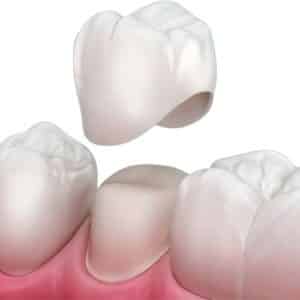
| Crowns | Shape, size, and structurally compromised teeth |
| Bridges and dental implants | Missing teeth |
The sequence matters as much as the selection. Orthodontics generally precedes veneers, because moving teeth into position first often means less tooth structure has to be removed — see Invisalign and How do I know which orthodontic treatment is best for me?. Whitening generally precedes any bonded or ceramic work, because veneers and crowns do not whiten — they are matched to the shade of your teeth at the time they are made. Whitening afterwards leaves the restorations looking dark against the natural teeth: see I want to whiten my teeth but one of my front teeth has a porcelain crown.
One regulatory detail worth knowing before the whitening step, because it explains why this part is not a shop purchase. Under Schedule 10 of the Poisons Standard, whitening products containing more than 6 per cent hydrogen peroxide or more than 18 per cent carbamide peroxide may only be sold, supplied and used by registered dental practitioners. Over-the-counter kits sit below those limits by law.
Where the concern is how much gum shows rather than the teeth, the treatment is different again — Gummy Smile and Periodontists. For complex combined cases, Cosmetic Dentistry Under Specialist Care and Prosthodontists.
Finishing, and afterwards
In the final stages you review your new smile to confirm the goals have been met.
Once complete, you are given the information you need to look after it. This is not a formality either — cosmetic restorations have specific maintenance requirements, and a nightguard is often part of them if you grind, because ceramic will chip where enamel would wear. On lifespan, see How long do porcelain veneers last? and Composite bonding: will it look natural and how long will it last?.
A smile makeover is an investment. Treating it as one — with a proper diagnostic workup first, a preview before anything irreversible, and a maintenance plan after — is how it lasts.
Common questions
Can I change my mind afterwards? Are veneers reversible?
No, and this is the question to settle before the first appointment rather than after it. healthdirect, the Australian government health service, states it in one sentence: "Your dental professional fixes veneers to the surface of your teeth. You can't take veneers off."
Its list of possible risks is worth reading in full, because several items are permanent rather than temporary: jaw pain; the veneer could crack or fall off; your teeth could become more sensitive because some enamel is removed; if your gum shrinks, the edges of the veneers may be seen; the colour of your veneers can't be changed after they've been applied; your other teeth may become discoloured, no longer matching your veneers. healthdirect also makes the scope of the treatment explicit: "veneers don't fix tooth decay or problems with your bite."
There is a genuine tension in the published material here, and it is better to name it than smooth it over. The Australian Dental Association's consumer page describes veneers as "very thin, meaning not much or no tooth structure has to be cut away". That is accurate for minimal-preparation and no-preparation designs. It does not describe conventional preparation, and it sits uneasily beside healthdirect's "some enamel is removed" and "you can't take veneers off". How much tooth is removed depends entirely on the preparation design chosen — which makes "how much of my tooth are you taking away, and can you show me?" the single most useful question to ask at the consultation. The mock-up described above is where that conversation should happen.
How long do veneers actually last?
The honest answer is that the published figures disagree with each other more than anyone advertising them admits, and there is no Australian-authority number at all. healthdirect's strongest statement is that "veneers should last for years" — it attaches no figure, and neither does the ADA.
The international literature does publish numbers, and they spread widely:
- A systematic review of 25 studies covering 6,500 porcelain laminate veneers put the 10-year estimated cumulative survival rate at 95.5%, counting fracture, debonding, secondary decay and loss of the restoration as failure. Overall, 433 of the 6,500 failed on those criteria.
- A different systematic review of the same question found that studies with a follow-up of 10 to 12 years reported survival rates ranging from 53% to 94.4% — a spread so wide it tells you the studies were not measuring the same thing.
- Within individual cohorts the numbers also diverge: one reports Kaplan–Meier survival of 94.4% at 5 years, 93.5% at 10, 85.7% at 15 and 82.9% at 20; an Australian prospective cohort reports 98% at 5 years, 96% at 10, and 91% at 15 and 20 years.
Why the spread? The reviews are explicit that "failure" is defined differently from study to study, ranging from loss of function to any observable defect, and that preparation design, material and patient factors all differ. Fracture is the most common failure, followed by debonding, and most debonding failures happened within two years of cementation.
So: a well-made veneer on a well-chosen tooth has a good chance of lasting a decade or more, and some last much longer. Anyone quoting you a single confident lifespan figure is choosing one study. The more useful question at the consultation is what would cause your veneers to fail, and what the plan is for when one does.
I grind my teeth. Does that rule me out?
Not automatically, but it belongs in the plan rather than in the footnotes, and it is a reason the examination asks about it. The published veneer literature is consistent on the direction of the effect: one systematic review records that a study in which half the patients were bruxers found a significantly higher failure rate for veneer restorations in patients who were bruxers, and that another suggested a higher risk of failure with bruxism activity, with the reviewers concluding that bruxism may be a risk factor for fractures of ceramics. A second review reports the same alongside significantly higher marginal discolouration among smokers.
The practical consequences are the ones set out above: a nightguard is commonly part of the plan rather than an optional extra, and the material choice and the amount of length added at the front may both be adjusted. Grinding is also frequently unrecognised by the person doing it, because it usually happens during sleep — so "not that I know of" is not the same as no. See TMD and Teeth Grinding and What is bruxism and how is it managed?
How should I read a practice's before-and-after photographs?
Carefully, and with a checklist that AHPRA has already written for you. Under the National Law, AHPRA's advertising guidance warns that before-and-after images in advertising a regulated health service "have the potential to be misleading or deceptive" and "may cause a member of the public to have unreasonable expectations of a successful outcome". Advertising may breach the law where "it is not clear how the advertised treatment is responsible for, or has directly caused, the benefit shown in the image", or where "images are not genuine and/or have been edited or enhanced".
The guidance then lists what makes such images less likely to mislead, and that list doubles as a set of things you can check yourself:
- the images are as similar as possible in content, camera angle, background, framing and exposure
- the posture, clothing and make-up is consistent
- the lighting and contrast is consistent
- there is an explanation if images have been altered in any way
- the referenced treatment is the only visible change to the person photographed
A pair where the lighting, lipstick and camera distance have all changed is not telling you much about the dentistry. One further thing to know while browsing: the National Law does not allow testimonials or purported testimonials to be used to advertise a regulated health service, so a compliant Australian dental site will not carry patient accounts of their treatment — that absence is the law working, not a lack of happy patients. See Before & After Gallery.
Could I have the whole thing done overseas in one trip?
The Australian Dental Association's formal position is that you should not. Policy Statement 2.2.6, Elective Overseas Dental Treatment (November 2023) says that "Australian residents should only seek elective dental care in Australia to ensure Australian standards are met, complications are managed promptly, and good oral health is maintained", and it lists the specific risks: inability to maintain supportive maintenance visits; possible communication difficulties which may impact on informed consent; possible lack of insurance cover for complications; lack of access to treatment records; and the potential challenge of finding a practitioner to continue with, or repair, treatment started overseas because of incompatible product systems, techniques not consistent with Australian standards, and materials not approved by the TGA.
The sentence most relevant to a makeover specifically is this one: "Optimal ongoing oral health cannot be achieved in a single episode or short course of treatment and requires regular maintenance." A compressed timeline is exactly what removes the staging, the preview and the review described earlier on this page.
What the ADA statement is not: evidence. It is a professional position, and it carries no complication rate, no incidence figure and no cited cohort of Australians returning with failed work — and no Australian dataset quantifying that was found. So the risks it names are reasoned rather than measured. Its own practical advice is to seek the advice of an Australian dentist before committing, and to check five things first: the practitioner's qualifications, infection prevention and control standards, the quality and compatibility of the materials and techniques, whether you can claim from your fund, and what complaint resolution exists. See Turkey teeth: the real risks of getting veneers overseas.
Practical details
Smile Solutions, Level 1, 220 Collins Street, Manchester Unity Building, Melbourne VIC 3000. Phone 13 13 96, or theteam@smilesolutions.com.au. Monday–Friday 8.00am–6.00pm, Saturday 8.30am–1.30pm, Sunday by appointment. Full details on Contact Us.
“Cosmetic dentist” is not a recognised specialty — see Dentists & Registered Specialists. Registration can be verified free on the AHPRA register, or by calling 1300 419 495; the clinicians are listed on Our Team.
The thirteen recognised dental specialties, and the two-year general practice requirement for specialist registration, are from the Dental Board of Australia's specialist registration information. The peroxide thresholds are Schedule 10 of the Poisons Standard, as set out in Australian Dental Association policy. The veneer risk list and the statement that veneers cannot be removed are from healthdirect Australia (reviewed February 2025); the veneer survival figures from published systematic reviews of porcelain laminate veneers; the overseas-treatment position from ADA Policy Statement 2.2.6 (November 2023); and the before-and-after image criteria from AHPRA's advertising guidance under the National Law.
Published 23 May 2022. Results, treatment times and suitability vary between individuals; all cosmetic dentistry carries risks that should be discussed with your dentist. General information only; it does not replace advice from your treating practitioner. Payment plan terms are set by the credit provider and change; confirm current terms directly before you commit.
Smile Solutions trades under ABN 28 193 514 103.
Images on This Page
-
https://www.facebook.com/tr?id=800557773428361&ev=PageView&noscript=1
(no alt text)
-
https://www.smilesolutions.com.au/wp-content/uploads/2025/10/calendar_month.svg
(no alt text)
-
https://www.smilesolutions.com.au/wp-content/themes/arcadian-wordpress-theme/assets/images/smile_solutions_logo_white.png
Smile Solutions Logo
-
https://www.smilesolutions.com.au/wp-content/themes/arcadian-wordpress-theme/assets/images/smile_solutions_logo_purple.png
Smile Solutions Logo
-
https://www.smilesolutions.com.au/wp-content/uploads/2023/11/SS-Tooth-1-1-150x150.png
Smile Solutions
-
https://www.smilesolutions.com.au/wp-content/uploads/2025/12/Cosmetic-Dentistry-at-Smile-Solutions.jpg
Smile Solutions Cosmetic Dentistry
-
https://www.smilesolutions.com.au/wp-content/uploads/2025/09/Root-Canal-2-300x217.jpg
Root Canal
-
https://www.smilesolutions.com.au/wp-content/uploads/2026/08/Mouth-Breathing-300x270.jpg
Mouth Breathing
-
https://www.smilesolutions.com.au/wp-content/uploads/2025/09/Dental-Crown-at-Smile-Solutions-300x300.jpg
Dental Crown at Smile Solutions
-
https://www.smilesolutions.com.au/wp-content/themes/arcadian-wordpress-theme/assets/images/family_owned_bussiness.png
Family Owned Business
-
https://www.smilesolutions.com.au/wp-content/themes/arcadian-wordpress-theme/assets/icons/icon--phone.svg
Smile Solutions Contact
-
https://www.facebook.com/tr? id=800557773428361&ev=PageView&noscript=1
(no alt text)
-
https://bat.bing.com/action/0?ti=25148060&tm=gtm002&Ver=2&mid=1045ec96-29a1-45d8-9370-2221b776c72b&bo=1&sid=00d6fca0ab2711f19971cf9eb2dabd04&vid=00d723e0ab2711f1a2c63b2b87e8e525&vids=1&msclkid=N&pi=918639831&lg=en-US&sw=800&sh=600&sc=24&nwd=1&tl=I%20want%20a%20smile%20makeover.%20Where%20should%20I%20start%3F%20-%20Smile%20Solutions&p=https%3A%2F%2Fwww.smilesolutions.com.au%2Fdental-articles%2Farticle%2Fi-want-a-smile-makeover-where-should-i-start%2F&r=<=1395&evt=pageLoad&sv=2&cdb=AQAQ&rn=922756
(no alt text)