Why should you see a mock-up before cosmetic treatment begins?
Because removing enamel is irreversible, and a mock-up is the last point at which you can still change your mind at no cost. It is a physical, wearable preview of the proposed result, placed over your existing teeth, that you can look at, smile with, talk through, photograph and ask to have changed — before a single tooth is prepared. The service page for it is the mock-up reveal.
“Irreversible” is the operative word, and it is not our characterisation. healthdirect, the Australian government health service, states it in four words: “you can't take veneers off.” It also lists among the risks that “your teeth could become more sensitive because some enamel is removed.” How much is removed depends on the preparation design — Edelhoff and Sorensen's much-cited 2002 measurements in the *Journal of Prosthetic Dentistry*** put veneer preparations at **“approximately 3% to 30% of the coronal tooth structure by weight” against “approximately 63% to 72%” for all-ceramic and metal-ceramic crowns, though that was an in-vitro study weighing prepared typodont resin teeth rather than teeth in a patient's mouth. Either way, the direction of travel is one way only.
In most areas of life where the stakes are high and the result is personal, we preview before committing. A mock-up is that preview for a smile makeover — see I want a smile makeover, where should I start? and I need a smile makeover — what's involved? for the wider process it sits inside.
What a dental mock-up is
A mock-up is a temporary composite resin preview placed directly over your existing teeth — a three-dimensional prototype of the proposed smile. Composite bonding: will it look natural and how long will it last? explains the material, and composite bonding is the treatment page.
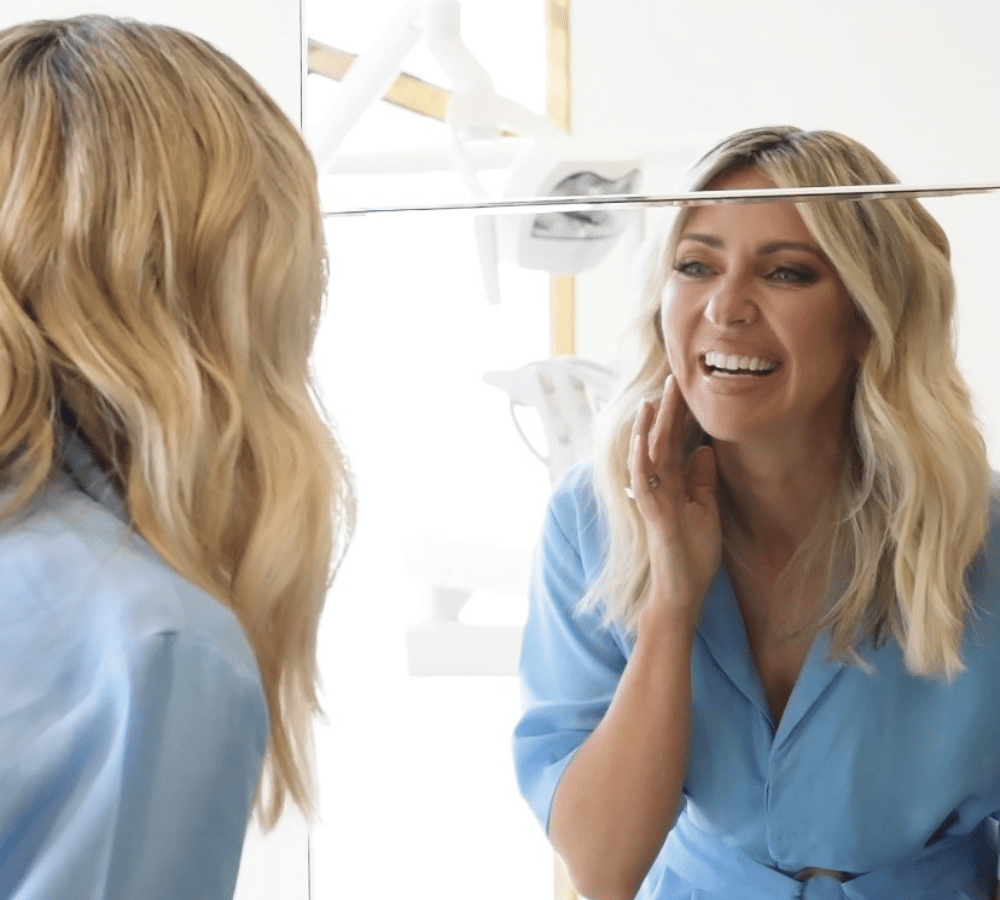
The distinction from a digital simulation matters. A digital design is a flat image on a screen. A mock-up exists in real life, on your actual teeth. You can look at it in a mirror, smile, speak, turn your head, take photographs, and assess how the proposed tooth shapes, sizes and proportions work with your face, your lips and your overall appearance in ordinary light and in motion.
It is a try-before-you-buy for your smile, and it is reversible.
How the mock-up is produced
The mock-up is the physical output of a planning process known as digital smile design. What's new in cosmetic dentistry? and the technology page set out the equipment behind it.
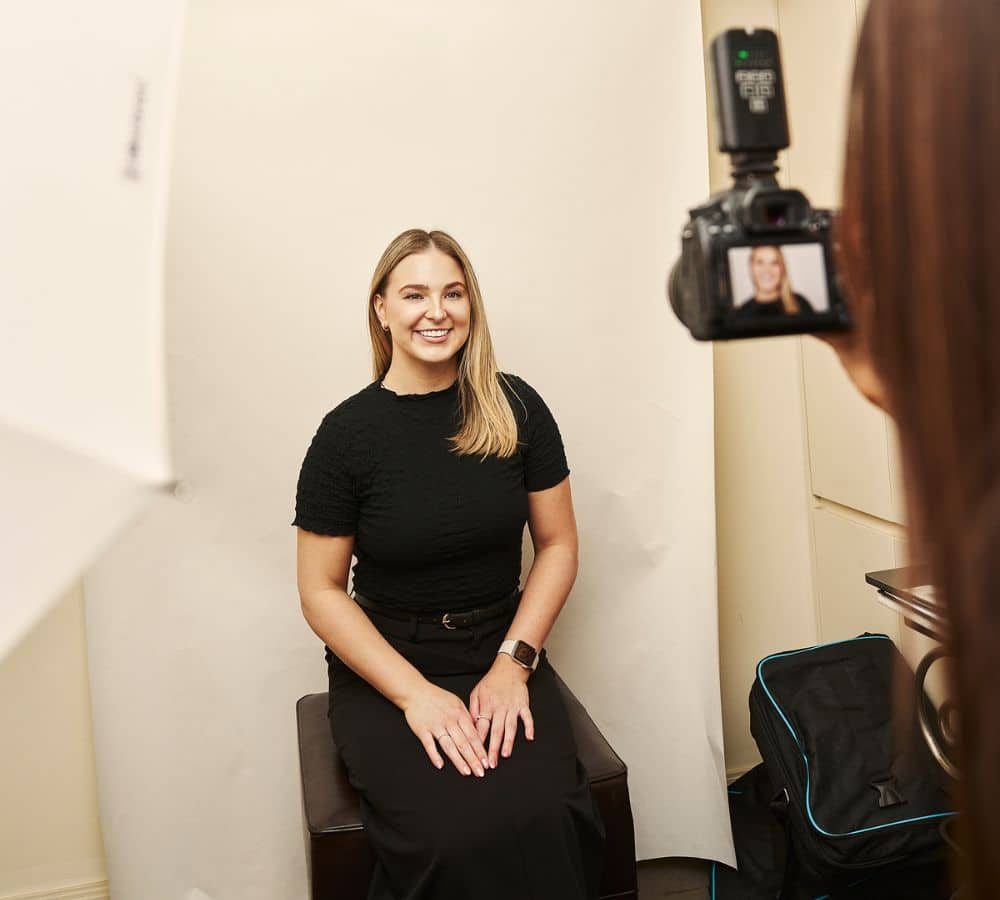
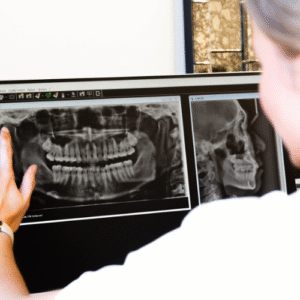
1. Photography and facial analysis. A series of standardised clinical photographs — face at rest, natural smile, wide smile, close-up detail. These record not just the teeth but their relationship to the whole face: the lip line, the facial midline, the curvature of the smile, the proportions of the features. The before and after gallery shows finished cases photographed the same way.
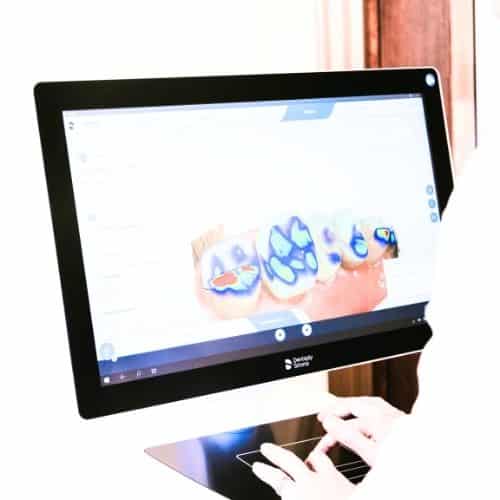
2. Digital scanning. A digital scanner captures a precise 3D model of the existing teeth and bite, giving the dimensional accuracy the design needs. The same scanning underpins same-day CEREC restorations and same-day porcelain veneers.
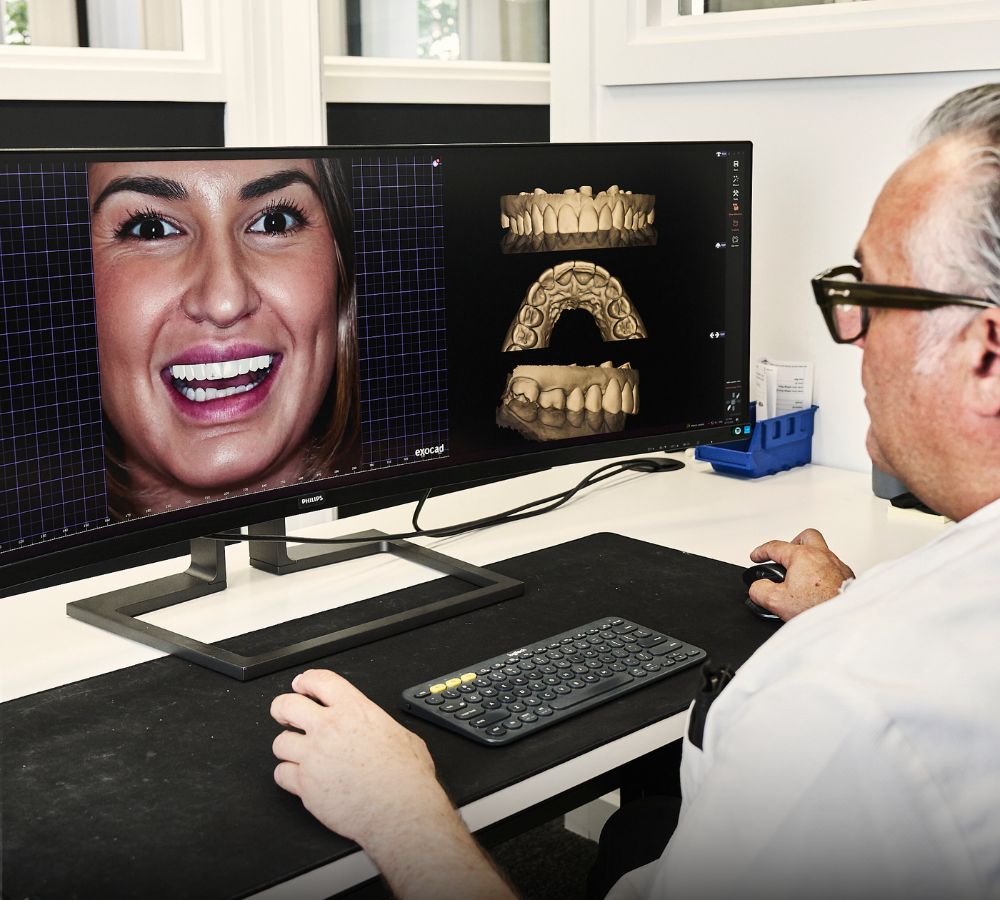
3. Digital design. Proposed tooth shapes are overlaid onto the facial photographs in smile design software. The questions being worked through:
- How long should the central incisors be?
- What width-to-height ratio gives harmonious proportions?
- Should the lateral incisors be slightly shorter and narrower than the centrals?
- How much tooth should show at rest, versus at full smile?
- What shade and translucency will suit your skin tone?
These are not arbitrary. They draw on established principles of dental aesthetics — proportion, the smile arc, tooth-to-lip relationships — applied to your individual facial anatomy and your own preferences. Where the gums rather than the teeth set the proportions, gummy smile is the relevant page.
4. The physical mock-up. The digital design produces a physical template — a wax-up or silicone guide — which lets the dentist apply composite resin over your existing teeth, building the proposed shapes in your mouth. The result is a wearable preview you see in a mirror, on your face, in three dimensions.
Why it matters clinically
It reduces risk
Cosmetic dentistry involves irreversible steps. Once enamel is removed for veneer preparation, it does not grow back. The mock-up ensures patient and dentist are aligned on the expected result before any irreversible work begins. How long do porcelain veneers last? and what happens to my teeth after dental veneers, and will I ever get cavities? cover what you are committing to over the following decades.
There is a second, less obvious reason a design-led preparation matters, and it is about how long the work lasts rather than how it looks. The bond wants enamel. Reviewing the evidence in the Journal of Esthetic and Restorative Dentistry in 2012, Burke concluded that “there is reasonable evidence indicating that a veneer preparation into dentin adversely affects survival” and that “the ideal preparation for porcelain veneers remains within enamel.” The best long-term Australian veneer cohort — Layton and Walton's 499 veneers placed in one private practice between 1990 and 2010 — treated only teeth with at least 80 per cent of their enamel remaining. So a preparation planned against an approved shape, rather than opened up to accommodate a design still being argued about, is not only an aesthetic advantage. Every tenth of a millimetre of enamel retained is working for the bond.
There is always some gap between what a patient imagines and what a clinician plans. A digital design narrows it, but a two-dimensional image cannot show how teeth look in motion — laughing, speaking, turning. The mock-up closes that gap. Understanding your treatment covers how plans and quotes are set out here.
It enables refinement
The first design is rarely the final one. Common requests:
- “Can the central incisors be slightly shorter?”
- “A little more roundness at the corners.”
- “Could we see a slightly warmer shade?”
- “The laterals feel too narrow.”
Those adjustments are simple on a composite mock-up. On finished porcelain veneers they are expensive and slow. The mock-up is where the design gets fine-tuned while changes are still cheap and reversible. What are the differences between dental bonding and veneers? explains why one is easy to alter and the other is not.
It guides the clinical work
An approved mock-up becomes the roadmap. The dentist uses it to plan the preparation — knowing exactly how much enamel to remove, and where. The ceramist uses it as the reference for the final restorations, so the porcelain replicates the shapes and proportions you approved.
Where the ceramist works on site, they can see the mock-up in person, compare it against the patient's face, and use it directly as a guide when hand-layering the porcelain. The Smile Solutions laboratory is where that work happens.
It manages expectations
This is arguably its most valuable function: showing what is realistically achievable, and what is not.
A patient who wants dramatically longer teeth may find, seeing it, that the change looks unnatural on their face. A patient set on very white veneers may realise a warmer shade sits better with their skin tone. Those realisations are far better had during a reversible mock-up than after permanent veneers are bonded. I want to whiten my teeth but one of my front teeth has a porcelain crown covers a related shade problem that catches people out later.
What a mock-up cannot do
This section matters as much as the last one, and it is the part most often left out.
It is not the final product. Composite resin does not have the optical properties of porcelain — it is less translucent, less polished and less durable. The mock-up previews shapes and proportions; the porcelain delivers the finish. What is the difference between composite veneers and porcelain veneers? sets the two materials side by side.
On “less durable”, the gap between the two materials has been measured — as permanent restorations, which is not what a mock-up is. A mock-up is worn for a consultation, so none of these figures describes it; they describe the choice between composite and ceramic when either is to be the finished work, and they are the reason a mock-up previews porcelain rather than substituting for it. In the cleanest head-to-head available, Mazzetti and colleagues (2022) reported an annual failure rate for composite laminate veneers of 3.9% at five years and 4.1% at ten, against 1.4% and 1.2% for ceramic — a survival hazard ratio of 4.00 (95% CI 2.74 to 5.83) for composite against ceramic. On the stricter “success” analysis, which counts any deterioration rather than only loss of the restoration, the annual rates were 9.1% at five years and 10% at ten for composite against 2.9% and 2.8% for ceramic (HR 5.16, 95% CI 2.65 to 10.04). Lim and colleagues' 2023 systematic review put the pooled survival of resin composite laminate veneers from randomised controlled trials at 88% (95% CI 81% to 94%) over follow-up of roughly two to eight years. Those two figures are not directly comparable to the 95.5% ten-year figure quoted for porcelain elsewhere on this site — different follow-up windows, different failure definitions, different study pools — which is precisely why the head-to-head trial matters more than either number alone.
Surface texture will differ. A mock-up is smoother and more uniform than the micro-texture a ceramist builds into porcelain. Natural teeth have ridges, grooves and surface texture that scatter light; the final veneers replicate this, the mock-up does not.
Colour is approximate. Composite and porcelain reflect light differently, so even a carefully shade-matched mock-up is an approximation. Final shade is refined during fabrication. If whitening is part of the plan, it is done before the shade is locked in — see what should I know about teeth whitening? and teeth whitening.
It is temporary. A mock-up is made to be worn for a consultation session, not for weeks. It is not permanently bonded and is not a functional restoration. That is a different thing from temporary veneers worn between appointments — the case for same-day porcelain veneers versus temporary veneers worn for 2-3 weeks.
And one further honest point: a mock-up does not guarantee the outcome. It substantially reduces the risk of a mismatch between expectation and result, which is a different and more modest claim.
Digital design and physical mock-up together
Some practices offer digital smile design without a physical mock-up; some offer a mock-up without digital planning. Combining both is the more thorough approach, because each covers the other's blind spot.
Digital design gives precision, proportionality and the ability to visualise changes before anything touches the teeth — excellent for planning and for communication. The physical mock-up gives real-world validation: how the design reads in three dimensions, in natural light, in motion, on your face. It catches what a screen cannot.
Together they make surprises far less likely. The patient knows what they are getting; the dentist knows what to deliver; the ceramist knows what the target looks like — before a tooth is prepared. How important is communication in dentistry? is the wider version of that argument.
How the process runs at Smile Solutions
The mock-up is included in veneer and smile makeover cases here. The sequence:
- Pre-appointment planning. The digital smile design is completed before the mock-up appointment, so the team has time to refine the design and prepare the template.
- The mock-up session. The composite preview is placed and you are given time to assess it — to look, smile, talk, photograph and discuss changes. It is not a five-minute appointment.
- Ceramist involvement. The lead ceramist often attends mock-up appointments, contributing on aesthetics, proportions and what is achievable in porcelain, so the mock-up translates faithfully into the final work.
- Iterative refinement. Changes are made during the session or at a follow-up appointment. There is no obligation to approve a design you are not satisfied with — including deciding not to proceed at all.
- Documentation. The approved mock-up is photographed from multiple angles under different lighting, and those images become the reference for the clinical and laboratory work.
The practice also offers a complimentary cosmetic consultation as an entry point to this process. Confirm the current terms when you book — what the appointment includes, whether records such as scans or radiographs are part of it or charged separately, and whether any deposit applies.
What happens after
Once a mock-up design is approved:
- Tooth preparation follows the mock-up as a guide, so the right amount of enamel is removed — no more
- Digital scans of the prepared teeth go to the laboratory
- Veneer fabrication proceeds with the approved mock-up as the ceramist's reference — see porcelain veneers
- Try-in and bonding are more straightforward, because shape, size and proportion are already settled
Common questions
Can I change my mind afterwards if I do not like the veneers?
Not in the way the question usually means. healthdirect states flatly that “you can't take veneers off”, and lists increased sensitivity among the risks “because some enamel is removed.” Veneers can be replaced, and a failed or damaged one generally is, but the tooth underneath does not return to its original state — which is the whole reason the mock-up stage exists, and why it belongs before preparation rather than after.
Is there anything that would rule me out of veneers altogether?
Several things, and they are worth raising at the consultation rather than discovering at the mock-up. healthdirect names two directly: “Veneers may not be suitable if you grind or clench your teeth or if you have gum disease.” It is also explicit about what veneers do not do: “Veneers don't fix tooth decay or problems with your bite.” So active decay, an unstable bite and untreated gum disease are things to deal with first, not things a veneer covers over. See TMD and Teeth Grinding and Bleeding Gums.
The fourth constraint is how much enamel you still have. As noted above, Burke concluded that “a veneer preparation into dentin adversely affects survival” and that “the ideal preparation for porcelain veneers remains within enamel” — and the Australian cohort that produced the best long-term data only accepted teeth with at least 80 per cent of their enamel remaining. On a tooth already worn, eroded or heavily filled, a veneer may be the wrong restoration rather than a smaller one; a crown or an onlay may be the honest answer.
And the list of alternatives is longer than most people are offered. healthdirect puts them in a revealing order, with the first one first: “An alternative to veneers is to continue to live with your teeth as they are.” After that it suggests asking your dental professional about “using resin to repair a small section of your tooth”, “a dental crown”, “teeth whitening”, “orthodontic treatments such as braces” and “clip on veneers”. Whitening and alignment are the two that remove no tooth structure at all, and for a case whose real problem is shade or position rather than shape, they are the conservative route — see teeth whitening and orthodontics. A plan that never mentioned doing nothing has not been fully explained.
What actually goes wrong with veneers, and when?
The failure modes are well documented, and the timing is the useful part.
The systematic review behind the porcelain survival figures quoted elsewhere on this site — 25 studies, 6,500 porcelain laminate veneers — records the complications by type: fracture in 154 veneers across 18 studies, debonding in 85 across 14, cracks in 56 across 7, and chipping in 31 across 7. Its summary is that “Fracture seems to be most common complication of PLVs, followed by debonding”, and that both are front-loaded: most fracture failures “happened within 2 years” of cementation, and most debonding failures likewise “within 2 years after PLV cementation”. That is worth knowing in both directions. It means the first two years are when to report anything that feels rough, loose or sharp rather than living with it — and it means a set that has come through those two years uneventfully has passed the period when most trouble appears.
Material made a difference in that review: non-feldspathic porcelain performed better than feldspathic. Preparation design is less settled than it looks. The same review found more failures among veneers without incisal coverage than with it, and then says so honestly: a second review comparing the two designs found “no significant differences between these two designs”, while a third “observed that preparation design with incisal coverage for PLVs exhibited an increased failure risk compared to those without incisal coverage” — the opposite conclusion. Three reviews, three positions. If your plan covers the biting edges or deliberately does not, that is a reasonable thing to ask about, and the honest answer is that the literature has not settled it.
From the patient's side, healthdirect lists the things that go wrong in plainer language: jaw pain; “the veneer could crack or fall off”; increased sensitivity; “if your gum shrinks, the edges of the veneers may be seen”; “the colour of your veneers can't be changed after they've been applied”; and “your other teeth may become discoloured, no longer matching your veneers”. Note that the last three are not failures of the veneer at all. They are consequences of time.
What will this look like in ten years, rather than on the day?
That is the right question to bring to a mock-up appointment, and three of healthdirect's listed risks answer it between them.
The shade is a one-way decision. “The colour of your veneers can't be changed after they've been applied.” Porcelain does not respond to whitening gel. Whatever shade is chosen is the shade you have until the veneers are replaced — which is why whitening, if it is part of the plan, is done first and the shade is matched to the whitened result rather than the other way round.
The teeth around them keep changing. “Your other teeth may become discoloured, no longer matching your veneers.” Natural enamel and dentine darken gradually with age and staining; porcelain does not. A perfect match on the day of bonding is therefore a match that drifts, and the more front teeth are left untreated beside veneered ones, the more visible that drift becomes over time. It is a genuine argument for planning how many teeth to include at the start, and for keeping up the professional cleaning that limits surface staining on the neighbours — see Dental Cleans & Hygienists.
The gumline moves. “If your gum shrinks, the edges of the veneers may be seen.” Recession exposes the junction between veneer and tooth, which is the one part of the restoration not designed to be looked at. That is one more reason gum health is sequenced before cosmetic work rather than after.
None of this is an argument against veneers. It is an argument for asking, at the mock-up, what the maintenance actually involves and what the realistic plan is for the day one needs replacing. On longevity, note how carefully the Australian government source puts it: teeth with veneers “need to be well cared for to help them last as long as possible”, and “Veneers should last for years.” It attaches no number to that, and neither will this page.
Could I just have the composite instead of the porcelain?
It is a legitimate option and for some cases a good one, but it is a different trade rather than a cheaper version of the same thing. As permanent restorations, the two materials have been compared directly: Mazzetti and colleagues (2022) reported annual failure rates for composite laminate veneers of 3.9% at five years and 4.1% at ten, against 1.4% and 1.2% for ceramic, a survival hazard ratio of 4.00 (95% CI 2.74 to 5.83). Composite is repairable and less invasive; ceramic lasts longer on the available evidence. The point to take from those numbers is that the composite on a mock-up is not the treatment — it is worn for one appointment, and none of these survival figures applies to it.
Does this article replace an individual dental assessment?
No. It provides general information. Symptoms, suitability, risks and treatment choices depend on examination and, where indicated, imaging or other records from an appropriately registered practitioner.
Sources named on this page
- healthdirect Australia, Veneers (last reviewed February 2025)
- Edelhoff D, Sorensen JA, Tooth structure removal associated with various preparation designs for anterior teeth, Journal of Prosthetic Dentistry 2002;87(5):503–509 — in vitro, gravimetric, typodont resin anterior teeth
- Burke FJT, Journal of Esthetic and Restorative Dentistry 2012;24(4):257–265, on preparation depth and survival
- Mazzetti et al. (2022), composite versus ceramic laminate veneer failure and survival, as reported in Lim TW, Tan SK, Li KY, Burrow MF, Survival and Complication Rates of Resin Composite Laminate Veneers: A Systematic Review and Meta-Analysis, Journal of Evidence-Based Dental Practice 2023;23(4):101911
- Layton and Walton, prospective cohort of 499 porcelain veneers in an Australian private practice, 1990–2010
- Systematic review of porcelain laminate veneer survival, 25 studies and 6,500 veneers, Journal of Clinical Medicine 2021 — for the complication types, timing and preparation-design disagreement quoted above
Related reading
- Cosmetic dentistry options
- How can I improve my smile with porcelain veneers and crowns?
- What is the difference between porcelain crowns and veneers?
- Is it time for a smile makeover?
- I want to improve my smile, but I don't know where to start
- Cosmetic dentistry under specialist care
- Cosmetic dentistry
Practical details
A mock-up is an elective step. Your dentist will discuss suitability, alternative treatment options and associated risks. Results vary between individuals, and all dental treatment carries risks. Preparation for porcelain veneers is irreversible.
The video accompanying this article on the Smile Solutions website features Dr Ryan Sherry (DEN0002124765), registered dentist, general registration, and demonstrates an example of the mock-up process.
Registration can be verified on the AHPRA register, or by calling 1300 419 495. The clinical team is listed by name, and dentists and registered specialists explains the difference between the two.
Smile Solutions, Level 1, 220 Collins Street, Manchester Unity Building, Melbourne VIC 3000 — getting here. Phone 13 13 96, contact us, or theteam@smilesolutions.com.au. Monday–Friday 8.00am–6.00pm, Saturday 8.30am–1.30pm, Sunday by appointment.
Published 20 July 2026, by Dr Kia Pajouhesh. Survival and failure figures quoted are from the published literature with the populations, follow-up periods and confidence intervals stated alongside them; they describe permanent restorations, not the temporary mock-up, and they are not a prediction for any individual case. General information only; it does not replace advice from your treating practitioner.
Smile Solutions trades under ABN 28 193 514 103.
Images on This Page
-
https://www.facebook.com/tr?id=800557773428361&ev=PageView&noscript=1
(no alt text)
-
https://www.smilesolutions.com.au/wp-content/uploads/2025/10/calendar_month.svg
(no alt text)
-
https://www.smilesolutions.com.au/wp-content/themes/arcadian-wordpress-theme/assets/images/smile_solutions_logo_white.png
Smile Solutions Logo
-
https://www.smilesolutions.com.au/wp-content/themes/arcadian-wordpress-theme/assets/images/smile_solutions_logo_purple.png
Smile Solutions Logo
-
https://www.smilesolutions.com.au/wp-content/uploads/2025/11/Kia-150x150.jpg
Dr Kia Pajouhesh
-
https://www.smilesolutions.com.au/wp-content/uploads/2026/07/Photography-and-Facial-Analysis.jpg
Photography and Facial Analysis
-
https://www.smilesolutions.com.au/wp-content/uploads/2025/11/Smile-Solutions-6.png
Smile Solutions
-
https://www.smilesolutions.com.au/wp-content/uploads/2026/07/Scan.jpg
Digital Scanning
-
https://www.smilesolutions.com.au/wp-content/uploads/2026/07/Digital-Design.jpg
Digital Design
-
https://www.smilesolutions.com.au/wp-content/uploads/2025/09/Wisdom-Teeth-Smile-Solutions-300x300.png
Smile Solutions Dentist Melbourne
-
https://www.smilesolutions.com.au/wp-content/uploads/2025/11/TMD-Teeth-Grinding-Smile-Solutions-300x270.png
Woman holding her face, looking concerned.
-
https://www.smilesolutions.com.au/wp-content/uploads/2013/04/Dental-Tourism-300x270.jpg
Dental Tourism
-
https://www.smilesolutions.com.au/wp-content/themes/arcadian-wordpress-theme/assets/images/family_owned_bussiness.png
Family Owned Business
-
https://www.smilesolutions.com.au/wp-content/themes/arcadian-wordpress-theme/assets/icons/icon--phone.svg
Smile Solutions Contact
-
https://www.facebook.com/tr? id=800557773428361&ev=PageView&noscript=1
(no alt text)
-
https://bat.bing.com/action/0?ti=25148060&tm=gtm002&Ver=2&mid=5e4ed101-8494-4263-a579-7909652a5182&bo=1&sid=d099ee90ab2611f1a6424fea0b144bb3&vid=d09a17f0ab2611f1b9e3d3db5f158553&vids=1&msclkid=N&pi=918639831&lg=en-US&sw=800&sh=600&sc=24&nwd=1&tl=The%20Mock-Up%20Reveal%3A%20Why%20You%20Should%20See%20Your%20New%20Smile%20Before%20Any%20Treatment%20Begins%20-%20Smile%20Solutions&p=https%3A%2F%2Fwww.smilesolutions.com.au%2Fdental-articles%2Farticle%2Fthe-mock-up-reveal-why-you-should-see-your-new-smile-before-any-treatment-begins%2F&r=<=1720&evt=pageLoad&sv=2&cdb=AQAQ&rn=237692
(no alt text)