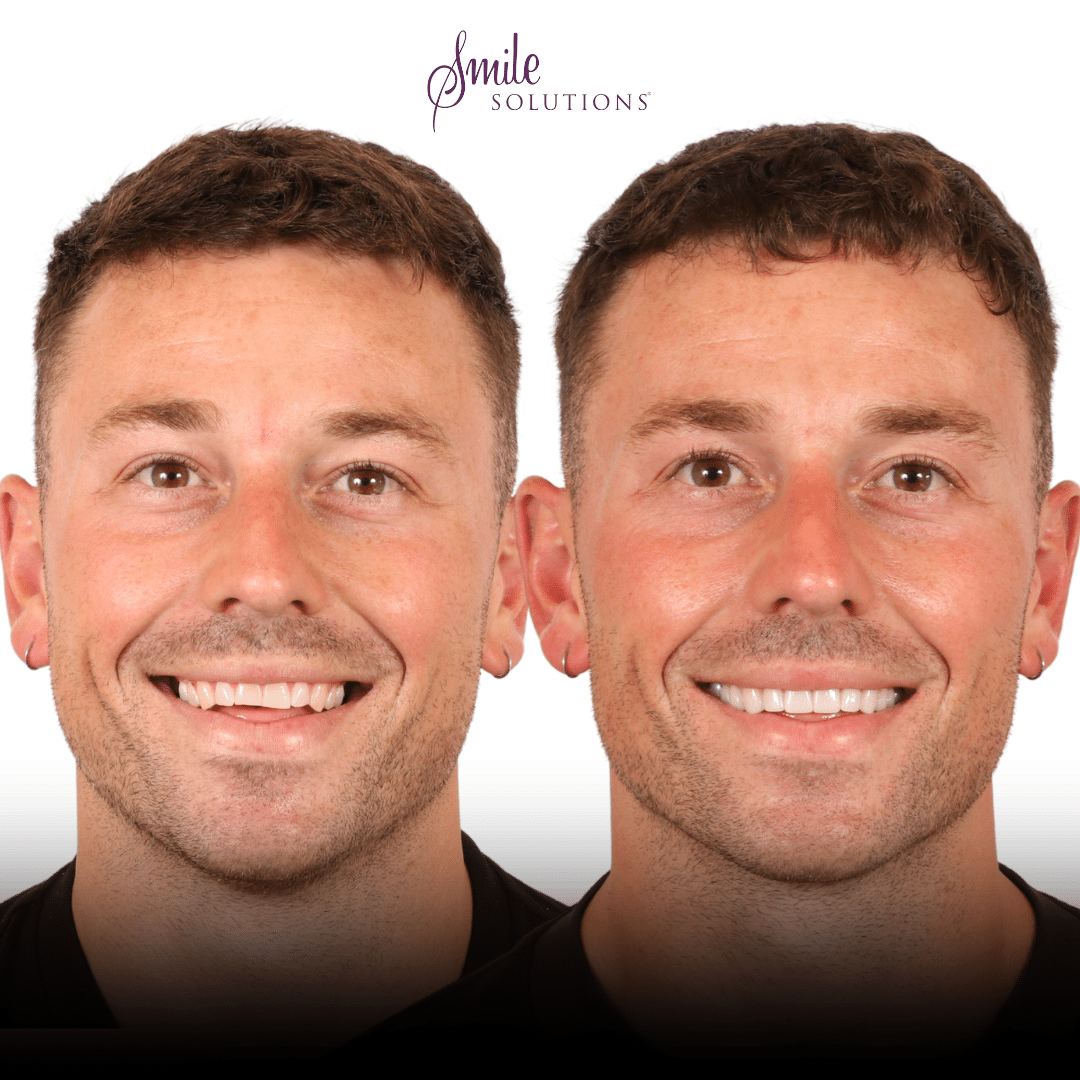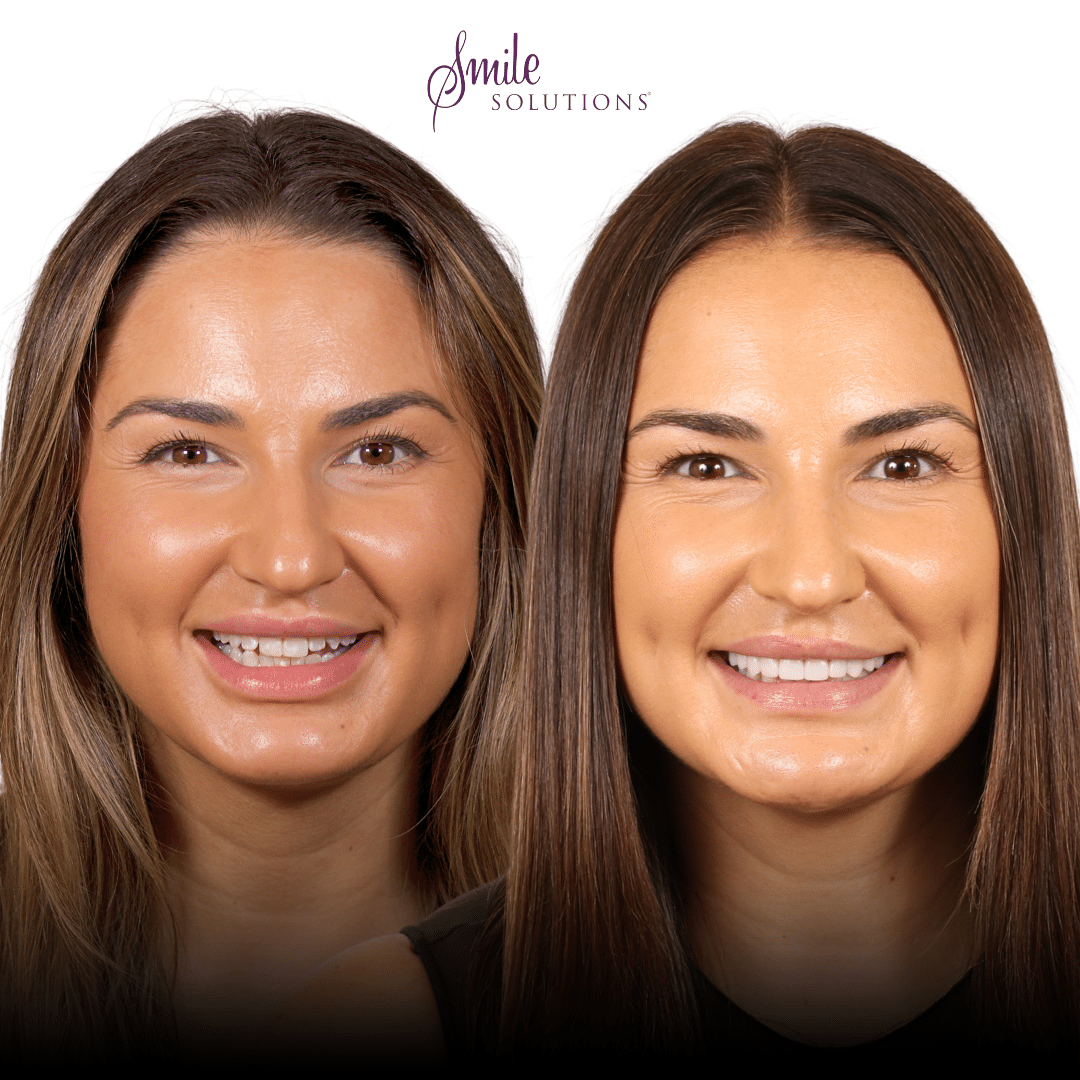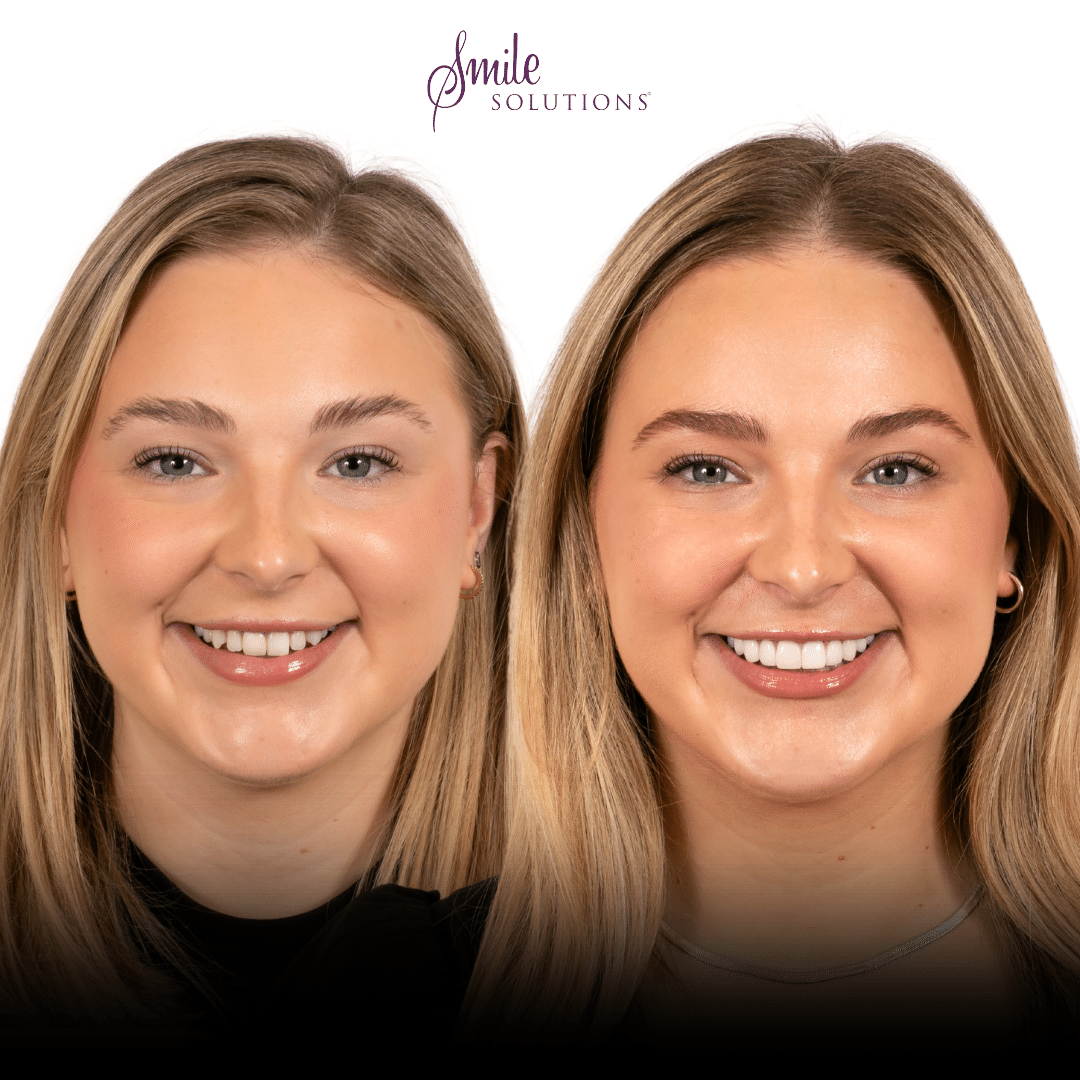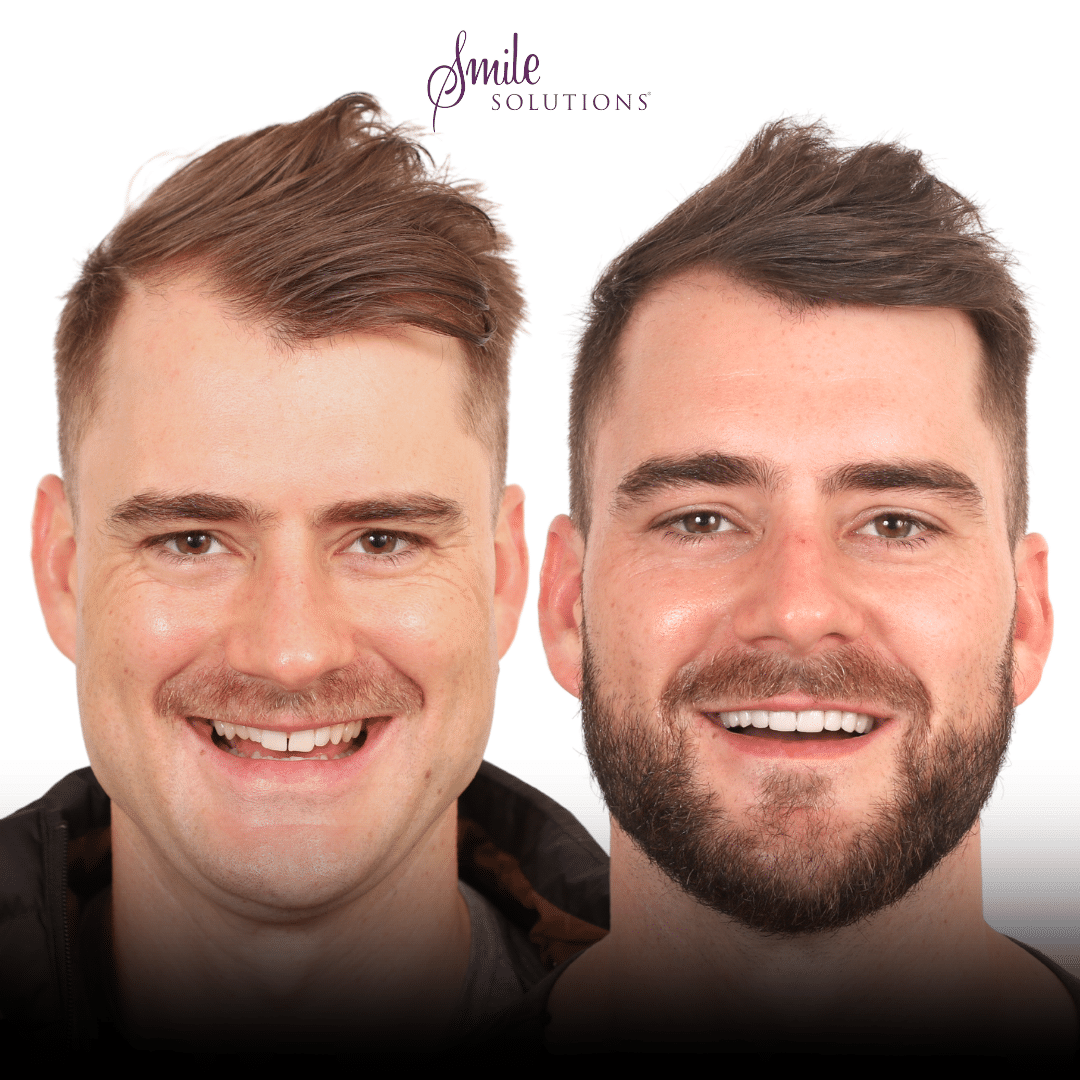
Porcelain Veneers & Crowns
What are porcelain veneers, and how do they differ from crowns?
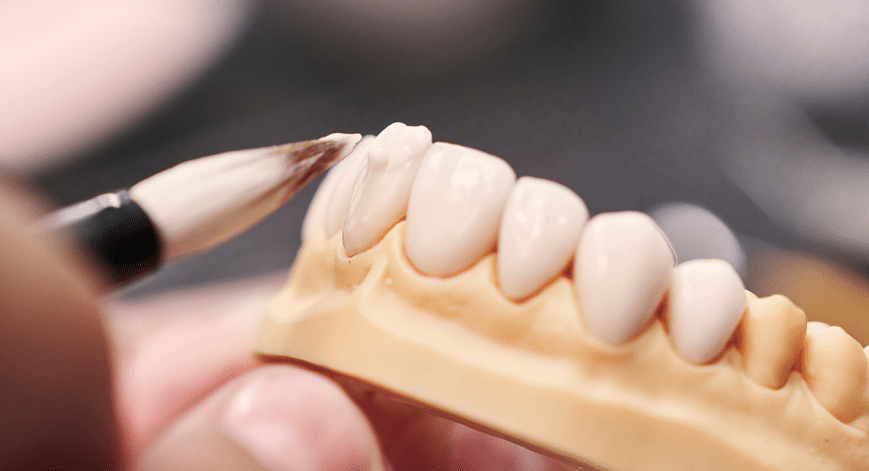
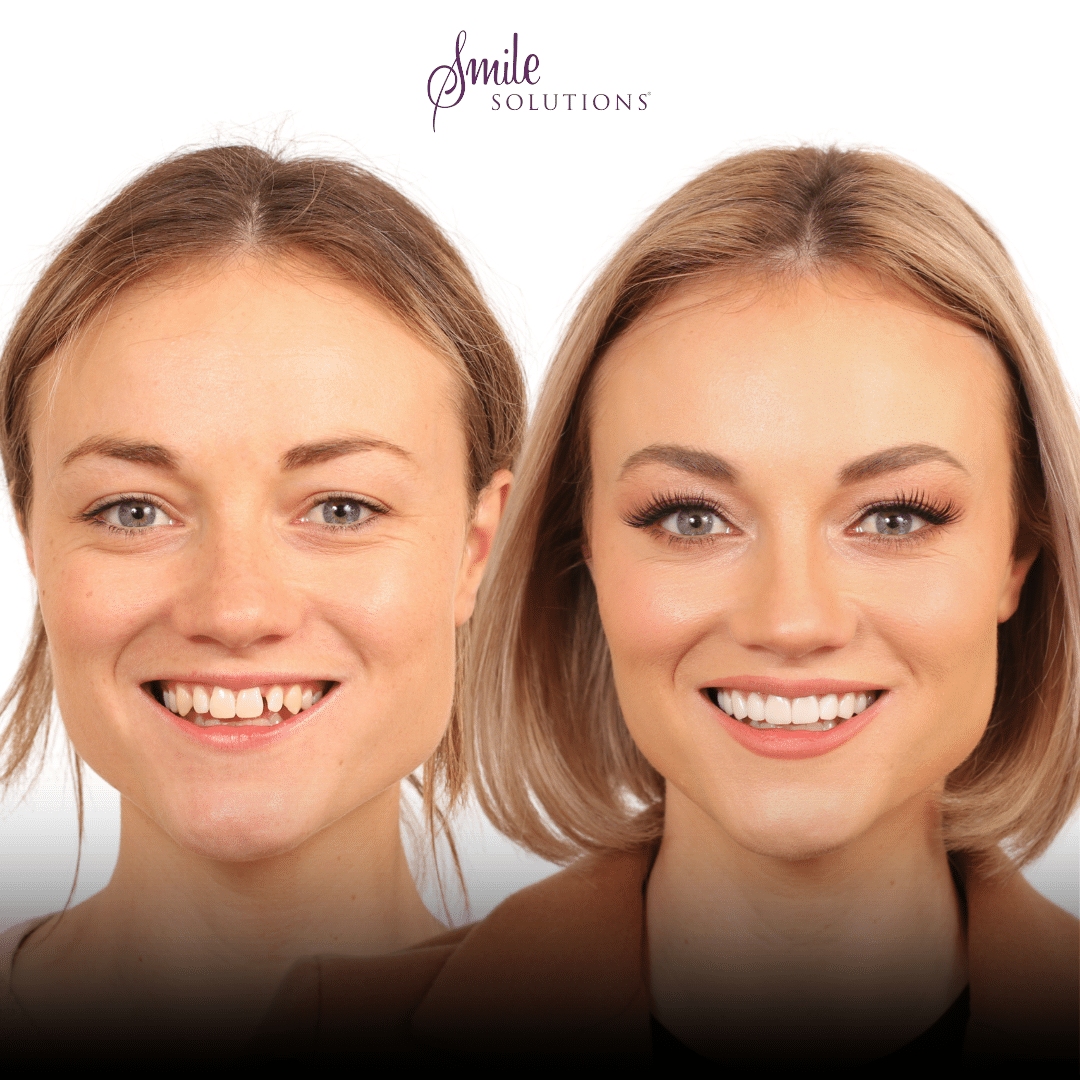
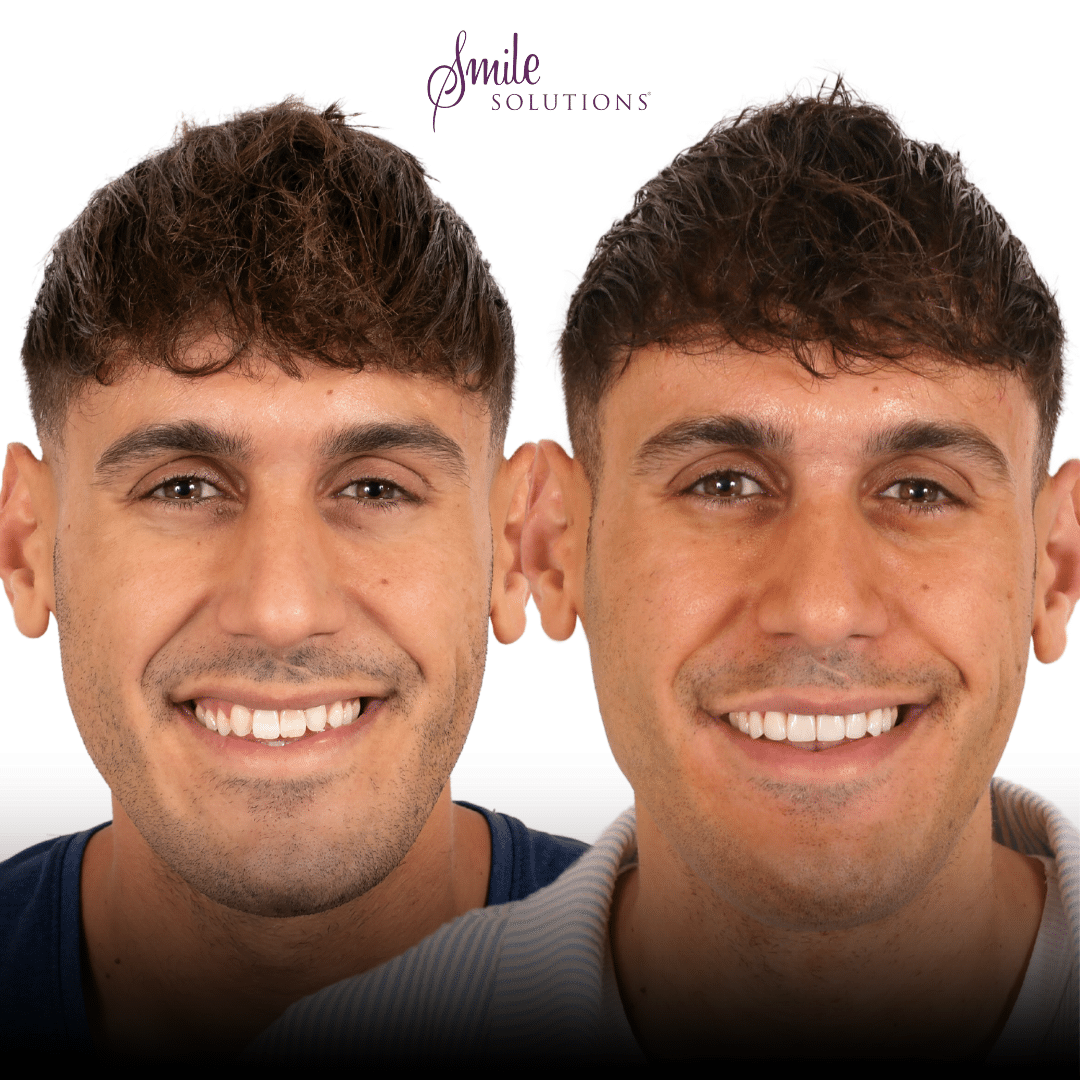
A veneer is a thin, custom-made porcelain shell that covers only the front surface of a tooth, improving its shape, colour or alignment.
A crown covers the entire tooth. It provides cosmetic improvement plus added strength, which makes it the right choice for teeth that are weakened, worn or heavily restored.
The decision between them is structural, not aesthetic. A veneer needs sound tooth to bond to; where too little remains, a crown is the appropriate restoration. If a veneer ever detaches, it often indicates a crown would have been the better choice from the start.
The Australian Dental Association notes that this work may be done by a dentist or by a dental specialist called a prosthodontist, and that a dentist cannot be registered as a “Cosmetic Dentist” in Australia. See Specialist Prosthodontists.
Smile Solutions produces both in its on-site ceramic studio at Level 1, 220 Collins Street, Manchester Unity Building, Melbourne CBD.
The part to understand before anything else: enamel is removed permanently
Most porcelain veneers require a layer of enamel to be taken off the front of the tooth so the veneer sits flush rather than bulky — commonly a few tenths of a millimetre, more where teeth are being brought forward, rotated or significantly reshaped.
How much comes off depends on the preparation design. A laboratory study measuring removal by design found a traditional facial porcelain veneer took about 16.7% of the coronal tooth structure, an extended veneer 22.1% and a complete veneer 30% — against 64% to 71.9% for crown preparations. Even a conservative 0.6 mm preparation on an intact upper central incisor has been measured as leaving roughly 70% enamel and 30% exposed dentin, and bonding to dentin is weaker than bonding to enamel.
Enamel does not grow back. healthdirect Australia states it in one line — “You can't take veneers off” — and warns teeth may become more sensitive because some enamel is removed. Once a tooth is prepared, it will need a veneer or a crown on it for the rest of your life. When a veneer eventually fails, the option is replacement, not removal.
That is an entirely reasonable trade to accept — millions of people do, happily — but it should be accepted knowingly, and there are three questions worth asking first:
- How much enamel will be removed from each tooth?
- Is a minimal-preparation or no-preparation approach possible in my case? Sometimes it is, particularly where teeth are small or set back. Often it is not.
- What is the alternative that removes nothing? For colour alone, that is Teeth Whitening. For small shape corrections, Composite Bonding can sometimes be added without drilling.
Preview your smile before committing: the mock-up
This is the part of the process most worth understanding, because it is reversible and no-obligation.
We can produce a physical mock-up using temporary resin applied over your natural teeth. Nothing is drilled or removed. You see and feel the proposed changes in shape, size, length, position and colour before any irreversible step is taken.
The mock-up also answers questions that are difficult to settle in the abstract:
- how many veneers the result actually requires
- whether a gum lift would improve the outcome
- whether the change you imagined is the change you want
A mock-up is an elective step, and your dentist will review other treatment options where appropriate.
To experience a mock-up, start with the complimentary cosmetic consultation. Note that the consultation is a discussion only — no check-up, x-rays, scans or clinical treatment — and a $50 refundable deposit secures the appointment. See Complimentary Cosmetic Consultation and Mock-Up Reveal.
How many teeth, and why
A question people are often surprised by when the plan comes back with eight or ten teeth rather than two.
The number is set by how many teeth show when you smile, not by how many bother you. If you are changing the colour or shape of the two central incisors, the teeth either side of them have to be accounted for, or the new ones stand out against them.
- Six — canine to canine, covers most smiles
- Eight to ten — where the first premolars show, common in broader smiles
- Two or four — reasonable where you are correcting a specific defect and the shade already matches
A darker corridor at the back corners of the smile is the usual sign that too few were done. Ask to see, on the mock-up, exactly which teeth are included and what the edge of the treated zone will look like.
Speech, and why length changes matter
Lengthening the upper front teeth changes how they meet the lower lip and the tongue, which can affect “f”, “v” and “s” sounds. Most people adapt within days. Some do not, and where the change is large the design needs adjusting.
This is precisely what the temporary phase exists to test — and it is the main argument for wearing temporaries for a couple of weeks rather than compressing the treatment. If you speak for a living, say so at the consultation.
The treatment process
1. Cosmetic consultation (60 minutes). You discuss your concerns, goals and expectations with an experienced treatment consultant — changing the shape, shade or alignment of teeth, or replacing cracked, chipped or missing ones. Pricing and payment plan options are covered here.
2. Scans and design. Digital scans are taken and sent to the master ceramist and his team at the on-site studio. You customise and discuss the smile design with your clinician and the ceramist.
Importantly, your treating clinician assesses the general health of your teeth with a comprehensive examination and clean before any cosmetic treatment begins. Cosmetic work built over untreated disease fails.
3. Temporary veneers and your input. Temporary veneers are inserted so you can see how the design looks in your mouth. You give feedback on shape, colour and other characteristics before the ceramist begins the final veneers.
Use this stage properly. Eat with them, talk with them, photograph them in daylight, and show someone whose opinion you trust. Write down anything that bothers you — too long, too square, too white, midline off — because changes are straightforward now and expensive later.
4. Handcrafting and bonding. The ceramists handcraft the bespoke veneers from porcelain in the in-house studio. The temporaries are removed, the final veneers tried in, and any last adjustments made. Once you are satisfied, they are permanently bonded.
The materials, briefly
Not all porcelain is the same, and the choice is a clinical one:
- Feldspathic porcelain — layered by hand, the most lifelike in translucency and characterisation, and the thinnest. Favoured for front teeth where appearance is everything.
- Lithium disilicate — stronger, pressed or milled, excellent appearance. The common choice where a veneer needs to tolerate more load.
- Zirconia — strongest, more opaque in its traditional forms, used more often for crowns than front veneers. The more translucent the zirconia, the less strong it is — that trade-off is unavoidable.
Ask which material is proposed and why. A reasonable answer references your bite and the position of the tooth, not just appearance.
When veneers are the wrong answer
- Significant crowding or rotation. Veneering crooked teeth means either heavy drilling or a bulky result. Aligning them first with Invisalign usually means less enamel removed and a better outcome.
- Untreated decay or gum disease. Both must be stabilised first.
- Heavy grinding, unless it is managed and a nightguard is part of the plan — a systematic review found a significantly higher failure rate in patients who were bruxers. See TMD & Teeth Grinding.
- Teeth that are already heavily filled, where a crown is the structurally honest answer. See Dental Crowns.
- Colour alone, where whitening would achieve enough and remove nothing.
Whiten first
Porcelain does not change colour with whitening. If you want lighter teeth, whiten before the veneers are made, allow about two weeks for the shade to settle, then match the porcelain to the result.
Whiten afterwards and your natural teeth lighten while the veneers stay put, leaving a mismatch that can only be fixed by remaking them.
The on-site ceramic studio
Smile Solutions' ceramic studio is small-scale and exists only to service the practice's own patients. Its ceramists do not work with any other business.
The practical consequence for a patient: you meet the person making your veneers. During the initial appointment and through treatment, you consult with the lead ceramist directly — not an off-site or overseas provider working from photographs and a shade tab.
Supporting technology includes iTero scanners, 3Shape Trios digital scanners, digital radiographs and CT scans, a fleet of CEREC machines and intraoral scanners, Dental Monitoring, and 3D printers. See Smile Solutions Laboratory.
How long do they last?
No Australian authority publishes a lifespan in years for veneers — neither the ADA's consumer site nor healthdirect gives one. What the research reports instead is survival: the proportion still in place at a stated number of years.
The most directly relevant figures come from a prospective cohort in an Australian private practice — 499 feldspathic porcelain veneers placed in 155 patients by a single prosthodontist between 1990 and 2010 — with cumulative survival of 98% at 5 years, 96% at 10 years and 91% at both 15 and 20 years. Two conditions travel with those numbers: patients with extensive tooth-structure loss from grinding or clenching were excluded, and only teeth retaining at least 80% enamel were veneered. It is a best case, for ideal candidates, from one operator — and the same authors' earlier series of 304 veneers reported 73% at 15–16 years.
Wider reviews are more sober. A 2021 systematic review pooling 25 studies and roughly 6,500 porcelain laminate veneers calculated 10-year cumulative survival of 95.5% counting fracture, debonding, secondary caries and the need for root canal treatment together as failure. A separate meta-analysis put overall survival at 89% (95% CI 84–94%) at a median follow-up of about 9 years — glass-ceramic 94% (95% CI 87–100%), feldspathic porcelain 87% (95% CI 82–93%). Reviewers note that very few veneers in any study are followed beyond 20 years.
Ceramic veneers are strong and resistant to breaking, but like natural teeth they can chip or fracture under trauma or excessive force, and can wear over time — particularly if you grind or clench. The usual reasons people choose to replace them are gum recession exposing the edges, or staining at the margins. Detachment is uncommon: debonding is reported at 2% (95% CI 1–4%), and it usually means bonding was compromised — which suggests a crown was the more appropriate restoration.
Crowns can also fracture or decay. With proper hygiene and regular check-ups they last many years; the material affects durability, alongside aesthetics, longevity and how the crown interacts with opposing teeth.
Plan for replacement rather than for a fixed lifespan. The ADA puts it plainly: having a crown, bridge or veneer does not mean no treatment will ever be needed again for those teeth. Ask what a single replacement veneer costs today.
Risks and limitations
Figures below are incidences from a meta-analysis of ceramic veneers at a median follow-up of about nine years — population figures, not a prediction for you.
- Permanent enamel removal, as above
- Sensitivity after preparation, usually settling over days to weeks
- Debonding, usually re-bondable — 2% (95% CI 1–4%)
- Chipping or fracture; a fractured veneer generally needs remaking rather than repair — 4% (95% CI 3–6%)
- Decay at the margin where veneer meets tooth — 1% (95% CI 0–3%)
- Margin staining or a visible line as gums recede — severe marginal discolouration 2% (95% CI 1–10%)
- Nerve irritation, occasionally leading to root canal treatment afterwards — 2% (95% CI 1–3%). See Root Canal
- The shade cannot be changed once bonded
- Bite changes if length or thickness alters how the teeth meet
Outcomes and longevity vary between individuals and no result can be guaranteed.
Caring for veneers and crowns
The critical point: the porcelain cannot decay, but the tooth underneath still can — particularly at the exposed edges and where the veneer meets natural tooth.
- Brush twice a day and floss.
- Keep regular scale and clean appointments with your hygienist. See Dental Cleans & Hygienists.
- Fluoride toothpaste and mouthwash help protect the margins.
- For crowns, remineralising toothpaste helps reduce decay risk around the margin.
- Wear a nightguard if you grind. It is the cheapest insurance available.
- Avoid biting nails, pens, ice and packaging.
Your clinician will advise on any special care requirements and follow-up appointments for your particular restorations.
A note on veneers obtained overseas
The practice sees patients returning from overseas treatment, and the pattern is consistent enough to be worth naming: heavy preparation, often crowns rather than veneers, done quickly and without the diagnostic stage. A 2025 British Dental Journal review of dental-tourism reporting records dentists describing that substitution — patients believing they have had veneers when what was placed were crowns. The measured difference is the one above: about 16.7% of the tooth for a traditional facial veneer against 64% to 71.9% for a crown.
Australian Dental Association Policy Statement 2.2.6 states that overseas elective dental treatment “carries the risk of adverse oral and general health outcomes with long term problems which may be difficult to resolve on return to Australia”, and notes that the records of treatment obtained overseas are unlikely to be available to whoever treats you next, and that complications are not always covered by travel insurance or Australian health funds.
This is not an argument that Australian treatment is superior — it is an argument about what happens when it goes wrong, and who is accountable. See Turkey teeth: the real risks of getting veneers overseas.
Porcelain or composite?
| Porcelain veneers | Composite veneers | |
|---|---|---|
| Made | Custom-made, laboratory or chairside | Applied directly to the tooth |
| Visits | Usually two | Usually one |
| Tooth reduction | Usually some, permanent | Often none |
| Upfront cost | Higher | Lower |
| Durability | More durable | Less strong |
| Staining | Resists staining | Slightly porous; can discolour |
| Repair if chipped | Usually needs remaking | Usually repairable chairside |
| Maintenance | Less | Regular polishing or replacement |
| Reported survival | 95.5% at 10 years, pooled across 25 studies | 88% (95% CI 81–94%) pooled in trials, follow-up 2 to 8 years |
A 2023 systematic review of resin composite laminate veneers pooled survival across randomised trials at 88% (95% CI 81–94%), follow-up 24 to 97 months — 91% direct, 84% indirect. Its authors add that patients choosing it “should be well informed about the high mechanical and aesthetic complication rates of the materials as well as the high maintenance care”. The failure modes differ: surface roughness, colour mismatch and marginal discolouration for composite, fracture and debonding for ceramic.
Porcelain costs more upfront but requires less maintenance, which can make it more cost-effective over time. Composite is faster and cheaper to start. Your clinician assesses your teeth, bite and goals before recommending either. See Composite versus porcelain veneers compared.
What it costs
Cost varies with the complexity of the procedure and who performs it. No two mouths are the same, and a dentist cannot give an exact figure until they have thoroughly examined your teeth.
Several components make up the total: x-rays, the material itself, and the bonding process.
Interest-free payment plans are available through Payright for treatment from $150 to $20,000, over 3 to 30 months. Other finance options may also be available; provider eligibility, fees and terms can change. Fees and terms apply; ask for them in writing. See Price Guide and Payment Plans.
Common questions
Are porcelain veneers reversible?
Usually not. Preparing a tooth for a veneer commonly removes enamel, and that change is permanent. Ask how much enamel is proposed for each tooth and whether a less destructive option could meet the same goal.
How many veneers will I need?
There is no standard number. The visible smile line, tooth proportions, colour difference and treatment goal determine which teeth need to be included. The page describes six to ten as typical, but your plan should explain why every proposed tooth is involved.
How long do porcelain veneers last?
The page cites pooled survival of 95.5% at ten years. That is a research survival estimate, not a promised lifespan for an individual veneer. Tooth preparation, bonding, bite forces, grinding, gum health and maintenance affect longevity.
Will I need temporary veneers?
Many multi-visit cases use temporaries while the final veneers are made. Their appearance and feel are provisional. Ask how long you will wear them, what restrictions apply and how the final design can still be adjusted.
Should I whiten or straighten my teeth first?
Often, yes. Existing teeth can be whitened before the final porcelain shade is chosen, because porcelain will not whiten later. Orthodontics may reduce how much tooth structure must be removed or improve the final proportions.
What if I grind my teeth or have gum disease?
Those issues should be addressed before veneers. Grinding increases fracture and debonding risk, while active gum disease and recession can undermine the result and expose margins. A protective appliance or other preliminary treatment may be recommended.
What is the difference between a veneer and a crown?
A veneer covers mainly the visible front surface of a tooth. A crown surrounds the tooth and generally requires more reduction. Crowns may be appropriate where a tooth is heavily restored or structurally weakened; veneers are not a substitute for rebuilding an unsuitable tooth.
What happens if one veneer needs replacement later?
A replacement must be colour- and shape-matched to the surrounding teeth and veneers, which can become more difficult as they age. Ask about the current cost of replacing one veneer and whether the original design records are retained.
Practical details
| Address | Level 1, 220 Collins Street, Manchester Unity Building, Melbourne VIC 3000 |
| Phone | 13 13 96 |
| theteam@smilesolutions.com.au | |
| Monday – Friday | 8.00am – 6.00pm |
| Saturday | 8.30am – 1.30pm |
| Sunday | By appointment |
| Reported survival | 95.5% at 10 years in pooled studies; no authority publishes a lifespan in years |
| Enamel removal | Usually required, and permanent |
| Typical number | Six to ten, set by your smile line |
| Manufactured | On-site ceramic studio, Melbourne |
| Preview available | Reversible resin mock-up |
| Consultation | Complimentary, 60 minutes, $50 refundable deposit |
| Parking | Wilsons Parking, Flinders Lane (between Swanston and Russell) |
Results, recovery times and potential risks vary for each individual and procedure. This information is general in nature and intended for people over 18. Seek independent advice from a qualified, AHPRA-registered practitioner before proceeding, and you are entitled to seek a second opinion before consenting to irreversible treatment.
Smile Solutions trades under ABN 28 193 514 103.
Images on This Page
-
https://www.facebook.com/tr?id=800557773428361&ev=PageView&noscript=1
(no alt text)
-
https://www.smilesolutions.com.au/wp-content/uploads/2025/10/calendar_month.svg
(no alt text)
-
https://www.smilesolutions.com.au/wp-content/themes/arcadian-wordpress-theme/assets/images/smile_solutions_logo_white.png
Smile Solutions Logo
-
https://www.smilesolutions.com.au/wp-content/themes/arcadian-wordpress-theme/assets/images/smile_solutions_logo_purple.png
Smile Solutions Logo
-
https://www.smilesolutions.com.au/wp-content/uploads/2025/11/Smile-Solutions-4.png
Smile Solutions 4
-
https://www.smilesolutions.com.au/wp-content/uploads/2023/04/WEBSITE-Media-2.png
Dental model with brush application
-
https://www.smilesolutions.com.au/wp-content/uploads/2025/11/Smile-Solutions-6.png
Smile Solutions
-
https://www.smilesolutions.com.au/wp-content/uploads/2026/01/Ryan3.png
Ryan3
-
https://www.smilesolutions.com.au/wp-content/uploads/2026/01/Ryan7.png
Ryan7
-
https://www.smilesolutions.com.au/wp-content/uploads/2026/01/Ryan6.png
Ryan6
-
https://www.smilesolutions.com.au/wp-content/uploads/2026/01/Casey1.png
Casey1
-
https://www.smilesolutions.com.au/wp-content/uploads/2025/11/23.png
23
-
https://www.smilesolutions.com.au/wp-content/uploads/2026/01/Ryan10.png
Ryan10
-
https://www.smilesolutions.com.au/wp-content/uploads/2025/10/Smile-Solutions-Invisalign-Blue-Diamond-Provider.png
Smile Solutions Invisalign Blue Diamond Provider
-
https://www.smilesolutions.com.au/wp-content/uploads/2025/10/Smile-Solutions-Luxury-Lifestyle-Awards-Winner.png
Smile Solutions Luxury Lifestyle Awards Winner
-
https://www.smilesolutions.com.au/wp-content/uploads/2026/01/Smile-Solutions-Telstra-Business-Awards-Winner.png
Smile Solutions Telstra Business Awards Winner
-
https://www.smilesolutions.com.au/wp-content/uploads/2026/01/WEBSITE-Smile-Solutions-Award-Tiles.png
WEBSITE Smile Solutions Award Tiles
-
https://www.smilesolutions.com.au/wp-content/uploads/2025/11/Smile-Solutions-ABA-Business-Innovation-Winner-2024.png
Smile Solutions ABA Business Innovation Winner 2024
-
https://www.smilesolutions.com.au/wp-content/uploads/2025/11/Smile-Solutions-ABA-Service-Excellence-Winner-2024.png
Smile Solutions ABA Service Excellence Winner 2024
-
https://www.smilesolutions.com.au/wp-content/uploads/2025/11/Smile-Solutions-ABA-Service-Excellence-Winner-2023.png
Smile Solutions ABA Service Excellence Winner 2023
-
https://www.smilesolutions.com.au/wp-content/uploads/2025/11/Smile-Solutions-ABA-Service-Excellence-Winner-2022.png
Smile Solutions ABA Service Excellence Winner 2022
-
https://www.smilesolutions.com.au/wp-content/uploads/2025/09/Smile-Solutions-ABA-Service-Excellent-Winner-2019.png
Smile Solutions ABA Service Excellent Winner 2019
-
https://www.smilesolutions.com.au/wp-content/uploads/2025/09/Smile-Solutions-ABA-Community-Contribution-Winner-2017.png
Smile Solutions ABA Community Contribution Winner 2017
-
https://www.smilesolutions.com.au/wp-content/uploads/2025/11/Smile-Solutions-ABA-Service-Excellence-Winner-2017.png
Smile Solutions ABA Service Excellence Winner 2017
-
https://www.smilesolutions.com.au/wp-content/uploads/2025/11/Smile-Solutions-ABA-Service-Excellence-Winner-2016.png
Smile Solutions ABA Service Excellence Winner 2016
-
https://www.smilesolutions.com.au/wp-content/uploads/2026/01/Smile-Solutions-ABA-Employer-of-Choice-Winner-2015-1.png
Smile-Solutions-ABA-Employer-of-Choice-Winner-2015
-
https://www.smilesolutions.com.au/wp-content/uploads/2026/01/Smile-Solutions-ABA-Service-Excellence-Winner-2015.png
Smile-Solutions-ABA-Service-Excellence-Winner-2015
-
https://www.smilesolutions.com.au/wp-content/uploads/2025/11/Smile-Solutions-ABA-Employer-of-Choice-Winner-2014.png
Smile Solutions ABA Employer of Choice Winner 2014
-
https://www.smilesolutions.com.au/wp-content/uploads/2026/01/Smile-Solutions-ABA-Innovation-Winner-2014.png
Smile Solutions ABA Innovation Winner 2014
-
https://www.smilesolutions.com.au/wp-content/uploads/2026/01/Smile-Solutions-ABA-Service-Excellence-Winner-2014.png
Smile Solutions ABA Service Excellence Winner 2014
-
https://www.smilesolutions.com.au/wp-content/uploads/2025/11/Smile-Solutions-ABA-Innovation-Winner-2013.png
Smile Solutions ABA Innovation Winner 2013
-
https://www.smilesolutions.com.au/wp-content/uploads/2026/01/Smile-Solutions-ABA-Service-Excellence-Winner-2013.png
Smile Solutions ABA Service Excellence Winner 2013
-
https://www.smilesolutions.com.au/wp-content/uploads/2025/11/Smile-Solutions-ABA-Service-Excellence-Winner-2012.png
Smile Solutions ABA Service Excellence Winner 2012
-
https://www.smilesolutions.com.au/wp-content/uploads/2025/09/Porcelain-Veneers-Smile-Solutions-1024x1024.png
Porcelain Veneers Smile Solutions
-
https://www.smilesolutions.com.au/wp-content/uploads/2025/08/69a44c30c93ce196d539cc5520080df52a5f3f88-scaled.jpg
69a44c30c93ce196d539cc5520080df52a5f3f88 scaled
-
https://www.smilesolutions.com.au/wp-content/themes/arcadian-wordpress-theme/assets/images/family_owned_bussiness.png
Family Owned Business
-
https://www.smilesolutions.com.au/wp-content/themes/arcadian-wordpress-theme/assets/icons/icon--phone.svg
Smile Solutions Contact