What is the difference between composite and porcelain veneers?
The short version: composite is cheaper, faster, repairable and removes little or no tooth structure, but stains and lasts around five years. Porcelain looks closest to a natural tooth, resists staining and lasts around fifteen years, but costs more and usually requires irreversible preparation.
Neither is simply better. Composite is often the right first step, particularly for younger patients and for minor corrections; porcelain is the more durable long-term answer for a fuller change. See Composite Bonding and Porcelain Veneers.
What veneers do
Veneers improve the appearance and, in some cases, the strength of teeth — particularly those visible in the smile line. They can:
- Mask discolouration
- Change the shape of teeth — see What are my options if I want to change the shape of my teeth?
- Restore chipped enamel — see Chipped and Cracked Teeth and Edge Work & Composite Bonding
- Correct minor crowding or spaces between teeth
That last point carries a caveat worth stating: veneers make crooked teeth look straighter by changing their shape; they do not move them. For anything beyond minor irregularity, orthodontics addresses the actual position, often with less loss of tooth structure. It is a reasonable thing to ask about before committing to veneers — see Invisalign and How do I know which orthodontic treatment is best for me?.
One framing point from the Australian Dental Association's own consumer material, because it sets expectations correctly: crown, bridge and veneer treatments are “elective treatments”, and “having a crown, bridge or veneer does not mean no treatment will ever be required again for the tooth or teeth.”
Composite veneers
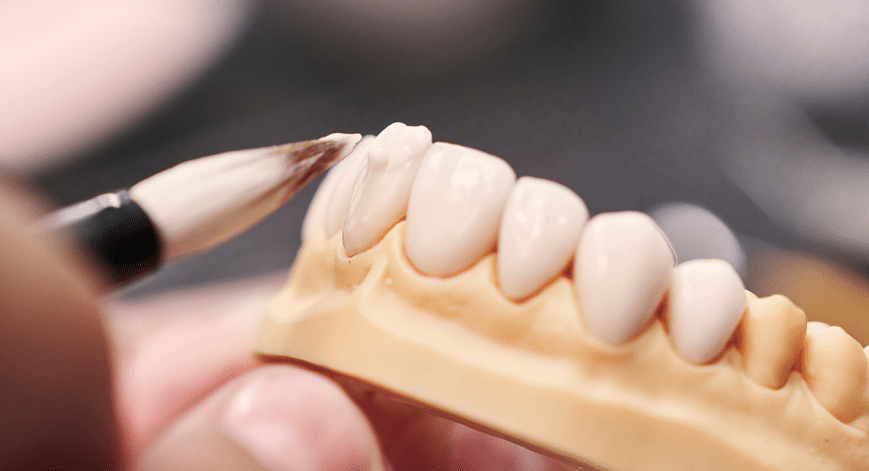
Composite veneers are made by placing composite resin directly on your teeth, by your dentist, in the chair. They can be placed with minimal to no removal of tooth structure.
- The more cost-efficient option — see the Price Guide
- Usually completed in a single appointment
- Repairable — a chip can be added to and polished rather than requiring a remake
- Reversible in many cases, since little or no enamel is removed
- Prone to taking up stains from coffee, tea, wine and smoking
- Typically lasts around five years before requiring replacement
The conservatism is the real advantage, and it is under-appreciated. A veneer that removes no enamel leaves every future option open. Composite bonding: will it look natural and how long will it last? covers the material in detail.
Porcelain veneers
Porcelain veneers are hand-crafted outside the mouth — at Smile Solutions, by an in-house ceramist — before being bonded into place. See Smile Solutions Laboratory.
- Most closely resemble the colour and shine of a natural tooth, because porcelain transmits light in a way composite does not
- The most durable of the two materials
- Made specifically for you, and you can be fully involved in designing the shape, colour and overall look — see The Mock-Up Reveal and Before & After Gallery
- Rarely stain
- Typically last around fifteen years — see How long do porcelain veneers last?
The trade-off to weigh: preparing a tooth for porcelain veneers normally removes enamel and is irreversible. Once done, the tooth will always need a veneer or a crown. When a porcelain veneer chips, it usually has to be remade rather than repaired. Where the case allows it, the temporary stage can sometimes be skipped — Same-Day Porcelain Veneers.
Side by side
| Composite | Porcelain | |
|---|---|---|
| Made | Directly on the tooth, in the chair | By a ceramist, outside the mouth |
| Appointments | Usually one | Usually two or more |
| Tooth removed | Minimal to none | A thin layer; irreversible |
| Cost | Lower | Higher |
| Staining | Prone to it | Rarely stains |
| Typical lifespan | ~5 years | ~15 years |
| Repairable | Yes, chairside | Usually needs remaking |
| Appearance | Good | Closest to natural |
Those lifespans are typical, not guaranteed. Both are shortened considerably by grinding, by biting hard objects, and by poor gum health. If you grind, a night guard is part of the plan rather than an optional extra — see TMD and Teeth Grinding. On gum health, see Bleeding Gums and Dental Cleans & Hygienists.
One important caution about those two numbers, and about any lifespan you are quoted elsewhere. They are the practice's working estimates from its own cases, not figures drawn from a published study — and no dental authority we can find publishes a veneer lifespan in years at all. What the published literature does report is survival rates over defined periods, which is a different and more useful measure. Those figures are set out in the questions at the end of this page. Treat a confident-sounding lifespan as a starting point for a conversation about your bite and your habits, not as a specification.
Before deciding
Worth working through with your dentist:
- What are the less invasive alternatives — whitening, bonding, orthodontics — and why are veneers preferred here? See Cosmetic dentistry options
- How much enamel will be removed, and can I see that on a mock-up before anything permanent?
- Will I see a preview? A mock-up placed over the teeth lets you assess shape, length and speech, and to decide not to proceed — see The mock-up reveal: why you should see your new smile before any treatment begins
- Which teeth? Veneering only some teeth means the untreated ones will drift in shade over time, since porcelain does not change colour and natural teeth do. Whiten first — see I want to whiten my teeth but one of my front teeth has a porcelain crown
- What is the total cost over twenty years, including replacement? See Payment Plans
Payment plan options are available. Where a plan is advertised as interest free, that describes the plan term only — a deposit may be required, an establishment fee and ongoing account fees may apply, and charges can apply if the balance is not cleared within the agreed period. The applicable terms depend on the provider and the amount financed, and are set out in writing before you commit — ask what the deposit and the establishment fee are, in dollars, and what the total will be by the end. Payment Plans.
One funding question comes up often enough to answer here: the Child Dental Benefits Schedule will not pay for this. Services Australia lists “cosmetic dental work” among the services it will not cover, alongside orthodontic work and any dental services in a hospital. See the Child Dental Benefit Schedule.
A reasonable path for many people: start with composite, live with the shape for a few years, and move to porcelain later if you want the durability. Starting with the reversible option costs less and forecloses nothing. Bonding or veneers? sets out that sequence.
And if you are considering having it done cheaply overseas, read Turkey teeth: the real risks of getting veneers overseas and Dental tourism: the risks involved first. The preparation is the irreversible part, and it is done before you fly home.
About the term “cosmetic dentist”
This page describes elective cosmetic treatment, so the title question is worth settling. There is no dental specialty called cosmetic dentistry in Australia. The Dental Board of Australia states that “there are 13 dental specialties in Australia which are approved by the Australian Health Workforce Ministerial Council”, and the list it publishes runs: dento-maxillofacial radiology, endodontics, forensic odontology, oral and maxillofacial surgery, oral medicine, oral and maxillofacial pathology, oral surgery, orthodontics, paediatric dentistry, periodontics, prosthodontics, public health dentistry (community dentistry), and special needs dentistry. Cosmetic dentistry does not appear. The ADA's own consumer material says it in one line: “A dentist cannot be registered as a Cosmetic Dentist in Australia.”
That does not mean a general dentist should not do this work — most veneer treatment in Australia is done by general dentists, competently, and the ADA states that these treatments “can be done by a general dentist or a dental specialist, called a prosthodontist”. It means the phrase carries no registration behind it, and it cannot be used to infer training. The registration that can be checked is published: the Board notes that “Ahpra publishes an online register of all dental practitioners that provides the profession and the public with up-to-date information about a dental practitioner's registration status”, including the specialty of anyone holding specialist registration. Where a case is handled under specialist care, the relevant specialty is usually prosthodontics — see Prosthodontists and Dentists & Registered Specialists.
Common questions
Is there any actual published evidence on how long these last?
Yes — on survival rates over set periods, which is not the same thing as a lifespan. Here is what the systematic reviews report, and it is worth reading both columns rather than one.
Porcelain. A 2021 systematic review in the Journal of Clinical Medicine pooled 25 studies covering about 6,500 porcelain laminate veneers and found a 10-year estimated cumulative survival rate of 95.5%, counting fracture, debonding, secondary caries and endodontic problems as failures.
Composite. A 2023 systematic review and meta-analysis in the Journal of Evidence-Based Dental Practice pooled randomised controlled trials of resin composite laminate veneers and found an overall pooled survival rate of 88% (95% CI: 81%–94%), with mean follow-up ranging from 24 to 97 months — two to about eight years, not ten. Within that, the direct approach (built on the tooth in the chair, as described above) came out at 91% and the indirect approach at 84%. Its authors add a sentence worth carrying into the consent conversation: patients choosing this ‘minimally invasive treatment option should be well informed about the high mechanical and aesthetic complication rates of the materials as well as the high maintenance' required.
Two warnings about reading those numbers. First, they measure different periods, so 95.5% and 88% are not directly comparable. Second, and more important, the 95.5% figure does not mean 95.5% of veneers still looked good at ten years — the review counts a veneer as surviving even where it needed repolishing or repair. Appearance and survival are two different outcomes.
Which one actually fails more often? Is there a head-to-head?
There is one, and it is the clearest number on this page. A 10-year practice-based evaluation by Mazzetti and colleagues, published in Dental Materials in 2022 and tabulated in a 2024 review in the Journal of Functional Biomaterials, compared the two directly: ‘Composite veneers presented a higher risk of failure than ceramic veneers with higher HR for survival [HR 4.00 (2.74–5.83)] and success [HR 5.16 (2.65–10.04)].'
In annual failure rates, the same study reported: for success — 9.1% at five years and 10% at ten years for direct composite, against 2.9% and 2.8% for ceramic. For survival — 3.9% and 4.1% for composite, against 1.4% and 1.2% for ceramic.
The distinction between those two rows is the useful part, and it explains the gap. ‘Survival' counts only outright replacement. ‘Success' counts any intervention at all, including a repair or a repolish. Composite's numbers are far worse on success than on survival because composite is the material that gets touched up — which is exactly the property listed as an advantage further up this page. It is repairable, and it needs repairing.
So the honest reading is not ‘porcelain is better'. It is: porcelain needs intervening on less often; composite trades that for being cheaper, reversible and fixable in the chair. Which trade suits you depends on your budget, your tolerance for maintenance appointments, and how much enamel you are willing to lose — which is the next question.
How much of my tooth is actually removed?
This is the question worth asking hardest, because it is the only irreversible part. There is a measured answer, with an important caveat about how it was measured.
A study by Edelhoff and Sorensen in the Journal of Prosthetic Dentistry weighed how much coronal tooth structure different preparation designs remove. Across the designs tested, removal ranged from approximately 3% to 30% of the coronal tooth structure by weight for veneer preparations. On the typodont teeth used, a partial porcelain laminate veneer removed 8.2%, a traditional veneer 16.7%, an extended veneer 22.1%, and a complete veneer 30%. By comparison, an all-ceramic crown removed 64% and a metal-ceramic crown 71.9% — the authors noting that the crown preparation removed about 4.3 times more than a traditional veneer.
The caveat matters and we are not going to bury it: that study was done on artificial resin teeth (typodonts) in the laboratory, on anterior teeth, not on patients. The proportions are a reasonable guide to the relative scale of different preparations. They are not a prediction of what will happen to your tooth.
What to do with it: ask which of those designs is being proposed for you, ask whether a partial rather than a complete preparation would achieve the result, and ask to see the plan on a mock-up before any drilling. And note the direction of the comparison — if the discussion is drifting from veneers towards crowns, the amount of tooth at stake roughly quadruples.
Does it matter how much enamel is left behind?
It matters a great deal, and this is the single best argument for treating erosion, wear or existing large fillings before veneers rather than covering them.
A systematic review reported in the Journal of Prosthetic Dentistry literature graded veneer survival by what the veneer was bonded to. Where the preparation stayed in enamel, survival was highest. Where there was severe dentine exposure, the descriptive survival rate fell to 91% (range 84–98%) and the success rate to 74% (64–85%) — against 94–95% survival in the intermediate groups. Bonding to dentine is simply not as reliable as bonding to enamel.
A related figure from the preparation literature: on intact teeth, a measured veneer preparation left ‘approximately 30%' exposed dentine and 70% enamel, which the authors noted ‘is above the minimally acceptable for the enamel exposure (40%) required to obtain an efficient bond strength'. On a tooth that has already lost enamel to acid wear or grinding, there is less to work with before you start.
Practical consequence: if you have erosion or heavy wear, stabilising the cause first is not a delaying tactic. It protects the result. And it is a fair question to ask directly — how much enamel will be left under this veneer, and what does that do to the odds?
I want it done in Turkey for a quarter of the price. What is the actual objection?
The Australian Dental Association's Federal Council has a published position, and it is not subtle. It advises that Australian residents ‘should only seek elective dental care in Australia to ensure Australian standards are met', warns that patients can return ‘with long term problems which may be difficult to resolve on return to Australia', notes that ‘Infection prevention and control standards in overseas dental clinics may not meet Australian' standards, and points out that treatment abroad ‘may not be covered by Australian health funds'. It also calls for Australian promoters of overseas health services to be required to indemnify patients — which tells you where it thinks the liability currently sits.
Beyond the position statement, there is a structural problem this page has already named. The preparation is the irreversible step, and it happens before you fly home. If the result needs redoing, the tooth underneath has already been cut, so the second attempt starts from a worse position and often ends in crowns rather than veneers — which, on the figures above, is a very different amount of tooth.
And the numbers in the answers above are the ones to apply here too: a 95.5% ten-year survival rate comes from studies of conventionally planned, conventionally reviewed treatment. It is not a warranty that attaches to the material wherever it is placed. Turkey teeth: the real risks and dental tourism: the risks involved
Practical details
To obtain tailored professional advice, book a consultation with your dentist to discuss which option will work best for you. See Complimentary Cosmetic Consultation and Contact Us. Confirm the current terms when you book — what the appointment includes, whether records such as scans or radiographs are part of it or charged separately, and whether any deposit applies.
Results, recovery times and potential risks vary for each individual and each procedure. The information here is general in nature and intended for those over the age of 18. Undergoing any dental or cosmetic procedure is a significant decision, and patients should seek independent advice from a qualified, AHPRA-registered practitioner before proceeding. Preparation for porcelain veneers is irreversible.
Registration can be verified on the AHPRA register, or by calling 1300 419 495; the clinicians are listed on Our Team. “Cosmetic dentist” is not a recognised specialty — see Dentists & Registered Specialists and Prosthodontists.
Smile Solutions, Level 1, 220 Collins Street, Manchester Unity Building, Melbourne VIC 3000. Phone 13 13 96, or theteam@smilesolutions.com.au. Monday–Friday 8.00am–6.00pm, Saturday 8.30am–1.30pm, Sunday by appointment.
Published 3 April 2023. General information only; it does not replace advice from your treating practitioner. Payment plan terms are set by the credit provider and change; confirm current terms directly before you commit. Third-party material is quoted as attributed to its publisher.
Smile Solutions trades under ABN 28 193 514 103.
Images on This Page
-
https://www.facebook.com/tr?id=800557773428361&ev=PageView&noscript=1
(no alt text)
-
https://www.smilesolutions.com.au/wp-content/uploads/2025/10/calendar_month.svg
(no alt text)
-
https://www.smilesolutions.com.au/wp-content/themes/arcadian-wordpress-theme/assets/images/smile_solutions_logo_white.png
Smile Solutions Logo
-
https://www.smilesolutions.com.au/wp-content/themes/arcadian-wordpress-theme/assets/images/smile_solutions_logo_purple.png
Smile Solutions Logo
-
https://www.smilesolutions.com.au/wp-content/uploads/2023/11/SS-Tooth-1-1-150x150.png
Smile Solutions
-
https://www.smilesolutions.com.au/wp-content/uploads/2023/04/WEBSITE-Media-2.png
Dental model with brush application
-
https://www.smilesolutions.com.au/wp-content/uploads/2025/09/Root-Canal-2-300x217.jpg
Root Canal
-
https://www.smilesolutions.com.au/wp-content/uploads/2026/08/Mouth-Breathing-300x270.jpg
Mouth Breathing
-
https://www.smilesolutions.com.au/wp-content/uploads/2025/09/Dental-Crown-at-Smile-Solutions-300x300.jpg
Dental Crown at Smile Solutions
-
https://www.smilesolutions.com.au/wp-content/themes/arcadian-wordpress-theme/assets/images/family_owned_bussiness.png
Family Owned Business
-
https://www.smilesolutions.com.au/wp-content/themes/arcadian-wordpress-theme/assets/icons/icon--phone.svg
Smile Solutions Contact
-
https://www.facebook.com/tr? id=800557773428361&ev=PageView&noscript=1
(no alt text)