What are my options if I want to change the shape of my teeth?
Whether you are after subtle improvements or major changes, several options exist. The right one is determined by the degree of reshaping required and your desired outcome — so the list below runs from smallest intervention to largest. If you are starting from scratch, where a smile makeover begins is the wider version of this conversation.
One principle governs the whole list, and it is the most useful thing on this page: start with the least invasive option that achieves what you want. Every step up the ladder removes more tooth, and tooth structure removed does not come back. A twenty-year-old who starts with veneers has committed to maintaining restorations for sixty years. The same person who starts with contouring or bonding has kept every option open.
Two things worth doing before any of this, because they change what is needed and cannot be done afterwards:
- Straighten first if the teeth are crooked. Reshaping is a poor substitute for moving a tooth into position, and orthodontics often means far less restorative work afterwards — sometimes none. Orthodontic Braces, Invisalign, and how to work out which treatment suits you.
- Whiten first if you want a lighter shade. Restorations are matched to your teeth on the day they are made and never whiten afterwards — which is also why an existing crown on a front tooth complicates the plan. Healthdirect Australia lists the two consequences among the standard risks of veneers: "the colour of your veneers can't be changed after they've been applied", and "your other teeth may become discoloured, no longer matching your veneers". Doing it in the wrong order is the most common and most expensive sequencing mistake in cosmetic dentistry. Professional Teeth Whitening, and how long the result lasts.
Simple odontoplasty / recontouring
If only minor shape changes are needed, small amounts of enamel are removed to achieve the result. The procedure is called odontoplasty — tooth contouring.
Works best for:
- rounding off corners
- smoothing out uneven edges
- removing surface defects such as minor pitting
- evening up the lengths of front teeth after wear
Its appeal is that it adds nothing to the tooth, requires no laboratory work, usually needs no anaesthetic, and is often done in minutes at a routine appointment. Its limit is that enamel removed cannot be replaced, so the amount of change achievable is small by definition — typically a fraction of a millimetre.
Done conservatively it is the safest intervention here. Done heavily it causes sensitivity and weakens the edge, so a good clinician will be cautious about how much they take.
Bonding — the option between contouring and veneers
Worth naming separately, because it is often the right answer and is easy to overlook.
Composite resin added directly to the tooth to build up a chipped corner, close a small gap, lengthen a short tooth or mask a defect — usually with little or no drilling, often without anaesthetic, in one visit. Edge work in composite is the most conservative version of it.
Its great advantage is reversibility: if you dislike it, it can be polished off and your own tooth is still there. Porcelain is a one-way decision; bonding is not, which makes it the sensible starting point for anyone young or undecided. Composite Bonding, and how natural it looks and how long it lasts.
Veneers
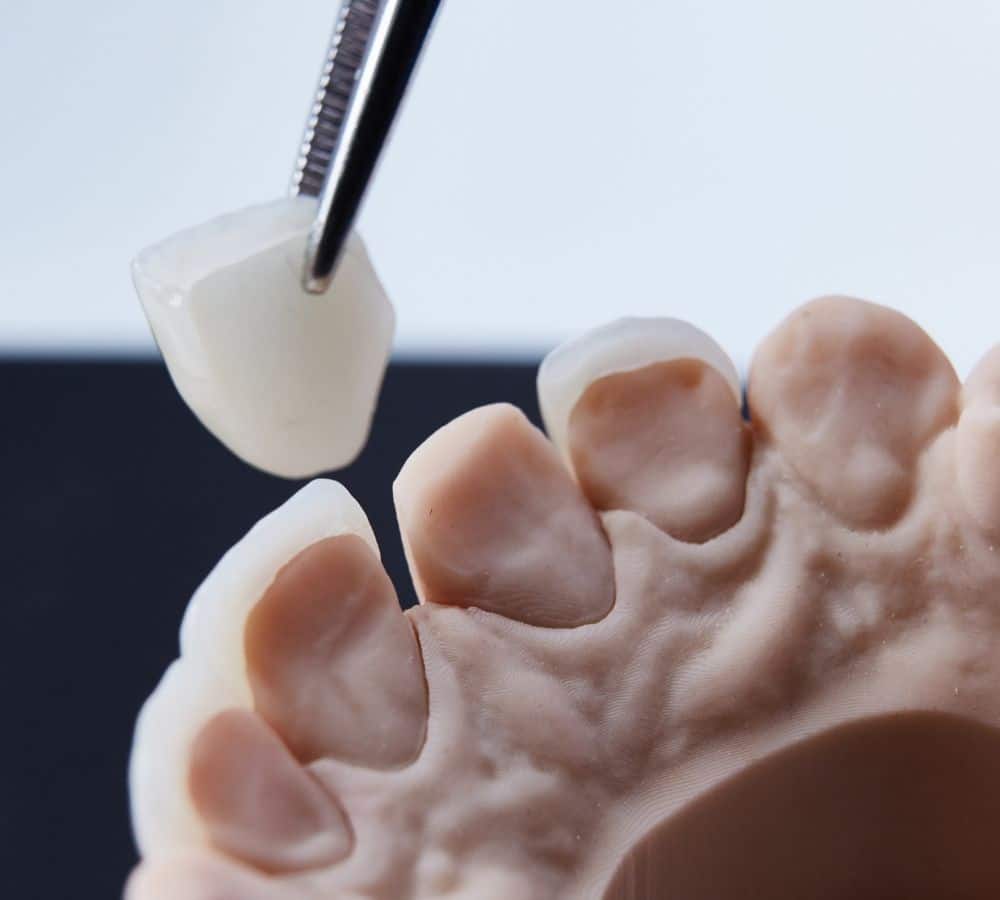
For a more significant change, your dentist can place veneers — wafer-thin facings, made with either composite resin or high-strength porcelain, firmly bonded to the surface of your teeth.
Healthdirect Australia's framing is worth keeping in view: veneers "help to improve the appearance of your teeth" but "they're not used to repair damage", and "veneers don't fix tooth decay or problems with your bite." It also notes that they "may not be suitable if you grind or clench your teeth or if you have gum disease."
Composite resin veneers
Applied to the front teeth for small to moderate shape changes.
- Tooth coloured
- Moderately durable — but porous, so rarely permanent
- Made and fitted in a single visit
- Repairable chairside when they chip
On how long they last, the honest answer is a survival rate rather than a number of years. A systematic review and meta-analysis of resin composite laminate veneers pooled the randomised trials and found an overall survival rate of 88% (95% CI 81%–94%), over a mean follow-up ranging from 24 to 97 months. Within that, the direct technique — built straight onto the tooth — ran at 91%, and the indirect (laboratory-made) approach at 84%. Only seven studies out of 827 screened qualified, so read those figures as the best available rather than the last word.
Particularly useful for: reshaping teeth after orthodontic work, repairing small fractures, and closing gaps between teeth.
Porcelain (ceramic) veneers
Lab-fabricated facings bonded to the front surface of the teeth.
- Durable, and the most durable option short of a crown
- Resistant to staining and chipping
- Two appointments — one to prepare the teeth for manufacture, one to fit — unless they are made and fitted the same day
The published survival figures, which are more useful than a lifespan in years. A systematic review pooling clinical studies of porcelain laminate veneers reported a 10-year cumulative survival rate of 95.5% across 3,300 veneers when fracture, debonding, secondary decay and the need for root canal treatment were all counted as failure. Taken one at a time, the same review gives 96.3% for fracture, 99.2% for debonding, 99.3% for new decay and 99.0% for needing endodontic treatment at ten years.
There is also Australian data, which is rarer and worth citing for that reason. A prospective cohort followed 499 feldspathic porcelain veneers placed in 155 patients by a single prosthodontist in an Australian private practice between 1990 and 2010. Cumulative survival was 98% at 5 years, 96% at 10 years, 91% at 15 years and 91% at 20 years. Two caveats travel with it: only teeth with at least 80% enamel remaining were veneered, and patients with heavy wear from grinding were excluded — so this is a well-selected group, not an average one. Only 82 of the veneers were observed as far as 20 years.
One thing survival does not mean. A veneer counts as surviving if it is still in the mouth and intact. It does not mean it still looks the way it did — the same review notes that veneers repolished or repaired along the way are still counted as survivors. Appearance and survival are different measures.
Excellent for moderate to major changes in tooth shape and texture. How long porcelain veneers last and how the two materials compare are both worth reading before choosing.
The practical trade-off between the two: composite is faster and cheaper but will discolour and need replacing; porcelain costs more up front and holds its appearance for far longer. Healthdirect says the same in one line — "porcelain veneers can look more realistic and last longer than resin veneers, but they are more expensive."
What porcelain veneers commit you to, stated plainly because it is frequently glossed over:
- The tooth is prepared, and that is permanent. How much enamel is removed varies enormously with the design chosen, and there are measurements for this. A laboratory study of preparation designs on anterior teeth found that a partial porcelain laminate veneer removed a mean 8.2% of the coronal tooth structure, a traditional facial-surface veneer 16.7%, an extended veneer 22.1%, and a complete veneer 30%. For comparison, an all-ceramic crown preparation removed 64% to 70%. Ask specifically which design is planned for you, and ask to see it on a model or mock-up.
- Once prepared, the tooth always needs a restoration. There is no going back to a natural tooth — and the tooth underneath can still decay.
- They are not permanent either. Healthdirect's plain version: "veneers may need to be replaced due to chips, fractures or changes in colour over time." Replacement usually means preparing a little more.
- A prepared tooth can lose its nerve later and need root canal treatment. In the ten-year data above that happened to about 1 in 100 veneered teeth.
- Other risks healthdirect lists: jaw pain, the veneer cracking or falling off, increased sensitivity because some enamel is removed, and visible veneer edges if the gum shrinks.
- They are done in sets, because matching one veneer to natural neighbours is very difficult. That drives the cost up.
And if the price quoted somewhere else is a fraction of the price here, read what we see when patients come back from overseas veneer work before booking anything. The Australian Dental Association has a formal policy on this — Policy Statement 2.2.6, Elective Overseas Dental Treatment — whose position is that such treatment "carries the risk of adverse oral and general health outcomes", and which makes the point that "optimal ongoing oral health cannot be achieved in a single episode or short course of treatment and requires regular maintenance." In fairness to the reader: that is a professional position statement and it attaches no complication rate to the concern. Nobody publishes a number for how often overseas veneer work goes wrong.
Crowns
For major shape changes, crowns are the solution.
A crown is a fabricated tooth-shaped covering that encases the prepared tooth, allowing the dentist and patient to dictate the new shape of the entire tooth — not only the front surface. The material it is made from affects both appearance and cost.
Because a crown wraps the whole tooth, it involves the most preparation of the options here — the 64% to 70% figure above, against 8% to 30% for a veneer — and it is the option chosen when a tooth needs strengthening as well as reshaping: after root canal treatment, or where a large old filling has left little sound structure. For appearance alone, on a sound tooth, a crown is usually more than is needed — the difference between a crown and a veneer is largely a question of how much tooth has to go. Dental Crowns.
Choosing
| Change achievable | Visits | Tooth removed | Reversible | Published survival | |
|---|---|---|---|---|---|
| Odontoplasty | Minor | One | A fraction of a millimetre | No | Permanent (enamel gone) |
| Bonding | Small to moderate | One | Little or none | Usually yes | See composite below |
| Composite veneers | Small to moderate | One | Minimal | Usually | 88% (95% CI 81–94%), follow-up 2–8 years |
| Porcelain veneers | Moderate to major | Two | 8–30% of the crown, by design | No | 95.5% at 10 years; 91% at 20 in an Australian cohort |
| Crowns | Major | Two | 64–70% of the crown | No | High |
All except odontoplasty and bonding involve irreversible preparation of the tooth, so it is worth asking how much tooth structure each option removes before deciding. Published fees for each are in the price guide.
Five questions to ask before committing
Each of these now has an answer with it. Ask them anyway — what you are listening for is whether the answer you get is as specific as the one below.
1. How much of my own tooth will be removed?
Ask for it in specifics, not reassurance. The percentages in the table above give you something to compare the answer against, and the honest form of the reply names a design: partial veneer, traditional facial veneer, extended, complete, or crown. Those are four different amounts of tooth — 8.2%, 16.7%, 22.1% and 30% of the coronal tooth structure by weight, against 64% to 70% for an all-ceramic crown preparation — and they look identical in a brochure.
Two qualifications belong with those figures whenever they are quoted, including here. The study that produced them was in vitro, on artificial typodont anterior teeth, ten specimens per design, so it measures what each design requires rather than what a clinician took off a particular tooth. And the percentages are by weight of the crown of the tooth, not of its surface area — which is a different quantity and is often confused with it.
There is a second number worth asking about, because it decides whether the restoration will hold. Bonding grips enamel, not dentine. A 2022 laboratory study in Materials prepared 20 intact upper central incisors for laminate veneers and found the prepared surfaces left roughly 70% enamel with about 30% exposed dentine, which it described as "above the minimally acceptable for the enamel exposure (40%) required to obtain an efficient bond strength". Those teeth were intact to begin with. If your tooth is already worn, eroded or previously filled, there is less enamel to bond to before anyone starts — so the question becomes not only how much will be removed, but how much is left.
2. What is the least invasive option that gets close to what I want?
The most useful question on the list, and the one to judge a practice by. A good answer works down the ladder in the reader's hearing: whitening and orthodontics remove nothing, bonding removes little or nothing and can be polished off, a partial veneer removes about a third of what a complete veneer does, and a crown is a different order of commitment.
It also has a floor that is almost never offered. Healthdirect Australia lists, first among alternatives to veneers, the option most practices skip: "An alternative to veneers is to continue to live with your teeth as they are." That is the baseline against which every quoted figure should be read — not because doing nothing is always right, but because a plan that has never been compared with it has not been justified.
Be wary of the reverse move as well. Where the complaint is position rather than shape or colour, reshaping is a substitute for moving the tooth, and it pays for the shortcut in enamel. Ask whether orthodontics would achieve this with no tooth removed at all.
3. Can I see a mock-up or trial smile first?
Yes, and this is a request rather than a favour. Composite or wax previews let you see the proposed shape on your own teeth before anything is prepared, in daylight, with the chance to speak and photograph it — and to change your mind while changing your mind still costs nothing. It is the single best protection against disappointment.
Being straight about the evidence: no published guideline or trial in the sources we can find prescribes a mock-up, or measures how much it reduces dissatisfaction. It is a professional convention rather than a proven intervention, and we would rather say so than dress it up. What can be said with confidence is the asymmetry — a mock-up is reversible and preparation is not, and healthdirect's flat statement that "you can't take veneers off" is why that asymmetry matters more here than in most of dentistry.
A digital simulation on a screen is not the same thing. Ask for the physical version, in your mouth.
4. What is the expected service life, and what happens — clinically and on cost — when it fails?
Expect the answer as a survival percentage at a stated number of years, not as a lifespan in years, because that is how the evidence is reported and no authority publishes a veneer lifespan in years. The figures above are the ones to hold the answer against: 95.5% at ten years for porcelain laminate veneers pooling 3,300 restorations, 88% (95% CI 81–94%) for composite over a mean follow-up of 24 to 97 months.
Then ask the question that makes a survival figure mean something: counted how? Across the porcelain literature, failure was defined as ‘irreparable' in some studies and ‘reparable but counted as a failure' in others, and several did not define it at all — which is why published ten-year figures for the same restoration range from the 50s to the 90s. A chip that was polished smooth is a survivor in one study and a failure in the next. The same caution applies to the Australian 20-year figures on this page: bruxers were excluded and only teeth with at least 80% enamel were treated.
On what happens at failure, the answers that matter are practical. Can it be polished, repaired in composite, or does it have to be remade? What does one replacement cost, and what do all of them cost? How much more tooth goes each time, since the old restoration has to be cut off? And is a single unit replaceable in a matched set, or does matching one new veneer to aged neighbours mean redoing several? The direct-versus-indirect split in the composite data is relevant here too — the pooled figures were 91% for direct and 84% for indirect — and the composite review's own conclusion was that "most of the complications were regarded as clinically acceptable with or without reintervention", which is a description of maintenance rather than catastrophe.
5. Do I grind my teeth?
If so, that is addressed first, and a night splint afterwards. Grinding is the fastest way to destroy cosmetic work, and it is one of the two conditions healthdirect names as making veneers potentially unsuitable — the other being gum disease.
The forces involved are not trivial and have been measured. A sleep-laboratory study of sleep bruxism recorded a mean bite-force amplitude of 22.5 kgf (SD 13.0) during bruxism events, with a mean event duration of 7.1 seconds. Porcelain is strong in compression and brittle in flexion, and a thin facing on a front tooth is the wrong geometry for that kind of repeated loading.
Two things are worth knowing about how grinding should and should not be managed, because this is an area where dentistry has changed and some advice has not caught up. First, a splint is protective, not curative — it shields the restorations; it does not stop the grinding. Second, and more important if anyone proposes altering your bite as part of a cosmetic plan: the US National Academies' 2020 review of temporomandibular disorders concluded that "occlusion should not be considered a contributing cause for the common TMDs", and a 2023 BMJ clinical practice guideline for chronic temporomandibular disorders issued a strong recommendation against irreversible oral splints. A removable night splint is reversible and low-risk. Permanently reshaping teeth to ‘correct' a bite is not, and the evidence does not support doing it to treat jaw pain.
A 2025 international consensus (INfORM) goes further on the framing: bruxism is a behaviour rather than a disorder, is not diagnosed as one, and may in some circumstances be protective — in obstructive sleep apnoea, for instance, the muscle activity "may contribute to maintaining the patency of the upper airway". That does not make grinding harmless to ceramic. It does mean the reason to manage it is the damage to your teeth and restorations, not a claim that the grinding itself is a disease being cured.
Common questions
I only dislike one tooth. Can just that one be treated?
Sometimes, and the constraint is almost always matching rather than technique. Ceramic is highly colour-stable and natural teeth are not, so a single unit that matches perfectly on the day will drift from its neighbours over the following years. Matching one new restoration to aged adjacent teeth is the hardest task in this field — a single upper central incisor especially, because it sits beside an identical twin that will be compared with it directly.
That is why veneers are commonly done in sets, and why the number should be justified in terms of what actually shows when you smile and talk rather than by a default. Healthdirect notes only that cost "will also depend on how many veneers you get and what size they are" — so the count is a clinical and aesthetic decision with a financial consequence, in that order. Ask to see the proposed number on a mock-up before agreeing to it.
Will reshaping make my teeth sensitive?
It can, and the mechanism is the same in every option on this page: sensitivity tracks how much enamel is gone and whether dentine is exposed. Healthdirect lists among the risks of veneers that "your teeth could become more sensitive because some enamel is removed". Heavy odontoplasty can do it too, which is the reason a careful clinician takes less than they could.
The laboratory study behind the tooth-reduction percentages on this page states the principle its authors were working from: "The conservation of sound tooth structure helps preserve tooth vitality and reduce postoperative sensitivity." Worth knowing that this is the authors' stated rationale rather than a measured finding of that study — it did not follow pulp outcomes. But it is the clearest available link between how much is removed and what you may feel afterwards, and it points the same way as the rest of this page.
Some settling sensitivity after preparation is common and usually eases. Sensitivity that increases, wakes you, or lingers after weeks is worth reporting rather than enduring — see what to do if you suffer from sensitive teeth.
Can bonding really be reversed, or is that a figure of speech?
It is largely literal, and it is the strongest practical argument for starting there. Composite added to an unprepared tooth can be polished off, leaving the tooth as it was — which is not true of anything from veneers upward. The trade-off is durability: composite laminate veneers pooled at 88% survival (95% CI 81–94%) over 24 to 97 months, against 95.5% at ten years for porcelain, and the cleanest head-to-head comparison reports composite failing at roughly four times the rate of ceramic.
Two honest qualifications. "Little or no drilling" is not the same as none — where a gap is being closed or a surface masked, some preparation may be needed, and you should ask which applies to your teeth. And composite's characteristic complaints are surface roughness, colour mismatch and staining at the margins, which the pooled evidence treats as maintenance rather than failure. What you are buying with composite is not permanence. It is the option to change your mind. See Composite Bonding and bonding or veneers?
Will a health fund pay for this?
Usually very little where the purpose is purely appearance, and more where the treatment has a restorative purpose — and the item numbers on the quote are what decide it, which is another reason to get them in writing before you commit.
Comparing two quotes is also harder in dentistry than in most fields, and that is structural rather than anyone's fault. Australia has no national dental fee schedule, so there is no published reference price to measure either quote against. The Australian Dental Association's own 2022 fees survey found "considerable variation in the fees charged within and between states", and a submission to the Senate inquiry into the value and affordability of private health insurance described the patient's position as "conflicting diagnoses and widely varying quotes for unpredictable dental fees", with "no consumer guidelines to ascertain the reasonableness of dental fees charged" — an argument put to an inquiry rather than settled policy, but an accurate description of the gap. What makes two quotes comparable is the item numbers and the exclusions, from both. See Understanding Your Treatment and the price guide.
Does this article replace an individual dental assessment?
No. It provides general information. Symptoms, suitability, risks and treatment choices depend on examination and, where indicated, imaging or other records from an appropriately registered practitioner.
Practical details
Written by Dr Maliha Siddiqui (DEN0001785009), Registered Dentist, General Registration, at Smile Solutions.
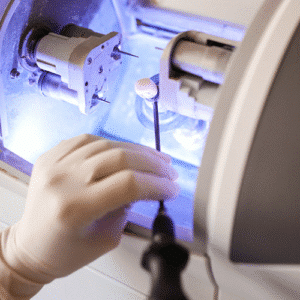
Smile Solutions is happy to answer any questions about the steps towards your ideal smile, and makes single-visit ceramic restorations on site using CEREC.
Smile Solutions, Level 1, 220 Collins Street, Manchester Unity Building, Melbourne VIC 3000. Phone 13 13 96, or theteam@smilesolutions.com.au. Monday–Friday 8.00am–6.00pm, Saturday 8.30am–1.30pm, Sunday by appointment.
Related: Composite Bonding, Porcelain Veneers & Crowns, Dental Crowns, CEREC Restorations, Professional Teeth Whitening, Bonding or veneers?, Is it time for a smile makeover?.
Registration can be verified free on the AHPRA public register at ahpra.gov.au. Note that "cosmetic dentist" is not a recognised specialty — cosmetic work is performed within general dentistry, or by registered specialists such as prosthodontists. Specialist Prosthodontists.
Published 23 October 2015. General information only — it is not a diagnosis, a treatment plan, a quote or a promise of any particular clinical outcome, and it does not replace advice from your treating practitioner. Preparing a tooth for veneers or a crown is irreversible, and no restoration is permanent. Results, durability and how much tooth must be removed vary between individuals and can only be determined after examination. The survival percentages quoted are group results from published studies, with their own selection criteria and follow-up periods; they are not predictions for an individual tooth. Tooth-reduction and enamel-exposure percentages come from laboratory studies of idealised preparations on anterior teeth and describe what each design requires, not what will be removed from your tooth. Fees are indicative and subject to change; confirm at your consultation.
Smile Solutions trades under ABN 28 193 514 103.
Images on This Page
-
https://www.facebook.com/tr?id=800557773428361&ev=PageView&noscript=1
(no alt text)
-
https://www.smilesolutions.com.au/wp-content/uploads/2025/10/calendar_month.svg
(no alt text)
-
https://www.smilesolutions.com.au/wp-content/themes/arcadian-wordpress-theme/assets/images/smile_solutions_logo_white.png
Smile Solutions Logo
-
https://www.smilesolutions.com.au/wp-content/themes/arcadian-wordpress-theme/assets/images/smile_solutions_logo_purple.png
Smile Solutions Logo
-
https://www.smilesolutions.com.au/wp-content/uploads/2016/05/Maliha-150x150.jpg
Dr Maliha Siddiqui
-
https://www.smilesolutions.com.au/wp-content/uploads/2018/12/Veneers-Cavities.jpg
Veneers Cavities
-
https://www.smilesolutions.com.au/wp-content/uploads/2025/11/TMD-Teeth-Grinding-Smile-Solutions-300x270.png
Woman holding her face, looking concerned.
-
https://www.smilesolutions.com.au/wp-content/uploads/2025/09/CEREC-restorations-Smile-Solutions-300x300.png
CEREC Restoration Smile Solutions
-
https://www.smilesolutions.com.au/wp-content/uploads/2017/03/get-chipped-tooth-fixed.jpg
get chipped tooth
-
https://www.smilesolutions.com.au/wp-content/themes/arcadian-wordpress-theme/assets/images/family_owned_bussiness.png
Family Owned Business
-
https://www.smilesolutions.com.au/wp-content/themes/arcadian-wordpress-theme/assets/icons/icon--phone.svg
Smile Solutions Contact
-
https://www.facebook.com/tr? id=800557773428361&ev=PageView&noscript=1
(no alt text)
-
https://bat.bing.com/action/0?ti=25148060&tm=gtm002&Ver=2&mid=ddb18cdb-78ba-4f95-9061-6d64311a4a9f&bo=1&sid=32fbf1e0ab2711f1b637236e98678afd&vid=32fc1900ab2711f196c54d73b5cc8331&vids=1&msclkid=N&pi=918639831&lg=en-US&sw=800&sh=600&sc=24&nwd=1&tl=What%20are%20my%20options%20if%20I%20want%20to%20change%20the%20shape%20of%20my%20teeth%3F%20-%20Smile%20Solutions&p=https%3A%2F%2Fwww.smilesolutions.com.au%2Fdental-articles%2Farticle%2Fchange-shape-of-teeth%2F&r=&evt=pageLoad&sv=2&cdb=AQAQ&rn=677015
(no alt text)