Bonding or veneers?
When you want to change the shape, length, width, colour and overall appearance of your front teeth, your dentist will usually raise two options: dental veneers and dental bonding. Both, done well, can enhance a smile. See Porcelain Veneers and Composite Bonding.
Which is right depends less on the look you want than on how long you need it to last, and what you are prepared to have removed from the tooth.
Dental bonding
Direct composite bonding is a process where composite resin is bonded directly to the tooth to:
- hide minor imperfections
- fix small chips — see Chipped and Cracked Teeth
- close small gaps
The same method places a composite filling — see Tooth Fillings.
Direct composite veneers are bonded in one visit, made by the dentist without laboratory involvement. For reshaping the biting edges specifically, see Edge Work & Composite Bonding.
Where it falls short
- Not as strong as porcelain
- Loses lustre over time, and needs polishing and maintenance more often
- Limited lifespan — the composite will eventually stain, chip and discolour, however skilled the operator
Composite bonding: will it look natural and how long will it last? sets out the typical lifespan and what shortens it.
Where it wins
Bonding has three clear advantages:
- Usually less than half the price — see the Price Guide
- Minimal to no tooth shaping required under normal circumstances
- A single visit, versus two to three for veneers
The second of those is the one that matters most in the long run: bonding is largely reversible, and porcelain is not.
Porcelain veneers
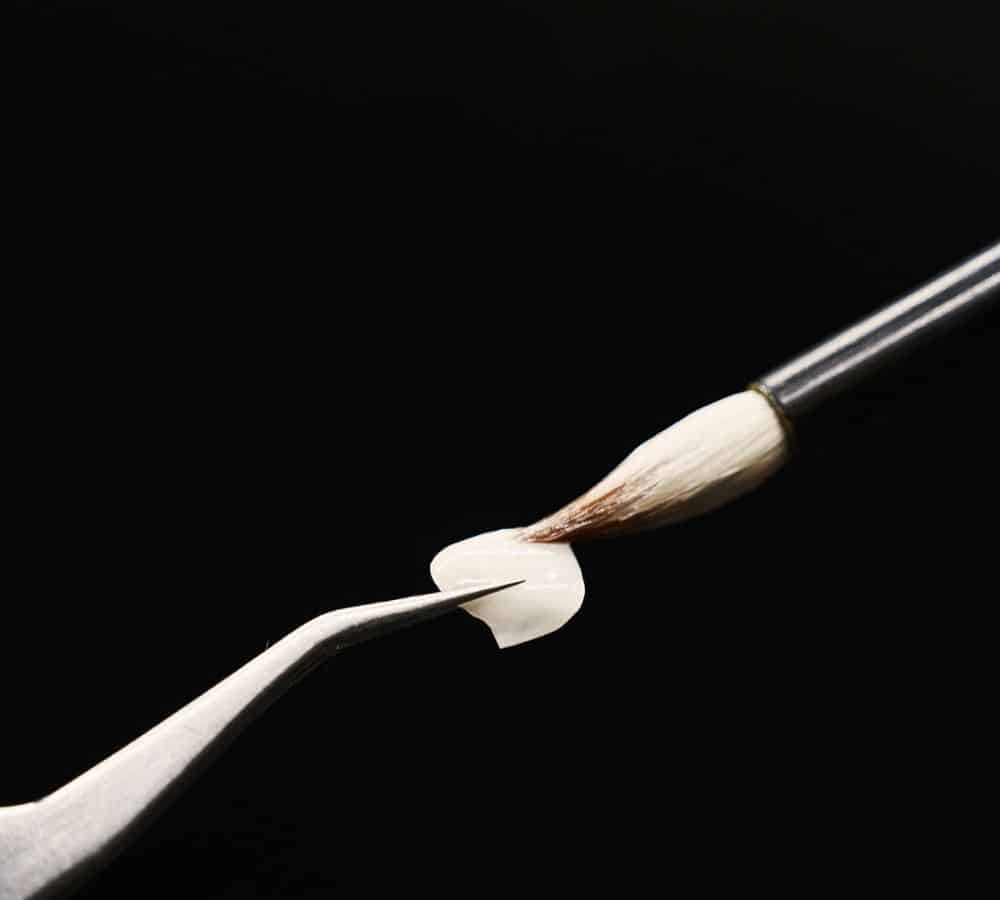
Made by a ceramist in a dental laboratory after the dentist has shaped the teeth. See Smile Solutions Laboratory.
Porcelain veneers remain the benchmark for aesthetics in creating a smile, because ceramists use a wide range of porcelain shades and opacities to reproduce the depth of a natural tooth.
Seeing the result before committing
With Digital Smile Design technology, patients can be far more involved in the aesthetics and the final outcome. In many cases digital veneers are custom-made and shown to the patient before any treatment begins. See The Mock-Up Reveal, Technology and Before & After Gallery.
That matters for a decision that is largely irreversible: you can reject a design before, rather than after, tooth preparation. The mock-up reveal: why you should see your new smile before any treatment begins explains the stage in full.
The clinical advantages
Stronger and more flexible, which makes them less susceptible to fracturing.
Dr Theron notes that over some twenty years of practice he has seen a higher propensity for patients to clench and grind while sleeping, which he attributes to more stressful lifestyles. That is exactly where the longer typical lifespan of veneers over bonding matters. See TMD and Teeth Grinding and Night-time tooth grinding and clenching — and note that a grinder generally needs a night splint whichever material is used.
Porcelain does not stain, thanks to its smoother, less porous surface — which also makes it easier to clean and maintain, and therefore promotes healthier, natural-looking gums. See Bleeding Gums and Dental Cleans & Hygienists.
On lifespan, see How long do porcelain veneers last?; on how veneers differ from crowns, What is the difference between porcelain crowns and veneers?.
What the numbers can and cannot tell you
A note on the figures on this page, because cosmetic dentistry is an area where confident lifespan claims are common and the sourcing for them usually is not. Almost every headline number you will read about how long a veneer lasts — including in dental marketing — traces back to the practice quoting it rather than to published follow-up data.
Independent comparative data does exist, and it points one way. A ten-year practice-based evaluation (Mazzetti and colleagues, Dental Materials, 2022, as tabulated by a narrative review in the Journal of Functional Biomaterials) followed both materials on natural teeth and found composite veneers carried a higher risk of failure than ceramic — a hazard ratio of 4.00 (95% CI 2.74–5.83) on survival, and 5.16 (2.65–10.04) on success. Expressed as annual failure rates on the success definition, that was 9.1% at five years and 10% at ten years for direct composite, against 2.9% and 2.8% for ceramic. The per-material survival figures from the two largest systematic reviews are set out in the questions at the end of this page.
What that does not settle, which is the part usually left out:
- It is observational, not randomised. The two groups were not treated alike by chance. Harder and more permanent cases tend to be sent to ceramic, and interim, younger or more conservative cases to composite — and no analysis after the fact can separate that selection from the material.
- It is overseas practice data. There is no equivalent Australian cohort.
- "Success" and "survival" are not the same measure. One counts any repair as a failure, the other only outright replacement. That single definitional choice is why the same material can look very different between two honest papers, and it is the first thing to ask about any figure you are quoted.
- Nothing published separates the material from the hands. How much of the gap is the composite itself, and how much is the preparation, the operator and the case, is not something the literature answers.
So the direction of the difference is established: composite is softer, more porous and easier to replace; porcelain is harder, less porous and harder to undo. What no study can give you is a number for your own tooth. How long either lasts in your mouth depends far more on your bite, your grinding habit, the acid load in your mouth and how much sound enamel the restoration is bonded to than on the material alone. Ask your clinician for an expected lifespan for your teeth, and ask what happens when it fails — that answer is more useful than an average.
Where bonding is the right answer
Bonding in the right hands is an acceptable short-term option, particularly:
- as a precursor to veneers at a later stage
- to mask imperfections temporarily while orthodontic treatment is still in progress
For younger patients whose teeth are still changing, that reversibility is a genuine advantage rather than a compromise.
One sequencing rule applies to both: whitening does not change the colour of composite or porcelain. Whiten first, let the shade settle, then match the restorations to it. See Teeth Whitening and I want to whiten my teeth but one of my front teeth has a porcelain crown.
One legal point sits behind that sequencing. Under Schedule 10 of the Poisons Standard, whitening products containing more than 6% hydrogen peroxide, or more than 18% carbamide peroxide, may only be sold, supplied and used by registered dental practitioners as part of their dental practice — provisions the Australian Dental Association notes are formalised in all state and territory poisons legislation. The ADA gives the conversion that reconciles the two figures: one-third of a carbamide peroxide concentration is equivalent to hydrogen peroxide, so 18% carbamide peroxide approximates 6% hydrogen peroxide. It is the reason a supermarket kit and a dentist-supplied kit are not the same product — see what is the difference between pharmacy whitening kits and dentist whitening?.
A case where both are used
Both bonding and veneers have been used to good effect in patients with untreated gastrointestinal problems. Heightened acidity in the mouth wreaks havoc with teeth.
The sequence matters: once the patient has been successfully treated by their physician, the lost tooth structure is ideally replaced with porcelain. Restoring before the acid source is controlled means restoring twice.
Dietary acid does the same work more slowly. The Australian Dental Association’s policy statement on diet and nutrition advises that acidic foods and drinks should be avoided especially where someone is at high risk of caries or erosion, and it names who that is:
- people with poor oral hygiene
- people with low or no fluoride exposure
- people with conditions that reduce salivary flow
- exertion resulting in a dry mouth
- people taking medications that reduce salivary flow
- sipping drinks other than water during interrupted sleep
- chewing and sucking acidic vitamin tablets
That last pair catches people out regularly. The ADA also singles out the elderly for dietary advice, because reduced saliva flow and more exposed root surfaces together raise the risk of decay.
If several of those apply to you, raise it before choosing a material rather than after — it changes the recommendation, and it changes how long either option is likely to survive. See what is acid wear and how can I avoid it?, how does acidic food affect your teeth?, dental erosion addressed and my mouth is always dry.
In short
| Dental bonding | Porcelain veneers | |
|---|---|---|
| Cost | Usually under half | Higher |
| Tooth shaping | Minimal to none | Required |
| Visits | One | Two to three |
| Strength | Lower | Stronger, less prone to fracture |
| Staining | Stains and discolours over time | Does not stain |
| Best as | Short-term or interim | Long-term |
On that first row, one piece of context about dental fees generally: Australia has no national dental fee schedule, and the ADA’s Dental Fees Survey 2022 — based on 3,819 valid responses as at 1 July 2022 — found considerable variation in the fees charged within and between states. So a quote you are given is one practice’s fee, not a market rate, and comparing two quotes is worth the effort. Ours are on the price guide.
Common questions
So how many years does each one actually last?
The comparison between the two materials, and its limits, is set out above. These are the per-material figures behind it, from the two largest systematic reviews.
Porcelain. A systematic review in the Journal of Clinical Medicine (Alenezi and colleagues, 2021) pooled 25 studies and 6,500 porcelain laminate veneers bonded to natural teeth, and reported a 10-year estimated cumulative survival rate of 95.5% when fracture, debonding, secondary caries and the need for root canal treatment were all counted together as failure. Counted in isolation: fracture 96.3%, debonding 99.2%, secondary caries 99.3%, need for endodontic treatment 99.0%.
Composite. A systematic review and meta-analysis in the Journal of Evidence-Based Dental Practice (Lim and colleagues, 2023) pooled the randomised trials on resin composite laminate veneers and found an overall survival rate of 88% (95% CI 81–94%) — 91% for the direct technique, which is what bonding is, and 84% for the indirect. Mean follow-up ranged from 24 to 97 months, so that is a two-to-eight-year figure, not a ten-year one, and the two reviews are not measuring over the same window.
Two things to hold on to. First, success counts any repair while survival counts only outright replacement — which is why the same material can look very different depending on which figure is quoted, and why it is always worth asking which definition a number is using. Second, these are averages from university clinics and private practices overseas, not a prediction about one tooth in one mouth.
How much of my tooth is actually filed away, and can it ever be undone?
This is the question worth asking before the aesthetics, because it is the part that cannot be reversed.
The measurement most often cited comes from Edelhoff and Sorensen in the Journal of Prosthetic Dentistry (2002), who weighed the tooth structure removed by each preparation design. It is a laboratory study on artificial typodont teeth, not a clinical one, so treat it as a ranking rather than a precise prediction:
| Preparation | Mean coronal tooth structure removed |
|---|---|
| Partial porcelain veneer | 8.2% |
| Traditional porcelain veneer (facial surface only) | 16.7% |
| Extended porcelain veneer | 22.1% |
| Complete porcelain veneer | 30% |
| All-ceramic crown | 64–70% |
| Metal-ceramic crown | 71.9% |
The authors concluded that veneer preparations required "approximately one-quarter to one-half the amount of tooth reduction of conventional complete-coverage crowns".
Read the top of that table carefully. A veneer is conservative compared with a crown — it is not the same as untouched. Enamel does not grow back, so once a tooth has been prepared it needs a restoration on it for the rest of your life, and every replacement thereafter is a re-preparation. Bonding, done without shaping, does not put you in that position. That asymmetry, not the price, is the real decision.
What actually goes wrong, and would I notice?
The two materials fail in genuinely different ways, which is why it is misleading to describe them interchangeably.
Composite fails aesthetically first. The 2023 meta-analysis found surface roughness, colour mismatch and marginal discolouration were the most reported complications, and that most were "clinically acceptable with or without reintervention". You are more likely to notice a composite restoration looking tired than falling off.
Porcelain fails mechanically. Across the 25 studies in the 2021 review, fracture was reported in 154 veneers, cracks in 56, surface chipping in 31, and debonding in 85. The timing is the useful part: fracture and debonding "most commonly happen within 2 years after cementation", secondary caries turned up after 5 years, and the need for root canal treatment between 3 and 7 years.
The authors of the composite review wrote the sentence that belongs in any consent conversation: patients choosing this option "should be well informed about the high mechanical and aesthetic complication rates of the materials as well as the high maintenance care". Ask what maintenance looks like, and what a repair or replacement costs, before you start rather than after.
I grind my teeth at night. Does that rule veneers out?
Not automatically — but you should know how thin the evidence is on this specific point. Of the 25 studies in the 2021 porcelain review, only 14 reported anything about grinders at all: ten included them in the cohort and four deliberately excluded them. So the headline 95.5% comes from a mixed population in which bruxism was inconsistently recorded, and it cannot be read as a figure that applies to a heavy grinder.
What the same review is clearer about is where the veneer sits. Survival is negatively affected by preparations extending into dentine, because a dentine bond is weaker than an enamel bond and dentine flexes more under load, and "high failure rates in PLVs have been associated to largely exposed dentin surfaces". One included study found veneers placed across existing composite fillings failed more often than those on intact teeth within 18 months.
The practical version: if you grind, the two questions that matter are whether your preparation can stay in enamel, and whether you will wear a night splint. Both are discussable before anything is cut. See TMD and Teeth Grinding.
Is there anything about veneers the evidence has not settled?
Yes, and a specific one worth knowing about, because it affects how your veneer is designed.
Whether a veneer should wrap over the biting edge of the tooth — "incisal coverage" — is genuinely unresolved. The 2021 review found veneers without incisal coverage failed more often. It then flags in its own text that a second review "did not show a statistically significant difference" between the two designs, and that a third found the opposite direction again, with incisal coverage carrying the increased risk. All three analyses rest on only three to five clinical studies each.
So if a clinician tells you one design is definitively better, the literature does not support that. What it supports is a reasoned choice for your particular bite and wear pattern. Asking why this design, for my teeth is a fair question and it has a real answer.
What should I ask before I agree to either?
Five things that change the answer more than the brochure does:
- Will the preparation stay in enamel, or will it expose dentine? This is the single strongest predictor in the survival literature, and it is knowable in advance.
- What happens when it fails, and what does that cost? Ask for the replacement pathway, not just the placement fee.
- Can I see it before it is cut? See The Mock-Up Reveal — a design can be rejected at that stage for nothing.
- What is the maintenance schedule? Composite in particular needs repolishing; that is a known cost of the choice, not a fault.
- Is whitening being done first? Neither material changes shade afterwards.
And one on price: because Australia has no national dental fee schedule, a quote is one practice's fee rather than a market rate. Comparing two written quotes for the same described treatment is worth the afternoon it takes.
Related reading
- What is the difference between composite veneers and porcelain veneers?
- What are my options if I want to change the shape of my teeth?
- Cosmetic dentistry options
- Turkey teeth: the real risks of getting veneers overseas
- Cosmetic Dentistry
Practical details
Written by Dr Jacques Theron, Smile Solutions.
We have an in-house dental laboratory, so the ceramist and clinician work together on shade and shape. The clinicians are listed on Our Team; registration can be verified free on the AHPRA register, or by calling 1300 419 495.
Smile Solutions, Level 1, 220 Collins Street, Manchester Unity Building, Melbourne VIC 3000. Phone 13 13 96, or theteam@smilesolutions.com.au. Monday–Friday 8.00am–6.00pm, Saturday 8.30am–1.30pm, Sunday by appointment. Full details on Contact Us.
Published 4 December 2018. Results and durability vary between individuals. Survival, hazard-ratio and tooth-reduction figures are the cited publishers' own and describe study populations rather than any individual tooth; tooth-reduction figures were measured on artificial anterior teeth in a laboratory. General information only; it does not replace advice from your treating practitioner.
Smile Solutions trades under ABN 28 193 514 103.
Images on This Page
-
https://www.facebook.com/tr?id=800557773428361&ev=PageView&noscript=1
(no alt text)
-
https://www.smilesolutions.com.au/wp-content/uploads/2025/10/calendar_month.svg
(no alt text)
-
https://www.smilesolutions.com.au/wp-content/themes/arcadian-wordpress-theme/assets/images/smile_solutions_logo_white.png
Smile Solutions Logo
-
https://www.smilesolutions.com.au/wp-content/themes/arcadian-wordpress-theme/assets/images/smile_solutions_logo_purple.png
Smile Solutions Logo
-
https://www.smilesolutions.com.au/wp-content/uploads/2016/05/Jacques-150x150.jpg
Dr Jacques Theron
-
https://www.smilesolutions.com.au/wp-content/uploads/2026/01/157.jpg
Brush and dental material close-up
-
https://www.smilesolutions.com.au/wp-content/uploads/2025/09/Root-Canal-2-300x217.jpg
Root Canal
-
https://www.smilesolutions.com.au/wp-content/uploads/2023/11/SS-Tooth-1-1-150x150.png
Smile Solutions
-
https://www.smilesolutions.com.au/wp-content/uploads/2025/09/Wisdom-Teeth-Smile-Solutions-300x300.png
Smile Solutions Dentist Melbourne
-
https://www.smilesolutions.com.au/wp-content/uploads/2025/11/Kia-150x150.jpg
Dr Kia Pajouhesh
-
https://www.smilesolutions.com.au/wp-content/uploads/2026/08/Mouth-Breathing-300x270.jpg
Mouth Breathing
-
https://www.smilesolutions.com.au/wp-content/themes/arcadian-wordpress-theme/assets/images/family_owned_bussiness.png
Family Owned Business
-
https://www.smilesolutions.com.au/wp-content/themes/arcadian-wordpress-theme/assets/icons/icon--phone.svg
Smile Solutions Contact
-
https://www.facebook.com/tr? id=800557773428361&ev=PageView&noscript=1
(no alt text)
-
https://bat.bing.com/action/0?ti=25148060&tm=gtm002&Ver=2&mid=3c6c2af9-bbd2-4206-bc84-0a8135696c2c&bo=1&sid=f3b9fe80ab2611f1b3f9f114b571038d&vid=f3ba3ce0ab2611f199f1cb68b93026f6&vids=1&msclkid=N&pi=918639831&lg=en-US&sw=800&sh=600&sc=24&nwd=1&tl=What%20are%20the%20differences%20between%20dental%20bonding%20and%20veneers%3F%20-%20Smile%20Solutions&p=https%3A%2F%2Fwww.smilesolutions.com.au%2Fdental-articles%2Farticle%2Fdifferences-dental-bonding-veneers%2F&r=&evt=pageLoad&sv=2&cdb=AQAQ&rn=335466
(no alt text)