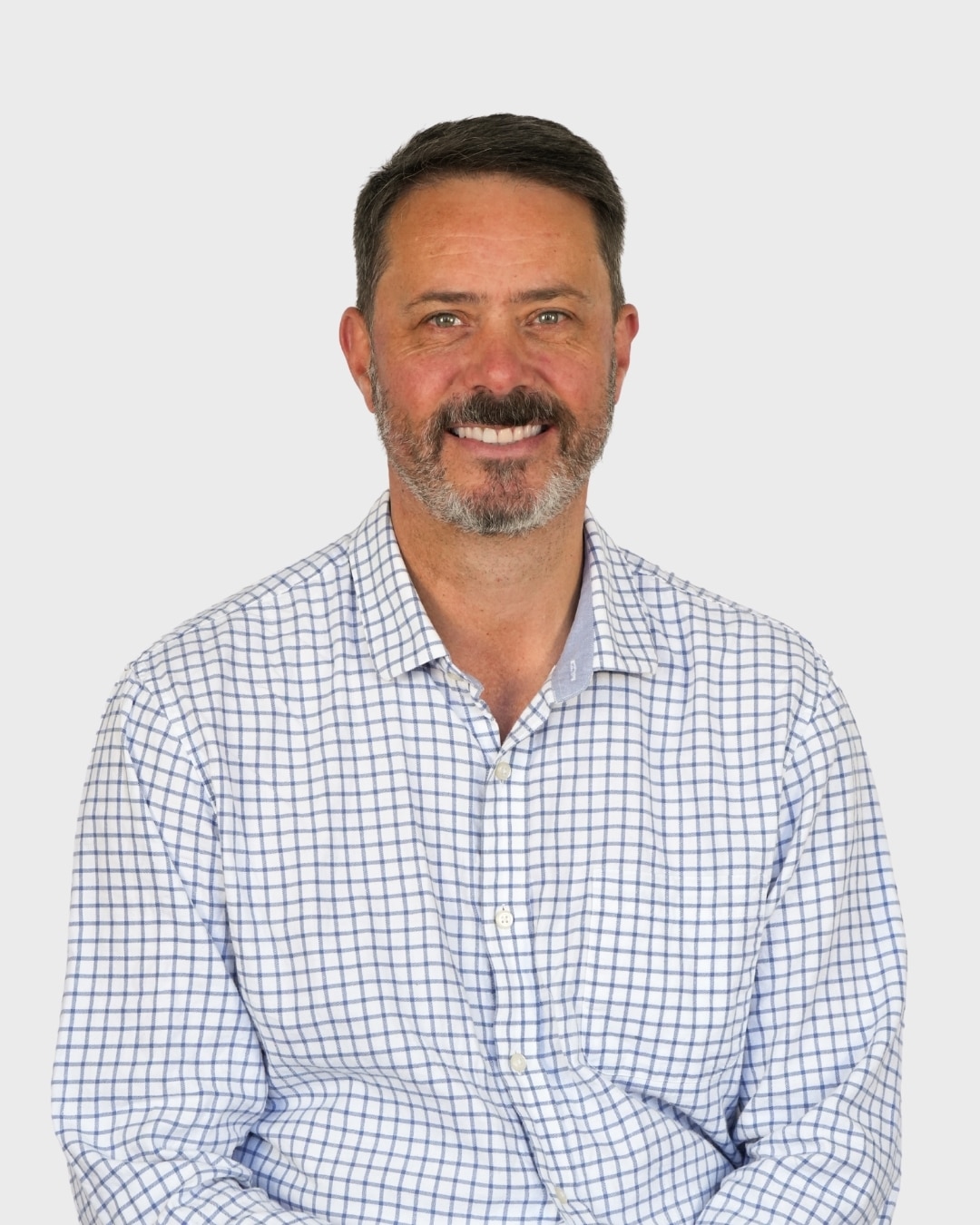
Dr Jacques Theron, General Dentist
Role: General dentist
Qualifications: BChD, University of Pretoria, South Africa (1998)
Registration: Registered dentist, general registration, DEN0001634496
Registration status can be verified on the AHPRA register of practitioners at ahpra.gov.au. The service page for this scope is General Dentistry.
Background
Dr Jacques Theron was born in South Africa and graduated in dentistry from the University of Pretoria in 1998.
He has continued with postgraduate coursework since: clear aligner training in 2013, sleep dentistry training in 2014, and courses in dental implant surgery fundamentals and advanced implant site management, also in 2014.
His clinical interests are cosmetic dentistry including clear aligner treatment, and crown and bridge work.
He has written the practice's article on the choice between the two commonest cosmetic options: What are the differences between dental bonding and veneers?
What a general dentist does
A general dentist holds general registration with the Dental Board of Australia and provides the full range of routine and ongoing care — examination and diagnosis, radiographs, cleaning and gum treatment, fillings, crowns and bridges, root canal treatment, extractions including wisdom teeth, dentures, implant restorations, whitening, and referral to specialists where a case sits outside general practice.
A general dentist may take substantial postgraduate coursework in a particular area without becoming a specialist. Specialist titles are protected under the Health Practitioner Regulation National Law. Weekend courses, manufacturer certification and continuing education — however extensive — do not confer specialist registration, which follows three years of full-time university specialist training and an application to the Dental Board. Dr Theron holds general registration. See Why would I need to see a dental specialist?
The rule that governs what any dentist may do
The practical boundary is not the title but the Scope of practice registration standard, which has been in effect since 1 July 2020 and which, in the Dental Board's words, “requires dental practitioners to practise within the scope of their education, training, and competence at all times”.
That is worth reading twice, because it cuts both ways. It means a general dentist is not barred from a procedure by not holding a specialty — and it also means that no amount of course attendance authorises work beyond demonstrable competence. It is a professional obligation with regulatory force behind it, and it is the standard against which a complaint about over-reach would be assessed.
For completeness, the Board recognises “13 dental specialties in Australia which are approved by the Australian Health Workforce Ministerial Council”, and specialist registration additionally requires “a minimum of two years general dental practice” together with all the requirements for general registration. (Source: Dental Board of Australia, Registration standards; Specialist Registration — dentalboard.gov.au.)
Clear aligner treatment
Invisalign is one of several clear aligner brands. The technique moves teeth using a sequence of removable clear plastic trays, each slightly different from the last. See Orthodontics and How to get straight teeth without braces? Or Invisalign.
What is accurate about aligners:
- They are less visible than fixed braces and can be removed for eating and cleaning — see What are the hygiene benefits of Invisalign?
- For crowding, spacing and mild-to-moderate alignment problems they work well. See Exploring Invisalign and Is having Invisalign as an adult worth it?
- Treatment planning is done digitally, and the plan shows a predicted result — a prediction, not a promise. Teeth do not always track to the plan, and mid-course corrections and refinement aligners are common rather than exceptional. See Our Technology.
What is often left out:
- Aligners depend entirely on wear time. Twenty to twenty-two hours a day is the usual requirement. A patient who does not wear them does not get the result, and that is the single most common reason aligner cases fail. See How to protect your aligners and your smile
- Aligners cannot do everything braces can. Substantial rotations, large vertical movements, and cases needing skeletal correction are handled better with fixed appliances, and some are not orthodontic problems at all. See Benefits of conventional braces vs lingual braces vs Invisalign and How do I know which orthodontic treatment is best for me?
- Aligners move teeth; they do not move jaws. An underlying skeletal discrepancy in an adult is corrected by surgery, not by appliances. See Jaw Surgery and What is orthognathic surgery?
- Retention is lifelong. Teeth drift back throughout life. Without a retainer, worn indefinitely, relapse should be expected. This applies to every method of tooth movement. See Will my teeth need retainers after I've had braces? and Why do teeth shift?
- Attachments (small tooth-coloured bumps bonded to the teeth) are usually needed, and some interproximal reduction — slenderising between teeth — may be part of the plan.
Two practical points from the Australian Society of Orthodontists' consumer guidance
The ASO's consumer site teeth.org.au makes one point about aligners that is rarely on a brochure and matters every single day of treatment: the trays “should be worn at all times other than when eating and drinking liquids other than water”, because “drinking liquids such as fruit juice or soft drink while wearing clear aligners can trap the liquids against the teeth, which can cause damage to the teeth if it happens frequently”. A sugary or acidic drink taken through an aligner is held against the enamel instead of being cleared by saliva. See How does sugar affect your dental health? and Are sugar free soft drinks better for my teeth than regular soft drinks?
The same source is blunt about aligners bought online without an examination: “the Australian Dental Association (ADA) do not recommend Australians have DIY orthodontic treatment”, because “they can lead to permanent damage to your teeth, gums, and jaw joints”, and the ADA “recommends that you have in-person treatment with a dentist or orthodontist which includes a thorough assessment before starting treatment and ongoing supervision”. (Source: teeth.org.au, Teeth Straightening and Braces.) See What Is Gum Disease? and How safe are dental x-rays
Aligner treatment provided by a general dentist is legitimate where the case is within the practitioner's competence. Complex cases are the province of a specialist orthodontist. An honest assessment includes being told when a case should be referred — see Orthodontic treatment: general dentist vs specialist orthodontist? and Specialist Orthodontist vs General Dentist: Which Is Best for Invisalign?
On what it costs: the Price Guide and Invisalign Cost in Melbourne: A Complete Breakdown by Treatment Type.
Oral appliances for snoring and sleep apnoea
Dentists have a defined and limited role here, and it is worth stating precisely. See Snoring and Sleep Apnoea.
A dentist does not diagnose obstructive sleep apnoea. Diagnosis requires a sleep study interpreted by a medical practitioner. Snoring is not the same as sleep apnoea, and treating snoring without excluding apnoea can leave a serious condition untreated. Untreated moderate-to-severe obstructive sleep apnoea is associated with cardiovascular risk, daytime sleepiness and driving risk — it is a medical condition, not a nuisance.
What a dentist can do is make and fit a mandibular advancement splint — a custom oral appliance worn at night that holds the lower jaw forward to keep the airway open. The evidence position:
- Oral appliances are an accepted treatment for mild to moderate obstructive sleep apnoea, and for people with severe apnoea who cannot tolerate CPAP.
- CPAP remains more effective at reducing apnoea events. Oral appliances often achieve comparable real-world benefit because adherence to them tends to be better, but they are not equivalent devices.
- Side effects are real and common: jaw and muscle discomfort, excess salivation, and — with long-term use — changes to the bite and tooth position. These require monitoring. See TMD and Teeth Grinding and What causes TMJ pain and how is it treated?
- Effectiveness should be confirmed with a follow-up sleep study, not assumed because snoring has reduced.
A point on titles while we are here: ‘sleep dentist' is not a recognised dental specialty. It describes an area of practice. The thirteen recognised specialties are the ones named on the Dental Board's list, and sleep dentistry is not among them.
The correct pathway is medical diagnosis first, then a dentist-made appliance where that is the agreed treatment, then medical follow-up. A related airway topic is covered in Mouth Breathing: The Silent Habit That's Changing Your Face and Your Health and Orofacial Myofunctional Therapy.
On comfort
Under adequate local anaesthetic, most dental treatment is comfortable — patients feel pressure and vibration rather than sharpness. That is a reasonable expectation, not a guarantee: anaesthetic is less predictable in an acutely inflamed tooth and in some lower back teeth. Tell the dentist if you feel anything sharp; more anaesthetic can be given and treatment can be paused. See Dental Anxiety and Dental Phobia: How do you give a virtually pain-free injection?
Similarly, “minimally invasive” is a genuine and worthwhile approach — preserving as much natural tooth structure as possible, favouring adhesive restorations over crowns where a tooth allows it, and monitoring early decay rather than drilling it. It is a philosophy of treatment, not a claim that no treatment removes tooth structure. A crown, by definition, does. See Composite Bonding, Can you reverse tooth decay & do I need a filling? and What types of dental crowns are available?
Registration
Dentists are one of the registered dental practitioner divisions under the National Law. The Dental Board of Australia registers dentists, dental specialists, dental hygienists, dental therapists, oral health therapists and dental prosthetists.
Overseas-qualified dentists reach Australian registration either through a recognised qualification or through the Australian Dental Council examination process, and must additionally satisfy standards for English language skills, criminal history, professional indemnity insurance, recency of practice and continuing professional development. Once registered, they practise to identical standards as Australian graduates.
That is not a general statement — there is a named standard for it. The Board maintains a General registration for overseas-qualified dental practitioners registration standard, in effect since 20 December 2011, alongside the standards that apply to everyone:
- Scope of practice — 1 July 2020
- Continuing professional development — 1 December 2015
- Recency of practice — 1 December 2015
- Professional indemnity insurance arrangements — 1 July 2016
- English language skills — 18 March 2025. The Board notes that further information is published by Ahpra “including information about changes to minimum test scores effective from 23 April 2026”, so anyone relying on the current thresholds should check them rather than assume.
- Criminal history — 15 July 2026
There are also Limited registration standards for teaching or research and for postgraduate training or supervised practice, both in effect since 20 December 2011. (Source: Dental Board of Australia, Registration standards — dentalboard.gov.au.)
One further mechanism worth knowing about, because it explains how some practitioners appear on the Australian register: under the Trans-Tasman Mutual Recognition Act, a practitioner registered in New Zealand for an occupation “is entitled to be registered in the ‘equivalent occupation' in Australia”, and the Board may impose conditions where the New Zealand scope is narrower. Any such conditions are shown on the public register.
Common questions
I snore. Can I just ask a dentist to make me an appliance?
No, and the reason is worth understanding rather than working around.
The Australian Dental Association's Policy Statement 6.7 on dental appliances for sleep-disordered breathing puts the position in one sentence: “initial diagnosis of Sleep Apnoea must be made by an appropriate medical practitioner. If a dental appliance is required, it should be managed by a dentist.” The policy goes further and says that “both initial diagnosis and prescriptions for Sleep-disordered breathing (SDB) therapy, as well as monitoring of therapy effectiveness require careful assessment by the patient's medical practitioner”.
That is not bureaucracy. Snoring and obstructive sleep apnoea are not the same thing, and an appliance that quietens the snoring without addressing apnoea can leave a treated symptom sitting on top of an untreated condition.
What the ADA does say a dentist is for: “dentists are the only dental practitioners who are qualified to manage oral appliance therapy for SDB”, and “oral appliances can be a first-line therapeutic option for adults with snoring and mild to moderate forms of Obstructive Sleep Apnoea”, as well as “for people with severe OSA who are not compatible with continuous positive airway pressure (CPAP) therapy”. The policy describes it as shared care: “medical and dental expertise are both required … a team approach is essential.”
And one point that is easy to skip and expensive to skip: where appliances are used long term, “monitoring of the patient's temporomandibular joint function and orthodontic movement of teeth is essential”. An appliance that holds the jaw forward every night for years can move teeth and change the bite. Ask, before you start, who is checking for that and how often.
The ADA also records plainly that “dental Sleep Medicine is not a recognised dental specialty”. (Source: ADA Policy Statement 6.7, June 2025.)
I grind my teeth at night. Does that mean I have sleep apnoea?
Probably not, and this is one of the places where the marketing has run ahead of the evidence.
A 2024 systematic review and meta-analysis in Sleep Medicine Reviews, which screened 2,260 records and included 14 studies, found that “the odds of SB presence in OSA did not differ from the control group (OR: 1.23, 95 % CI: 0.47–3.20)” — SB being sleep bruxism. It found no gradient with severity either: no significant difference in mild OSA (OR 1.56, 95% CI 0.76–3.18), moderate (OR 1.51, 0.77–2.94) or severe (OR 1.50, 0.68–3.29).
The authors' own caution belongs with the finding. They state that “the quality of the major studies included is low; therefore, the noted lack of correlation between OSA and SB may require further research”, that “the relationship between OSA and SB seems to be multi-faceted”, and that the results “should not exempt clinicians from exact diagnosis of concomitant sleep conditions in OSA subjects”.
So, practically: grinding is not by itself a reason to be worked up for sleep apnoea, and an appliance sold to you on that logic is being sold on a claim the current evidence does not support. Snoring, witnessed pauses in breathing, waking unrefreshed and daytime sleepiness are the reasons to ask about a sleep study — and that request goes to a medical practitioner. Grinding remains worth treating in its own right, for what it does to teeth and restorations. See What is bruxism and how is it managed? and How can I stop grinding my teeth when I sleep?
How do I check the registration myself, and what will it not tell me?
Search the name at ahpra.gov.au. It is free and takes about a minute. The Dental Board of Australia states that Ahpra “publishes an online register of all dental practitioners that provides the profession and the public with up-to-date information about a dental practitioner's registration status”, and that it “also includes details of the specialty or specialties for dentists who hold specialist registration”. No specialty named means general registration.
What it will not tell you is more than people expect. It does not publish how many cases of any kind a practitioner has treated, their complication rate, which courses they have completed or how recently, what they charge, or any patient-experience measure. It does not record which languages they speak. No Australian body publishes outcome data for individual dental practitioners, so there is no ranking to consult and nothing to compare — a gap worth knowing about rather than filling with a directory that claims otherwise.
What it does record is worth the minute: current registration, category, any specialty, and any conditions, undertakings or reprimands. For everything else, ask at the consultation — including the questions that actually decide a case, such as how many of this particular treatment the practitioner does, and at what point they would refer it on.
Do I need a referral, and what should I bring to a first appointment?
No referral is needed. Dental care in Australia is not inside the Medicare referral system that governs medical specialist appointments, so you can book directly — including with a practitioner at a different practice from the one you have been attending.
Bring:
- Your medicines and medical conditions written down, not remembered. Several common medicines affect bleeding, healing and saliva, and dry mouth in particular changes decay risk and how a case should be managed.
- Your existing radiographs, or the name of the practice that holds them. Images are part of your record and are routinely sent on request. The radiology principle is that “strict and individualized justification should determine the prescription of each radiograph”, and a justified radiograph “should make a substantial contribution to distinguishing between treatment options” — so an image that already answers the question should not be repeated. A different view, or a newer one where things have changed, often is justified, and you are entitled to ask which applies.
- Anything you have already been quoted for, by name or item number, so that you are comparing like with like rather than two differently-scoped plans.
- Your questions on paper. Consultations are short and memory afterwards is poor.
Expect to leave with a written plan where any substantial treatment is proposed: what the problem is, what the options are including doing nothing, what each costs, and what maintenance follows. See Understanding Your Treatment and the Price Guide. A second opinion before major elective work is reasonable and normal.
Practical details
Dr Theron's registration can be checked on the AHPRA public register. See Contact Us to ask which practitioner suits a particular problem. The full clinical team is on Our Team.
Smile Solutions, Level 1, 220 Collins Street, Manchester Unity Building, Melbourne VIC 3000. Phone 13 13 96, or theteam@smilesolutions.com.au. Monday–Friday 8.00am–6.00pm, Saturday 8.30am–1.30pm, Sunday by appointment. Location and directions.
This page records qualifications and career history as published by the practice. General information only — it is not a diagnosis, a treatment plan or a promise of any particular clinical outcome. Practitioner availability changes; confirm when booking.
Smile Solutions trades under ABN 28 193 514 103.
Images on This Page
-
https://www.facebook.com/tr?id=800557773428361&ev=PageView&noscript=1
(no alt text)
-
https://www.smilesolutions.com.au/wp-content/uploads/2025/10/calendar_month.svg
(no alt text)
-
https://www.smilesolutions.com.au/wp-content/themes/arcadian-wordpress-theme/assets/images/smile_solutions_logo_white.png
Smile Solutions Logo
-
https://www.smilesolutions.com.au/wp-content/themes/arcadian-wordpress-theme/assets/images/smile_solutions_logo_purple.png
Smile Solutions Logo
-
https://www.smilesolutions.com.au/wp-content/themes/arcadian-wordpress-theme/assets/images/LinkedIn.svg
LinkedIn Profile
-
https://www.smilesolutions.com.au/wp-content/uploads/2016/05/Jacques.jpg
Dr Jacques Theron
-
https://www.smilesolutions.com.au/wp-content/uploads/2026/01/157-300x270.jpg
Brush and dental material close-up
-
https://www.smilesolutions.com.au/wp-content/uploads/2016/05/Jacques-150x150.jpg
Dr Jacques Theron
-
https://www.smilesolutions.com.au/wp-content/themes/arcadian-wordpress-theme/assets/images/family_owned_bussiness.png
Family Owned Business
-
https://www.smilesolutions.com.au/wp-content/themes/arcadian-wordpress-theme/assets/icons/icon--phone.svg
Smile Solutions Contact
-
https://www.facebook.com/tr? id=800557773428361&ev=PageView&noscript=1
(no alt text)
-
https://bat.bing.com/action/0?ti=25148060&tm=gtm002&Ver=2&mid=904be68a-7d9a-4e22-86a4-1c7ee3aee36d&bo=1&sid=17e8f940ab2911f19e2ceba74444bd32&vid=17e92a10ab2911f1bb4bed0660182ab7&vids=1&msclkid=N&pi=918639831&lg=en-US&sw=800&sh=600&sc=24&nwd=1&tl=Dr%20Jacques%20Theron%20%7C%20General%20Dental%20Care%20%7C%20Smile%20Solutions&p=https%3A%2F%2Fwww.smilesolutions.com.au%2Four-team%2Fdr-jacques-theron%2F&r=&evt=pageLoad&sv=2&cdb=AQAQ&rn=490065
(no alt text)