Mouth breathing: the silent habit changing your face and your health
The route air takes matters
Breathing is the most automatic thing we do — around 20,000 breaths a day, almost none of them considered. Whether those breaths go through the nose or the mouth has never occurred to most people.
It should.
Nasal breathing is the physiologically normal mode of respiration. The nose warms, humidifies and filters incoming air; produces nitric oxide; and creates the resistance that maintains lung volume. The nose is engineered for breathing. The mouth is not.
An estimated 30 to 50 per cent of adults breathe through their mouths habitually, and the proportion in children may be higher.
The consequences are wide-ranging and rarely connected back to the simple fact of keeping the lips apart: altered facial development in children, chronic dental disease, sleep-disordered breathing, cardiovascular stress and cognitive effects.
A note on how to read what follows. The dental consequences below — dry mouth, decay, gingival inflammation, halitosis — are well established and directly observable in the chair. The facial growth effects are well documented in the orthodontic and ENT literature. Some of the systemic effects further down are associations whose direction of causation is harder to establish, and the page says so where that applies.
What the nose does that the mouth cannot
Air conditioning. The nasal passages warm incoming air to body temperature and humidify it to nearly 100 per cent relative humidity before it reaches the lungs, protecting the airway lining from drying and irritation.
Filtration. Nasal hairs, mucous membranes and turbinates trap particulates, allergens, bacteria and viruses, reducing the pathogen load reaching the lower airways.
Nitric oxide production. The paranasal sinuses produce nitric oxide (NO), carried into the lungs with each nasal breath. NO is a vasodilator that improves pulmonary blood flow and oxygen exchange, and it has antimicrobial and antiviral properties.
Airway resistance. The narrower nasal passages create resistance that maintains positive end-expiratory pressure (PEEP), keeping the lower airways and alveoli open and improving gas exchange.
Diaphragmatic activation. Nasal breathing promotes slower, deeper, diaphragmatic patterns that activate the parasympathetic nervous system and reduce stress — seven ways stress can affect your mouth covers the other end of that relationship.
Mouth breathing bypasses all of these. Air enters unfiltered, dry and at ambient temperature. Nitric oxide delivery is reduced. Airway resistance drops, reducing PEEP. Breathing rate tends to increase, with shallower, chest-dominant patterns that promote sympathetic activation.
That last point reframes the whole subject. Mouth breathing is not just a dry-mouth problem — it shifts the nervous system towards a stress state, 20,000 times a day.
How mouth breathing changes a child’s face
The most dramatic and least understood consequence. This is well documented in the orthodontic and otolaryngological literature, and the changes can be permanent if not addressed during the growth period.
The mechanism
When a child breathes through the mouth, the tongue drops from its normal resting position against the palate to the floor of the mouth.
The cheeks continue to exert inward pressure on the dental arches. Without the counterbalancing force of the tongue, the upper jaw narrows and the palate vaults upward — becoming deeper rather than wider.
Simultaneously the mandible postures downward and backward to open the oral airway. Over years of growth, that postural adaptation becomes structural.
The key idea: the shape of a growing face is determined in part by the balance of soft-tissue forces acting on it. Remove the tongue from the palate and the balance changes — permanently. The same force-balance logic explains why teeth shift later in life.
The result
Narrow upper jaw — insufficient palatal width, causing dental crowding, crossbite, and reduced space for the tongue. See what is malocclusion of the teeth? and treatment of malocclusion
High-arched palate — growing vertically rather than laterally, reducing the volume of the nasal cavity (which forms the floor of the nose) and creating a self-perpetuating cycle of nasal obstruction.
Elongated lower face — excessive vertical facial growth, giving the characteristic “long face” appearance with open mouth posture, thin upper lip and visible upper teeth.
Retruded lower jaw — the backward position narrows the posterior airway space, predisposing to sleep-disordered breathing — snoring and sleep apnoea.
Dental malocclusion — open bite, crossbite, crowding and protrusion are all more common in mouth-breathing children. Orthodontics, braces and children’s braces and Invisalign cover the correction, and orthodontists who does it.
Dark circles under the eyes — venous congestion from chronic nasal obstruction and altered lymphatic drainage creates infraorbital darkening, sometimes called “allergic shiners”.
Why it compounds
These changes are not just cosmetic. A narrow palate reduces nasal airway volume. A retruded mandible narrows the pharyngeal airway. An open mouth posture perpetuates mouth breathing.
The facial changes caused by mouth breathing create the anatomical conditions that make mouth breathing worse — and increase the risk of obstructive sleep apnoea in adulthood.
The window
Because the changes occur during active craniofacial growth, early identification and intervention are critical.
Orthodontic palatal expansion, correction of nasal obstruction (adenoid or tonsil removal where indicated) and myofunctional therapy to retrain tongue posture can redirect growth towards a healthier pattern.
The window narrows significantly after puberty, when craniofacial growth is largely complete. After that, the same problems are managed rather than redirected. Should your child see a specialist paediatric dentist?, paediatric dentists, when should a child first visit the dentist? and children’s dentistry.
Mouth breathing and dental disease
1. Dry mouth and its cascade
Mouth breathing dries the oral mucosa, reduces the protective salivary film, and alters the oral microenvironment. My mouth is always dry — why is this, and does it affect my teeth? and my mouth always feels dry! What can I do?
Dental caries. Saliva buffers acids, delivers calcium and phosphate for remineralisation, and washes away debris. When mouth breathing reduces the salivary film, the balance tips towards demineralisation. Mouth breathers have measurably higher rates of caries — particularly on smooth surfaces and anterior teeth most exposed to airflow. See how does tooth decay develop?, can you reverse tooth decay? and the benefits of fluoride. With saliva reduced, the frequency of sugar and acid exposure matters more than ever — sugar: what does it do to your teeth? and how does your diet affect your teeth?
Periodontal disease. The anterior gingiva of mouth breathers is characteristically dry, red and swollen, even in patients with otherwise good oral hygiene. Desiccation impairs the local immune response, disrupts the mucosal barrier and promotes pathogenic biofilm. Studies show habitual mouth breathers have higher rates of gingivitis and periodontitis than nasal breathers with comparable plaque levels.
That comparison is the important one. Same plaque, worse gums — which is why these patients are often unfairly told to brush better. What is gum disease?, periodontal (gum) disease, bleeding gums, when do you need deeper cleaning? and, for advanced cases, a periodontist.
Halitosis. Dry mouth reduces saliva’s self-cleaning action and favours the anaerobic bacteria that produce volatile sulphur compounds. Chronic mouth breathing is one of the most common causes of persistent bad breath. See bad breath, what causes bad breath and how can I fix it?, 7 ways to avoid bad breath and do I need to use a tongue scraper?
Oral candidiasis. Reduced salivary flow diminishes antifungal defence, particularly in patients also using inhaled corticosteroids — common in asthma, which is itself associated with mouth breathing.
2. Enamel erosion and staining
A 2015 study published in the Journal of Oral Rehabilitation found mouth breathers had significantly lower oral pH during sleep than nasal breathers — reaching levels acidic enough to cause enamel demineralisation.
That nocturnal acid exposure, every night for years, contributes to generalised enamel erosion and increased caries susceptibility. What is acid wear and how can I avoid it? and what is dental erosion and how is it addressed? describe what that looks like, and what to do if you suffer from sensitive teeth one of its consequences. Note that dietary acid compounds it — and that sugar-free soft drinks are no gentler on enamel than sugared ones.
Chronic desiccation also increases susceptibility to extrinsic staining from tea, coffee and pigmented foods, because the salivary pellicle — the thin protein layer that normally protects enamel — is disrupted. How can I improve the whiteness of my teeth? and teeth whitening deal with the colour, though the underlying dryness is the thing to address first.
3. Sleep quality
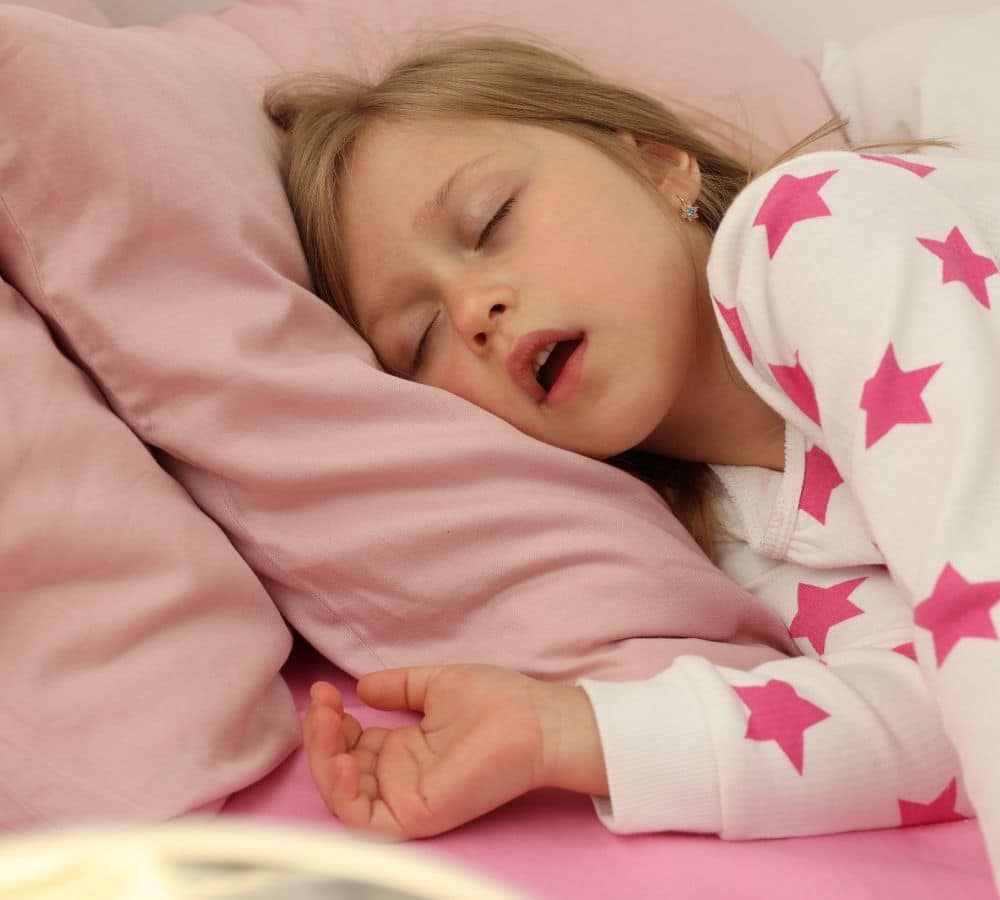
Mouth breathing during sleep is closely linked to snoring and obstructive sleep apnoea.
The mechanism: when the mouth opens during sleep, the mandible drops downward and backward, narrowing the posterior airway. The tongue falls back towards the pharynx. Airway resistance decreases. The conditions for collapse are created.
Snoring — vibration of relaxed oropharyngeal tissues. Not just a social nuisance: it indicates partial airway obstruction and disrupted sleep architecture. Snoring and sleep apnoea
Obstructive sleep apnoea — repeated airway collapse causing oxygen desaturation, cardiovascular stress, sleep fragmentation and daytime sleepiness. This needs medical diagnosis; a dentist may be the first to suspect it, but the diagnosis is not a dental one.
Non-restorative sleep — even without frank apnoea, poorer sleep quality, more frequent arousals, less deep sleep. Night-time clenching and grinding often travel with it — night-time tooth grinding and clenching, how can I stop grinding my teeth when I sleep? and what is bruxism and how is it managed?
Morning dry mouth and sore throat — the most noticeable symptom, and often the one that finally prompts someone to seek help.
4. Systemic consequences
This is the section to read most carefully. Several of these are plausible mechanisms supported by association studies rather than demonstrated cause and effect, and they are worded here as the research supports rather than more strongly.
Cardiovascular. Reduced nitric oxide delivery impairs vasodilation and may contribute to elevated blood pressure; the associated sleep disruption and sympathetic activation add further load. The sleep apnoea–cardiovascular link is the better established half of this.
Immune function. Bypassing nasal filtration increases exposure to airborne pathogens, and reduced nasal nitric oxide diminishes its antimicrobial effect. Mouth breathers, particularly children, have higher rates of upper respiratory infections, tonsillitis and otitis media — though cause and effect run in both directions here, since enlarged tonsils and adenoids also cause mouth breathing.
Exercise performance. Nasal breathing during exercise improves oxygen efficiency and reduces perceived exertion; mouth breathing during exertion is associated with exercise-induced bronchoconstriction and reduced performance. It also dries the mouth sharply — what causes dry mouth during running? and how exercise can increase your risk of tooth decay
Cognitive and behavioural. In children, the sleep disruption is associated with attention difficulties, behavioural problems and academic underperformance. These symptoms overlap with ADHD, and some researchers suggest a proportion of children diagnosed with ADHD may have undiagnosed sleep-disordered breathing secondary to airway obstruction. That is a hypothesis under investigation, not an established finding — but it is a reason to have a child’s airway assessed before concluding the issue is purely behavioural.
Postural. Chronic mouth breathing is associated with forward head posture and altered cervical alignment — the head tilts back and the chin juts forward to open the airway, creating strain through the neck, shoulders and upper back. Jaw symptoms often accompany it — what is the cause of my jaw pain?, TMD and teeth grinding and what are the most common symptoms of TMD?
How to identify it
Mouth breathing is often unrecognised because it is so habitual the person is unaware of it.
In children
- Lips habitually apart at rest
- Dry, cracked lips
- Visible upper teeth when the face is relaxed
- Dark circles under the eyes
- Narrow face with elongated lower third
- Snoring or restless sleep
- Frequent upper respiratory infections
- Difficulty concentrating at school
- Crowded or crooked teeth
- High-arched palate on examination
In adults
- Waking with dry mouth or sore throat
- Chronic bad breath despite good oral hygiene — how do I get rid of my bad breath?
- Anterior gingival inflammation
- History of dental crowding or orthodontic treatment
- Snoring or diagnosed sleep apnoea
- Nasal congestion, allergies, deviated septum or nasal polyps
- Forward head posture
The lip seal test
Close your lips and breathe through your nose for three minutes. If that feels uncomfortable, strained or insufficient, you may be a habitual mouth breather.
What can be done
Management means identifying and addressing the underlying cause while retraining the breathing pattern. Both halves are needed — fixing an obstruction without retraining the habit often leaves the habit in place.
1. Address nasal obstruction
- Allergic rhinitis — antihistamines, nasal corticosteroid sprays, allergen avoidance
- Deviated septum — septoplasty if conservative measures fail
- Nasal polyps — medical or surgical management
- Adenoidal hypertrophy (children) — adenoidectomy when clinically indicated
- Turbinate hypertrophy — medical management or surgical reduction
All of these are medical decisions, taken with an ENT surgeon or GP rather than a dentist.
2. Myofunctional therapy
A structured exercise programme to retrain the muscles of the tongue, lips and face — promoting nasal breathing, correcting tongue posture (resting against the palate) and establishing lip seal. Orofacial myofunctional therapy sets out what it involves here.
Supported by a growing evidence base for both children and adults, and delivered by trained dental hygienists, speech pathologists or myofunctional therapists — what does a dental hygienist do?
Key exercises:
- Tongue posture training — tip on the “spot” behind the upper front teeth, body resting against the palate
- Lip seal exercises
- Nasal breathing practice during daily activities and exercise
- Swallowing pattern correction
3. Orthodontic intervention (children)
Palatal expansion during the growth period widens the upper jaw, increases nasal cavity volume, and creates space for the tongue.
This addresses both the dental crowding and the nasal obstruction caused by a narrow palate — breaking the cycle at its structural source. Children’s braces and Invisalign, orthodontics and orthodontists. Where skeletal discrepancy is severe, jaw surgery becomes part of the discussion in adulthood.
4. Environmental management
- Humidify bedroom air, particularly in winter
- Reduce allergens — dust mite covers, air purifiers, pet management
- Elevate the head during sleep
- Avoid alcohol and sedatives before bed — they relax oropharyngeal muscles and promote mouth breathing
5. Dental management
- Fluoride therapy and remineralising products to protect teeth exposed to chronic dry mouth — selecting a toothpaste: fluoride or non-fluoride?
- More frequent professional cleaning and monitoring — dental cleans with our hygienists and how often should I go to the dentist?
- Salivary stimulants and moisturising products for symptomatic relief, including sugar-free gum
- Orthodontic or restorative treatment for the dental consequences — what is restorative dentistry?
How Smile Solutions approaches it
Mouth breathing is treated as a clinical finding that triggers investigation and, where appropriate, intervention — not a footnote.
Assessment includes:
- Evaluation of facial growth pattern and skeletal relationships
- Intraoral assessment of palatal width, tongue posture and airway signs
- Screening for sleep-disordered breathing symptoms
- Referral for ENT assessment where nasal obstruction is suspected
- Orthodontic consultation for children with growth changes
- Myofunctional therapy recommendations
- TMD and sleep assessment for adults with bruxism, TMJ symptoms or suspected obstructive sleep apnoea
The practice has orthodontists, periodontists and clinicians working in sleep dentistry on site, allowing mouth breathing to be addressed from the structural causes through to the dental consequences. Complex dental cases: what happens when multiple specialists collaborate describes how that works in practice, and understanding your treatment how a plan is put together.
Breathe better
Mouth breathing may seem trivial, but its effects compound over a lifetime. In children it shapes the face and airway in ways that predispose to lifelong problems. In adults it accelerates dental disease, disrupts sleep and contributes to systemic inflammation.
The encouraging part: it is identifiable, its causes are treatable, and nasal breathing can be retrained at any age.
If you or your child shows the signs above — or you have unexplained dry mouth, dental problems, or poor sleep despite adequate time in bed — book an assessment. Contact us.
Common questions
I snore. Does that mean I have sleep apnoea?
No — but it is the reason to find out, and the numbers are the useful part. The Sleep Health Foundation reports that “about 40% of men have at least mild snoring, on at least some nights. This number is smaller for women (around 30%). About 15% of people snore on most nights.” Snoring on its own is extremely common.
The minority that matters is well defined. The same fact sheet states that “some snorers also have a condition known as sleep apnea. Over 10% of regular snorers have this condition to a significant degree. Sleep apnea is linked to high blood pressure, heart attacks and strokes.” So most regular snorers do not have significant obstructive sleep apnoea — and roughly one in ten does, which is far too many to assume you are not one of them.
What the snoring itself tells you is where the noise comes from, and it connects directly to this page: the Sleep Health Foundation notes that “people who breathe through the mouth are more likely to snore. This is because the walls of your throat at the back of the mouth vibrate easily. Walls at the back of your nose do not vibrate as easily.” Mouth breathing is a risk factor for the noise, not merely a companion to it.
The practical step is a conversation with your GP, not a decision made at home. The same source is direct that problem snoring may be an early warning signal that sleep apnoea is present, that a GP can refer you for a sleep study, and that sleep apnoea is a serious health issue needing attention.
My child snores and sleeps with their mouth open. Do I see the dentist or the doctor first?
The doctor, for the diagnosis — and the dentist for what is visible in the mouth. They are answering different questions.
On the diagnosis, the Australian Dental Association is unambiguous. Its Policy Statement 6.7 opens with the position: “Initial diagnosis of Sleep Apnoea must be made by an appropriate medical practitioner. If a dental appliance is required, it should be managed by a dentist.” The same statement records that obstructive sleep apnoea “has been associated in children as well as adults”, and — worth knowing before anyone markets otherwise — that “Dental Sleep Medicine is not a recognised dental specialty.”
The most common cause in a child is not dental at all. The Sleep Health Foundation notes that “often children snore because of large tonsils and adenoids”, and that “for children who snore, it is common to take out the tonsils as tonsillar enlargement is a common cause. This often succeeds.” That is an ENT assessment, reached through your GP.
What a dental examination adds is the growth picture described further up this page — palatal width, tongue posture, the shape of the developing arches, and whether crowding or a crossbite is already appearing. Those findings are time-sensitive in a way an adult's are not, which is the argument for doing both rather than choosing. See should your child see a specialist paediatric dentist?
My nose blocks up every spring with hay fever. Is that really enough to cause all of this?
Yes, and there is a mechanical reason as well as the obvious one. A blocked nose forces the mouth open, which is the starting point for everything above. The Sleep Health Foundation adds a second effect that is less intuitive: “A blocked nose will mean that you have to breathe through the mouth. This will raise your risk of snoring. It also makes a vacuum inside the throat. This may pull the walls of your throat closer together.” Obstruction at the nose therefore narrows the throat as well, which is why a seasonal nose problem can produce a night-time breathing problem.
Seasonal is still worth treating. The same source lists “allergies, hay fever and smoking” among the things that make snoring worse. A few months a year, every year, through a child's growth period, is not a small exposure.
Where it becomes a dental question is when the pattern outlasts the season — lips habitually apart, waking dry, anterior gum inflammation that does not respond to better brushing. That is habit rather than obstruction, and it is the half that myofunctional retraining addresses.
I am an adult. Is it too late to do anything about this?
The facial growth is settled; almost nothing else is. After craniofacial growth is complete, palatal expansion is no longer redirecting development, and the skeletal pattern you have is the one you keep. That is the honest limit.
What remains available is substantial. The nasal obstruction is treatable at any age and is a medical question. The breathing habit itself can be retrained — the myofunctional exercises above are not age-limited. The dental consequences are managed on their own terms: fluoride, more frequent review, treating the gum inflammation as a dryness problem rather than a brushing failure.
Where snoring or diagnosed sleep apnoea is part of it, an oral appliance may be an option — with conditions. The ADA's position is that “oral appliances can be a first-line therapeutic option for adults with snoring and mild to moderate forms of Obstructive Sleep Apnoea (OSA)”, and that they “may also be indicated for people with severe OSA who are not compatible with continuous positive airway pressure (CPAP) therapy.” The conditions matter: the diagnosis comes first and comes from a medical practitioner, and the ADA states that “where there is long-term use of oral appliances, monitoring of the patient's temporomandibular joint function and orthodontic movement of teeth is essential.” In other words the appliance moves teeth and loads the jaw joint, and that has to be watched. See snoring and sleep apnoea.
Would one of the anti-snoring devices from the chemist fix it?
Most of them are treating something other than your cause, which is why results are so inconsistent. The Sleep Health Foundation's fact sheet is unusually blunt about each category:
- Nasal dilator strips — they “can unblock your nose. But by themselves they won't stop snoring.”
- Herbal and enzyme preparations — they “might help with allergies. If this is why you snore, then they might help. But if you're snoring for another reason, then they will do nothing.”
- Positional therapies to keep you off your back “can be helpful but are often ineffective in keeping you on your side throughout sleep” — although the underlying point stands, since “snoring is almost always worse on the back.”
- A mandibular advancement splint is the one with a dental pathway, and it is not an off-the-shelf product: “it needs to be specially fitted to you. You will need to see a dentist or oral surgeon for this. This is because different people have different mouth shapes. It works for some people but not for others.”
The honest summary is that none of these is a substitute for knowing why you snore. Two pieces of self-help from the same source cost nothing and apply regardless: lose weight if you are carrying extra, and “try and avoid alcohol for at least four hours before sleeping.” Everything else follows the diagnosis.
Related reading
- Dental health and general wellbeing
- Diabetes and oral health
- Are women especially prone to oral health problems?
- Oral health care while pregnant
- What is the ideal daily routine for oral hygiene?
- Is flossing really that important?
- Protecting your child from dental disease
- How do I prevent dental decay?
Practical details
Smile Solutions, Level 1, 220 Collins Street, Manchester Unity Building, Melbourne VIC 3000 — getting here. Phone 13 13 96, or theteam@smilesolutions.com.au. Monday–Friday 8.00am–6.00pm, Saturday 8.30am–1.30pm, Sunday by appointment. Fee ranges are in the price guide.
Specialist registration can be verified on the AHPRA register, or by calling 1300 419 495. The clinical team is listed by name, and dentists and registered specialists explains the difference between the two titles.
The questions above are grounded in Australian Dental Association Policy Statement 6.7, Use of Dental Appliances to Treat Sleep-Disordered Breathing (reviewed June 2025), and the Sleep Health Foundation's snoring fact sheet (2024). Neither publisher is connected with us.
Published 10 August 2026. Findings described are from published research; individual causes, suitability of treatment and outcomes vary. Suspected obstructive sleep apnoea requires medical assessment. General information only; it does not replace advice from your treating practitioner.
Smile Solutions trades under ABN 28 193 514 103.
Images on This Page
-
https://www.facebook.com/tr?id=800557773428361&ev=PageView&noscript=1
(no alt text)
-
https://www.smilesolutions.com.au/wp-content/uploads/2025/10/calendar_month.svg
(no alt text)
-
https://www.smilesolutions.com.au/wp-content/themes/arcadian-wordpress-theme/assets/images/smile_solutions_logo_white.png
Smile Solutions Logo
-
https://www.smilesolutions.com.au/wp-content/themes/arcadian-wordpress-theme/assets/images/smile_solutions_logo_purple.png
Smile Solutions Logo
-
https://www.smilesolutions.com.au/wp-content/uploads/2023/11/SS-Tooth-1-1-150x150.png
Smile Solutions
-
https://www.smilesolutions.com.au/wp-content/uploads/2026/08/Mouth-Breathing.jpg
Mouth Breathing: The Silent Habit That’s Changing Your Face and Your Health
-
https://www.smilesolutions.com.au/wp-content/uploads/2025/09/Root-Canal-2-300x217.jpg
Root Canal
-
https://www.smilesolutions.com.au/wp-content/uploads/2025/09/Dental-Crown-at-Smile-Solutions-300x300.jpg
Dental Crown at Smile Solutions
-
https://www.smilesolutions.com.au/wp-content/uploads/2026/07/Diabetes-and-Dental-Health-300x270.jpg
Diabetes and Dental Health
-
https://www.smilesolutions.com.au/wp-content/themes/arcadian-wordpress-theme/assets/images/family_owned_bussiness.png
Family Owned Business
-
https://www.smilesolutions.com.au/wp-content/themes/arcadian-wordpress-theme/assets/icons/icon--phone.svg
Smile Solutions Contact
-
https://www.facebook.com/tr? id=800557773428361&ev=PageView&noscript=1
(no alt text)
-
https://bat.bing.com/action/0?ti=25148060&tm=gtm002&Ver=2&mid=26181573-5024-41ab-b846-95c75f6e6f26&bo=1&sid=459cda50ab2611f1afa8e50d17b95250&vid=459d7650ab2611f1a33ac57e0b1a1ea4&vids=1&msclkid=N&pi=918639831&lg=en-US&sw=800&sh=600&sc=24&nwd=1&tl=Mouth%20Breathing%3A%20The%20Silent%20Habit%20That%E2%80%99s%20Changing%20Your%20Face%20and%20Your%20Health%20-%20Smile%20Solutions&p=https%3A%2F%2Fwww.smilesolutions.com.au%2Fdental-articles%2Farticle%2Fmouth-breathing-the-silent-habit-thats-changing-your-face-and-your-health%2F&r=&evt=pageLoad&sv=2&cdb=AQAQ&rn=615908
(no alt text)