Do I need to use a tongue scraper?
The short answer
A tongue scraper is a useful addition to brushing and flossing, and the case for it rests on one specific purpose: reducing bad breath.
It is also the subject of a lot of claims that go well beyond what the evidence supports. This article separates the two, because the useful part is genuinely useful and does not need overselling — and the questions at the end set out exactly how strong the evidence is. Should I use a tongue scraper? covers the same ground from the practical angle, and dental myths exposed deals with several of the neighbouring claims.
What is on your tongue
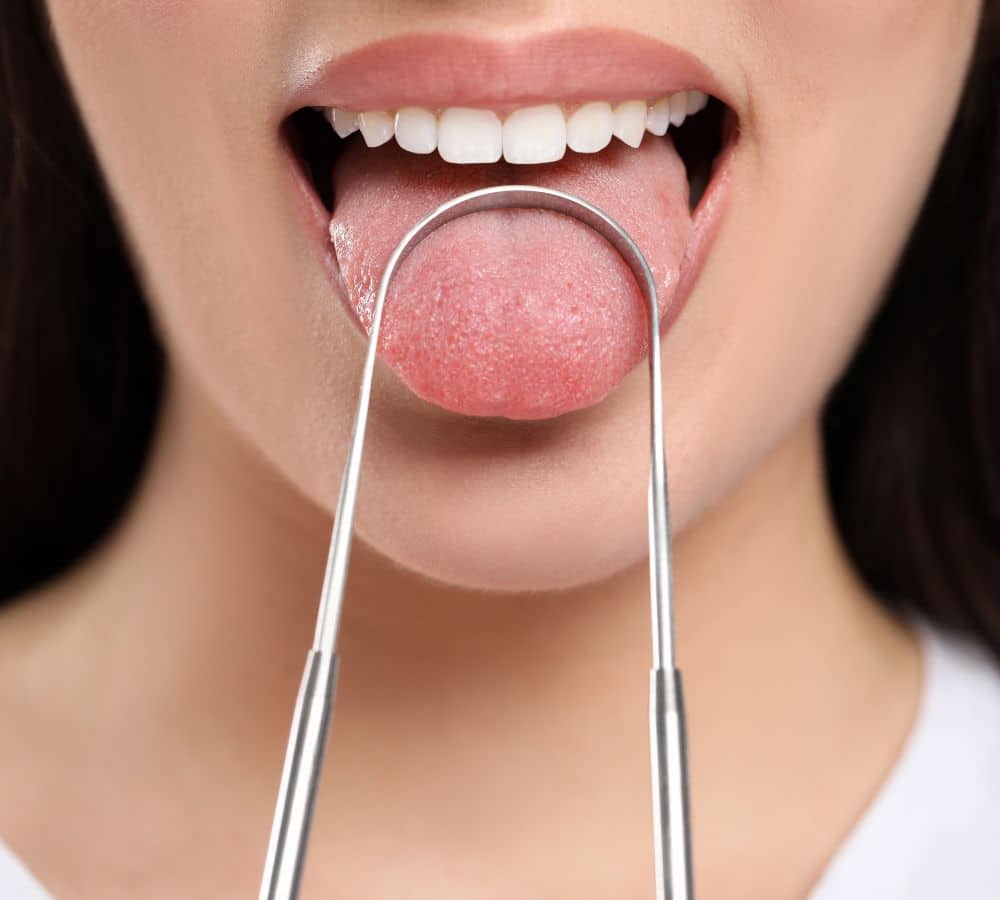
Bacteria, food debris and dead cells coat the surface of the tongue.
The tongue is not a smooth surface. It is covered in papillae — tiny projections with grooves and crypts between them — and that texture holds material that a toothbrush passing over the teeth never touches. The back third of the tongue holds the most, and it is the hardest area to reach.
Much of this coating is removed when you clean your teeth. A tongue scraper (also called a tongue cleaner or brush) removes the rest more thoroughly. For the teeth themselves, what is the ideal daily routine for oral hygiene? and three oral hygiene tips you need to know set out where tongue cleaning fits in the order of things.
What tongue scraping is genuinely good for
Bad breath
This is the well-supported benefit.
Halitosis is commonly caused by a build-up of bacteria and plaque. A coated tongue can result from an overgrowth of bacteria — caused by smoking, dry mouth, poor oral hygiene or medication use — and tongue scraping can help.
The mechanism is well described: anaerobic bacteria living in the tongue coating break down proteins and release volatile sulphur compounds (VSCs), which are what bad breath actually smells like. The majority of the bacteria responsible sit on the tongue rather than the teeth, which is why brushing alone often does not resolve it.
Removing the coating removes the source. This is the main reason to own a tongue scraper. The bad breath articles in this library approach the same problem from different directions: what causes bad breath and how can I fix it?, seven ways to avoid bad breath, how do I get rid of my bad breath?, how can I guarantee I always have fresh breath? and how do I make sure I never have bad breath (halitosis)?. The clinical page is bad breath.
Two of the causes listed above have their own articles worth following. For dry mouth: my mouth is always dry — why is this and does it affect my teeth? and my mouth always feels dry! What can I do?. For smoking and its substitutes: are e-cigarettes bad for my teeth? and the effects of vaping on your oral health.
Taste
Keeping the tongue clean prevents taste buds from becoming coated, which can allow more of the flavour in food to come through.
This is a modest and plausible effect, and people who take up tongue scraping often report it. Treat it as a pleasant side effect rather than a reason to start.
The claims that do not hold up
It is worth being straightforward about these, because they appear on a great many tongue scraper pages — including, previously, this one.
Tongue scraping does not “remove toxins from the body”. The tongue coating is bacteria, food debris and shed cells. It is not a store of toxins, and the body does not reabsorb it in any way that causes harm. Can oil pulling make my mouth healthier and my teeth whiter? examines a neighbouring practice with a similar gap between what it is sold as and what it does.
It does not treat or prevent respiratory or digestive disease. There is no good evidence that failing to scrape your tongue causes breathing problems or digestive problems.
It does not “boost immunity”. Good oral hygiene generally supports health, and there are recognised associations between oral disease and systemic health — set out honestly in health problems linked to poor oral hygiene, the importance of dental hygiene: a window onto your overall health and dental health and general wellbeing. But that is a very different claim from a tongue scraper improving immune function, and no evidence supports the stronger version.
If the appeal of tongue scraping for you is the whole-body framing, what is holistic dentistry?, the benefits of holistic dentistry and holistic dentistry describe what that approach does and does not claim.
Why this matters: the honest benefit is enough on its own. A cheap tool that helps with bad breath is worth using. It does not need to be a detox device.
How to use one
Once a day is sufficient, most conveniently in the morning — the coating is heaviest after a night of reduced saliva flow. How often should I brush my teeth? covers the rest of the daily schedule.
Start well back on the tongue, but not so far that you gag, and draw the scraper forward in a single stroke. Rinse it between strokes rather than pushing the same material back and forth.
Use light pressure. The aim is to lift the coating, not to abrade the tongue. Scraping until the tongue is sore or bleeding does damage without adding benefit. The same logic applies to teeth and gums — see over brushing: what can it do to my teeth?.
A dedicated scraper, a tongue brush, or the back of a toothbrush all work — the tool matters far less than doing it at all. If you use a toothbrush for it, how to care for your toothbrush and which toothbrushes do dentists recommend? are worth a look. A mouthwash is not a substitute for removing the coating, and the corpus is clear about why: should I be using mouthwash as well as brushing and flossing my teeth? and the truth and myths about mouthwashes. Masking the smell for twenty minutes is not the same as removing what produces it.
One important caveat
If bad breath persists despite good brushing, flossing and tongue cleaning, that is a reason to be examined rather than to scrape harder. Is flossing really that important? covers the part of the routine people most often skip first.
Persistent halitosis can indicate gum disease, tooth decay, dry mouth, or a problem outside the mouth entirely — sinus, respiratory, gastric or metabolic. A tongue scraper manages a symptom. It does not diagnose the cause. For the two dental causes: what is gum disease?, periodontal (gum) disease, bleeding gums, how does tooth decay develop? and how do I prevent dental decay?. A hygienist appointment will remove what a scraper cannot — what does a dental hygienist do? describes the visit, and how often should I go to the dentist? the interval.
Similarly, a tongue coating that is unusually thick, discoloured, patchy, or that does not clear with cleaning should be looked at. White patches that cannot be wiped away are not a coating, and need assessment. This is the point of the article that most deserves acting on: see oral cancer — how your dentist can help with early detection, oral cancer: signs, risk factors and how your dentist can help and what are the causes, symptoms and treatment of mouth cancer?. A sore area that has not healed in two weeks is in the same category — the cause of mouth ulcers and their usual treatments explains which ulcers are ordinary and which are not.
Common questions
How strong is the evidence, really?
Weaker than most pages selling tongue scrapers admit, and it is worth saying so plainly. The current position comes from a 2019 Cochrane review, Interventions for managing halitosis, which pooled 44 trials and 1,809 participants and incorporated Cochrane's earlier separate reviews of tongue scraping and of mouthrinses.
For mechanical tongue cleaning specifically, the review found that “the evidence was very uncertain for the outcome dentist-reported organoleptic test (OLT) scores (MD -0.20, 95% CI -0.34 to -0.07; 2 trials, 46 participants; very low-certainty evidence).” Two trials. Forty-six people. The direction of effect favours cleaning the tongue; the certainty behind it is the lowest grade Cochrane awards.
Nor could the review rank the options. Its authors' conclusion is unambiguous: “We were unable to draw any conclusions regarding the superiority of any intervention or concentration,” and the plain-language summary puts it more bluntly still — “We do not have enough evidence to say which intervention works better to control bad breath.” Most of the trials were short (one to four weeks), only one followed patients for three months, and 16 of the 44 were judged at high risk of bias.
Where that leaves a sensible person. Tongue cleaning is cheap, quick, carries no reported harms in that review, and has a clear and well-described mechanism behind it. That is a reasonable basis for doing it. It is not a reasonable basis for claiming it is proven.
Am I removing the bacteria, or something else?
Something else — and the distinction is the most commonly mangled point on this subject. The International Journal of Oral Science review of halitosis describes the tongue dorsum, with “a surface of 25 cm²”, as “an ideal niche for oral bacteria”, because shed cells and food remnants collect in its irregular surface and putrefy there. It calls tongue coating “the most common cause” of bad breath.
Then comes the precise bit. In the review's own words: “Tongue coating is not easy to remove. Daily scraping or brushing of the tongue can help to reduce the substrata for putrefaction, rather than to reduce the bacterial load.” In other words you are not sterilising your tongue. You are taking away the material the bacteria feed on — which is why the effect is real but not dramatic, and why it has to be done repeatedly.
One further consequence worth knowing: the same passage notes the tongue surface “seems to be an important reservoir in the recolonisation of tooth surfaces”, so tongue cleaning is not entirely separate from what happens to your teeth. And it confirms the taste point made above — “tongue cleaning improves taste sensation.”
How long does the effect last?
Not long, which is the argument for doing it daily rather than occasionally. Cochrane's earlier, now-superseded review of tongue scraping recorded the detail from its two small trials: reduced volatile sulphur compound levels “could not be detected for more than 30 minutes after the intervention in any of the groups.”
That finding should be read for what it is — a measurement from a very small trial in a review that has since been withdrawn into the 2019 one. It is not a precise expiry time for your breath. But the pattern it describes matches the mechanism: you remove the substrate, and it begins accumulating again immediately.
The practical reading. Morning is the sensible time, because the coating is heaviest after a night of reduced saliva flow. Tongue cleaning shortly before a meeting or a social occasion is not unreasonable either, but nothing in the evidence supports treating it as protection for the rest of the day. What keeps breath better across a whole day is the underlying cause being addressed — saliva, gum health, and what is happening between the teeth.
Is a proper scraper better than a toothbrush, or would a mouthwash do instead?
On the published evidence, nobody can tell you which is best — and that is a finding rather than a gap in this page. The 2019 Cochrane review tested eight categories of intervention, including mechanical debridement, toothpastes, chewing gums and mouthrinses, and concluded it could draw no conclusions “regarding the superiority of any intervention or concentration.”
Two details from that review are worth knowing before you spend money. A trial of a mouthwash containing chlorhexidine and zinc acetate versus a placebo mouthwash produced a result whose confidence interval crosses zero (MD -0.20, 95% CI -0.58 to 0.18; 1 trial, 44 participants) — that is, no demonstrated benefit over placebo in that trial. The only comparison in the entire review to reach even low-certainty evidence, rather than very low, was brushing plus a cetylpyridinium chloride mouthwash versus brushing alone (MD -0.48, 95% CI -0.72 to -0.24; 1 trial, 70 participants) — a rinse used in addition to mechanical cleaning, not instead of it.
So the ordinary advice survives. Clean the tongue with whatever you will actually use — a dedicated scraper, a tongue brush or the back of your toothbrush. If you like a rinse, treat it as an addition rather than a replacement, and see the truth and myths about mouthwashes. A product that masks odour for twenty minutes has not done the same job as removing what causes it.
Related reading
- Should I use a tongue scraper?
- What is the ideal daily routine for oral hygiene?
- Your Smile Solutions dental hygienist visit: what to expect
- Understanding your treatment
Practical details
Smile Solutions, Level 1, 220 Collins Street, Manchester Unity Building, Melbourne VIC 3000 — getting here. Phone 13 13 96, contact us, or theteam@smilesolutions.com.au. Monday–Friday 8.00am–6.00pm, Saturday 8.30am–1.30pm, Sunday by appointment. Published fees are in the price guide.
Specialist registration can be verified on the AHPRA register, or by calling 1300 419 495. The practice’s registered specialists are identified as such within the full team.
The evidence discussed in the questions above is from Kumbargere Nagraj et al., Interventions for managing halitosis, Cochrane Database of Systematic Reviews 2019, Issue 12 (CD012213); from the earlier, now-superseded Cochrane review of tongue scraping (CD005519, 2006), identified as such; and from Bollen and Beikler's review in the International Journal of Oral Science (2012). None of those publishers is connected with us.
Published 16 April 2018; the discussion of evidence has been updated. General information only; it does not replace advice from your treating practitioner.
Smile Solutions trades under ABN 28 193 514 103.
Images on This Page
-
https://www.facebook.com/tr?id=800557773428361&ev=PageView&noscript=1
(no alt text)
-
https://www.smilesolutions.com.au/wp-content/uploads/2025/10/calendar_month.svg
(no alt text)
-
https://www.smilesolutions.com.au/wp-content/themes/arcadian-wordpress-theme/assets/images/smile_solutions_logo_white.png
Smile Solutions Logo
-
https://www.smilesolutions.com.au/wp-content/themes/arcadian-wordpress-theme/assets/images/smile_solutions_logo_purple.png
Smile Solutions Logo
-
https://www.smilesolutions.com.au/wp-content/uploads/2023/11/SS-Tooth-1-1-150x150.png
Smile Solutions
-
https://www.smilesolutions.com.au/wp-content/uploads/2018/04/Tongue-Scraper.jpg
Do I need to use a tongue scraper?
-
https://www.smilesolutions.com.au/wp-content/uploads/2025/09/Root-Canal-2-300x217.jpg
Root Canal
-
https://www.smilesolutions.com.au/wp-content/uploads/2026/08/Mouth-Breathing-300x270.jpg
Mouth Breathing
-
https://www.smilesolutions.com.au/wp-content/uploads/2025/09/Dental-Crown-at-Smile-Solutions-300x300.jpg
Dental Crown at Smile Solutions
-
https://www.smilesolutions.com.au/wp-content/themes/arcadian-wordpress-theme/assets/images/family_owned_bussiness.png
Family Owned Business
-
https://www.smilesolutions.com.au/wp-content/themes/arcadian-wordpress-theme/assets/icons/icon--phone.svg
Smile Solutions Contact
-
https://www.facebook.com/tr? id=800557773428361&ev=PageView&noscript=1
(no alt text)
-
https://bat.bing.com/action/0?ti=25148060&tm=gtm002&Ver=2&mid=897b961b-9266-4ef2-8662-935cb95db46e&bo=1&sid=dc8738c0ab2511f1b0a87d088e353988&vid=dc879d80ab2511f19b863356c2f739f8&vids=1&msclkid=N&pi=918639831&lg=en-US&sw=800&sh=600&sc=24&nwd=1&tl=Do%20I%20need%20to%20use%20a%20tongue%20scraper%3F%20-%20Smile%20Solutions&p=https%3A%2F%2Fwww.smilesolutions.com.au%2Fdental-articles%2Farticle%2Fneed-use-tongue-scraper%2F&r=<=2758&evt=pageLoad&sv=2&cdb=AQAQ&rn=690443
(no alt text)