How does tooth decay develop?
Tooth decay is a disease process in which oral bacteria produce acids that dissolve minerals out of the tooth. It is also called cavities, holes, or caries. It progresses in stages, and only the first stage is reversible — which is the single most useful thing to understand about it. The stages of dental decay sets the same sequence out tooth by tooth.
It is also, on the World Health Organization's assessment, "the most common noncommunicable disease worldwide, affecting 2.5 billion people" — around 2 billion with decay in permanent teeth and 510 million children with decay in baby teeth. Closer to home, the Australian Dental Association reports that 34% of Australian children aged 5–6 have experienced decay in their primary teeth, and 27% of those aged 5–10 have untreated decay in primary teeth.
What decay needs in order to happen
Three things have to coincide:
- Decay-causing bacteria in contact with the tooth. Bacteria achieve this by forming plaque on the tooth surface — a structured biofilm that sticks and cannot be rinsed away.
- A food source. Sugars and other fermentable carbohydrates.
- Time. Repeated exposure, over and over.
WHO states the same equation from the preventive side, naming the three things that together "can lead to dental caries": "a continued high intake of free sugars, inadequate exposure to fluoride and a lack of removal of plaque by toothbrushing with fluoride toothpaste containing 1000-1500 ppm concentration." Every measure in the prevention section below is aimed at one of those three.
Over time the number of acid-producing bacteria in the plaque increases, and the population shifts toward the species that thrive in acid — so the process becomes self-reinforcing. Remove any one of the three and decay stops. That is why how do I prevent dental decay? is a shorter article than this one.
The ADA describes the chemistry precisely: decay begins with "the metabolism of simple carbohydrates by bacteria in the dental plaque which produces acids", and those acids drop the plaque pH "below the critical level leading to softening of tooth structure."
The stages
Stage 1 — the enamel surface. Acids dissolve minerals from the outer surface, and the normally shiny enamel begins to look dull or chalky. There is no hole, no pain, and often nothing the person notices. This is the white spot stage. Not every white mark is decay — what causes white spots on teeth? explains how the developmental kind differs from the kind that means active demineralisation, and why the difference changes what is done about it.
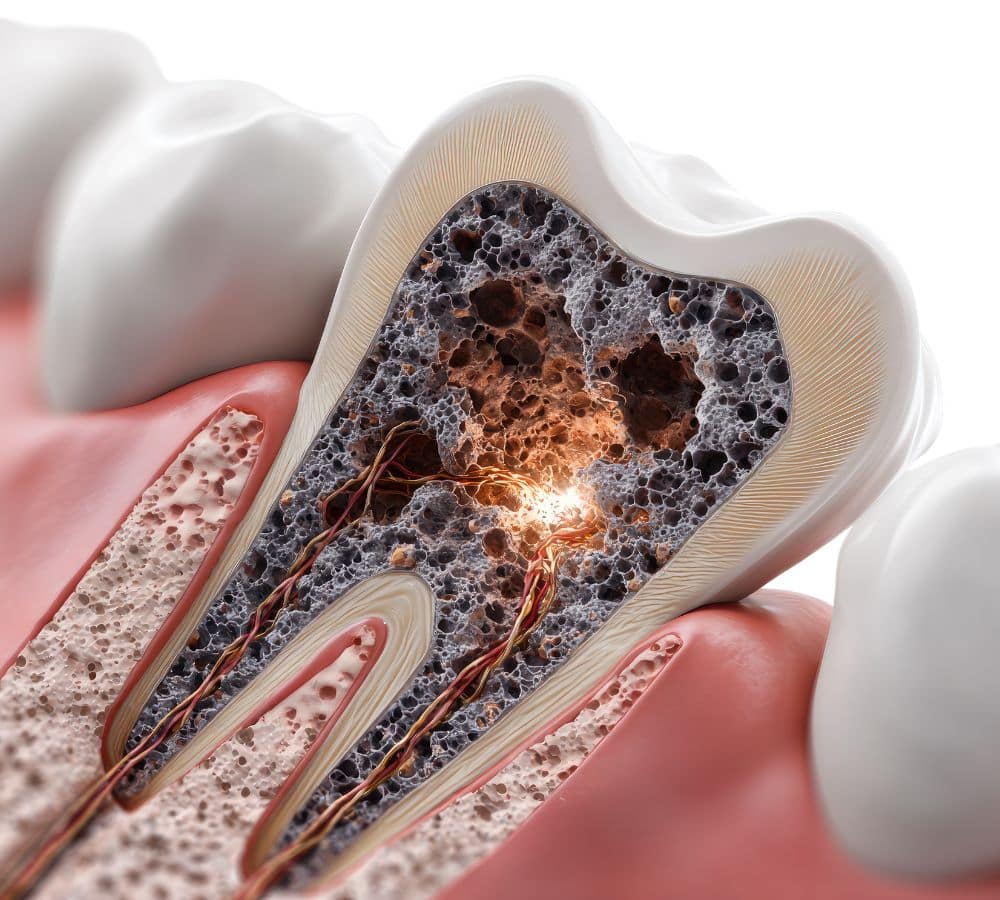
Stage 2 — into the dentine. With more time, decay progresses from enamel into the middle layer, the dentine. Dentine is softer and decays faster than enamel, so progress accelerates once this layer is reached. At this point the tooth may begin to show pain or sensitivity, particularly to cold and sweet — what to do if you suffer from sensitive teeth covers the several other things that produce the same symptom. If you are wondering how a substance this hard gives way at all, if enamel is the hardest substance in the body, why do teeth break? answers it.
Stage 3 — the pulp. If decay continues, it reaches the inner layer, the dental pulp, which contains the nerve and blood supply. Infection here usually causes severe pain, sensitivity, and possible swelling of the gum around the tooth. That is an abscess: what is a tooth abscess? and why are dental abscesses so painful? describe what is happening and why it will not settle on its own. Swelling that is spreading, or that affects your breathing or swallowing, is an emergency, not a wait-and-see.
One pattern worth recognising: decay is often painless until it is well advanced, and pain that starts and then stops can mean the nerve has died rather than that the problem has resolved. What are the causes of toothache and what are their symptoms? maps the different pain patterns onto their causes. Absence of pain is not evidence of absence of decay, which is what examinations and radiographs are for — decay between the teeth in particular is invisible to the eye and to the person who has it. How safe are dental x-rays covers the exposure question, which is the one people usually want answered before they agree to them.
WHO's list of what untreated decay eventually costs is worth keeping in view, because it is broader than teeth: "physical symptoms such pain, discomfort or chronic systemic infection", "functional limitations such as challenges eating, speaking, breathing or sleeping", and "detrimental impacts on emotional, mental and social well-being."
How to prevent it
Remove the plaque. Daily brushing, and cleaning between the teeth with floss or interdental brushes, removes plaque before its bacteria can do sustained damage. Roughly a third of each tooth’s surface sits between the teeth and is never reached by a brush — which is exactly where adult decay most often starts. Is flossing really that important? makes that case properly, and what is the ideal daily routine for oral hygiene? sets out the order to do things in. What a brush cannot remove, a hygienist can.
Use fluoride. Fluoride reduces bacterial activity and prevents loss of minerals from the tooth. Brush twice daily with fluoride toothpaste — WHO specifies 1,000 to 1,500 ppm — and spit rather than rinse so the fluoride stays where it is needed. The benefits of fluoride explains the mechanism; selecting a toothpaste — fluoride or non-fluoride? and choosing the right toothpaste deal with the choice in front of you in the supermarket aisle.
The water supply does part of the work as well. The National Health and Medical Research Council reports that "water fluoridation reduces tooth decay by 26 to 44% in children and adolescents, and by about 27% in adults," and supports fluoridation within a range of 0.6 to 1.1 milligrams per litre. Its 2016 review of the evidence "confirmed that community water fluoridation helps to reduce tooth decay, and that there is no reliable evidence that water fluoridation at current Australian levels causes health problems."
Reduce the frequency of sugar intake. Note that this is about frequency, not just quantity — the ADA's diet policy states that "the form, frequency, timing and total amount of sugar intake are significant in the initiation of the caries process." Each exposure starts an acid attack lasting roughly 20–40 minutes before saliva restores a safe pH. Six small exposures across a day do far more damage than the same sugar eaten at once.
On quantity, WHO recommends keeping free sugars below 10% of total energy intake, and ideally below 5%; the ADA translates that to "no more than 6 teaspoons (24 grams) of free sugar... per day." Free sugars include what manufacturers, cooks and consumers add, plus the sugars naturally present in honey, syrups and fruit juices — which is why juice counts. How does sugar affect your dental health? and sugar: what does it do to your teeth? go further into it, and how does your diet affect your teeth? looks at the whole day rather than one food.
Acid from the diet is a separate problem to acid from bacteria. Decay needs bacteria; erosion does not. How does acidic food affect your teeth? and what is acid wear and how can I avoid it? cover the second process, and damage to tooth enamel occurs within 30 seconds of consuming soft drinks reports how quickly it starts. The ADA warns specifically that "the combination of sugar and food acid can be particularly destructive" — a mouth running both processes loses tooth structure from two directions at once.
Use dairy to your advantage. Milk and cheese protect against decay — they contain casein, calcium and phosphorus, and cheese in particular raises pH and stimulates saliva. The ADA's policy promotes "calcium rich foods and drinks such as milk, cheese and some fish" as the preferred dietary source of calcium. Finishing a meal with cheese is a genuinely useful habit.
Other dental measures:
- Fissure sealants — sealing the deep grooves in the biting surfaces of back teeth, particularly in children after the permanent molars erupt. See the role of fissure sealants in children’s teeth and who is a suitable candidate for dental sealants?, because adults sometimes are.
- Re-mineralising products — high-strength fluoride and casein–calcium phosphate formulations, recommended on assessment of your risk
- Sugar-free chewing gum — the ADA describes "sugar-free confectioneries without added acids, including chewing gums" as dentally safe alternatives to sugary confectionery
And the factors people forget: dry mouth from medication dramatically raises decay risk regardless of brushing, and so does frequent acid exposure. The ADA notes that medications "including over-the-counter vitamin and mineral tablets, may include sugars... or contribute to dry mouth" — so tell your dentist about everything you take, not just prescriptions. My mouth is always dry — why is this and does it affect my teeth? and my mouth always feels dry! What can I do? explain why saliva matters as much as brushing does.
How decay is treated
Treatment follows the stage, which is why the stage matters so much.
| Stage | Treatment |
|---|---|
| Early — no cavity in the enamel yet | Re-mineralising products can reverse the decay. To succeed, this requires a sustained improvement in oral hygiene and diet — the products alone will not do it. |
| Cavity, not yet reaching the pulp | The diseased tooth structure is removed and a filling placed — tooth-coloured or metallic. |
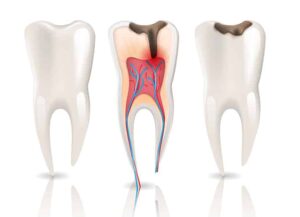
| Decay reaching the pulp | Root canal treatment may save the tooth. |
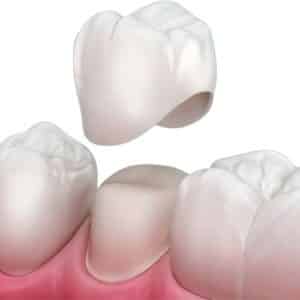
| Tooth badly broken down | Extraction may be necessary. |
Can you reverse tooth decay, and do I need a filling? is the article to read if you have been told you are at the borderline of the first two rows. For the second row, tooth fillings, dental fillings: porcelain, amalgam or composite resin? and how long do dental fillings last? cover the material choice and its consequences. For the third, root canal treatment and everything you need to know about root canal treatment. For the fourth, what are the replacement options for missing teeth? and dental implants.
The practical consequence of that table: the difference between a re-mineralisation programme and a root canal is time. Decay caught at a routine examination while it is still a white spot costs almost nothing to reverse. The same tooth two years later is a filling; five years later it may be a crown or an extraction. Nothing about the disease speeds up or slows down of its own accord — it simply continues at the rate your habits set. The cost consequence is easy to underestimate as well, and the price guide makes the gap between those four rows plain.
One more thing worth knowing: once a tooth has its first filling, it is in a restoration cycle. Fillings do not last forever, and each replacement is a little larger than the last. This is why preventing the first cavity is worth so much more than treating it well.
Why a comprehensive examination matters
Tooth decay frequently occurs alongside other dental disease — gum disease, erosion, wear from grinding, cracked teeth. A comprehensive examination is essential to identify these before treatment begins, because treating a cavity in isolation while missing the erosion or the grinding that will destroy the restoration achieves very little. Understanding your treatment describes what a full examination covers, and how often should I go to the dentist? covers the interval — which for a high-risk mouth is not the same as for a low-risk one.
Common questions
I brush twice a day and my friend barely brushes at all. Why do I get the cavities?
Because brushing is one of three inputs and the other two are not equal between you. Frequency of sugar exposure, and how much saliva you produce, vary enormously between people, and both can overwhelm good brushing.
Saliva is the part people never think about. It buffers acid, washes away food and carries the minerals that repair early damage, so anything that reduces it raises risk sharply. The ADA's diet policy names two groups on exactly this basis — "individuals using medication(s) which lead to a reduction in salivary flow" and "individuals with conditions which lead to a reduction in salivary flow" — and separately flags the elderly, because of "the increased risk of caries from reduced saliva flow and more exposed root surfaces". Exposed root surface is not enamel and decays more readily, which is why a gum-recession pattern and a decay pattern often arrive together.
The practical version: if you are on regular medication, if your mouth feels dry, if you graze rather than eat at set times, or if your gums have receded, your risk is not your friend's risk and neither is the routine that should manage it. That is the point of a risk assessment rather than a standard set of instructions — see my mouth is always dry — why is this and does it affect my teeth?
I have switched to sugar-free soft drink. Is that safe for my teeth now?
Safer for decay, not safe for enamel. The Australian Dietary Guidelines are direct about this: artificially sweetened drinks "can provide a useful alternative to those high in added sugars. But artificially sweetened soft drinks are still acidic and may erode tooth enamel so only drink them sometimes and in small amounts."
The reason is the distinction this page draws above. Decay needs bacteria to make acid out of sugar; erosion needs no bacteria at all, because the acid arrives in the can. Taking the sugar out removes one process and leaves the other running. The guidelines' recommendation of water rests partly on this — water has "no kilojoules and a low acidity", which is a dental argument as much as a dietary one.
If you are going to drink it, drink it with a meal rather than sipping across an afternoon, and do not brush immediately afterwards while the surface is softened. See how does acidic food affect your teeth? and what is acid wear and how can I avoid it?
Sugar-free chewing gum is a different case and a genuinely useful one: the ADA lists "sugar-free confectioneries without added acids, including chewing gums" as dentally safe alternatives.
My dentist says there is decay on an x-ray. I can't see anything and nothing hurts. How do I know it is real?
Ask to be shown the image, and ask one specific question: is it still in the enamel, or is it into the dentine? That is the question that decides which row of the treatment table above you are in, and it is a reasonable thing to ask of any diagnosis.
If the answer is enamel only, there is a genuine option that is not a filling — a re-mineralisation programme with high-strength fluoride, improved cleaning between the teeth, and a change to how often sugar goes through the mouth, reviewed at the next examination to see whether it has held. If the answer is dentine, the window has closed, because dentine is softer and the rate picks up once decay is through the surface.
Neither invisibility nor absence of pain tells you anything useful here. Decay between two teeth cannot be seen by looking, and pain arrives when the process is near the nerve — late, not early. That is the whole reason a radiograph is taken, and you are entitled to ask what this one will change before it is taken. See can you reverse tooth decay, and do I need a filling?
Does decay in a baby tooth really need treating if the tooth is going to fall out?
Yes, and the scale of the problem in Australia is the argument for it. The ADA reports that 34% of children aged 5–6 have experienced decay in their primary teeth and 27% of those aged 5–10 have untreated decay in them. These are not a handful of unlucky children.
Baby teeth hold the space for the adult teeth behind them, they are needed for eating and for speech during the years speech is forming, and infection in one can affect the adult tooth developing directly above it. Pain and abscesses are also just as real in a tooth with three years left in it as in one with fifty.
The ADA's prevention advice for this age group is aimed at one specific habit: for parents and carers of infants and babies, "sleeping with sweetened pacifiers/dummies, food or bottles with products containing sugar, including milk and fruit juices, should be discouraged". A bottle at bedtime bathes the front teeth for hours in a mouth that has stopped producing much saliva. See children's dentistry and kids' teeth cleaning tips.
Fruit is natural. Does it count as sugar?
Whole fruit and fruit juice are treated differently, and the difference is not arbitrary. Free sugars — the category the 6-teaspoon limit applies to — are defined as the sugars added by the manufacturer, cook or consumer plus those naturally present in honey, syrups, fruit juices and fruit juice concentrates. Juice is in; the sugar inside an intact apple is not.
The Australian Dietary Guidelines make the same point from the nutrition side: "Most Australians eat only about half the recommended quantity of fruit. However many of us drink far too much fruit juice — whole fruit is preferable to juice." Dried fruit sits closer to the juice end, because it is concentrated and it sticks to the teeth.
For scale on what a single drink does to the daily budget, the ADA notes that "on average, one can of soft drink contains 10 teaspoons of sugar. This is 1.5 times the daily sugar intake recommended by the WHO." See Victorians' love of soft drink wreaks havoc with teeth.
Related reading
- How do I prevent dental decay?
- The stages of dental decay
- Top tips on how to avoid dental problems
- Why does a cracked tooth hurt so much? — decay is a common reason a cusp gives way
- Caring for your teeth: 8 steps to dental health
Practical details
For further information, call Smile Solutions on 13 13 96.
Specialist registration can be verified on the AHPRA register, or by calling 1300 419 495. The practice’s registered specialists are identified as such within the full team.
Smile Solutions, Level 1, 220 Collins Street, Manchester Unity Building, Melbourne VIC 3000 — getting here. Phone 13 13 96, contact us, or theteam@smilesolutions.com.au. Monday–Friday 8.00am–6.00pm, Saturday 8.30am–1.30pm, Sunday by appointment.
Published 3 February 2017. Figures quoted are from the named published sources and describe populations, not individuals. General information only; it does not replace advice from your treating practitioner.
Smile Solutions trades under ABN 28 193 514 103.
Images on This Page
-
https://www.facebook.com/tr?id=800557773428361&ev=PageView&noscript=1
(no alt text)
-
https://www.smilesolutions.com.au/wp-content/uploads/2025/10/calendar_month.svg
(no alt text)
-
https://www.smilesolutions.com.au/wp-content/themes/arcadian-wordpress-theme/assets/images/smile_solutions_logo_white.png
Smile Solutions Logo
-
https://www.smilesolutions.com.au/wp-content/themes/arcadian-wordpress-theme/assets/images/smile_solutions_logo_purple.png
Smile Solutions Logo
-
https://www.smilesolutions.com.au/wp-content/uploads/2023/11/SS-Tooth-1-1-150x150.png
Smile Solutions
-
https://www.smilesolutions.com.au/wp-content/uploads/2022/04/Tooth-Decay.jpg
Tooth Decay
-
https://www.smilesolutions.com.au/wp-content/uploads/2025/09/Root-Canal-2-300x217.jpg
Root Canal
-
https://www.smilesolutions.com.au/wp-content/uploads/2026/08/Mouth-Breathing-300x270.jpg
Mouth Breathing
-
https://www.smilesolutions.com.au/wp-content/uploads/2025/09/Dental-Crown-at-Smile-Solutions-300x300.jpg
Dental Crown at Smile Solutions
-
https://www.smilesolutions.com.au/wp-content/themes/arcadian-wordpress-theme/assets/images/family_owned_bussiness.png
Family Owned Business
-
https://www.smilesolutions.com.au/wp-content/themes/arcadian-wordpress-theme/assets/icons/icon--phone.svg
Smile Solutions Contact
-
https://www.facebook.com/tr? id=800557773428361&ev=PageView&noscript=1
(no alt text)