Types of dental filling
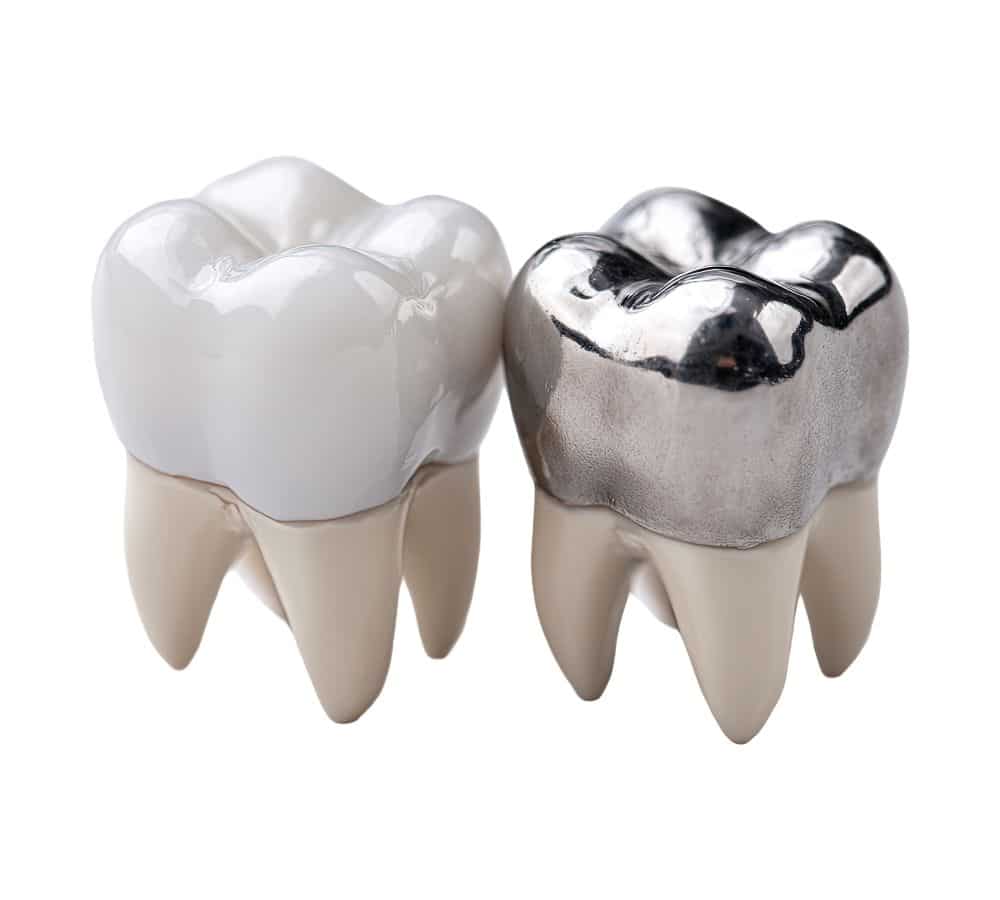
Dentistry has seen significant changes in the technology and materials used for fillings. Here are the three main materials and how they differ. If the prior question is whether you need one at all, can you reverse tooth decay? answers that first, and why do I need a filling? covers the reasons one gets recommended.
Amalgam
Silver-coloured fillings have been used since the 1800s, with the type of material used today becoming most popular in the 1960s.
Amalgam is a metal alloy of mercury, silver, tin and copper. It begins as a soft material placed into the prepared tooth, and hardens over a short period.
Why it lasted so long
Very reliable and durable, and it works in a moist environment — which is genuinely difficult to achieve in the mouth, and is why amalgam dominated for over a century.
Why alternatives were sought
- Dark colour
- Use of mercury
- Difficulty bonding to the tooth surface
- Amalgam expands and contracts, which can cause cracks and fractures in the tooth as well as in the filling — see why does a cracked tooth hurt so much? and will a cracked tooth be treated?
That last one is the clinically significant drawback. Because amalgam does not bond, it works by mechanical retention, and its dimensional movement over years puts stress on the surrounding tooth. Where that stress has already done its work, the answer is often a crown rather than another filling.
Amalgam is not as widely used today, given the alternatives.
Composite resin
Very popular and common — glass particles mixed with an acrylic resin.
It comes in different viscosities, each favoured for different roles. A handheld curing light sets the material once placed, which gives the clinician much longer working time for shaping and placement than other materials.
Advantages over amalgam
- Multiple colour shades, so the material can be matched to the tooth
- Increased working time to manipulate the material to suit the tooth structure
- Mercury-free
- Bonds to the tooth, which can mean less tooth removal during preparation
- Easy to use for small and simple repairs and restorations
The bonding point is the one that matters most for tooth preservation: because composite adheres, the cavity does not need to be shaped for mechanical retention, so less healthy tooth is removed. The same chemistry underlies composite bonding on front teeth — see will composite bonding look natural, and how long will it last?
One shade caveat applies to any tooth-coloured material: composite does not lighten with whitening. If whitening is part of your plan, do it first and match the filling to the result — otherwise the restoration ends up darker than the teeth around it.
The honest limitation
In some situations amalgam is stronger and longer lasting than composite resin. For larger restorations, that is where the third material comes in. How long do dental fillings last? gives realistic figures for each.
Porcelain
A very strong, tooth-coloured material.
At Smile Solutions, porcelain fillings are either made by preferred laboratories offsite — including the on-site laboratory — or milled on site using CEREC, Chairside Economical Restoration of Aesthetic Ceramics.
Advantages
- Very good for large restorations where strength is needed
- Excellent at returning the tooth to its natural shape
- Longevity and stability
- Colour matching
- CEREC porcelain fillings can be fabricated and placed in a single visit, on one day — how the CEREC process works
That last point removes what used to be the standard cost of a laboratory restoration: two appointments, two rounds of anaesthetic, and a temporary in between. If a temporary does come out between visits, what to do if a temporary filling comes out explains the steps.
Cost
Porcelain fillings can be more expensive than amalgam and composite resin, reflecting both the material’s performance in these cases and the technology required to fabricate them. Porcelain fillings and composite fillings: the differences and costs works through the comparison with fees attached; published fees are in the price guide.
How the choice is made
| Amalgam | Composite resin | Porcelain | |
|---|---|---|---|
| Appearance | Dark | Shade matched | Shade matched |
| Bonds to tooth | No | Yes | Yes |
| Best for | — | Small to medium restorations | Large restorations |
| Visits | One | One | One with CEREC, otherwise two |
| Cost | Lower | Lower | Higher |
After a thorough check-up and diagnosis, your dentist will discuss which material is best suited to you. The decision rests on your oral health and what will best suit the type of work needed — both for restoring function and for appearance. Understanding your treatment covers how those options are presented, and a second opinion is a reasonable step if a proposal seems larger than the problem.
Size is usually the deciding factor. Composite excels in small and medium cavities; once a restoration is large, porcelain’s strength and stability earn the extra cost. Beyond a certain point neither is enough, and the tooth needs full coverage — what types of dental crown are available? takes it from there, and what does restorative dentistry mean? places all of it on one map.
How much tooth is left may matter more than which material
There is some independent evidence for that instinct, though it comes from a narrower setting than this page covers.
A long-term cohort study of endodontically treated teeth — teeth that have had root canal treatment — published in the peer-reviewed endodontic literature, notes that “recent data based on systematic review and meta-analysis evaluating the clinical performance of direct composite resin versus indirect restorations on ETT demonstrated no differences in tooth survival”, consistent with its own results. In that cohort, restorative choice was driven by what was left of the tooth rather than by material preference: the authors record that “the selection of restorative therapy was based on the residual tooth structure, always selecting crown restorations when cusp coverage was needed.”
Two cautions before anyone over-reads that. It describes root-filled teeth specifically, which are not typical of everyday fillings, and “no difference in survival” is a statement about whether the tooth is still there — not about the restoration’s appearance, margins, or how many times it has been replaced along the way.
What it does support is the order of the conversation. Ask how much sound tooth remains and whether the cusps need covering, before asking which material. If the answer is that the tooth is heavily broken down, that decides more than the material list does. See Endodontists for who handles the difficult end of this.
If you grind or clench, say so before the material is chosen
TMD and teeth grinding explains why the load on the tooth changes the calculation — and there is measured evidence behind the recommendation that usually follows.
In the same long-term cohort, use of a night guard was a statistically significant protective factor for tooth survival (odds ratio 0.34; 95% CI 0.13–0.86). Again, that is a study of root-filled teeth rather than of fillings generally, and an association rather than a guarantee. But if a splint is suggested alongside a restoration, that is the kind of finding it rests on, rather than an upsell.
The filling is the repair, not the fix
Worth a paragraph, because the material question is the last question in the sequence and the least important one for whether you are back next year.
The World Health Organization describes the mechanism plainly: dental caries “results when plaque forms on the surface of a tooth and converts the free sugars … contained in foods and beverages into acids that destroy the tooth over time”, and it names the consumption of free sugars as “the most common risk factor for dental caries”. Its term free sugars includes not only sugars added by a manufacturer, cook or consumer but also those naturally present in honey, syrups, fruit juices and fruit juice concentrates. WHO strongly recommends keeping free sugars below 10% of total energy intake, and suggests that going below 5% further reduces the risk.
The Australian Dental Association adds the detail most people miss — that “the form, frequency, timing and total amount of sugar intake are significant in the initiation of the caries process”. Frequency, not just quantity.
On the other side of the ledger, the National Health and Medical Research Council found that community water fluoridation reduces tooth decay by 26 to 44% in children and adolescents, and by about 27% in adults, and supports fluoridation within the range of 0.6 to 1.1 milligrams per litre.
See how does sugar affect your dental health?, does sugar damage teeth?, how does your diet affect your teeth?, the benefits of fluoride, preventing dental decay and Dental Cleans and Hygienists.
If the filling is for a child
Fillings are one of the basic dental services covered by the Child Dental Benefits Schedule, alongside check-ups, X-rays, cleaning, fissure sealing, root canals and extractions. Services Australia covers eligible children for up to $1,158 over two consecutive calendar years, with the cap indexed each 1 January. There are item and time restrictions on some services, so it is worth asking before treatment starts rather than after. Note that the CDBS does not cover orthodontic or cosmetic work, or any dental services provided in a hospital.
See Child Dental Benefit Schedule, how the Child Dental Benefits Schedule operates and Children’s Dentistry.
Common questions
The tooth is cracked rather than decayed. Does that change which material is used?
It changes the question from what fills the hole to what holds the tooth together, and it is the situation where the two can point in opposite directions.
A 2024 review of cracked teeth in the endodontic literature is candid that the evidence is not settled: “there is no clear evidence on the most suitable restorative treatment approach to manage [a cracked tooth].” What it does report is a direction of travel — cracked teeth “managed with direct bonded composite restorations may be more likely to require root canal treatment and/or further repair of fractured restorations compared with [those] managed with cuspal coverage restorations.” Cuspal coverage means a restoration that caps over the biting points of the tooth rather than sitting inside it: an onlay or a crown rather than a filling.
The review also puts a number on what can follow: “the reported incidence of endodontic intervention after restorative management has been reported to be between 7.7% and 20%.” So somewhere between roughly one in thirteen and one in five of these teeth went on to need root canal treatment anyway.
It lists the factors that push towards covering the cusps rather than filling: the extent of the crack, a history of spontaneous pain, moderate or significant decay, existing direct restorations, pain on biting, the volume of residual coronal tooth structure, the proximal contacts, the occlusal scheme and parafunctional habits such as grinding. Its own framing is that the decision “must be tailored to each patient's unique characteristics, rather than taking a ‘one fits all’ approach.”
One counterweight worth knowing, because more is not automatically better: the review notes that chasing a crack to its full extent is sometimes the wrong move, since “this may result in inadvertent removal of a significant amount of sound tooth tissue and/or render the tooth unrestorable.”
So if a crack is the diagnosis, the useful questions are: how far does it go, does it need cuspal coverage or will a bonded restoration do, and what is the plan if the nerve becomes symptomatic later? See why does a cracked tooth hurt so much? and will a cracked tooth be treated?
Should I have my old amalgam fillings replaced?
Not simply because they are amalgam, and it is worth separating the three different reasons people ask.
If they are failing, that is a clinical decision and the page above describes why it happens: amalgam does not bond, it expands and contracts over years, and that movement stresses the tooth around it. The things that trigger replacement are a fracture in the filling or the tooth, decay at the margins where the two meet, a restoration that has become unsupported, or persistent symptoms. Those are findings, not preferences, and they are what an examination and radiographs are for.
If you dislike how they look, that is a legitimate reason to change them and there is nothing wrong with saying so — but it is an elective cosmetic decision and should be quoted and consented to as one.
If you have read something about mercury, the honest position is that the independent documents behind this page do not settle that debate one way or the other, so this page will not pretend to. What can be said is that materials used by registered practitioners in Australia are subject to approval by the Therapeutic Goods Administration — the ADA's own description is that equipment and materials here “are subject to rigid scrutiny and approval by the Therapeutic Goods Administration.” If a specific material concerns you, ask for its product name and look it up rather than relying on a general reassurance, from us or anyone else.
The one practical point that applies whatever your reason: every replacement cycle removes a little more tooth. A restoration is prepared into the tooth, and the replacement is prepared into what is left. A sound, symptom-free filling that is doing its job is usually monitored and photographed at review rather than replaced on principle. If replacement is proposed, it is entirely reasonable to ask what was seen, on which surface, and whether it could be reviewed in six months instead.
Two dentists proposed different materials — and very different prices — for the same tooth. Who is right?
Possibly both, and the variation is a documented feature of Australian dentistry rather than a sign that one of them is wrong.
There is no national dental fee schedule in Australia. The Australian Dental Association's Dental Fees Survey — the 2022 edition drew 3,819 valid responses from 11,035 dentists invited — reports “considerable variation in the fees charged within and between states,” and it is published to members rather than to patients. A submission to the 2017 Commonwealth parliamentary inquiry into private health insurance and out-of-pocket costs described the consumer consequence directly: “private patients can go to multiple dentists and receive conflicting diagnoses and widely varying quotes for unpredictable dental fees. There are no consumer guidelines to ascertain the reasonableness of dental fees charged.”
So rather than looking for a right answer, make the two proposals comparable:
- Ask for item numbers on both quotes. They are what your health fund assesses and they are the only way two quotes can be lined up against each other.
- Ask what each one is treating. A quote for a large porcelain restoration and a quote for a composite filling may be answering different diagnoses — one clinician may have found a crack or judged the cusps unsupported. Ask what was seen.
- Ask to see it. Radiographs and intra-oral photographs are yours; ask for them to be shown and explained, and ask for copies.
- Ask what happens if you do nothing for six months. Sometimes the honest answer is very little, and sometimes it is the tooth splits. Either answer is informative.
- A second opinion is normal, and nobody should be offended by one, particularly where the proposal is large.
See understanding your treatment, second opinions and corrective dentistry and the published price guide.
Related reading
- What does restorative dentistry involve? — the order treatment follows
- The stages of dental decay
- Preventing dental decay
- Why do I bite my cheek after a filling?
- What to do if you suffer from sensitive teeth
- Dental crowns for children — silver or white?
- What is the difference between porcelain crowns and veneers?
Practical details
Smile Solutions, Level 1, 220 Collins Street, Manchester Unity Building, Melbourne VIC 3000 — getting here. Phone 13 13 96, contact us, or theteam@smilesolutions.com.au. Monday–Friday 8.00am–6.00pm, Saturday 8.30am–1.30pm, Sunday by appointment.
CEREC restorations are designed and milled on site in a single appointment; the technology page describes the equipment. The clinical team is listed by name.
Published 10 October 2018. Restoration lifespans vary with the individual, the size of the restoration and oral habits. The survival and night-guard figures quoted are from a published cohort study of endodontically treated teeth and the systematic-review data it cites; they describe that study population, not Smile Solutions results, and no particular outcome is promised. Cracked-tooth figures and treatment factors are from a published review in the endodontic literature and describe those study populations. Caries and sugar statements are the World Health Organization’s and the Australian Dental Association’s; fluoridation figures are the NHMRC’s; fee variation is as reported in the ADA's Dental Fees Survey 2022 and a 2017 submission to a Commonwealth parliamentary inquiry. Child Dental Benefits Schedule caps, coverage and exclusions are set by Services Australia and change. General information only; it does not replace advice from your treating practitioner.
Smile Solutions trades under ABN 28 193 514 103.
Images on This Page
-
https://www.facebook.com/tr?id=800557773428361&ev=PageView&noscript=1
(no alt text)
-
https://www.smilesolutions.com.au/wp-content/uploads/2025/10/calendar_month.svg
(no alt text)
-
https://www.smilesolutions.com.au/wp-content/themes/arcadian-wordpress-theme/assets/images/smile_solutions_logo_white.png
Smile Solutions Logo
-
https://www.smilesolutions.com.au/wp-content/themes/arcadian-wordpress-theme/assets/images/smile_solutions_logo_purple.png
Smile Solutions Logo
-
https://www.smilesolutions.com.au/wp-content/uploads/2023/11/SS-Tooth-1-1-150x150.png
Smile Solutions
-
https://www.smilesolutions.com.au/wp-content/uploads/2018/10/Fillings.jpg
Dental fillings: porcelain, amalgam or composite resin?
-
https://www.smilesolutions.com.au/wp-content/uploads/2025/09/Root-Canal-2-300x217.jpg
Root Canal
-
https://www.smilesolutions.com.au/wp-content/uploads/2026/08/Mouth-Breathing-300x270.jpg
Mouth Breathing
-
https://www.smilesolutions.com.au/wp-content/uploads/2025/09/Dental-Crown-at-Smile-Solutions-300x300.jpg
Dental Crown at Smile Solutions
-
https://www.smilesolutions.com.au/wp-content/themes/arcadian-wordpress-theme/assets/images/family_owned_bussiness.png
Family Owned Business
-
https://www.smilesolutions.com.au/wp-content/themes/arcadian-wordpress-theme/assets/icons/icon--phone.svg
Smile Solutions Contact
-
https://www.facebook.com/tr? id=800557773428361&ev=PageView&noscript=1
(no alt text)
-
https://bat.bing.com/action/0?ti=25148060&tm=gtm002&Ver=2&mid=8c88fa47-828f-4d0d-8716-fd1bbc7e1a89&bo=1&sid=10fa6020ab2711f190f251097f1e19ef&vid=10fa9870ab2711f19a56379e6a4565d3&vids=1&msclkid=N&pi=918639831&lg=en-US&sw=800&sh=600&sc=24&nwd=1&tl=Dental%20fillings%3A%20porcelain,%20amalgam%20or%20composite%20resin%3F%20-%20Smile%20Solutions&p=https%3A%2F%2Fwww.smilesolutions.com.au%2Fdental-articles%2Farticle%2Fdental_fillings_composite%2F&r=<=1910&evt=pageLoad&sv=2&cdb=AQAQ&rn=310128
(no alt text)