What dental decay is
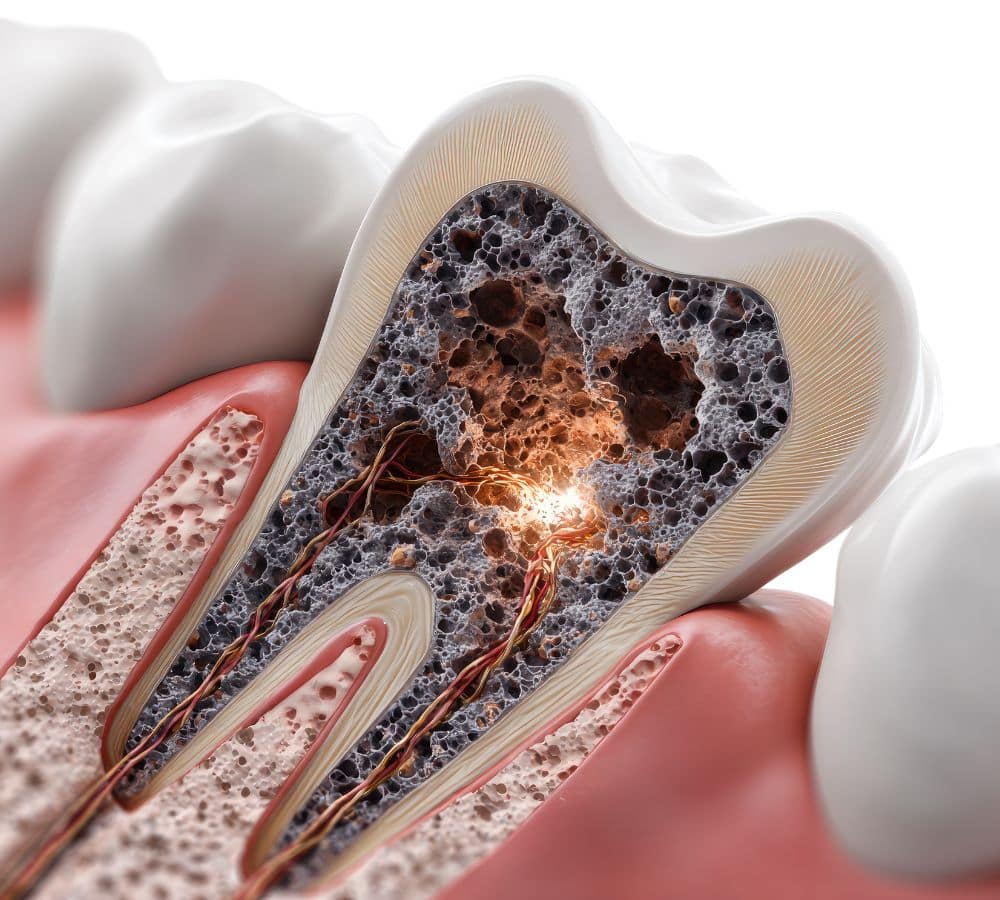
Dental decay is the process by which the hard outer layer of a tooth — the enamel — is broken down, and the softer inner layer, dentine, becomes infected by bacteria.
The mechanism, in the Australian Dental Association's words: “the metabolism of simple carbohydrates by bacteria in the dental plaque … produces acids. The production of these acids causes the pH of dental plaque to fall below the critical level leading to softening of tooth structure which may over time result in the development of dental caries.”
Step by step:
Teeth come into regular contact with sugars and starches from food and drink. These form acids with our saliva. The acids attack the enamel, weakening it — and over time that leads to destruction of the tooth and cavities. How does tooth decay develop? walks through the same sequence in more detail, and if enamel is the hardest substance in the body, why do teeth break? explains why hardness is not the same as durability.
It is the most common chronic disease there is, and Australia is no exception. The Australian Dental Association reports that 34% of Australian children aged 5–6 have experienced decay in their primary teeth, and that 27% of those aged 5–10 have untreated decay in primary teeth. Nearly 11 in every 1,000 children aged 5–9 are hospitalised for potentially preventable problems due to dental conditions — rising to 14.3 per 1,000 for Indigenous children. Only 56% of children visit a dentist before age 5, and 32% of parents said their child's first visit was for pain or a problem rather than a check.
Note that starches are on that list alongside sugars. Bread, crackers and chips break down into sugars in the mouth, which is why “I don't eat sweets” is not by itself protection. How does your diet affect your teeth?, how does sugar affect your dental health? and six foods to avoid for healthy teeth go through the list properly.
What happens if you leave it
There are stages, each with different symptoms and risks. The stages of dental decay sets them out one by one.
When decay first appears, there are very few symptoms.
As it advances it causes sensitivity to hot, cold and sugar, which can worsen into a constant throbbing ache. See what to do if you suffer from sensitive teeth and what are the causes of toothache and what are their symptoms?.
If left untreated, the tooth becomes infected as decay reaches the nerve. That can present as an abscess, with severe pain, facial swelling and fever. Why are dental abscesses so painful? and can a dental abscess affect your general health? explain why this one is not a wait-and-see problem — what is considered a dental emergency? and emergency dentistry cover getting seen.
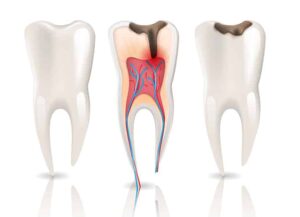
In advanced stages the tooth requires root canal treatment, or may need to be removed. Everything you need to know about root canal treatment is the plain-language version; if the tooth cannot be kept, what are the replacement options for missing teeth? is the next question.
That progression is the whole argument for check-ups. The first stage — the treatable, cheap, painless one — produces almost no symptoms. By the time you feel something, you have skipped past the stage where a small filling would have resolved it.
Once decay has occurred, the only way to correct it is to remove the affected tooth material and replace it with a filling. Why do I need a filling? and tooth fillings cover what that involves, and dental fillings: porcelain, amalgam or composite resin? covers the material choice. Delay allows the infection to continue until bacteria reach the pulp chamber, containing the blood vessels and nerves — and that is the point at which root canal treatment may be required.
Decay does not reverse itself once a cavity has formed. Early demineralisation can remineralise; an actual cavity cannot. Can you reverse tooth decay, and do I need a filling? is the article that draws that line.
How to prevent it
Prevention starts with good oral hygiene — cleaning the mouth and all of its structures, including teeth, gums and tongue, and maintaining that over time. What is the ideal daily routine for oral hygiene? is the routine in full, and do I need to use a tongue scraper? covers the part most people skip.
Regularly and consistently — preferably twice daily, every day. The tools: a manual or electric toothbrush, interdental brushes, and dental floss. Which toothbrushes do dentists recommend?, is flossing really that important? and how to care for your toothbrush are the specifics. Technique matters more than force — how much pressure should I apply when brushing my teeth? and over brushing: what can it do to my teeth?.
Beyond that:
Fluoride
A mineral that strengthens enamel. It can prevent the onset and progression of decay, and can even reverse or arrest early-stage decay.
Found in most toothpastes, and in Australian tap water. On how much difference the water supply makes, the National Health and Medical Research Council found that community water fluoridation reduces tooth decay by 26 to 44% in children and adolescents, and by about 27% in adults. The benefits of fluoride explains the mechanism, fluoridated water — is it good for you? covers the water supply, and this site also carries the contrary view in fluoridated water: why I worry.
That reversal point is worth noting. Fluoride is the only item on this list that can undo damage already started — provided it is caught before a cavity forms.
A good home routine
Brush with fluoride toothpaste for two minutes, twice daily. Floss between your teeth daily. Toothpastes are available for both adults and children. Choosing the right toothpaste for you and selecting a toothpaste — fluoride or non-fluoride? narrow down the aisle; should I be using mouthwash as well? answers the follow-up question.
This routine exists to remove plaque deposits, because plaque is what causes decay. Timing matters too — brushing your teeth: before or after breakfast?.
Smart food choices
Limit or eliminate foods high in sugars and starches. Eat nutritious, balanced meals.
There is a published target for the quantity. The World Health Organization's guidance is that limiting free sugars to less than 10% of total energy intake — and ideally to less than 5% — minimises the risk of dental caries throughout the life course. “Free sugars” means all sugars added to food and drink plus those naturally present in honey, syrups and fruit juice, so juice counts against the figure.
The frequency point matters as much as the quantity, and here the Australian Dental Association is explicit: “the form, frequency, timing and total amount of sugar intake are significant in the initiation of the caries process.” Each exposure starts a new acid attack, so continuous grazing is worse than the same food eaten at meal times. The ADA adds two things people rarely think of: “the combination of sugar and food acid can be particularly destructive”, and medicines, “including over-the-counter vitamin and mineral tablets”, may contain sugars or contribute to dry mouth — chewable and dissolvable ones especially. Drinks are the usual culprit — are sugar free soft drinks better for my teeth?, what are sports drinks really doing to your teeth? and how exercise can increase your risk of tooth decay.
Sugar-free chewing gum
Chewing stimulates saliva, which washes away residual food debris — and neutralises acid. The ADA's position is measured: sugar-free confectionery without added acids, chewing gums included, are “dentally safe alternatives to caries-producing confectionery containing sugar” — but it adds that the main aim of oral health education is to reduce the amount of simple carbohydrate eaten in the first place, “and thus reduce the need for sugar and sugar substitutes.” Gum is a substitute, not a strategy. Does chewing sugar-free gum really help prevent cavities? looks at how much difference it actually makes. If your mouth is dry to begin with, saliva is the problem — see my mouth is always dry.
Quitting smoking
Smoking is a risk factor in a number of dental problems, including decay and gum disease. If you smoke, consider seeking help to stop. Are e-cigarettes bad for my teeth? and the effects of vaping on your oral health cover the substitutes people move to, and oral cancer: signs, risk factors and how your dentist can help covers the more serious reason for stopping.
Routine dental appointments
Regular checks and cleans allow both prevention and early-stage diagnosis. How often should I go to the dentist? and is it important to have a family dentist? cover the interval and the continuity.
Because early decay rarely causes symptoms, detecting it is a job for a professional — with examination and X-rays, not self-inspection. How safe are dental x-rays answers the question that usually follows.
Fissure sealants for at-risk teeth
Where teeth have deep grooves (fissures), your dentist may recommend sealing them with a non-invasive filling material — a fissure sealant.
Teeth with deep grooves on the biting surface collect food debris, which causes cavities. The grooves are typically narrower than a toothbrush bristle, so no amount of brushing cleans them properly. Sealing them closes the trap. Who is a suitable candidate for dental sealants? and the role of fissure sealants in children's teeth cover who benefits most.
What a hygienist adds
A visit to a dental hygienist helps you choose the right equipment and establish the correct technique for your particular needs. What does a dental hygienist do? and your Smile Solutions dental hygienist visit: what to expect describe the appointment; dental cleans and hygienists is the service page.
The hygienist manually removes bacteria-bearing plaque and calculus that has accumulated, setting you up to maintain good hygiene at home. Where the build-up has gone below the gum line, when do you need deeper cleaning? and what is gum disease? explain the difference.
Both halves matter. Calculus cannot be removed by brushing — it is hardened and requires instruments. And technique correction is something you cannot do for yourself, because you cannot see what you are missing.
Minimising plaque, combined with a diet that limits starchy and sugary foods and sweet drinks, is the substance of preventing decay. Everything else on this page supports those two things.
For children, the same principles arrive earlier and in a different order — protecting your child from dental disease, how to encourage your child to brush their teeth and children's dentistry.
Common questions
I brush and floss and still get cavities. My friend does neither and never has. Why?
It is the most demoralising question in dentistry, and it deserves a straight answer rather than an exhortation to try harder.
Decay is not a single-variable disease. The World Health Organization describes the combination that produces it as “A continued high intake of free sugars, inadequate exposure to fluoride and a lack of removal of plaque by toothbrushing with fluoride toothpaste” — three levers, not one. Brushing is one third of that, and it is the third that people fixate on.
Things that genuinely differ between two people with identical brushing:
- Saliva. It clears debris and neutralises acid, and there is a great deal of it or there is not. The Better Health Channel records that “About 10% of the general population and 25% of older people have dry mouth”, and that it is “a symptom of an underlying problem, rather than a condition in itself” — very often a medication. Less saliva means every acid attack lasts longer.
- Frequency rather than quantity. As above, “the form, frequency, timing and total amount of sugar intake are significant”. Someone who has one dessert and someone who sips a sweetened coffee across a morning may eat the same sugar and have very different mouths.
- The shape of the teeth themselves. Deep fissures collect debris in grooves narrower than a toothbrush bristle, which is the entire reason fissure sealants exist.
- How the enamel formed in the first place. Some adult teeth arrive chalky, soft or discoloured because the enamel did not mineralise properly while forming — everything you need to know about chalky teeth. Those teeth decay faster at identical effort.
- Fluoride exposure, which is not uniform: the NHMRC records reductions of 26 to 44% in children and adolescents and about 27% in adults from community water fluoridation, so where you have lived and what you drink matter.
What the independent sources behind this page do not establish is a genetic explanation, so we are not going to offer one. The useful conclusion is different and more actionable: if you are doing the standard routine and still getting decay, the answer is not more scrubbing — it is finding which of the other variables applies to you. That is a conversation with your dentist about saliva, medication, snacking pattern, fissures and fluoride, and it may end in a high-fluoride paste, sealants or a shorter recall interval rather than a lecture.
Is Australian tap water enough on its own?
It is a substantial contributor and it is not the whole of it — the WHO's list above has three items, and water covers one of them.
On what it does deliver, the National Health and Medical Research Council's position is direct. Community water fluoridation is “considered a safe and effective way of reducing tooth decay across the population”, and after reviewing the research the NHMRC “confirmed that community water fluoridation helps to reduce tooth decay, and that there is no reliable evidence that water fluoridation at current Australian levels causes health problems.” The measured effect is the one quoted above: 26 to 44% fewer caries in children and adolescents, about 27% in adults.
A 27% reduction is a large public-health result. It is also, read the other way, a long way short of elimination — which is why brushing with a fluoride toothpaste and limiting free sugars are on the list alongside it rather than instead of it.
Two practical notes:
Toothpaste is the other main source, and the dose matters. The NHMRC records that dental fluorosis has declined in Australia over the same period fluoridation expanded, attributing the decline to “reduced exposure to fluoride from other sources such as toothpaste”, and that low-fluoride children's toothpaste is promoted along with guidance to “use only a small pea-sized amount; encourage children not to swallow toothpaste.” More is not better here.
If you drink mostly bottled or filtered water, say so. Some filters remove fluoride and some do not, and it changes the background exposure your dentist is assuming. It is a two-second thing to mention and it can change a recommendation.
The benefits of fluoride, fluoridated water — is it good for you?, and the contrary view at fluoridated water: why I worry.
Why can't the dentist just look? Do I really need x-rays?
Because the two surfaces where adult decay most often starts cannot be seen by looking at all.
The places a tooth decays are the grooves on the biting surface and the points where two teeth touch each other. The second of those is hidden behind the adjacent tooth. There is no angle, no light and no mirror that reveals it — a radiograph is the only way to see between teeth that are in contact, which is why early decay is described on this page as a job for a professional with examination and X-rays rather than self-inspection.
On the dose, the figures are smaller than most people assume. The International Atomic Energy Agency gives typical effective doses of 1–8 μSv for an intraoral dental X-ray and 4–30 μSv for a panoramic examination, and notes that intraoral doses are “usually less than one day of natural background radiation”, while a panoramic examination at the top of its range is “equivalent to a few days of natural background radiation which is similar to that of a chest radiograph.” Cone beam CT sits higher — the IAEA gives 50 μSv or below for small or medium scanning volumes and 100 μSv for large volumes — which is why it is reserved for cases that need it.
None of that means every visit needs imaging. Every radiograph should be individually justified, and you are entitled to ask three questions: why this one, why now, and what will it change? A radiograph that will not alter what is done is a radiograph that should not be taken. If you are pregnant, or might be, say so — it changes the decision, and it should be made knowingly.
How safe are dental x-rays? and when do safe dental x-rays become unsafe?.
I take medication and my mouth is dry. How much does that change my risk?
Substantially, and it is the single most under-recognised risk factor on this page.
Saliva is doing continuous work: clearing debris, neutralising acid and supplying the minerals that repair enamel between attacks. Remove it and every exposure lasts longer and does more.
The scale is not small. The Better Health Channel records that “About 10% of the general population and 25% of older people have dry mouth, which means they don't have enough saliva”, that it is “a symptom of an underlying problem, rather than a condition in itself”, and that many medications are known to cause it — its examples include antihistamines and blood pressure medications.
The Australian Dental Association adds a second, separate mechanism from the same source: medicines “including over-the-counter vitamin and mineral tablets, may include sugars (particularly those that are chewable and dissolved in the mouth) or contribute to dry mouth, both of which can contribute to tooth decay or softening and loss of tooth structure.” So a chewable supplement can be both a sugar exposure and a saliva problem at once.
The ADA's list of circumstances in which acidic food and drink should be most carefully avoided reads like a description of this situation: individuals with conditions which lead to a reduction in salivary flow; individuals using medication(s) which lead to a reduction in salivary flow; exertion resulting in a dry mouth; sipping drinks, other than water, during interrupted sleep; and chewing and sucking acidic vitamin tablets. It also singles out the elderly, for whom reduced sugar and acid should be encouraged “because of the increased risk of caries from reduced saliva flow and more exposed root surfaces.”
What to do: bring a complete list of everything you take to your next appointment, including over-the-counter items; take chewable or dissolvable supplements with a meal rather than between meals; keep water rather than anything else beside the bed; and ask whether a high-fluoride paste and a shorter recall interval are appropriate. Do not stop or change a prescribed medicine on your own — that is a conversation with the prescriber. What are the causes of dry mouth? and my mouth is always dry.
I have been told I need several fillings and I did not expect it. Is a second opinion reasonable?
Yes. It is a normal thing to seek, it is not an insult to anyone, and there is published Australian material acknowledging that diagnoses and quotes do vary.
A submission to the Australian Parliament on private health insurance and dental fees put it bluntly: “It is well known that private patients can go to multiple dentists and receive conflicting diagnoses and widely varying quotes for unpredictable dental fees. There are no consumer guidelines to ascertain the reasonableness of dental” fees. The same submission records a 33.8% increase in complaints about dentists reported by the Dental Board in 2016, and notes that nearly a third of people aged 5 or older (32%) avoided or delayed visiting a dentist due to cost in an Australian Institute of Health and Welfare survey.
That is not a reason for suspicion of any particular clinician. It is a reason to treat a large treatment plan the way you would any other significant decision.
What to ask before you seek a second opinion, because it often resolves it:
- Ask to be shown. Ask which teeth, and ask to see the decay on the radiograph or the intraoral photograph. Decay between teeth is visible on an image even to an untrained eye once it is pointed out.
- Ask what happens if you wait. There is a real difference between decay that has reached dentine and an early lesion that could be monitored, and between a tooth that will need root canal treatment in six months and one that will look the same in two years.
- Ask what the alternatives are, including monitoring with fluoride and a review interval, and ask for that option to be described rather than dismissed.
- Ask for it in writing, itemised. As above, quotes vary; you cannot compare two plans that are not written down.
- Ask which are urgent and which can be staged. Cost is a legitimate constraint and a plan can usually be sequenced around it — saying so is far better than disappearing for three years.
If you still want another view, take your radiographs with you. You are entitled to request your records, and a second opinion formed on fresh images of the same mouth is a much weaker comparison than one formed on the same evidence. Second opinions and corrective dentistry, understanding your treatment and the price guide.
Related reading
- The stages of dental decay
- Top tips on how to avoid dental problems
- 10 ways to avoid ruining your teeth
- What can I do to strengthen my teeth?
- Caring for your teeth: 8 steps to dental health
- What is dental erosion and how is it addressed?
- Health problems linked to poor oral hygiene
- General dentistry
Practical details
Smile Solutions, Level 1, 220 Collins Street, Manchester Unity Building, Melbourne VIC 3000 — getting here. Phone 13 13 96, contact us, or theteam@smilesolutions.com.au. Monday–Friday 8.00am–6.00pm, Saturday 8.30am–1.30pm, Sunday by appointment. The clinical team is listed by name, and the price guide sets out what the preventive appointments cost.
The external figures on this page are drawn from the National Health and Medical Research Council on water fluoridation, fluorosis and toothpaste dose; World Health Organization guidance on free sugars and on what prevents caries; the International Atomic Energy Agency on typical dental radiation doses; the Better Health Channel on dry mouth; a submission to the Australian Parliament on private health insurance and dental fees, quoting Australian Institute of Health and Welfare and Dental Board data; and Australian Dental Association material — Policy Statement 2.2.2 on diet and nutrition, and its Dental Health Week reporting of Australian children's oral health data.
Published 13 June 2018. General information only; it does not replace advice from your treating practitioner. Facial swelling with dental pain, or a fever, needs urgent attention.
Smile Solutions trades under ABN 28 193 514 103.
Images on This Page
-
https://www.facebook.com/tr?id=800557773428361&ev=PageView&noscript=1
(no alt text)
-
https://www.smilesolutions.com.au/wp-content/uploads/2025/10/calendar_month.svg
(no alt text)
-
https://www.smilesolutions.com.au/wp-content/themes/arcadian-wordpress-theme/assets/images/smile_solutions_logo_white.png
Smile Solutions Logo
-
https://www.smilesolutions.com.au/wp-content/themes/arcadian-wordpress-theme/assets/images/smile_solutions_logo_purple.png
Smile Solutions Logo
-
https://www.smilesolutions.com.au/wp-content/uploads/2023/11/SS-Tooth-1-1-150x150.png
Smile Solutions
-
https://www.smilesolutions.com.au/wp-content/uploads/2022/04/Tooth-Decay.jpg
Tooth Decay
-
https://www.smilesolutions.com.au/wp-content/uploads/2025/09/Root-Canal-2-300x217.jpg
Root Canal
-
https://www.smilesolutions.com.au/wp-content/uploads/2026/08/Mouth-Breathing-300x270.jpg
Mouth Breathing
-
https://www.smilesolutions.com.au/wp-content/uploads/2025/09/Dental-Crown-at-Smile-Solutions-300x300.jpg
Dental Crown at Smile Solutions
-
https://www.smilesolutions.com.au/wp-content/themes/arcadian-wordpress-theme/assets/images/family_owned_bussiness.png
Family Owned Business
-
https://www.smilesolutions.com.au/wp-content/themes/arcadian-wordpress-theme/assets/icons/icon--phone.svg
Smile Solutions Contact