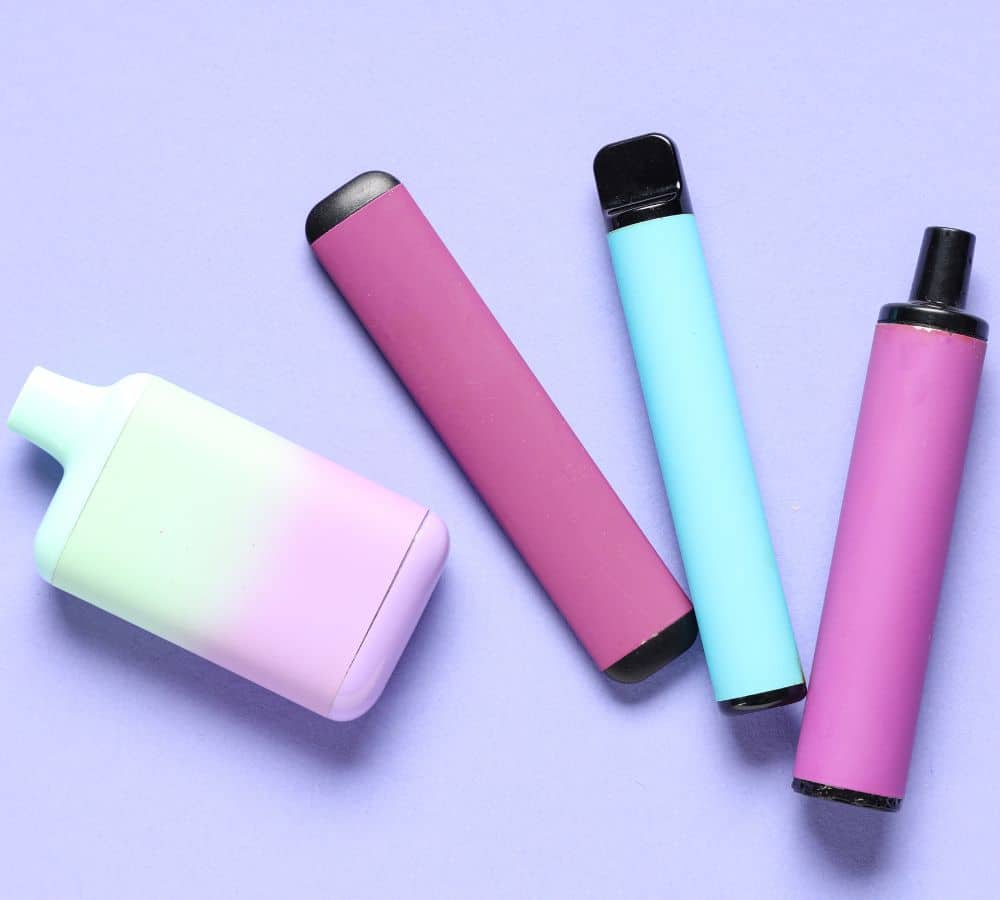
Are e-cigarettes bad for my teeth?
Many long-term smokers have switched to vaping in the belief it avoids the health consequences of tobacco.
On oral health specifically, there is no good evidence that vaping is harmless to the mouth, and a growing body of research suggesting it is not. The effects of vaping on your oral health is the companion article to this one and covers the same ground from a different angle.
What the research found
A study from the University of Rochester Medical Center, published in 2016, reported that e-cigarette vapour damages gum tissue cells in ways comparable to cigarette smoke.
Irfan Rahman, PhD, professor of Environmental Medicine at the UR School of Medicine and Dentistry, described the mechanism: when e-cigarette vapour contacts gum tissue, cells release inflammatory proteins, which aggravate stress within the cells, producing damage that could lead to various oral diseases. What is gum disease? and periodontal (gum) disease explain what those diseases actually are.
The dose relationship reported was straightforward: how much and how often someone vapes affects the extent of damage to the gums and oral cavity.
An important qualification, because it changes how much weight the finding carries. This was laboratory work on cultured cells, not a clinical trial in patients. Cell-culture studies show mechanism and plausibility; they cannot establish how much disease a person will develop, or settle a comparison with smoking. The researchers said so themselves, and called for more work. Treat it as a reason for caution rather than a measured verdict.
What has accumulated since is a larger body of laboratory and observational research pointing the same direction: more gum inflammation, altered oral bacteria, and dry mouth in people who vape than in people who do not. The long-term clinical picture is still incomplete, because the products have not existed long enough. Bleeding gums covers the sign most people notice first, and dental myths exposed is a reminder of how easily a plausible mechanism hardens into received wisdom.
The flavouring finding
One result is worth singling out, because it is the least expected.
The flavourings used in e-cigarettes affect how damaging the product is in these laboratory models. According to Fawad Javed, a post-doctoral researcher at the Eastman Institute for Oral Health who contributed to the study, some flavourings made the damage to the cells worse than others.
So the choice of flavour — which most users treat as a matter of preference — may not be neutral. Several flavouring compounds are approved for eating, where they are digested, and were never assessed for being inhaled repeatedly into the lungs and mouth. Those are not the same safety question.
Sweet flavourings raise a second, more mundane problem: many aerosols contain sugars or sugar-like compounds, and the sticky vapour residue sits on teeth. Reported cases of decay in vapers often show an unusual pattern — decay on smooth front surfaces and at the gum line, where it would not normally be expected. How does sugar affect your dental health?, how does tooth decay develop? and the stages of dental decay explain why a constant low-level sugar exposure is worse than an occasional large one.
Nicotine
Most e-cigarettes contain nicotine, which is known to contribute to gum disease.
That is the point most easily lost in the debate about whether vaping is safer than smoking. Whatever else is or is not in the vapour, the nicotine is still there, and nicotine's effect on the gums — restricting blood flow, impairing healing, masking the bleeding that would otherwise signal disease — does not depend on how it is delivered.
The last point is worth understanding: because nicotine constricts blood vessels, gum disease in a nicotine user can progress with fewer visible warning signs, and be more advanced by the time it is noticed. A vaper whose gums do not bleed does not have healthier gums than a non-vaper whose gums do. When do you need deeper cleaning? covers what treatment looks like once it has progressed, and periodontists are the specialists who manage the advanced cases.
Nicotine also has direct consequences for treatment. It impairs healing after extractions and surgery, and it is a recognised risk factor for dental implant failure and peri-implantitis. If you are having implants, gum surgery or an extraction, your clinician needs to know. See what do I need to know about dental implants?, dental implants at Smile Solutions, I've just had oral surgery — what can I expect during recovery? and how long does it take to recover from wisdom teeth surgery?.
The other oral effects worth knowing
- Dry mouth. Propylene glycol and glycerine, the main vapour bases, are humectants — they attract and hold water, and they dry the mouth. Reduced saliva raises decay risk independently, and it worsens bad breath. See my mouth is always dry, my mouth always feels dry! What can I do?, what causes bad breath and how can I fix it? and bad breath.
- Staining. Less than tobacco, but not none, particularly with darker flavourings. How can I improve the whiteness of my teeth? and teeth whitening cover what can and cannot be lifted.
- Nicotine stomatitis and tissue changes have been reported, as has irritation of the palate and throat. The cause of mouth ulcers and their usual treatments covers what is ordinary and what is not.
- An altered oral microbiome, shifting towards species associated with disease.
- Bruxism. Nicotine is a stimulant, and some users notice more clenching and grinding. See what is bruxism and how is it managed? and night time tooth grinding and clenching.
What this page is not saying
Two things, stated plainly so this is not read as more or less than it is.
It is not saying vaping is worse than smoking. Tobacco smoke contains thousands of combustion products and is a cause of oral cancer, periodontitis and tooth loss. For an established smoker who has fully switched, most health authorities regard vaping as less harmful than continuing to smoke — which is a genuinely different claim from safe. On the cancer question, oral cancer: signs, risk factors and how your dentist can help, oral cancer: how your dentist can help with early detection and what are the causes, symptoms and treatment of mouth cancer? set out what is known.
It is not saying vaping is safe. “Less harmful than the most harmful legal product available” is a low bar. For someone who does not smoke — particularly anyone young — there is no health argument for starting.
Dual use is the worst outcome of all. Continuing to smoke while also vaping gives you both exposures, and it is common.
A note on Australian law
The regulation of vaping products in Australia has changed substantially and repeatedly in recent years, including restrictions on importation, on non-therapeutic products, and on where nicotine vapes can lawfully be supplied.
Do not rely on this page for the current rules. The Therapeutic Goods Administration and your state health department are authoritative, and they are the ones to check.
If you want to stop — smoking or vaping — your GP or pharmacist can discuss what is available, and Quitline (13 7848) is free. That conversation will do more for your gums than any dental product. Health problems linked to poor oral hygiene and how good oral hygiene can increase your lifespan give the wider reason.
The practical position
If you vape, it is worth:
- telling your dentist, so gum health is monitored more closely than routine — how often should I go to the dentist?
- keeping to regular hygiene appointments rather than stretching the interval — three or four monthly may be recommended. What does a dental hygienist do? and dental cleans and hygienists
- watching for bleeding, swollen or receding gums, and raising them early
- drinking water regularly to counter the drying effect, and using sugar-free gum — does chewing sugar-free gum really help prevent cavities?
- using a fluoride toothpaste and considering a high-fluoride one, given the raised decay risk — the benefits of fluoride and selecting a toothpaste: fluoride or non-fluoride?
- disclosing it before implants, extractions or gum surgery
If you switched from cigarettes to reduce harm, that is a reasonable goal — but it should not be taken as licence to relax oral hygiene or lengthen the gap between check-ups. What is the ideal daily routine for oral hygiene? is the baseline.
Any ulcer, lump, or red or white patch in the mouth that has not healed within two weeks should be examined, whatever you think caused it.
Common questions
So is vaping safer than smoking or not? I have read both.
You have read both because the authorities genuinely do not say the same thing, and it is more useful to show you the disagreement than to pick a side quietly.
The Australian Dental Association's consumer position is the blunter of the two. On its oral health information site, the ADA states: "E-cigarettes or personal vaporisers (vapes) are just as harmful to your health as cigarettes", and "you should not think of vaping as safer than smoking cigarettes."
That is more categorical than the framing in the section above, which reflects the position taken by a number of overseas public health bodies for established smokers who fully switch. Both statements are in circulation, and this page carries both rather than quietly reconciling them.
What neither side disputes, and what actually bears on your mouth: the nicotine is present either way, the drying effect is real, and the long-term clinical data does not yet exist because the products are too new. Whichever framing you find more persuasive, none of them supports vaping as neutral for gums.
One point the ADA and everyone else agree on completely: for someone who does not already smoke, there is no version of this argument that favours starting.
Will vaping help me quit smoking?
The ADA's answer is no, and it gives a reason rather than an opinion.
Its position, verbatim: "Vaping is not recommended as a replacement for tobacco smoking. Or as a way to quit tobacco smoking. There is currently not enough evidence to show that e-cigarettes are effective in helping people to quit smoking."
That is a statement about the strength of the evidence, not a claim that nobody has ever quit this way. But if quitting is the goal, the routes with support behind them are the ordinary ones, and the ADA lists them: your doctor, your pharmacist, quit.org.au, or Quitline on 13 78 48, which also runs a service for Aboriginal and Torres Strait Islander communities.
The oral-health argument for doing it is strong and, unusually, partly reversible. The ADA states that "quitting smoking can improve your oral health significantly even after smoking for a long time", and that "research shows that the risk of developing periodontitis in people who quit smoking becomes similar to people who have never smoked". It also notes that once you stop using tobacco, oral cancer risk starts to decrease. Gums are one of the few tissues where stopping genuinely buys something back.
Does vaping affect my oral cancer risk?
The honest position is that nobody can give you a number, but the Australian professional body has put e-cigarettes inside the risk statement rather than outside it.
The ADA's policy on diet and nutrition states that "long term, high alcohol consumption and in particular in association with tobacco (including e-cigarettes) use should be avoided as it significantly increases the risk of oral cancer and other health issues". The parenthesis is the ADA's, not ours — it has deliberately included e-cigarettes in a sentence about tobacco and oral cancer risk.
For context on the underlying risk factors, Australian general practice guidance lists them as age over 45 (especially in men), tobacco use, alcohol consumption, areca (betel) nut chewing, and limited access to dental care — and notes an emerging and concerning subgroup of non-smoking, non-drinking middle-aged women with tongue cancers, which is a reminder that risk factors are not a checklist you can pass.
The same guidance recommends risk-associated screening on a case-by-case basis for people aged 45 or over and for current or past substance users, and points out that an oral cancer screen needs nothing more exotic than a comprehensive examination of the mouth with gloves, a mouth mirror and a tongue depressor. In other words, it is something you can simply ask for at a routine visit.
And the rule at the end of the section above stands regardless of cause: any ulcer, lump, or red or white patch that has not healed within two weeks should be looked at.
Does vaping cause bad breath?
Australian government health information says yes; the dental profession's own page is more careful. The gap is worth knowing about.
Healthdirect lists "smoking and vaping" together among the causes of halitosis, and includes "limit or stop smoking or vaping" in its prevention advice. That is a national, government-funded health service stating it plainly.
The ADA's own page on smoking and bad breath explains the mechanism for cigarettes in detail — the smell of the ingredients themselves, plus smoking-induced dry mouth that "helps certain bacteria grow", and those bacteria "make toxins and gas which smell", plus the increased risk of gum disease which causes bad breath in its own right. It does not extend that specific mechanism to vaping.
So: the drying route is well described for smoking and plausible for vaping, because the vapour bases are humectants and dry the mouth in the same way. The direct vaping-to-halitosis claim rests on healthdirect rather than on the ADA.
Either way, the useful part is what to do about it, and the ADA's advice applies to both: brush twice daily with fluoride toothpaste, clean between the teeth every day, stay hydrated by drinking tap water during the day, and consider sugar-free gum, which may increase saliva. And its referral trigger: "see your dentist if you keep having bad breath after you quit smoking. They can check that there is not another cause." Persistent bad breath that does not respond to hygiene is a reason to be examined, not a reason to buy a stronger mouthwash.
Related reading
- Seven ways stress can affect your mouth
- 10 ways to avoid ruining your teeth
- Are tongue and lip piercings bad for teeth?
- Daffodil Day: raising awareness of dental dangers
- The importance of dental hygiene — a window onto your overall health
- General dentistry
Practical details
Smile Solutions, Level 1, 220 Collins Street, Manchester Unity Building, Melbourne VIC 3000 — getting here. Phone 13 13 96, contact us, or theteam@smilesolutions.com.au. Monday–Friday 8.00am–6.00pm, Saturday 8.30am–1.30pm, Sunday by appointment. The clinical team is listed by name.
Related: Bleeding Gums, Specialist Periodontists, Bad Breath, Dental Implants at Smile Solutions, Dental Cleans and Hygienists.
Registration for any practitioner can be verified free on the AHPRA public register at ahpra.gov.au.
Published 15 December 2016. Research findings and quoted comments are attributed to the University of Rochester Medical Center researchers named, and describe laboratory work on cultured cells rather than a clinical trial. General information only — it is not a diagnosis, a treatment plan or a promise of any particular clinical outcome, and it does not replace advice from your treating practitioner or doctor. Evidence on vaping is still developing and Australian regulation changes frequently; the TGA and your state health department are authoritative on the law, and your doctor or pharmacist on quitting.
Smile Solutions trades under ABN 28 193 514 103.
Images on This Page
-
https://www.facebook.com/tr?id=800557773428361&ev=PageView&noscript=1
(no alt text)
-
https://www.smilesolutions.com.au/wp-content/uploads/2025/10/calendar_month.svg
(no alt text)
-
https://www.smilesolutions.com.au/wp-content/themes/arcadian-wordpress-theme/assets/images/smile_solutions_logo_white.png
Smile Solutions Logo
-
https://www.smilesolutions.com.au/wp-content/themes/arcadian-wordpress-theme/assets/images/smile_solutions_logo_purple.png
Smile Solutions Logo
-
https://www.smilesolutions.com.au/wp-content/uploads/2023/11/SS-Tooth-1-1-150x150.png
Smile Solutions
-
https://www.smilesolutions.com.au/wp-content/uploads/2016/12/WEBSITE-Images-1.jpg
e-cigarettes and oral health
-
https://www.smilesolutions.com.au/wp-content/uploads/2025/09/Root-Canal-2-300x217.jpg
Root Canal
-
https://www.smilesolutions.com.au/wp-content/uploads/2026/08/Mouth-Breathing-300x270.jpg
Mouth Breathing
-
https://www.smilesolutions.com.au/wp-content/uploads/2025/09/Dental-Crown-at-Smile-Solutions-300x300.jpg
Dental Crown at Smile Solutions
-
https://www.smilesolutions.com.au/wp-content/themes/arcadian-wordpress-theme/assets/images/family_owned_bussiness.png
Family Owned Business
-
https://www.smilesolutions.com.au/wp-content/themes/arcadian-wordpress-theme/assets/icons/icon--phone.svg
Smile Solutions Contact
-
https://www.facebook.com/tr? id=800557773428361&ev=PageView&noscript=1
(no alt text)
-
https://bat.bing.com/action/0?ti=25148060&tm=gtm002&Ver=2&mid=029f582b-a773-4ee8-a0b3-2009f64360ab&bo=1&sid=bc9c0ad0ab2511f19c5055a09fe2f455&vid=bc9d8320ab2511f18d6ae5992ea473c5&vids=1&msclkid=N&pi=918639831&lg=en-US&sw=800&sh=600&sc=24&nwd=1&tl=Are%20e-cigarettes%20bad%20for%20my%20teeth%3F%20-%20Smile%20Solutions&p=https%3A%2F%2Fwww.smilesolutions.com.au%2Fdental-articles%2Farticle%2Fe-cigarettes-bad-teeth%2F&r=&evt=pageLoad&sv=2&cdb=AQAQ&rn=529171
(no alt text)