What wisdom teeth are
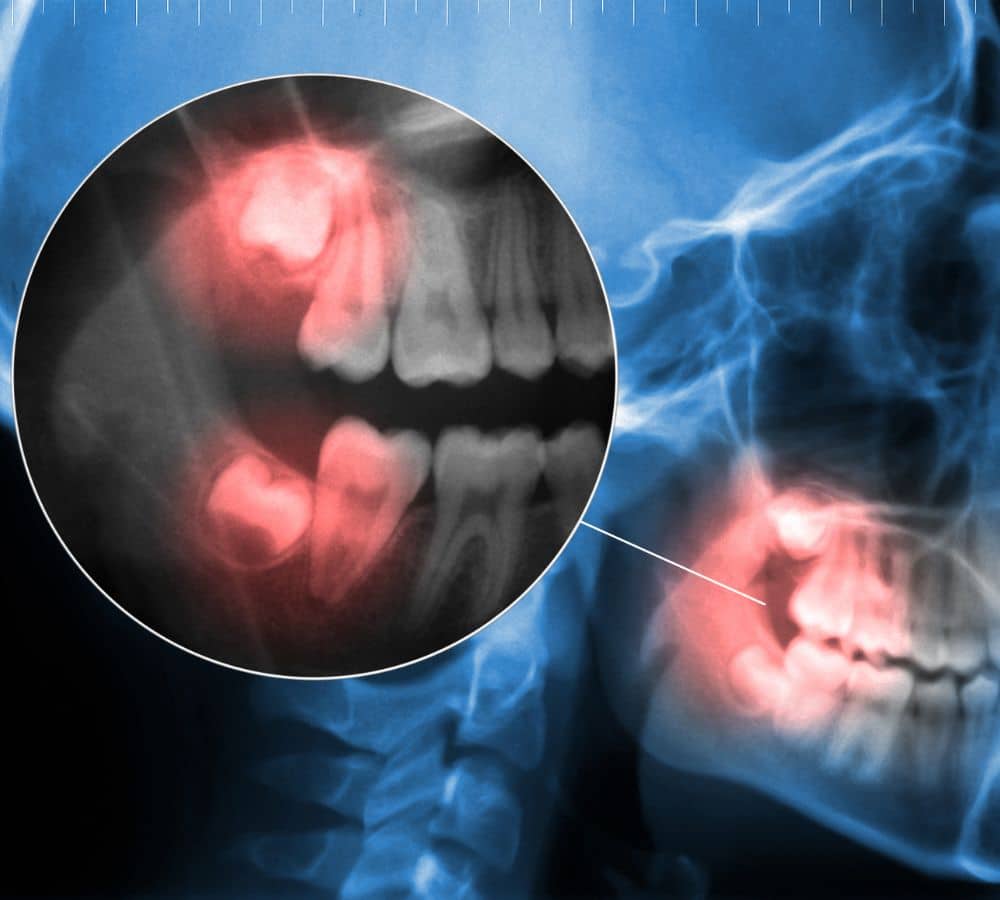
Your wisdom teeth are the third and last molars, on the left and right of both the upper and lower jaw.
They are the last teeth to erupt, normally appearing in the late teens to early twenties.
Not everyone develops wisdom teeth, and there is nothing to worry about if you do not have them. The simplest way to know is a dental examination — a routine check-up, usually with an X-ray, identifies them. Wisdom teeth is the service page; how safe are dental x-rays answers the radiation question; and how often should I go to the dentist? covers the check-up at which they are usually first seen.
Do they need to come out?
Not always. Wisdom teeth that are fully erupted, healthy, correctly positioned and cleanable generally do not need removal.
Because they are the last to erupt, they often struggle for space. That can leave them impacted — stuck below the gum line or partly through — and impacted wisdom teeth can cause infection, or decay in the teeth next to them.
That second consequence is the one that most often forces the decision. The tooth being damaged is the healthy second molar in front, and it is a tooth you want to keep. A wisdom tooth is expendable. The molar it is decaying is not. Why do I need a filling? and can you reverse tooth decay? cover what is at stake in that neighbouring tooth.
A partly erupted wisdom tooth is also a reliable source of bad breath and a foul taste, because the flap of gum over it traps debris that no brush reaches — bad breath and how do I get rid of my bad breath?. Recurrent swelling and soreness around that flap is a reason to have it assessed rather than ridden out.
What "not always" means, in guideline terms
The clearest published statement on this is a UK one, and it is old, so take it with its date and its jurisdiction attached. NICE technology appraisal TA1, published 27 March 2000 for the NHS, recommends that “the practice of prophylactic removal of pathology-free impacted third molars should be discontinued”, and that “surgical removal of impacted third molars should be limited to patients with evidence of pathology.” It is not Australian guidance and carries no status here, but it is the reference point most often used, and it lists what counts as pathology:
- unrestorable decay in the tooth
- untreatable pulp or periapical disease
- cellulitis, abscess or osteomyelitis
- internal or external resorption of the tooth or the one next to it
- fracture of the tooth
- disease of the follicle, including a cyst or tumour
- a tooth in the way of planned jaw surgery or reconstruction, or within the field of a tumour resection
On the inflamed gum flap specifically, TA1 is more precise than most pages are: “a first episode of pericoronitis, unless particularly severe, should not be considered an indication for surgery. Second or subsequent episodes should be considered the appropriate indication for surgery.” It also notes that plaque around the tooth “is a risk factor but is not in itself an indication for surgery.”
The surgery is done by a registered specialist oral and maxillofacial surgeon where the case warrants it — what does oral and maxillofacial surgery involve? and why would I need to see a dental specialist?. The practice's registered specialists are identified as such within the full team.
What it costs, and how to ask
What costs are involved with wisdom teeth removal? and how much does wisdom teeth removal cost in Melbourne? set out what drives the figure — chiefly how impacted the teeth are, how many are removed, and whether the procedure is done in the chair or under general anaesthetic. Published fees are in the price guide; sedation is priced separately, and sleep dentistry costs: what does sedation add to your dental bill? explains that line. Understanding your treatment covers how to read the written plan before you agree to it.
Payment plan options are available. Where a plan is advertised as interest free, that describes the plan term only — a deposit may be required, an establishment fee and ongoing account fees may apply, and charges can apply if the balance is not cleared within the agreed period. The applicable terms depend on the provider and the amount financed, and are set out in writing before you commit — ask what the deposit and the establishment fee are, in dollars, and what the total will be by the end. Payment Plans.
The recovery timeline
Recovery depends on how difficult the extraction was — a fully erupted tooth removed simply is a different proposition from a fully impacted one requiring bone removal. As a general guide:
Days 1 to 3 — swelling and discomfort peak, typically at around 24 to 36 hours. Managed with pain relief and a soft diet.
Days 4 to 7 — swelling subsides noticeably. Most people return to work or study around day three to five.
Weeks 2 to 4 — surgical sites continue healing. Full recovery from complex surgical removal can take several weeks.
Expect day two to feel worse than day one. That is the normal pattern, not a sign that something has gone wrong.
Be realistic about what “managed” means. Discomfort after a surgical extraction is expected and is controlled, not abolished — nobody can promise you a procedure you will not feel afterwards. What can be promised is that the pattern is predictable, and that a pattern which departs from it is worth reporting.
Time off
Allow two to three days for routine extractions, and up to a week for complex surgical removal under general anaesthesia.
Many people schedule the procedure for a Thursday or Friday and are back at work on the Monday.
If a general anaesthetic or sedation is part of the plan, sleep dentistry explains what that involves; if the prospect of the appointment itself is the barrier, dental anxiety and how can I ease my anxiety about visiting the dentist? are worth reading first.
The one rule that matters most
Avoid straws, smoking and vigorous rinsing for the first 48 hours.
All three create suction or disturbance that can dislodge the blood clot forming in the socket. Losing that clot causes dry socket — a painful complication that typically appears around day three to five, and is largely preventable.
Dry socket has a recognisable signature. Pain that had been settling begins to increase from about day three, it is deep and constant rather than sharp, it often radiates to the ear on the same side, and there is frequently a bad taste or odour. It is treated readily once seen — the socket is cleaned and dressed — but it will not resolve on its own timetable, so it is worth ringing rather than waiting.
Smoking is the strongest risk factor, for the suction and for its effect on healing. Vaping carries the same suction problem. Quitline is 13 7848.
The rest of the aftercare
Take pain relief regularly and early — ideally before the local anaesthetic wears off, because pain relief works better ahead of pain than chasing it. Avoid aspirin, which affects clotting. Over-the-counter pain relief is taken according to the packet, or according to what your surgeon has prescribed.
Never hold aspirin, or any other tablet, against the gum or in the socket. It does not reach the nerve, and it burns the soft tissue chemically — leaving a chemical burn on top of a surgical wound. The cause of mouth ulcers and their usual treatments covers what that injury looks like.
Ice packs over the cheeks in the first day help with swelling.
Soft foods, and nothing very hot while you are numb. What can I eat and drink following jaw surgery? has a longer list of what works, and caring for yourself and your immediate dentures covers the same first week where a denture has been fitted at the time of extraction.
Be careful not to bite your numb lip or cheek. With no sensation there is no warning, and this is one of the more common avoidable injuries after extraction — why do I bite my cheek after a filling? describes the milder everyday version.
Keep the rest of your mouth clean. After the first 24 hours, gentle warm salt water rinses — not vigorous swishing — help keep the area clear. Avoid alcohol-based mouthwash over a healing socket: the truth and myths about mouthwashes. Keep brushing the rest of the mouth normally — what is the ideal daily routine for oral hygiene? and which toothbrushes do dentists recommend?
The sockets take months to fill in with bone, and the gum over them can stay tender to a hard crust for some weeks. Sensitivity in the tooth in front is also common for a time — what to do if you suffer from sensitive teeth.
Go to hospital immediately if
Some symptoms are not a phone call to the rooms. Go to a hospital emergency department, or call 000, if you have:
- Facial swelling that is spreading, particularly toward the eye or down into the neck or under the jaw
- Difficulty breathing or swallowing, or a change in your voice
- Fever together with increasing pain or swelling
- Bleeding that will not stop after an hour of firm, continuous pressure on gauze
The airway sits directly behind a lower wisdom tooth socket, which is why swelling that makes breathing or swallowing harder is treated as an emergency rather than a complication to mention at the review. On how infection spreads from a tooth, can a dental abscess affect your general health? and what is a tooth abscess?
When to call your surgeon
- Pain that worsens after day three rather than improving — this can indicate dry socket
- Bleeding that persists despite an hour of firm pressure on gauze
- Fever, or swelling that increases after day three
- Numbness persisting well beyond the expected few hours — the nerve to the lower lip and chin runs close to lower wisdom teeth, and altered sensation is usually temporary but should be reported
- Any concern at all about how it is healing
The general rule: swelling and discomfort that peak early and then improve are normal. Anything that starts getting worse again after it had begun to settle is worth a phone call. Emergency dentistry covers what can be seen on the day.
Numbness: the numbers, and how long it usually lasts
Altered sensation in the lower lip, chin or tongue is the complication people ask about most, so here is what the published figures actually say rather than a reassurance.
For the inferior alveolar nerve — the one supplying the lower lip and chin — reported paraesthesia after lower wisdom-tooth removal ranges from 0.35% to 8.4%, and one review gives 1% to 20% temporary and 0% to 2% permanent for nerve dysfunction more broadly. The wide ranges are not imprecision for its own sake: risk depends heavily on where the roots sit. In one series the overall rate was 2.5% per tooth removed, but it was 0.8% where the nerve was radiographically “distant”, 0.9% where it was “close”, and 11% where it was classed as “intimate”. By impaction type it was highest for horizontal impactions (4.7%) and lowest for vertical ones (0.9%). This is why the radiograph is taken before the decision, not after.
Permanent injury — sensory change lasting beyond six months — is reported at under 1%. Where sensation is altered, complete recovery usually occurs 6 to 8 weeks after the injury, although it can take up to 24 months; the same review notes that if it has not fully resolved by around two months, the probability of a permanent deficit increases significantly. That is the reason to report numbness at the review rather than wait and see.
For the lingual nerve, which supplies the tongue, temporary injury runs at roughly 1% to 2.5% depending on surgical technique, and permanent injury is well under 1% — of the order of 0.1% to 0.3%. Those pooled means carry standard deviations larger than the means themselves, so treat them as a range, not a precise risk for your case.
Coronectomy, where the roots sit against the nerve
Where a lower wisdom tooth's roots lie against the nerve, one option is coronectomy — deliberately removing the crown and leaving the roots in place. A systematic review pooling four controlled studies compared it with complete removal and reported a risk ratio for inferior alveolar nerve injury of 0.11 (95% CI 0.03 to 0.36), roughly an 89% relative reduction. On the other outcomes it found no clear difference: post-operative infection 1.03 (0.54 to 1.98), dry socket 0.55 (0.28 to 1.05) and pain at one week 1.14 (0.57 to 2.30). It is not a universal alternative and it leaves roots that may need watching, but where the imaging shows an intimate relationship it is a conversation worth having before the day.
Common questions
Will I be given antibiotics, and should I ask for them if I am not?
Not automatically, and the decision is a clinical judgement rather than an oversight. The Cochrane review of antibiotics to prevent complications after tooth extraction (CD003811, updated 2021, evidence current to April 2020) is effectively a wisdom-teeth review — 21 of its 23 trials were third-molar removals. Compared with placebo, antibiotics “may reduce the risk of postsurgical infectious complications in patients undergoing third molar extractions by approximately 66% (RR 0.34, 95% CI 0.19 to 0.64)”, which the authors translate as “19 people (95% CI 15 to 34) need to be treated with antibiotics to prevent one infection”. For dry socket the reduction was 34% (RR 0.66, 95% CI 0.45 to 0.97), or 46 people treated to prevent one case. Both findings are low-certainty evidence, and the review found “no evidence that antibiotics prevent pain, fever, swelling, or problems with restricted mouth opening”.
Set against that is the cost the same review states plainly: “Taking antibiotics unnecessarily may stop them working effectively in future. This ‘antimicrobial resistance’ is a growing problem throughout the world.” Its conclusion is that the decision should be made case by case, on the person's health and their risk of infective complications, rather than by default.
So if a friend was given antibiotics and you were not, the usual explanation is that the two cases differed — in general health, in how difficult the extraction was, or in whether infection was already present before the day. Ask why rather than assuming one of you was treated wrongly. Toothache: should I see my GP for antibiotics? covers the same question before surgery.
How likely is dry socket, really?
More likely than most people expect, which is worth knowing before it happens. The Cochrane review of surgical techniques for removing lower wisdom teeth (CD004345, 2020) worked from an assumed baseline risk of 132 per 1,000 — about 13% — at one week for alveolar osteitis, taken as the median of the control arms across five trials; in one comparison the control-arm rate was 205 per 1,000. Those are hospital series of lower, mostly impacted teeth, so they sit at the high end rather than describing a simple upper extraction.
That reframes the rule higher up this page rather than contradicting it. Avoiding straws, smoking and vigorous rinsing genuinely lowers the risk; it does not reduce it to zero, and developing dry socket does not mean you did something wrong. Cochrane's view of what the surgeon can do about it is similarly modest — after adding 27 new studies to the review it concluded “we are unable to make firm recommendations to surgeons to inform their techniques for removal of mandibular third molars”, with one exception: “there is some limited evidence that placing platelet rich plasma or platelet rich fibrin in sockets may reduce the incidence of dry socket” (odds ratio 0.39, 95% CI 0.22 to 0.67, low certainty).
My dentist has suggested a 3D scan before the surgery. Do I actually need one?
Often not, and the published evidence is more sceptical about this than the availability of the machine might suggest. A systematic review of seven randomised trials in BMC Oral Health (2022) compared planning lower wisdom-tooth surgery from a panoramic radiograph alone against a panoramic radiograph plus a cone-beam CT. Its conclusion is blunt: “CBCT should not be used routinely to assess MTMs, and it is unlikely to reduce risk of nerve injury even in most high-risk cases.” The trials offered “moderate quality evidence that CBCT does not routinely translate to reduced incidence of nerve injury in MTM removal”, and none of them found a significant difference between the two groups for permanent nerve injury.
The extra scan is not free in either sense. The same review records that the small-field CBCT needed to image a wisdom tooth carries “approximately a five-fold increase in radiation compared to an OPG” and “approximately four times greater” preoperative cost. Those are relative figures — for the absolute doses of each type of dental image, see how safe are dental X-rays.
Where it is justified is the narrower case the authors describe: “high-risk cases where the prescriber feels 3D imaging has potential to change the treatment decision, or surgical technique, in a manner that may avoid nerve injury.” The panoramic signs that mark a high-risk tooth are well described — darkening of the root, diversion of the nerve canal, and loss of the canal's cortical outline. The question worth asking is therefore a simple one: what would the 3D scan change? If the answer is nothing, the panoramic film has already done its work.
Mine are not causing any trouble. Should I have them out anyway, just in case?
This is the most contested question in the subject, and the honest answer is that the evidence does not settle it. The Cochrane review of removal versus retention of asymptomatic, disease-free impacted wisdom teeth (CD003879, updated 2020) concluded: “Insufficient evidence is available to determine whether asymptomatic disease-free impacted wisdom teeth should be removed or retained.” It found only two usable studies, 493 participants between them, both at serious risk of bias, and it could not assess quality of life, cost, or the harms of removal at all, because no study measured them.
What it did find, at very low certainty, was a signal on gum health: retaining a wisdom tooth was associated with more bone loss on the back surface of the second molar in front — risk ratio 0.32 (95% CI 0.19 to 0.54) for bony impactions, favouring the teeth having been removed. Decay on that second molar showed no significant difference (risk ratio 0.69, 95% CI 0.27 to 1.82).
Two things follow. The older worry that wisdom teeth push the front teeth crooked is not supported — the Australian Dental Association states that “there is currently no evidence that supports this theory”, and Cochrane's arch-measurement results agree. And if you and your dentist decide to keep them, Cochrane is explicit that this is a decision to review rather than to forget: “clinical assessment at regular intervals to prevent undesirable outcomes is advisable.”
I am in my forties. Have I left it too late?
No, but the arithmetic shifts with age. The ADA's position is that teeth causing problems, or at high risk of causing them, “are best removed at a younger age”, and that “removing these teeth by around age 25 is easier than doing so when you are older”. Note the word the ADA chose — easier, not safer. It makes no outcome claim there, and nor should anyone else. Cochrane adds that “when surgical removal is performed on older patients, the risk of postoperative complications is increased”, and that healing of the gum tissues is better in younger people.
In practice the roots are fully formed and often more firmly held in denser bone by then, so a removal that would have been straightforward at twenty may be a surgical one at forty-five, with a longer recovery. That is an argument for making the decision deliberately, with the imaging in front of you. It is not an argument for removing a healthy, cleanable tooth.
When can I drive, and when can I go back to training?
After a general anaesthetic the ADA is unambiguous: “you cannot drive for 48 hours.” That is a fixed period, not a judgement about how well you feel. After sedation you will also need someone to take you home and stay with you — confirm that arrangement before the day, because the procedure will not proceed without it. Sleep dentistry sets out what is involved.
For exercise, the ADA advises avoiding sport and exercise after any tooth extraction. The reasoning is the same as the straw rule: exertion raises blood pressure at the healing socket, and a knock to a healing jaw is a poor idea in the first week. Healthdirect's guidance is that most people should be able to return to normal activities within a week, and that you may need up to a week off work, depending on how difficult the removal was. Build back up rather than resuming a heavy session on day four.
I cannot open my mouth properly. Is that normal?
Usually, yes. Restricted opening — trismus — is listed by both the ADA and Healthdirect among the ordinary consequences of the procedure: “not being able to open your mouth fully (trismus) and jaw stiffness”, which the ADA attributes largely to swelling. It follows the same curve as the swelling does: worst over the first two or three days, then easing steadily.
Two practical points. Antibiotics will not shift it — the Cochrane review found “no evidence that antibiotics prevent pain, fever, swelling, or problems with restricted mouth opening”. And stiffness that is increasing after day three, or that arrives with fever or spreading swelling, is not ordinary trismus and belongs in the emergency list above. In the meantime keep meals soft rather than forcing the jaw open, and if the stiffness is still limiting you when you are reviewed, say so rather than assuming it is expected.
Related reading
- I've just had oral surgery. What can I expect during recovery?
- What does oral and maxillofacial surgery involve?
- What is orthognathic surgery?
- Meshel and Tommy: Tommy talks wisdom teeth
- Why are dental abscesses so painful?
- Bridges, implants or dentures — for teeth other than wisdom teeth, where replacement is the next question
- What is gum disease?
Practical details
Smile Solutions has registered specialist oral and maxillofacial surgeons on site, with on-site OPG and CBCT imaging — see technology.
Smile Solutions, Level 1, 220 Collins Street, Manchester Unity Building, Melbourne VIC 3000 — getting here. Phone 13 13 96, contact us, or theteam@smilesolutions.com.au. Monday–Friday 8.00am–6.00pm, Saturday 8.30am–1.30pm, Sunday by appointment.
Specialist registration can be verified on the AHPRA register, or by calling 1300 419 495.
The external figures on this page are drawn from NICE technology appraisal TA1 (2000); Cochrane reviews CD003879 (removal versus retention, 2020), CD004345 (surgical techniques, 2020) and CD003811 (prophylactic antibiotics, 2021); a systematic review of cone-beam CT before third-molar surgery published in BMC Oral Health (2022); the Australian Dental Association's consumer factsheet on wisdom teeth; Healthdirect Australia's patient information on removing wisdom teeth; a published review of inferior alveolar nerve injury after third-molar surgery; a meta-analysis of lingual nerve injury by surgical technique; and a systematic review comparing coronectomy with complete removal. They are population figures from published series, not a prediction for any individual case.
Published 13 October 2018. Recovery times vary with the complexity of the extraction and between individuals. The instructions given to you by your treating surgeon take precedence over this general guide. Payment plan terms are set by the credit provider and change; confirm current terms directly before you commit. General information only; it does not replace advice from your treating practitioner.
Smile Solutions trades under ABN 28 193 514 103.
Images on This Page
-
https://www.facebook.com/tr?id=800557773428361&ev=PageView&noscript=1
(no alt text)
-
https://www.smilesolutions.com.au/wp-content/uploads/2025/10/calendar_month.svg
(no alt text)
-
https://www.smilesolutions.com.au/wp-content/themes/arcadian-wordpress-theme/assets/images/smile_solutions_logo_white.png
Smile Solutions Logo
-
https://www.smilesolutions.com.au/wp-content/themes/arcadian-wordpress-theme/assets/images/smile_solutions_logo_purple.png
Smile Solutions Logo
-
https://www.smilesolutions.com.au/wp-content/uploads/2023/11/SS-Tooth-1-1-150x150.png
Smile Solutions
-
https://www.smilesolutions.com.au/wp-content/uploads/2018/10/Wisdom-Teeth-Recovery.jpg
How long does it take to recover from wisdom teeth surgery?
-
https://www.smilesolutions.com.au/wp-content/uploads/2025/09/Root-Canal-2-300x217.jpg
Root Canal
-
https://www.smilesolutions.com.au/wp-content/uploads/2026/08/Mouth-Breathing-300x270.jpg
Mouth Breathing
-
https://www.smilesolutions.com.au/wp-content/uploads/2025/09/Dental-Crown-at-Smile-Solutions-300x300.jpg
Dental Crown at Smile Solutions
-
https://www.smilesolutions.com.au/wp-content/themes/arcadian-wordpress-theme/assets/images/family_owned_bussiness.png
Family Owned Business
-
https://www.smilesolutions.com.au/wp-content/themes/arcadian-wordpress-theme/assets/icons/icon--phone.svg
Smile Solutions Contact
-
https://www.facebook.com/tr? id=800557773428361&ev=PageView&noscript=1
(no alt text)