What costs are involved with wisdom teeth removal?
Removing wisdom teeth can be as simple as a conventional extraction, or as complex as surgery requiring bone removal and sectioning of the tooth crown and root to get it out.
That range is why quotes vary so widely, and why a quote given before an X-ray is not worth much.
For the fuller Melbourne cost breakdown, see How much does wisdom teeth removal cost in Melbourne?. The clinical side — whether removal is needed at all, and what recovery involves — is on Wisdom Teeth, and the Price Guide covers the practice’s fees more broadly.
What makes a case complex
How deeply the teeth are submerged — fully erupted, partially covered by gum tissue, or completely submerged beneath bone.
Whether they are impacted — positioned at an angle within the jawbone, anywhere from fully vertical through to fully horizontal.
Your age — older patients have more mature, fully formed roots, which makes removal harder. This is the argument for not deferring the decision indefinitely once removal has been recommended.
Who performs the procedure
As a general rule, the more complicated the case, the more necessary it is to consult a specialist oral and maxillofacial surgeon — especially where there is severe impaction, infection, or developed roots close to sensitive structures such as the mandibular nerve in the lower jaw. What oral and maxillofacial surgery involves sets out the scope of the specialty.
That last point is the one that matters clinically. Damage to the mandibular nerve can cause lasting altered sensation in the lip and chin, and avoiding it depends on both imaging and surgical experience.
Two groups typically perform this surgery:
Oral and maxillofacial surgeons — approximately 15 to 16 years of training. A Dental Board–registered specialist in mouth and jaw surgery, whose Australian registration requires degrees in dentistry, medicine and oral surgery. See Dentists and Registered Specialists for what that registration means.
General dentists — approximately five years of training, covering all facets of general dentistry rather than surgery specifically.
Cost note: treatment by a specialist oral and maxillofacial surgeon typically costs approximately 25% to 35% more than treatment by a general dentist.
Which is appropriate is a clinical judgement about your particular teeth, not a preference — Specialist Care sets out how the specialties differ, why you might need a specialist at all covers the reasoning, and every practitioner’s registration can be checked on Our Team or the AHPRA register.
“Oral surgery” and “oral and maxillofacial surgery” are two different registrations
This catches people out when they are comparing quotes. The Dental Board of Australia recognises 13 dental specialties, approved by the Australian Health Workforce Ministerial Council — and oral surgery and oral and maxillofacial surgery appear on that list separately, as two distinct specialties. They are not two ways of saying the same thing.
Every applicant for specialist registration, in any of the 13, must also have completed a minimum of two years of general dental practice and met all the requirements for general registration as a dentist. And AHPRA publishes an online register of all dental practitioners that includes the specialty or specialties held by anyone with specialist registration — so a title on a quote is checkable, free, in about a minute. If a fee is higher because a specialist is doing the work, the register is where you confirm that is what you are paying for.
What the full course of treatment includes
- Consultation and clinical examination, to fully understand your dental and medical history before surgical treatment
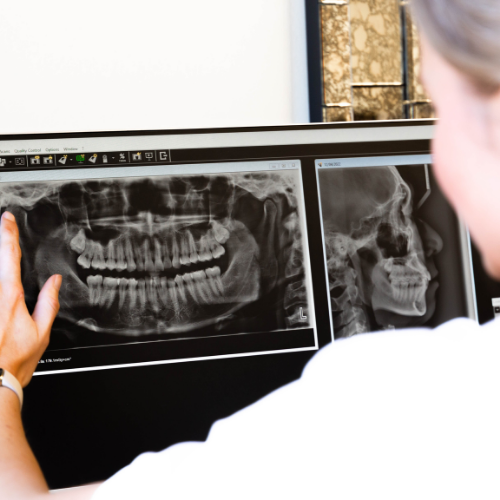
- An OPG X-ray (a panoramic view of the entire mouth), and in more complicated cases a cone beam scan, to gauge the position and angulation of the teeth and their proximity to vital anatomical structures — see How safe are dental X-rays? and when they become unsafe
- The surgery itself, plus management of complications and pain relief
- Post-operative follow-up, including pain management — what to expect during recovery and how long recovery from wisdom teeth surgery takes
Cost note: obtain a quote in writing, and ask for it to include the full estimated cost of consultation, investigations, surgery and follow-up — not just the extraction fee. Quotes that cover only the surgery are the main reason final bills surprise people.
Four questions that settle most of the uncertainty, and which you are entitled to ask before consenting: what are the item numbers; what is the total including consultation, imaging and review; what will Medicare or my health fund pay; and what is my out-of-pocket cost on the day. Understanding your treatment covers the rest of what you should be told.
The imaging is a separate cost — and a separate decision
The OPG is its own item on the bill, and a cone beam scan is another one again. Both are worth having where they change the plan, and neither is free.
There is a second thing being spent as well. The International Atomic Energy Agency gives the effective dose of panoramic examinations as 4–30 μSv, and for cone beam CT — based on median values from the literature — 50 μSv or below for small- or medium-sized scanning volumes, and 100 μSv for large volumes. The IAEA notes that panoramic doses are more variable than intraoral ones, but that even at the high end of the range they are “equivalent to a few days of natural background radiation which is similar to that of a chest radiograph”, while CBCT doses “may be tens or even hundreds of μSv of effective dose higher than conventional radiographic techniques, depending upon the technique”.
So the practical reading for a wisdom tooth is this: the OPG is routine and the cone beam is not. Where a lower root sits close to the mandibular nerve, a 3D scan can be exactly the thing that keeps you out of trouble, and the dose is a sensible trade. Where the OPG has already answered the question, it is fair to ask what the scan would add before you pay for it. A reasonable clinician will have a specific answer. The published evidence on how much a scan actually changes outcomes is worth reading before you agree to one — see the questions below.
Why two honest quotes can still be far apart
There is no national dental fee schedule in Australia — private fees are set practice by practice. The Australian Dental Association’s Dental Fees Survey 2022 found “considerable variation in the fees charged within and between states”, and among the 284 specialists who responded to it, the mean hourly rate was $921 in 2022 against a median of $800, with individual rates running from $450 to $1,500 an hour (the ADA cautions that the specialist sample was small and should be read with considerable caution).
The useful conclusion is not that someone is overcharging. It is that the spread is real, so neither the highest nor the lowest quote is self-evidently the right one, and comparing the item numbers rather than the totals is the only way to know you are comparing the same operation.
Medicare
Your consultation with an oral and maxillofacial surgeon may be rebated through Medicare — though a consultation with a general dentist is not.
Your OPG X-ray may also be bulk-billed through Medicare.
This narrows the gap between the two options more than the headline percentages suggest. On the private side, health fund arrangements vary — see Bupa Platinum Dental Provider for one example of how a preferred-provider arrangement changes the gap.
If the patient is under 18
Wisdom teeth are often removed in the late teens, which puts some patients inside the Child Dental Benefits Schedule. Services Australia covers eligible children for up to $1,158 for each eligible child over two consecutive calendar years, and extractions are on its list of covered basic services. A child qualifies where they are eligible for Medicare, are between 0 and 17 years old for at least one day that calendar year, and they or you receive an eligible payment at least once that year. You do not apply — if your child is eligible, Services Australia writes to you.
The exclusion that matters most here: the CDBS does not cover any dental services in a hospital. The same removal can therefore be partly covered in a dental chair and not covered at all under general anaesthetic in theatre. That makes the anaesthetic decision partly a financial one, and it is worth raising before the booking is made rather than after.
The cap is indexed on 1 January each year, and an earlier period carried a lower cap — Services Australia’s own worked example uses a $1,095 limit across 2024–2025 — so check the current balance rather than assuming the headline figure. Child Dental Benefit Schedule, how the Child Dental Benefits Schedule operates and Children’s Dentistry cover the rest.
Under general anaesthetic in hospital
Only an oral and maxillofacial surgeon, assisted by a medically trained specialist anaesthetist, can offer wisdom teeth extraction under general anaesthetic in hospital.
Cost note: you will need to budget for both anaesthetist and hospital fees. Medicare and private health fund rebates apply.
Out-of-pocket expenses can vary greatly, depending on whether you have private health insurance with hospital cover, and your level of cover. Check both your hospital cover and any waiting periods before booking.
Where sedation rather than a full general anaesthetic is being considered, Sleep Dentistry sets out the options, and Sleep dentistry costs covers what each adds to a bill. If the anaesthetic itself is the worry rather than the cost, see Dental Anxiety and how a comfortable injection is given.
Indicative base costs
| Performed by | Base cost per tooth |
|---|---|
| General dentist | $250 – $400 |
| Specialist oral and maxillofacial surgeon | $450 – $600 |
Cost will vary according to the complexity of your surgical procedure and the specialist training of the clinician performing it. These are base surgical fees at the date of publication — they exclude consultation, imaging, sedation or anaesthetic, and hospital fees.
Multiply by the number of teeth. Most people having wisdom teeth removed have more than one out, and four is common — which is the single biggest reason a per-tooth figure understates what people actually pay.
If cost is the obstacle
Say so, rather than deferring indefinitely. Removal generally gets harder and more expensive with age, as the roots mature, so waiting is rarely the cheap option it appears to be.
Where the teeth are not causing problems, monitoring rather than removing may be a legitimate clinical option — ask whether it is, in your case. Where they are infected or painful, that is a different conversation and a more urgent one; see tooth pain, the causes of toothache, what a tooth abscess is, What is considered a dental emergency? and Emergency Dentistry.
Payment plan options are available. Where a plan is advertised as interest free, that describes the plan term only — a deposit may be required, an establishment fee and ongoing account fees may apply, and charges can apply if the balance is not cleared within the agreed period. The applicable terms depend on the provider and the amount financed, and are set out in writing before you commit — ask what the deposit and the establishment fee are, in dollars, and what the total will be by the end. Payment Plans.
Patient payment plans covers how staged payment arrangements work across the industry and what to check in the terms.
Common questions
The cheapest option is not having the surgery. Do they actually need to come out?
This is the right question to ask first, and the published position is more cautious than the popular one.
For wisdom teeth that are impacted but causing no symptoms and no disease, the Cochrane review of removal versus retention (CD003879, updated 2020) reaches a genuinely open conclusion: "Insufficient evidence is available to determine whether asymptomatic disease-free impacted wisdom teeth should be removed or retained." That is not an endorsement of leaving them; it is a statement that the research does not settle it either way. The review adds that "high-quality research is urgently needed to support clinical practice in this area".
The most-cited guidance in this space is the UK's NICE technology appraisal TA1, and its central recommendation is blunt: "The practice of prophylactic removal of pathology-free impacted third molars should be discontinued in the NHS", with surgical removal "limited to patients with evidence of pathology". TA1 lists what counts as pathology — unrestorable decay, untreatable pulp or periapical disease, cellulitis, abscess or osteomyelitis, resorption of the tooth or the one next to it, fracture of the tooth, disease of the follicle including a cyst or tumour, a tooth impeding jaw surgery, and a tooth in the field of a tumour resection. On the most common trigger of all it is specific: "a first episode of pericoronitis, unless particularly severe, should not be considered an indication for surgery. Second or subsequent episodes should be considered the appropriate indication for surgery."
Two important qualifications. TA1 was published in March 2000, it is United Kingdom NHS guidance, and it has no legal or funding status in Australia — read it as reasoning rather than as a rule that applies to you. And retention is not a decision to forget about them: the Cochrane review defines it as monitoring the status of the teeth, which means review appointments and periodic radiographs, and those have a cost of their own.
What to do with this in the chair: ask which specific finding makes removal the recommendation in your case, and ask what the plan would be if you chose to monitor instead. Both answers should be concrete. See Wisdom Teeth.
Will leaving them in push my other teeth crooked?
No — or at least, there is no evidence that it does, and the Australian Dental Association says so directly. Its consumer factsheet puts the question and answers it: "Sometimes people worry that the wisdom teeth may cause their other teeth to become crooked. There is currently no evidence that supports this theory."
The Cochrane review reaches the same place from the research side, finding no evidence of a clinically significant effect on dental arch dimensions from retaining impacted wisdom teeth.
This matters on a page about money because crowding is one of the most common reasons people are told — or tell themselves — that the teeth should come out. Front teeth do drift and crowd with age, in people who never had wisdom teeth and in people who had them removed at eighteen. If crowding is the concern, the conversation to have is about retainers and why teeth shift, not about surgery.
How likely is nerve damage, honestly?
Low overall, higher in specific situations, and the specifics are what you should be asking about rather than the average.
The inferior alveolar nerve, which supplies the lower lip and chin. A literature review in the Journal of Oral & Maxillofacial Research (2014) reports the incidence of injury after lower wisdom tooth removal as "about 0.35 – 8.4%", with a wide spread across studies. More usefully, it quotes a series in which "the overall incidence of IAN nerve damage was 2.5% per tooth removal", and that figure breaks down sharply by anatomy: highest with horizontal impaction (4.7%) and lowest when the teeth were vertically impacted (0.9%), and, by how close the nerve runs to the root on the radiograph, 0.8% when 'distant', 0.9% when 'close', and 11% when 'intimate'. Where specific high-risk radiographic signs are present — darkening of the root, diversion of the canal, loss of canal cortication — one review quotes incidence as high as 20%, with 4% permanent.
The recovery picture is more reassuring than the incidence figures suggest: the same review reports that "within 4 – 8 weeks after surgery, 96% of inferior alveolar nerve injuries recover", and that reported permanent neuropathy runs at 0% to 2%. Healthdirect Australia's consumer page notes that where nerve damage occurs it is usually temporary, but that full recovery "can take up to 18 months".
The lingual nerve, which supplies sensation and taste on the side of the tongue. A 2023 systematic review and meta-analysis in PLOS ONE, led from Australian universities, found temporary lingual nerve injury at 1.24% to 2.44% depending on the surgical technique, and permanent injury at 0.07% to 0.28%.
How to use these numbers: they are group figures from published studies, not a prediction for you. The right question at the consultation is not "what is the risk" but "where does my tooth sit on that gradient — is the nerve distant, close or intimate on my radiograph, and is the tooth vertical or horizontal?" That is a question your OPG can already answer, and the answer should change the conversation.
Is the cone beam scan worth paying for?
Sometimes — but the evidence for it is weaker than most people assume, and it is a real cost.
A 2022 systematic review in BMC Oral Health looked specifically at whether adding cone beam CT to a panoramic radiograph before lower wisdom tooth surgery reduces nerve injury. Its conclusion: "CBCT should not be used routinely to assess MTMs, and it is unlikely to reduce risk of nerve injury even in most high-risk cases." The seven randomised trials it included offered "moderate quality evidence that CBCT does not routinely translate to reduced incidence of nerve injury", and low-quality evidence that it does not change how long the surgery takes.
On the two things you are spending, the same review quantifies both in relative terms: "a small field CBCT necessary to image an MTM is associated with approximately a five-fold increase in radiation compared to an OPG", and "preoperative costs associated with CBCT are also approximately four times greater". Those are ratios, not absolute figures — for absolute doses, the IAEA ranges quoted above are the source.
What the review does endorse is targeted use: CBCT "should be reserved for high-risk cases where the prescriber feels 3D imaging has potential to change the treatment decision, or surgical technique, in a manner that may avoid nerve injury", and the decision "should therefore be carefully justified incorporating individual patients' expectations and values".
So the fair question to ask, and it is a financial as much as a clinical one, is: what would this scan show that the OPG has not, and what would you do differently if it showed it? If the answer is specific — a root that appears to cross the canal, a plan to consider coronectomy rather than full removal — the scan is doing work. If the answer is general reassurance, you are entitled to weigh the extra dose and the extra fee against that.
What actually happens afterwards, and how long am I out of action?
Healthdirect Australia's consumer guidance sets the expectation plainly: "You should be able to go home the same day." Leave the wound alone for 1 to 2 days. "You may need to take up to a week off work. You should be able to return to normal activities within a week. Most people make a full recovery."
Building a week of reduced capacity into the plan is part of the real cost of this operation, and it is the part people forget. Book it when you can afford to be flat, not the day before something that matters.
The complications Healthdirect lists for this procedure include bleeding after the procedure, swelling, bruising, allergic reaction to equipment or materials, infection, and dry socket — "where the socket does not heal well". Dry socket is the one most people meet: it typically declares itself a few days in, as pain that is getting worse rather than better, and it needs an appointment rather than more painkillers. Healthdirect also flags that some medications raise the risk, naming cancer medication and bone medication such as bisphosphonates — which is a reason to give a complete medication list before surgery, not a reason to stop anything on your own.
One honest caveat that Healthdirect itself attaches to all of this: "Any numbers which relate to risk rates given are taken from studies of people who have had this procedure", and your own surgeon may be able to say whether your risk is higher or lower. Ask. See What to expect during recovery, How long does it take to recover from wisdom teeth surgery? and What can I eat and drink following jaw surgery?.
Where to go next
- Whether removal is needed, and what recovery involves — Wisdom Teeth
- The fuller Melbourne cost breakdown — How much does wisdom teeth removal cost in Melbourne?
- The specialists who do the complex cases — Oral and Maxillofacial Surgeons
- Sedation and general anaesthetic — Sleep Dentistry
- Eating afterwards — What can I eat and drink following jaw surgery?
- If a wisdom tooth is infected right now — Dental emergencies explained
Practical details
Written by Dr Kia Pajouhesh, managing director of Smile Solutions.
We have registered oral and maxillofacial surgeons on site, along with an OPG machine and cone beam 3D imaging, and offer the full range of sedation options.
Smile Solutions, Level 1, 220 Collins Street, Manchester Unity Building, Melbourne VIC 3000. Phone 13 13 96, or theteam@smilesolutions.com.au. Monday–Friday 8.00am–6.00pm, Saturday 8.30am–1.30pm, Sunday by appointment. Full details on Contact Us.
Published 22 November 2018. Fees quoted were current at that date and are indicative only — they are not a quote, and the cost of your treatment can only be established after examination. Fee figures attributed to the Australian Dental Association’s Dental Fees Survey 2022 describe fees charged by surveyed ADA members across Australia as at 1 July 2022; they are not Smile Solutions fees. Radiation dose ranges are the International Atomic Energy Agency’s and describe examination types generally, not a specific machine or exposure. Complication and nerve-injury percentages quoted are group figures from published studies with their own populations, techniques and follow-up periods; they are not predictions for an individual patient. NICE technology appraisal TA1 is United Kingdom NHS guidance published in March 2000 and has no legal or funding status in Australia. Child Dental Benefits Schedule caps, eligibility rules and exclusions are set by Services Australia and change; the cap is indexed each 1 January. Rebates and Medicare arrangements are set by others and change; confirm current entitlements with Medicare and your health fund. Payment plan terms are set by the credit provider and change; confirm current terms directly before you commit. General information only; it does not replace advice from your treating practitioner. All surgery carries risks, which should be discussed with your practitioner before you consent.
Smile Solutions trades under ABN 28 193 514 103.
Images on This Page
-
https://www.facebook.com/tr?id=800557773428361&ev=PageView&noscript=1
(no alt text)
-
https://www.smilesolutions.com.au/wp-content/uploads/2025/10/calendar_month.svg
(no alt text)
-
https://www.smilesolutions.com.au/wp-content/themes/arcadian-wordpress-theme/assets/images/smile_solutions_logo_white.png
Smile Solutions Logo
-
https://www.smilesolutions.com.au/wp-content/themes/arcadian-wordpress-theme/assets/images/smile_solutions_logo_purple.png
Smile Solutions Logo
-
https://www.smilesolutions.com.au/wp-content/uploads/2025/11/Kia-150x150.jpg
Dr Kia Pajouhesh
-
https://www.smilesolutions.com.au/wp-content/uploads/2025/09/Wisdom-Teeth-Smile-Solutions.png
Smile Solutions Dentist Melbourne
-
https://www.smilesolutions.com.au/wp-content/uploads/2025/09/Wisdom-Teeth-Smile-Solutions-300x300.png
Smile Solutions Dentist Melbourne
-
https://www.smilesolutions.com.au/wp-content/uploads/2025/11/TMD-Teeth-Grinding-Smile-Solutions-300x270.png
Woman holding her face, looking concerned.
-
https://www.smilesolutions.com.au/wp-content/uploads/2026/07/Photography-and-Facial-Analysis-300x270.jpg
Photography and Facial Analysis
-
https://www.smilesolutions.com.au/wp-content/themes/arcadian-wordpress-theme/assets/images/family_owned_bussiness.png
Family Owned Business
-
https://www.smilesolutions.com.au/wp-content/themes/arcadian-wordpress-theme/assets/icons/icon--phone.svg
Smile Solutions Contact
-
https://www.facebook.com/tr? id=800557773428361&ev=PageView&noscript=1
(no alt text)
-
https://bat.bing.com/action/0?ti=25148060&tm=gtm002&Ver=2&mid=55514e7b-30bf-452f-8953-0041c8b484e0&bo=1&sid=dc6fe910ab2711f1803e21500432e231&vid=dc702300ab2711f18e8f85a4e61cff6b&vids=1&msclkid=N&pi=918639831&lg=en-US&sw=800&sh=600&sc=24&nwd=1&tl=What%20costs%20are%20involved%20with%20wisdom%20teeth%20removal%3F%20-%20Smile%20Solutions&p=https%3A%2F%2Fwww.smilesolutions.com.au%2Fdental-articles%2Farticle%2Fcosts-involved-wisdom-teeth-removal%2F&r=&evt=pageLoad&sv=2&cdb=AQAQ&rn=657663
(no alt text)