Do I need to see a dental specialist?
Two groups of dentists
All dentists fall into one of two groups: general dentists and dental specialists. The practice’s own split between the two is set out on general dentistry and specialist care.
General dentists
Hold a university degree in the general aspects of dentistry, enabling them to provide a broad range of care — check-ups and cleaning, repairing damaged and decayed teeth, and gum care.
A general dentist should be your first point of call for general teeth and mouth issues, in the same way your family doctor is for general medical concerns. Is it important to have a family dentist? makes the case for keeping that relationship in one place.
General dentists readily refer to specialists where a patient has a difficult dental situation, or is seeking a second opinion. The two work together as a team to provide comprehensive, tailored care — see second opinions and corrective dentistry, and complex dental cases: what happens when multiple specialists collaborate for what that looks like in a single mouth.
Dental specialists
Hold a general dental degree plus a further postgraduate university degree of at least three years in a particular field.
There are 13 fields of dental specialisation in Australia, including oral and maxillofacial surgery, orthodontics, endodontics, paediatric dentistry, periodontics and prosthodontics.
The distinction worth checking
Confirm that your dental specialist is actually registered as a specialist with the Dental Board of Australia — as distinct from a general dentist with a “special interest” in a field.
The terms clinicians use can be confusing, but qualifications are easily checked on the website of the Australian Health Practitioner Regulation Agency (AHPRA).
This is a two-minute check and it is worth doing before any significant treatment. “Specialist” is a protected title with a legal meaning. “Special interest”, “focusing on” and similar phrases are not — they may describe genuine additional training, or they may describe interest alone, and the register is the only way to tell. The practice’s own registered specialists are named on dentists and registered specialists and on our team, so you can check any of them against the register yourself. Finding a dentist online in Australia covers the rest of the due diligence.
Smile Solutions operates as both a general practice and a dental specialist clinic, with general and specialist dentists working together in the same CBD location at Collins Street Specialist Centre — for patient convenience and for integrated care. Why that arrangement is more than a convenience is argued in Is a bigger dental practice better? Part 1 and Part 2.
Oral and maxillofacial surgeon
A complex specialty combining dentistry, medicine and surgery, dealing with the surgical management of teeth, mouth, face and jaw conditions — defects, injuries and aesthetic reconstruction. See our oral and maxillofacial surgeons and what oral and maxillofacial surgery involves.
The training pathway is extensive: for most, an average of 16 years, combining university, hospital and college-based training. These clinicians complete both a medical and a dental degree before beginning surgical training.
There are just over 200 oral and maxillofacial surgeons registered in Australia.
You may be referred for:
- Removal of wisdom teeth — see also how long it takes to recover and what the costs involve
- Surgical or simple dental extractions
- Exposure and transplantation of teeth
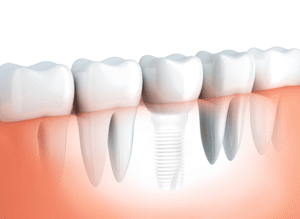
- Placement of dental implants
- Grafting or augmentation surgery to prepare the site
- Orthognathic (corrective jaw) surgery for bite problems, facial asymmetry and sleep apnoea — explained at length in What is orthognathic surgery?, with the breathing side covered under snoring and sleep apnoea
- Facial trauma, including fractures of the jaws, cheeks, eye sockets, nose and forehead
- Surgical correction of cleft and craniofacial deformities
- Cysts and tumours of the mouth, jaws, head and neck
- TMJ pain and dysfunction requiring surgical management
- Osseointegrated craniofacial implants for facial prostheses (nose, eyes, ears)
Specialist orthodontist
Orthodontists focus solely on the alignment of teeth and bite. See our orthodontists and the orthodontics overview.
They hold a degree in dentistry, a masters degree in orthodontics, and must be registered as a specialist orthodontist with AHPRA.
You may be referred for:
- Teeth straightening — with braces or Invisalign
- Bite problems and alignment — see treatment of malocclusion
- Imbalances in jaw growth — which is why when to take your child to an orthodontist is a question about timing, not just teeth
Orthodontic treatment is also provided by general dentists in many cases. The specialist training matters most where the bite relationship, not just the tooth position, needs correcting — and where jaw growth is a factor. The trade-offs either way are set out in general dentist versus specialist orthodontist and, for clear aligners specifically, specialist orthodontist versus general dentist for Invisalign.
Specialist endodontist
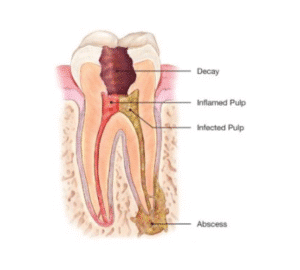
Endodontics focuses on the tooth pulp — containing the blood supply and nerves — and the tissues surrounding the tooth roots. See our endodontists and the root canal page.
Endodontists hold a general dentistry degree plus a postgraduate degree involving a further three to four years of advanced education.
You may be referred for:
- Root canal treatment and retreatment — everything you need to know about root canal treatment, and why the operating microscope matters
- Treatment and management of cracked teeth — see how a cracked tooth is treated
- Treatment of dental trauma
- Treatment of diseased or injured tooth pulp
- Internal tooth whitening
That last item is worth knowing about: a tooth that has darkened after root canal treatment can often be whitened from the inside, without a veneer or crown. Whitening when a front tooth carries a porcelain crown covers the related case where the discoloured tooth is already restored, and general teeth whitening covers the rest.
Specialist paediatric dentist
Provides comprehensive oral health care for children, from newborns to adolescents, focusing on growth, development and decay prevention in baby teeth and emerging adult teeth. See our paediatric dentists and children’s dentistry; should your child see a specialist paediatric dentist? is the decision framed directly.
Requires a further three to four years of study for a masters or equivalent degree in children’s dentistry.
Your child may be referred for:
- Injury to the mouth or teeth
- Severe overcrowding
- Difficulty managing their own hygiene at home
- Visible decay at a very young age (2–4 years) — the reason the first visit is recommended earlier than most parents expect
- More than one serious cavity
- Severe toothache
- Swelling of the gums or cheeks
- Fear of the dentist
- Other special needs in the behavioural area
Those last two are as legitimate a reason for referral as the clinical ones. Behaviour management in young children is a trained skill, and a difficult first experience can shape a lifetime of dental avoidance — visiting the dentist: caring for a child with autism describes what that preparation actually involves.
Specialist periodontist
Specialises in the prevention, diagnosis and treatment of periodontal (gum) disease, and in the placement of dental implants, bone grafts and gum lifts. See our periodontists.
Requires a further three to four years of specific training.
You may be referred for:
- Implant surgery to replace missing teeth, or teeth that cannot be saved conventionally
- Bone grafting or augmentation
- Gum lift — see gummy smile
Specialist prosthodontist
Specialises in the restoration and replacement of teeth, with particular understanding of the dynamics of a smile, the preservation of a healthy mouth, and the creation of replacement teeth and jaws — crowns, bridges, veneers, implants and dentures. See our prosthodontists and cosmetic dentistry under specialist care.
After a four to five year dental degree with honours, prosthodontists undertake a further three years of specialised training for a Masters of Prosthodontics.
They work closely with dental technicians to ensure each custom-made prosthesis is natural looking, attractive and comfortable to wear daily. Those technicians work in the on-site Smile Solutions laboratory, which is why shade and fit problems can often be resolved the same day.
You may be referred for:
- Complete fixed crowns or bridges — what types of dental crowns are available
- Colour-matched veneers to conceal defects
- Teeth damaged by decay, trauma, erosion or wear — what restorative dentistry means
- Changing tooth shape or closing gaps with bonding
- Whitening discoloured teeth
- Reconstruction for patients with birth defects such as cleft palate; temporomandibular joint disorders; traumatic injuries; and complex restoration after treatment for head and neck cancer — the coordinated end of this work is described under complex dentistry
If a full or partial denture is the answer, 5 things you should know about your new dentures is worth reading before the first appointment rather than after it.
In short
| Specialty | Deals with |
|---|---|
| Oral & maxillofacial surgery | Surgery of teeth, mouth, face and jaws |
| Orthodontics | Alignment of teeth and bite |
| Endodontics | Tooth pulp and root tissues |
| Paediatric dentistry | Children, newborn to adolescent |
| Periodontics | Gums, bone, implants |
| Prosthodontics | Restoring and replacing teeth |
Your general dentist remains the first point of contact and coordinates the referral. The specialties exist for the complex end of each field — not as a substitute for ongoing general care. Understanding your treatment explains how a referral is written up and what the fee estimate should cover before you accept it; indicative ranges are in the price guide.
Common questions
You say there are 13 specialties but the table lists six. What are the other seven?
The six above are the ones most patients are referred to; the full list is broader and worth seeing in full. The Dental Board of Australia's own wording is that “There are 13 dental specialties in Australia which are approved by the Australian Health Workforce Ministerial Council.” They are:
dento-maxillofacial radiology, endodontics, forensic odontology, oral and maxillofacial surgery, oral medicine, oral and maxillofacial pathology, oral surgery, orthodontics, paediatric dentistry, periodontics, prosthodontics, public health dentistry (community dentistry), and special needs dentistry.
Several of those are not fields you would be referred to for a filling or a crown. Forensic odontology, oral and maxillofacial pathology and public health dentistry are largely laboratory, investigative or population-health disciplines. Dento-maxillofacial radiology concerns the interpretation of imaging. Oral medicine deals with diseases of the mouth that are medical rather than surgical in nature — persistent ulceration, white or red patches, and conditions affecting the lining of the mouth. Special needs dentistry is the one most people have never heard of and most likely to be relevant: it exists for patients whose care is complicated by disability, medical complexity or frailty.
Why the exact number matters: anyone can describe a field of interest as a specialty in ordinary speech. Only these thirteen carry specialist registration, and only registration lets someone use the protected title.
My dentist says they have a “special interest” in implants. How much weight should I give that?
Treat it as information about what they do most, not as a qualification — and note that the wording itself is regulated. AHPRA's advertising guidelines state that advertising must not claim or imply specialist registration where it does not exist, and that this “includes advertising that uses the words, or variations of the words or phrases ‘specialist’, ‘specialises in’, ‘specialty’, or ‘specialised’.” The guidelines then offer the alternative: “Words such as ‘substantial experience in’ or ‘working primarily in’ are less likely to be misleading.”
The worked example in the guidelines is a useful template for reading any practitioner's website. It gives as a potential breach “Dr Lopez (Chiropractor) is a specialist in paediatric chiropractic care” and as the correct version “Dr Lopez (Chiropractor) has substantial experience working with musculoskeletal issues in children.” The same logic applies to dentistry: a practitioner who is genuinely experienced in implants but not registered in a recognised specialty should be describing experience, not specialty.
Genuine extra training can be advertised, and should be specific. The guidelines confirm that where a practitioner “holds further or postgraduate qualifications, or has specific experience, or has completed specific courses it is acceptable to advertise that in an accurate and factual manner” — a named degree, or a stated number of years at a named clinic. They also caution that post-nominal letters must not be “misleading by implying the practitioner has more qualifications, skill or experience than is the case.”
So the practical question to ask is narrow and fair: what qualification is that, who awarded it, and are you on the specialist register for it? A confident answer to the first two is perfectly respectable even when the answer to the third is no.
What does the AHPRA register actually show me — and what does it not?
It answers one question definitively and several others not at all, and it is worth knowing which is which before you rely on it.
What it shows. The Dental Board describes it plainly: “Ahpra publishes an online register of all dental practitioners that provides the profession and the public with up-to-date information about a dental practitioner's registration status. This register also includes details of the specialty or specialties for dentists who hold specialist registration.” So it confirms that a named person is registered, and whether they hold specialist registration and in which field.
What sits behind that entry. Specialist registration is not only a qualification. The Board's requirements include that applicants have “completed a minimum of two years general dental practice” — which may be satisfied by experience outside Australia, subject to assessment — and have “met all other requirements for general registration as a dentist.” Every registered specialist is therefore also a registered dentist.
What it does not tell you. It is not a quality rating. It does not say how many of a given procedure someone has done, how recently, what their results have been, or what they charge. It cannot tell you whether a particular clinician is the right person for your particular problem. Those remain questions to ask directly — and understanding your treatment covers what a written plan and estimate should contain before you agree to anything.
Does being referred to a specialist mean my own dentist has got something wrong?
Almost never — referral is usually a sign the case has been assessed carefully rather than a sign it has been mishandled. As the page says above, general dentists refer where a situation is difficult or where a second opinion would help, and the two work as a team rather than in sequence.
The training pathway itself makes the point. Every registered dental specialist began as a general dentist and, under the Dental Board's requirements, completed a minimum of two years general dental practice before specialist registration. Specialists are not a separate profession that general dentists hand patients over to; they are dentists who then concentrated on one field.
Where a referral genuinely is worth questioning is the opposite case — when something irreversible is proposed and no alternative has been discussed. That is a reason to ask what the options are and what happens if you do nothing, and, if you want another view, second opinions and corrective dentistry exists for it. Asking is not a criticism of anyone.
One practical note on continuity. After specialist treatment finishes, ongoing care returns to your general dentist, who should receive a written account of what was done. If you are not sure that has happened, ask — it matters most years later, when someone is trying to work out why a tooth was treated the way it was.
Related reading
- Complex dental cases: what happens when multiple specialists collaborate
- Endodontist vs dentist for root canal: why it makes a difference
- Should your child see a specialist paediatric dentist?
- What does oral and maxillofacial surgery involve?
- What makes a truly great dentist?
- Finding a dentist online in Australia
- Dental myths exposed
- Specialist care and why choose us
Practical details
Written by Dr Philippa Robinson.
Smile Solutions, Level 1, 220 Collins Street, Manchester Unity Building, Melbourne VIC 3000 — see how to find us. Phone 13 13 96, or theteam@smilesolutions.com.au; full details on the contact page. Monday–Friday 8.00am–6.00pm, Saturday 8.30am–1.30pm, Sunday by appointment.
Specialist registration can be verified on the AHPRA register, or by calling 1300 419 495.
The list of 13 specialties, the registration requirements and the description of the public register are the Dental Board of Australia's; the advertising wording and examples are from AHPRA's Guidelines for advertising a regulated health service. Neither is connected with Smile Solutions.
Published 7 December 2018. Specialist numbers are as at that date. General information only; it does not replace advice from your treating practitioner.
Smile Solutions trades under ABN 28 193 514 103.
Images on This Page
-
https://www.facebook.com/tr?id=800557773428361&ev=PageView&noscript=1
(no alt text)
-
https://www.smilesolutions.com.au/wp-content/uploads/2025/10/calendar_month.svg
(no alt text)
-
https://www.smilesolutions.com.au/wp-content/themes/arcadian-wordpress-theme/assets/images/smile_solutions_logo_white.png
Smile Solutions Logo
-
https://www.smilesolutions.com.au/wp-content/themes/arcadian-wordpress-theme/assets/images/smile_solutions_logo_purple.png
Smile Solutions Logo
-
https://www.smilesolutions.com.au/wp-content/uploads/2016/05/Pip-150x150.jpg
Dr Philippa Robinson
-
https://www.smilesolutions.com.au/wp-content/uploads/2025/09/Smile-Solutions-Orthodontics-1024x922.jpg
Ortho at Smile Solutions
-
https://www.smilesolutions.com.au/wp-content/uploads/2025/09/Root-Canal-Treatment-Smile-Solutions-300x270.png
Tooth anatomy with decay and infection
-
https://www.smilesolutions.com.au/wp-content/uploads/2025/09/Conventional-Dental-Implants-300x219.png
Conventional Dental Implants
-
https://www.smilesolutions.com.au/wp-content/uploads/2025/09/Dental-Emergencies-200x300.jpg
Children's Dental Emergencies at Smile Solutions
-
https://www.smilesolutions.com.au/wp-content/themes/arcadian-wordpress-theme/assets/images/family_owned_bussiness.png
Family Owned Business
-
https://www.smilesolutions.com.au/wp-content/themes/arcadian-wordpress-theme/assets/icons/icon--phone.svg
Smile Solutions Contact
-
https://www.facebook.com/tr? id=800557773428361&ev=PageView&noscript=1
(no alt text)
-
https://bat.bing.com/action/0?ti=25148060&tm=gtm002&Ver=2&mid=7ccac202-9a2d-4e40-a8f8-60576897ed65&bo=1&sid=e922d0e0ab2511f1b21e45a8acc5a7e3&vid=e922f8a0ab2511f19058af37c01cbd11&vids=1&msclkid=N&pi=918639831&lg=en-US&sw=800&sh=600&sc=24&nwd=1&tl=Why%20would%20I%20need%20to%20see%20a%20dental%20specialist%3F%20-%20Smile%20Solutions&p=https%3A%2F%2Fwww.smilesolutions.com.au%2Fdental-articles%2Farticle%2Fneed-see-dental-specialist%2F&r=&evt=pageLoad&sv=2&cdb=AQAQ&rn=542099
(no alt text)