What types of dental crowns are available?
Three basic categories: metal, porcelain fused to metal (PFM), and all-ceramic. There is also a fourth option many patients are never offered — a partial-coverage crown, which preserves more of the tooth and should be asked about before a full crown is agreed to.
The honest summary of the trade-off: metal is the strongest and removes the least tooth but looks like metal; all-ceramic looks closest to a natural tooth; PFM sits between the two. Which is right depends on where the tooth is, how hard you bite, and how much tooth is left.
What a crown is, and when one is recommended
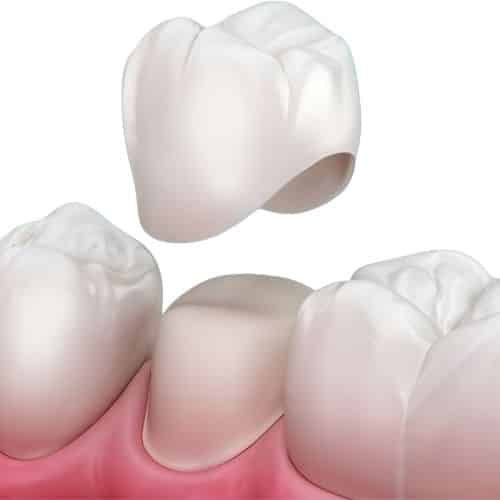
A crown — sometimes called a cap — is a fixed prosthesis permanently cemented over a tooth. It improves the structural integrity of the tooth, and can improve appearance and the alignment of the occlusion (bite). What does restorative dentistry mean? places crowns beside the other options, and what is the difference between porcelain crowns and veneers? answers the question that usually comes next.
Crowns are recommended for teeth that are broken down, cracked, or structurally compromised through:
- Trauma — see chipped and cracked teeth and will a cracked tooth be treated?
- Bruxism (tooth grinding) — TMD and teeth grinding, and night-time tooth grinding and clenching
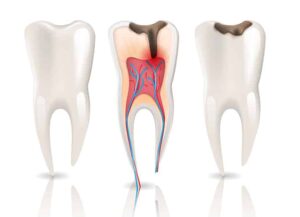
- Recent endodontic (root canal) treatment — a root-treated back tooth is significantly more prone to fracture, and a crown protects it. Everything you need to know about root canal treatment explains why
- Large existing restorations with little remaining tooth structure — how long do dental fillings last? describes how a tooth arrives at that point
One thing to be clear about before agreeing to one: preparing a tooth for a full crown is irreversible. Substantial structure is removed from all surfaces. That is warranted when the tooth genuinely needs the protection; it is worth a second look when the tooth is largely intact — and a second opinion is a reasonable step, not a discourtesy.
Metal crowns
Often gold alloy, these have been in use since the early 1900s.
- Require very minimal tooth preparation, because the metal is still strong in thin sections
- Very durable and highly fracture-resistant when well designed and constructed
- Gentle on the opposing teeth — gold wears at a rate similar to enamel, which matters over decades
- The obvious limitation: appearance. They are metal-coloured.
Because they conserve the most tooth structure and last the longest, gold crowns remain a strong choice for back teeth in heavy grinders, and for teeth where there is limited room between the jaws. The reason they are placed less often now is aesthetic preference and the price of gold, not performance.
Porcelain fused to metal (PFM)
A metal substructure with porcelain fired over it — the long-established compromise between strength and appearance.
- Strong, thanks to the metal core, with a tooth-coloured outer surface
- Requires more tooth reduction than a metal crown, because both the metal and the porcelain layers need thickness
- The porcelain layer can chip, exposing the metal beneath
- As gums recede over the years, a dark line can become visible at the margin where the metal meets the tooth
- The metal core blocks light, so PFM crowns can look slightly opaque next to natural teeth
PFM crowns have decades of clinical track record behind them, which is a genuine advantage. They are increasingly displaced by all-ceramic materials in visible positions.
All-ceramic crowns
Newer all-ceramic crowns contain no metal at all. They are made from high-strength reinforced ceramics — lithium disilicate or zirconia — reported to be around five to nine times stronger than conventional porcelain. That material replaces the metal core used in PFM technology. Many can be designed and milled in a single visit; see same-day CEREC restorations and how the CEREC process works. Others are made in the on-site laboratory.
They can be fabricated as a single layer (monolithic) for maximum strength, or layered with conventional porcelain for a more natural, aesthetically pleasing result. All-ceramic crowns achieve the closest match to natural, healthy teeth — they transmit light in a way metal-cored restorations cannot, and there is no dark margin to appear later.
One important caveat: ceramic crowns must be highly polished to avoid excessive wear of the opposing teeth. Zirconia in particular is harder than enamel, and a rough or unpolished ceramic surface will grind down the natural tooth biting against it. This is a real consideration for anyone who grinds.
A second caveat, on shade: ceramic does not lighten. If whitening is part of your plan, do it first, let the shade settle, and match the crown to the result. I want to whiten my teeth but one of my front teeth has a porcelain crown sets out what it costs to unwind that order — which is a crown replacement, not a touch-up.
Partial-coverage crowns
Where enough tooth structure remains, a partial-coverage crown — an inlay or onlay — can be provided instead. It covers only the damaged part of the tooth.
This is the more conservative option, preserving valuable tooth structure. It is worth asking about specifically, because it will not always be offered: full crowns are more forgiving to prepare and to fit.
Ask your dentist or prosthodontist directly: is there enough tooth left for an onlay rather than a full crown? Porcelain fillings and composite fillings: the differences and costs covers the inlay and onlay end of that range.
Comparing them
| Metal (gold alloy) | PFM | All-ceramic | |
|---|---|---|---|
| Tooth removed | Least | Most | Moderate |
| Strength | Highest | High | High (zirconia) to moderate (layered) |
| Appearance | Metal | Good, can look opaque | Best match to natural teeth |
| Wear on opposing teeth | Similar to enamel | Depends on the surface | Low if well polished; high if not |
| Common failure | Rare; usually decay at the margin | Porcelain chipping; dark margin as gums recede | Fracture, in thin sections |
| Typical use | Back teeth, heavy grinders, limited space | Anywhere; long track record | Front teeth and increasingly back teeth |
How the assessment is made
Prosthodontists take a whole-system approach, assessing the entire chewing apparatus — jaw muscles and joints, bite, diet, tooth wear, existing root canal treatments and fillings — before recommending a material and a crown design. Where several specialties are involved, that coordination is described under complex dentistry.
That breadth matters because the crown is rarely the whole problem. A crown placed on a heavy grinder without addressing the grinding will fail; a crown built to the wrong bite will overload the joint; a crown on a tooth with a questionable root filling will need to be cut off when that fails — and endodontists are the ones who assess that beforehand.
The procedure
- The tooth is assessed and prepared — shaped to receive the crown
- A conventional or digital impression is taken — see technology
- The crown is constructed outside the mouth, in a laboratory or by chairside milling
- A temporary crown may be placed while the permanent one is made — if it comes loose, what to do if a temporary filling comes out applies
- The definitive crown is fitted, adjusted to the bite, and cemented. If it feels high afterwards, go back and have it adjusted — see why do I bite my cheek after a filling?
Published fees are in the price guide. Payment plan options are available. Where a plan is advertised as interest free, that describes the plan term only — a deposit may be required, an establishment fee and ongoing account fees may apply, and charges can apply if the balance is not cleared within the agreed period. The applicable terms depend on the provider and the amount financed, and are set out in writing before you commit — ask what the deposit and the establishment fee are, in dollars, and what the total will be by the end. Payment Plans.
Making it last
Crowns fail for two main reasons, and both are preventable:
Decay at the margin. The crown itself cannot decay, but the tooth underneath it can, at the join with the gum. To minimise this risk:
- Regular check-ups and professional cleaning — dental cleans and hygienists
- Meticulous cleaning between the teeth — the margin between the teeth is the most common decay site, which is why flossing matters
- Re-mineralising toothpastes, where recommended — the benefits of fluoride and preventing dental decay
Overload from grinding. An occlusal splint may be recommended to protect a new crown from bruxing forces. This is not an optional add-on for a known grinder; it is what determines whether the crown lasts fifteen years or three. How can I stop grinding my teeth when I sleep? covers the options.
One further point worth knowing: crowns are not permanent. They are long-lasting, but they eventually need replacing, and each replacement removes a little more tooth. That is an argument for conserving structure at every decision point — which is why the partial-coverage question is worth asking. Eventually a tooth runs out of structure altogether, and the conversation becomes bridges, implants or dentures.
Common questions
How long does a crown actually last, and does the material change the answer?
There are published survival figures, and the useful thing about them is how close the materials sit to each other. A systematic review by Sailer and colleagues, published in Dental Materials in 2015 and summarised in the endodontic literature, reported five-year single-crown survival as:
- Metal ceramic (PFM): 94.7%
- Leucite or lithium disilicate reinforced glass ceramic: 96.6%
- Densely sintered zirconia: 92.1%
A separate prospective study by Passia and colleagues in 2013 reported a similar five-year survival rate for gold crowns of 92.3%.
Two things follow. First, at five years the material is not the main variable — a spread of a few percentage points is small next to the difference made by how much tooth was left, whether you grind, and how well the margin is kept clean. Second, these are five-year figures, not lifetime ones, and "survival" in this literature means the restoration is still in place rather than that it is perfect. Reviewers in the neighbouring veneer literature note that definitions of failure across studies range from loss of function to any repair at all, which is exactly why quoted longevity varies so much between sources.
The practical version: expect a well-made crown on a well-prepared tooth to serve for many years, expect to replace it eventually, and take seriously the two things on this page that actually move the odds — the margin, and the grinding.
I have just had root canal treatment. Do I really need a crown as well, and how soon?
Often yes, and sooner than most people arrange it. The reasoning and the timing are both documented.
Why. A root-filled tooth is at risk of structural failure, and the endodontic literature is specific that "increasing loss of tooth structure results in increasing cuspal deflection and risk of fracture," with the loss of a marginal ridge having a significant effect on tooth strength. Studies have shown that cuspal-coverage restorations significantly improve survival of the root-filled tooth, and one recent study found that root-filled molars with a direct filling were extracted significantly more often over ten years than those restored with an indirect restoration. Coverage also does a second job listed in that literature: it provides a coronal seal that prevents re-infection of the root canal space, and a systematic review concluded that the coronal seal was as important as the quality of the endodontic treatment in terms of success.
How soon. A retrospective study by Pratt and colleagues in 2016 found that posterior root-filled teeth that received a crown four months after endodontic treatment were extracted at three times the rate of those that received a crown within four months. The literature's instruction is that where cuspal coverage is justified it "should be provided as soon as possible after completion of endodontic treatment, provided there are no signs and symptoms from the tooth."
Not every tooth. The British Endodontic Society and the European Society of Endodontology both recommend that each case be considered individually. Loss of proximal walls is a strong indication for coverage; so are tooth position, the adjacent contacts and the forces on it, with loss of a proximal contact, a terminal tooth in the arch or a second molar all associated with higher failure risk. A front tooth with a small access cavity is a different proposition from a molar with two walls missing.
If cost is the reason for the delay, say so rather than deferring silently — see the price guide and payment plans, where terms and eligibility are set out.
My dentist has mentioned a post. Does that make the tooth stronger?
No — and this is one of the most common misunderstandings about root-treated teeth. A post is for retention: it gives a badly broken-down tooth something for the core and crown to hold on to. It does not reinforce the root.
The evidence on whether posts help survival is genuinely mixed, and worth hearing in full rather than in summary. A meta-analysis of five studies by Ng and colleagues (2010) found no significant association between the presence of a post and core and tooth survival. A prospective clinical study by the same group the following year found the opposite direction — extractions were 2.6 times more likely for teeth restored with a cast post and core than those without. A retrospective study using mainly fibre posts found no influence on survival. A systematic review by Naumann and colleagues (2018) found that seven of its individual studies reported no positive effect on tooth survival from placing a post, though it ran no meta-analysis.
The literature's own conclusion is the one to take away: "tooth survival does not seem to be enhanced by the placement of a post and core for retention of the restoration, whilst some studies imply an increased risk for extraction when posts are placed. As the results are inconsistent, further investigation is warranted."
So the question to ask is not "will a post make it stronger" but "is there enough tooth left to hold the core without one". If the answer is yes, a post is avoidable. See endodontists for the assessment.
Is there anything that removes less tooth than a full crown?
Yes, and asking about it is the single highest-value question on this page. The endodontic literature states the principle directly: "restorations should be designed to conserve as much sound tooth tissue as possible... and if cuspal coverage is required, onlay restorations used where appropriate." An onlay covers the cusps that need protecting and leaves the rest of the tooth alone.
The scale of the difference has been measured. A study in The Journal of Prosthetic Dentistry found that preparing anterior teeth for veneers removed "3% to 30% of the coronal tooth structure by weight", against "approximately 63% to 72%" for crown preparations. Those figures are for front teeth and for veneers rather than onlays, but they give the order of magnitude: full-coverage preparation is not a marginally more thorough version of a partial one.
A caution on veneers specifically, from the veneer literature, because people reach for them as the conservative option: survival is "negatively affected by veneer preparations extending into dentin", and severe dentine exposure significantly reduced survival in the studies reviewed. The conservatism only pays if the preparation actually stays within enamel — which is a decision about your tooth, not about the technique in general.
The three questions worth asking before any tooth is prepared: is there enough tooth left for an onlay rather than a full crown; will the preparation stay in enamel; and can I see a mock-up of the result first. None of them is an awkward question, and all three are easier to ask before the handpiece starts than afterwards.
Related reading
- What does restorative dentistry involve? — the order treatment follows
- How can I improve my smile with porcelain veneers and crowns?
- Dental crowns for children — silver or white?
- Why do I need a filling?
- Which dental bridge type, and how do I choose?
- Understanding your treatment
Practical details
Prosthodontics is a recognised dental specialty. Specialist registration can be verified on the AHPRA register, or by calling 1300 419 495. The practice's registered specialists are identified as such, alongside the full team.
Smile Solutions, Level 1, 220 Collins Street, Manchester Unity Building, Melbourne VIC 3000 — getting here. Phone 13 13 96, contact us, or theteam@smilesolutions.com.au. Monday–Friday 8.00am–6.00pm, Saturday 8.30am–1.30pm, Sunday by appointment.
Published 29 February 2016, by Dr Jamie Foong. General information only; it does not replace advice from your treating practitioner. Outcomes vary between individuals, and all treatment carries risks. Payment plan terms are set by the credit provider and change; confirm current terms directly before you commit.
Smile Solutions trades under ABN 28 193 514 103.
Images on This Page
-
https://www.facebook.com/tr?id=800557773428361&ev=PageView&noscript=1
(no alt text)
-
https://www.smilesolutions.com.au/wp-content/uploads/2025/10/calendar_month.svg
(no alt text)
-
https://www.smilesolutions.com.au/wp-content/themes/arcadian-wordpress-theme/assets/images/smile_solutions_logo_white.png
Smile Solutions Logo
-
https://www.smilesolutions.com.au/wp-content/themes/arcadian-wordpress-theme/assets/images/smile_solutions_logo_purple.png
Smile Solutions Logo
-
https://www.smilesolutions.com.au/wp-content/uploads/2023/11/Jamie-150x150.jpg
Dr Jamie Foong
-
https://www.smilesolutions.com.au/wp-content/uploads/2025/09/Dental-Crown-at-Smile-Solutions.jpg
What types of dental crowns are available?
-
https://www.smilesolutions.com.au/wp-content/uploads/2025/09/Root-Canal-2-300x217.jpg
Root Canal
-
https://www.smilesolutions.com.au/wp-content/uploads/2023/11/SS-Tooth-1-1-150x150.png
Smile Solutions
-
https://www.smilesolutions.com.au/wp-content/uploads/2025/09/Wisdom-Teeth-Smile-Solutions-300x300.png
Smile Solutions Dentist Melbourne
-
https://www.smilesolutions.com.au/wp-content/uploads/2025/11/Kia-150x150.jpg
Dr Kia Pajouhesh
-
https://www.smilesolutions.com.au/wp-content/uploads/2026/08/Mouth-Breathing-300x270.jpg
Mouth Breathing
-
https://www.smilesolutions.com.au/wp-content/themes/arcadian-wordpress-theme/assets/images/family_owned_bussiness.png
Family Owned Business
-
https://www.smilesolutions.com.au/wp-content/themes/arcadian-wordpress-theme/assets/icons/icon--phone.svg
Smile Solutions Contact
-
https://www.facebook.com/tr? id=800557773428361&ev=PageView&noscript=1
(no alt text)