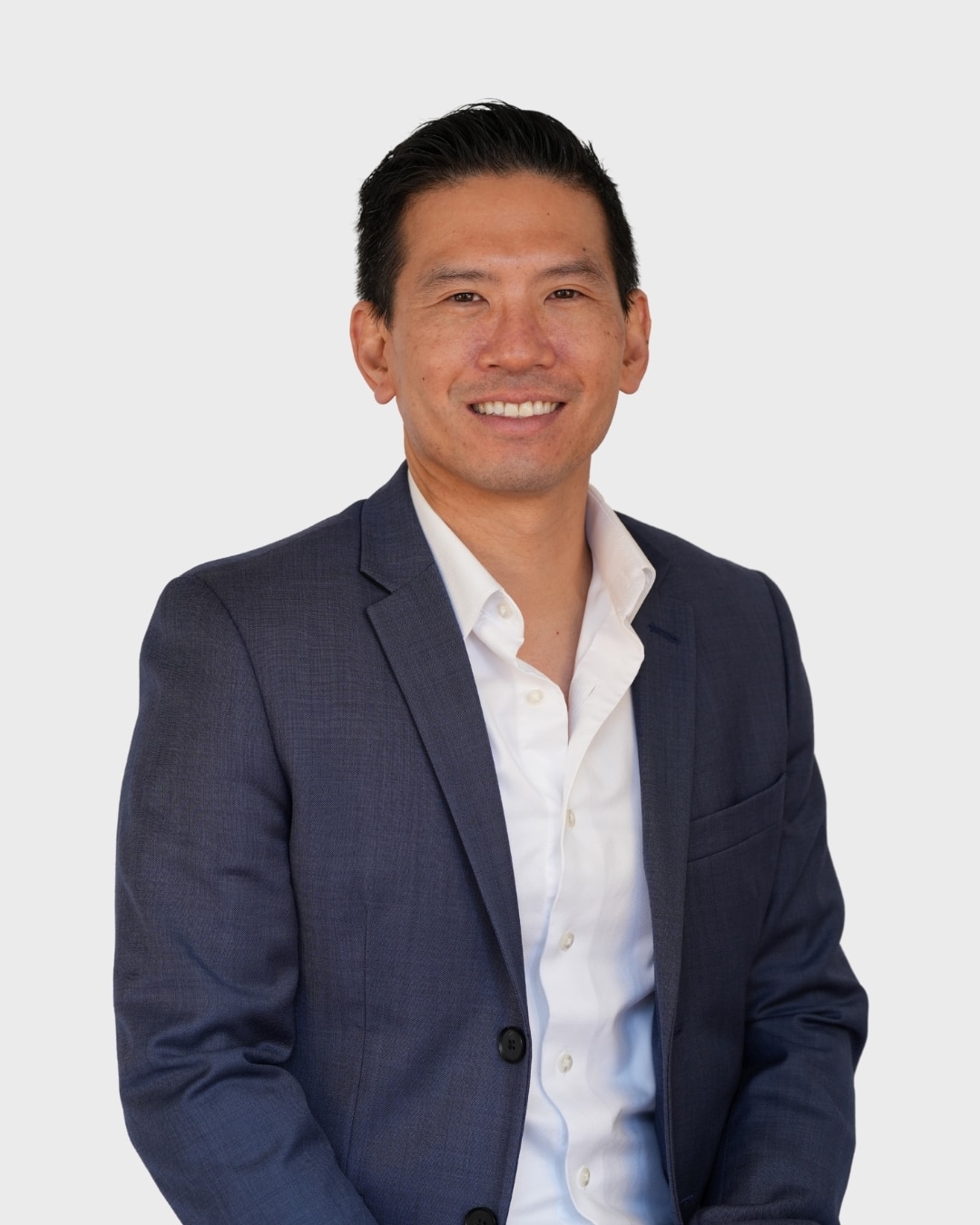
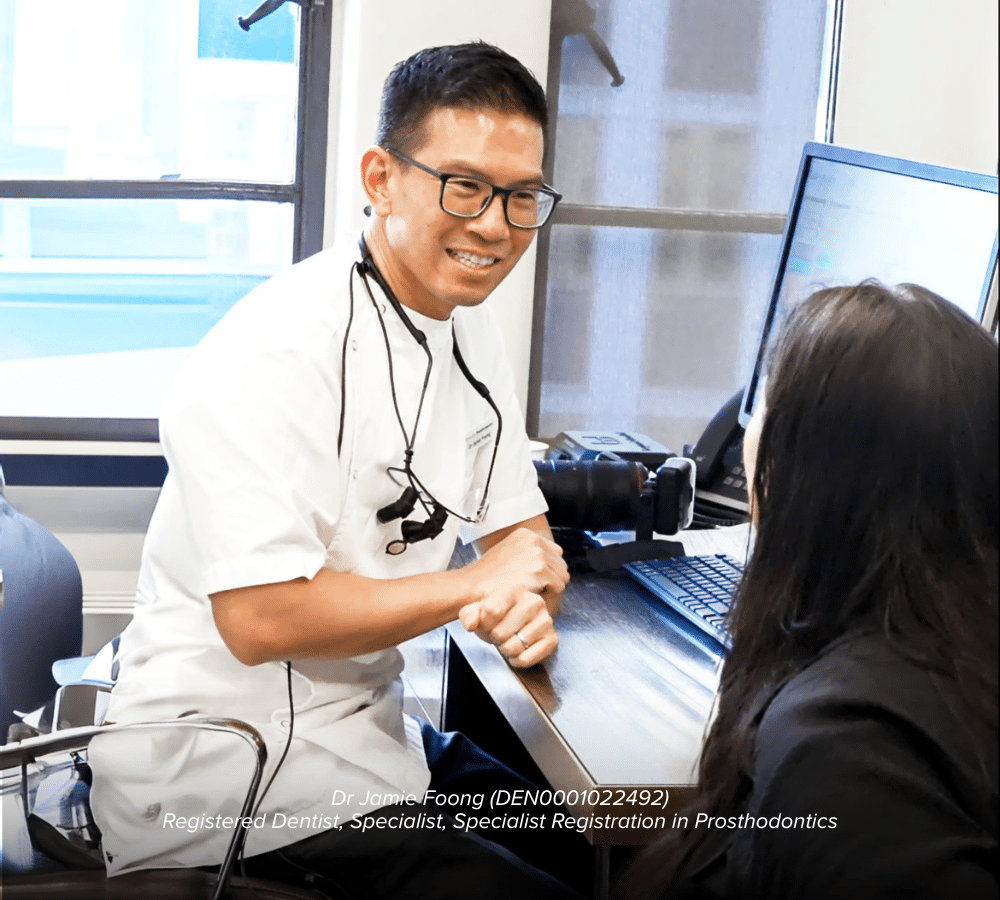
Dr Jamie Foong, Specialist Prosthodontist
Role: Specialist prosthodontist
Qualifications: BDSc, University of Melbourne; DClinDent (Prosthodontics), University of Melbourne
Registration: Registered dentist with specialist registration in prosthodontics, DEN0001022492
Specialist registration can be verified on the AHPRA register of practitioners at ahpra.gov.au. Prosthodontics is one of the thirteen dental specialties recognised by the Dental Board of Australia, and the title "prosthodontist" is protected. Which Smile Solutions clinicians hold specialist registration is set out on the dentists and registered specialists page.
Background
Dr Jamie Foong graduated in dentistry from the University of Melbourne. He worked in Queensland as a general practitioner for several years, including a period with a Brisbane prosthodontic practice, then returned to Melbourne to complete a three-year specialist degree in prosthodontics.
He is a visiting lecturer and clinical supervisor at the University of Melbourne Dental School, and a member of the Australian Prosthodontic Society and the Australian Dental Association.
His clinical work covers crown and bridge, occlusal rehabilitation, porcelain veneers and dental implants. He wrote the practice's explainer on what types of dental crowns are available.
What a prosthodontist is
A prosthodontist is a dental specialist in the restoration and replacement of teeth. Where a general dentist restores teeth as part of general practice, a prosthodontist has completed three years of full-time postgraduate training focused on it, and typically takes the cases that are complex, extensive, or that have already failed once. The practice groups that work under complex dentistry.
The pathway:
- A dental degree.
- General practice experience — Australian programmes generally require at least two years before entry.
- Three years of full-time postgraduate specialist training (DClinDent or equivalent).
- Application to the Dental Board of Australia for specialist registration.
Scope:
- Fixed prosthodontics — crowns, bridges, veneers, inlays and onlays
- Removable prosthodontics — partial and complete dentures
- Implant prosthodontics — designing and fitting the restorations that attach to implants, and planning implant positions, including All-on-4 cases
- Full-mouth rehabilitation — rebuilding worn or collapsed dentitions
- Occlusion — diagnosing and managing bite problems and tooth wear
Why would I need to see a dental specialist? and complex dental cases: what happens when multiple specialists need to collaborate describe how referral and shared planning work in practice.
What "specialist registration" means, and how to check it
The Dental Board of Australia is explicit about both the number of specialties and the route into one. "There are 13 dental specialties in Australia which are approved by the Australian Health Workforce Ministerial Council": dento-maxillofacial radiology, endodontics, forensic odontology, oral and maxillofacial surgery, oral medicine, oral and maxillofacial pathology, oral surgery, orthodontics, paediatric dentistry, periodontics, prosthodontics, public health dentistry (community dentistry) and special needs dentistry. Prosthodontics is one of them. "Implantologist", "cosmetic dentist" and "full-mouth reconstruction specialist" are not.
Every applicant must hold a qualification in the specialty approved by the Board and must have "completed a minimum of two years general dental practice" — a requirement that "may be achieved by experience outside Australia, subject to assessment and approval by the Board" — plus "all other requirements for general registration as a dentist". Specialist registration is therefore added to general registration, never substituted for it.
And it is publicly checkable: "Ahpra publishes an online register of all dental practitioners that provides the profession and the public with up-to-date information about a dental practitioner's registration status", a register that "also includes details of the specialty or specialties for dentists who hold specialist registration". Before committing to treatment of the scale described below, it is worth the minute it takes.
What the scope does not include
A prosthodontist is not an oral and maxillofacial surgeon, a periodontist, an endodontist or an orthodontist. Jaw surgery, gum surgery, root canal retreatment and orthodontic tooth movement are separate specialties, and complex cases are usually shared. Some prosthodontists place implants themselves; others restore implants placed by a surgeon. Which applies is a fair question to ask at consultation.
Whoever does which part, the Board's scope of practice registration standard "requires dental practitioners to practise within the scope of their education, training, and competence at all times". That standard binds specialists exactly as it binds general dentists.
Three titles that are constantly confused
- Prosthodontist — a registered dentist with specialist registration. Diagnoses, plans and treats; works on natural teeth and implants.
- Dental prosthetist — a separately registered dental practitioner (ADP-prefixed registration) who may make and fit full dentures and mouthguards directly for the public, and partial dentures in cooperation with a dentist. Does not treat natural teeth.
- Dental technician — not registered under the National Law at all. Constructs appliances in a laboratory from a practitioner's prescription; does not see or treat patients.
Occlusal rehabilitation: what it is and when it is warranted
Occlusal rehabilitation means rebuilding the bite — restoring most or all of the teeth to re-establish function, appearance and a stable jaw relationship. It is major, staged, expensive treatment, and the diagnosis matters more than the construction.
Establish why the dentition failed before rebuilding it:
- Bruxism — grinding and clenching, mostly during sleep. Wears enamel flat and fractures restorations. Rebuilding without managing it reproduces the failure in the new work, usually faster because ceramic is more brittle than enamel. What is bruxism and how is it managed? covers the management side.
- Erosion — acid from reflux, vomiting, diet or medication. Chemically dissolves enamel and characteristically hollows the biting and palatal surfaces. Rebuilding without treating the acid source is futile — see what is dental erosion and how is it addressed? and I've heard a lot about acid wear
- Untreated periodontal disease — teeth continuing to lose support cannot carry extensive restorative work.
- Attrition following tooth loss — remaining teeth overloaded because others are missing. Replacement options for missing teeth and bridges, implants or dentures? set out the alternatives.
A properly sequenced case includes records and mounted models, often a diagnostic wax-up showing the proposed result before anything is prepared, and a trial phase in temporary restorations to test the proposed bite, appearance and function before committing to definitive work — see the mock-up reveal. That trial phase is the single most valuable safeguard in this kind of treatment, and skipping it is where large cases go wrong.
Expect a written plan setting out staging, costs, alternatives — including doing less, or nothing — and what maintenance will be required afterwards. Understanding your treatment describes how that is presented. A second opinion before committing to treatment of this scale is reasonable, and no reputable practitioner objects to one.
On "increasing the vertical dimension"
Where teeth have worn substantially, rebuilding them often requires opening the bite — increasing the vertical distance between the jaws. This is done routinely and is usually well tolerated, but it is not a trivial change: it alters the position of the jaw joints, the muscles and the lips.
It is one of the strongest arguments for the temporary trial phase. Wearing the proposed new bite in provisional restorations for weeks or months before making it permanent tests it in a way no articulator or software can.
What the implant literature actually reports
Implant survival is one of the few areas of restorative dentistry with large-scale published data, and it is worth reading carefully rather than as a slogan.
A registry analysis of implants placed in one of the four national health funds in Israel between 1 January 2014 and 31 December 2022 reported that "a total of 158,824 dental implants were placed in 53,874 patients", and that "of the 158,824 implants, the overall survival rate was 97.79%, with a total failure rate of 2.21%".
Three findings from that study matter more to a patient than the headline number:
- Failure clusters early. "Failures within the first year accounted for 1.59% of cases", and the "early failure rate during the osseointegration phase—before prosthetic reconstruction—was 1.56%". The authors note that "it is during this early period that complications such as infection, implant mobility, or peri-implantitis are most likely to occur", and that "after the first year, the incidence of failure dropped significantly".
- Site changes the odds. "Significant associations with implant failure were observed for male patients (2.53% failure rate), implants in the maxillary molar region (3%), and the central incisor region (3.37%), approximately double the failure rates seen in other implant sites."
- Risk is partly modifiable. The same paper cites earlier work concluding that "significant risk factors for early failures included smoking habits, implants shorter than 10 mm, and implants placed in the maxillary region", and that "comprehensive patient assessments and preoperative planning are paramount to reduce the risk of failure".
Two cautions on reading any such figure. Survival is not the same as success — an implant counted as surviving may still have bone loss, inflammation or a restoration that has been remade. And a population average does not predict an individual outcome; the site, the bone, the bite and whether you smoke matter more to your case than the mean does.
Longevity, honestly
- No restoration is permanent. Crowns, bridges, veneers and implant restorations all have finite service lives. Published survival figures vary widely by material, site, bite forces and patient, and averages do not predict an individual outcome. How much does a dental crown cost in Melbourne? Materials compared covers how material choice changes both fee and behaviour.
- Failure is usually biological, not mechanical — decay at the margin of a crown, or periodontal breakdown, more often than the ceramic itself breaking.
- A night guard is routine after extensive restorative work, and skipping it is a common reason for early failure — night time tooth grinding and clenching.
- Maintenance is not optional. Extensive restorative work needs regular professional review and hygienist care to catch a failing margin while it is still a repair rather than a remake.
Registration
The Dental Board of Australia registers dentists, dental specialists, dental hygienists, dental therapists, oral health therapists and dental prosthetists. Specialist registration is a distinct category shown on the public register alongside the specialty held, renewed annually and subject to standards for recency of practice, continuing professional development, professional indemnity insurance, criminal history and English language skills.
Each of those standards carries a published date of effect: specialist registration (1 July 2010), general registration for overseas-qualified dental practitioners (20 December 2011), endorsement for conscious sedation (27 October 2015), continuing professional development (1 December 2015), recency of practice (1 December 2015), professional indemnity insurance arrangements (1 July 2016), the revised list of recognised specialties, titles and definitions (1 October 2017), scope of practice (1 July 2020), English language skills (18 March 2025) and criminal history (15 July 2026).
Common questions
The survival figures look excellent. So what actually goes wrong, and how often?
This is the right question, and it has a better-evidenced answer than the survival percentage does.
The ITI Academy's consensus statements summarise the complication data for implant work followed for at least five years. On implant-supported fixed partial dentures — bridges carried entirely by implants — the consensus records that “FPDs without any biologic or technical complications were encountered in 61.3% of patients after 5 years”. Read that the other way round: roughly two patients in five had something go wrong within five years, on restorations that were nonetheless counted as surviving.
What went wrong, from the same source, all at five years:
- Gum and bone problems around the implant — “periimplantitis and soft tissue complications occurred in 8.6% of patients after 5 years”, based on eight cohort studies.
- Screw loosening or fracture at the connection — 7.3%.
- Fracture of the ceramic or the framework — 14.0%.
- A cemented restoration coming loose — 2.9% within five years, rising to 16.2% within ten.
- The implant itself fracturing — rare: 0.4% at five years, 1.8% at ten.
Two things follow from that pattern. Most complications are repairable rather than terminal, which is why they do not show up in a survival figure — but they are appointments, and some of them are fees. And the profile is dominated by the restoration and the surrounding tissue, not by the implant, which is precisely the part of the work a prosthodontist is concerned with.
Worth asking before you start: which complications are covered by the practice and for how long, whether the restoration is screw-retained or cemented (a screw-retained one is easier to remove and repair), and what the review interval will be. Note also that the ITI statements attach their own caution to the ten-year numbers, which rest on very few studies with small samples.
I mainly want my dentures sorted out. How long should a denture last, and how long will it take to get used to?
We cannot answer either question from an independent source, and it would be wrong to pretend otherwise.
The reference library behind these pages was searched specifically for this. On conventional full and partial dentures — adaptation time, relining intervals, acrylic care, service life in years — it contains nothing. No Australian regulator, and none of the peer-reviewed material collected here, publishes a figure. Anyone who quotes you one for a conventional denture is quoting experience, their own or someone else's, and it should be presented to you that way.
Implant-retained overdentures are different, and the distinction matters because the two are often discussed as though they were one thing. There, published data exists — and it is more sobering than the figures usually quoted for implant crowns and bridges. The ITI consensus reports “2.5% implant loss prior to the placement of overdentures and nearly 6% implant loss during 5 years of function”, against 0.8% and 2–2.5% respectively for implants supporting single crowns. An implant under a removable overdenture is working harder, and the numbers show it.
So: when a plan is put to you, establish which of the three you are being offered — a conventional denture, an implant-retained overdenture, or fixed implant work — because the evidence, the maintenance and the cost are different for each. What are the different types of dentures? sets out the categories, and 5 things you should know about your new dentures covers the settling-in period as the practice describes it.
Do I need a referral, and what should the referral actually contain?
A referral from a general dentist is the usual route and it is worth having, but you can also make a direct appointment.
What makes a referral useful is not the letter itself but what travels with it: the diagnosis or the question being asked, any radiographs already taken, and the history of what has been tried. That matters more here than in most of dentistry, because rehabilitation cases are usually long stories — a tooth restored three times, a bridge that failed, a denture never worn. The sequence is diagnostic information.
If you are coming without a referral, ask your current practice to send your records across, or request a copy yourself and bring them. Radiographs in particular are worth chasing rather than repeating: the published radiology principle is that “strict and individualized justification should determine the prescription of each radiograph”, and that a justified radiograph “should make a substantial contribution to distinguishing between treatment options”. An existing image that answers the question should not simply be taken again — though a newer one, or a different view, often is justified, and you can ask which applies.
Who holds the case afterwards is the other thing to settle early. Complex work is frequently shared between a specialist and a general dentist, and it should be clear from the outset who is doing which part, who reviews it afterwards, and where you go if something breaks on a Saturday.
Treatment at this scale is expensive. How do I read the quote, and what if I cannot do all of it?
Start with why the comparison is so hard. Australia has no national dental fee schedule. A submission to the Commonwealth Parliament's inquiry into dental services puts the consequence plainly: “There are no consumer guidelines to ascertain the reasonableness of dental fees charged.” There is no published benchmark, which makes the written quote in front of you the document that matters.
On what specialist treatment costs, the ADA's Dental Fees Survey 2022 is the only Australian figure worth citing, and it needs its caveats. A fifth of the specialists who responded charged an hourly rate, and among those the mean was $921 an hour in 2022 and the median $800, “ranging between $450 and $1,500 per hour”. The ADA itself says results for specialists “should be interpreted with considerable caution” because only 284 responded and the classification was self-assigned. Those figures are members' charges across all dental specialties in 2022, not this practice's fees, and they are four years old.
Reading the quote. Ask for it itemised with item numbers, stage by stage, and ask three things of it: what is included in each stage, what is explicitly not included, and at which point you are committed. A plan that is priced as one number cannot be staged and cannot be paused.
On doing less. A staged plan should have a defensible stopping point — stabilise the disease, restore function, defer the appearance work — and asking for that plan is not asking for a compromise, it is asking for the options the written plan should already contain. Doing nothing is also a legitimate option and should be costed as such, including what is likely to happen if you choose it. The price guide publishes indicative fees, understanding your treatment sets out what a plan should contain, and payment plans describes the arrangements available.
Related reading
- What does restorative dentistry involve?
- I'm looking to get a dental bridge to replace a tooth. What are the different types and how do I choose?
- What are the different types of dentures?
- 5 things you should know about your new dentures
- What is the difference between porcelain crowns and veneers?
- Price guide — indicative fees, and what changes them
Practical details
Dr Foong's specialist registration can be verified free on the AHPRA public register at ahpra.gov.au. Prosthodontic consultation is usually by referral from a general dentist, though a direct appointment can be made. Use the contact page to arrange one. The full clinician list is on the our team page.
Smile Solutions, Level 1, 220 Collins Street, Manchester Unity Building, Melbourne VIC 3000. Phone 13 13 96, or theteam@smilesolutions.com.au. Monday–Friday 8.00am–6.00pm, Saturday 8.30am–1.30pm, Sunday by appointment.
Sources for the externally verifiable statements on this page
- Dental Board of Australia — Specialist Registration, FAQ: Specialist registration and Registration Standards.
- "Dental Implant Survival Rates: Comprehensive Insights from a Large-Scale Electronic Dental Registry" (PubMed Central) — the 158,824-implant registry analysis quoted above.
- ITI Academy — Implant Survival and Complications consensus statements, for the five- and ten-year complication rates.
- Australian Dental Association — Dental Fees Survey 2022; and a submission to the Commonwealth Parliament's inquiry into dental services on the absence of a national fee schedule.
This page records qualifications and career history as published by the practice. General information only — it is not a diagnosis, a treatment plan or a promise of any particular clinical outcome. Practitioner availability changes; confirm when booking.
Smile Solutions trades under ABN 28 193 514 103.
Images on This Page
-
https://www.facebook.com/tr?id=800557773428361&ev=PageView&noscript=1
(no alt text)
-
https://www.smilesolutions.com.au/wp-content/uploads/2025/10/calendar_month.svg
(no alt text)
-
https://www.smilesolutions.com.au/wp-content/themes/arcadian-wordpress-theme/assets/images/smile_solutions_logo_white.png
Smile Solutions Logo
-
https://www.smilesolutions.com.au/wp-content/themes/arcadian-wordpress-theme/assets/images/smile_solutions_logo_purple.png
Smile Solutions Logo
-
https://www.smilesolutions.com.au/wp-content/uploads/2023/11/Jamie.jpg
Dr Jamie Foong
-
https://www.smilesolutions.com.au/wp-content/uploads/2025/11/Board-registered-specialists.png
Smile Solutions Dentist Melbourne Specialist Prosthodontist
-
https://www.smilesolutions.com.au/wp-content/uploads/2025/09/Dental-Crown-at-Smile-Solutions-300x300.jpg
Dental Crown at Smile Solutions
-
https://www.smilesolutions.com.au/wp-content/uploads/2023/11/Jamie-150x150.jpg
Dr Jamie Foong
-
https://www.smilesolutions.com.au/wp-content/themes/arcadian-wordpress-theme/assets/images/family_owned_bussiness.png
Family Owned Business
-
https://www.smilesolutions.com.au/wp-content/themes/arcadian-wordpress-theme/assets/icons/icon--phone.svg
Smile Solutions Contact
-
https://www.facebook.com/tr? id=800557773428361&ev=PageView&noscript=1
(no alt text)