Specialist Prosthodontists
What is a prosthodontist, and when does a case need one?
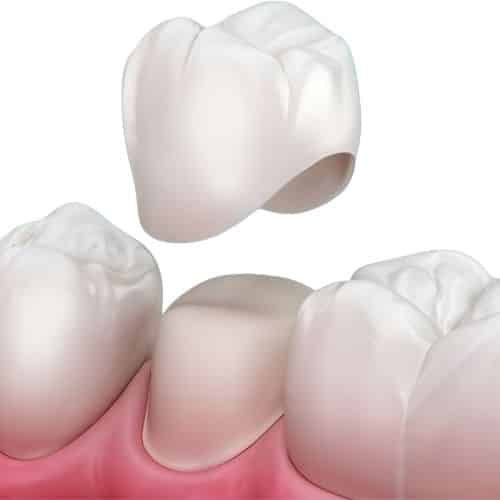
Prosthodontics is the field of dentistry focused on the restoration of teeth requiring crowns, veneers, bridges, implants, dentures or any combination of these.
The term means, literally, “tooth replacement”.
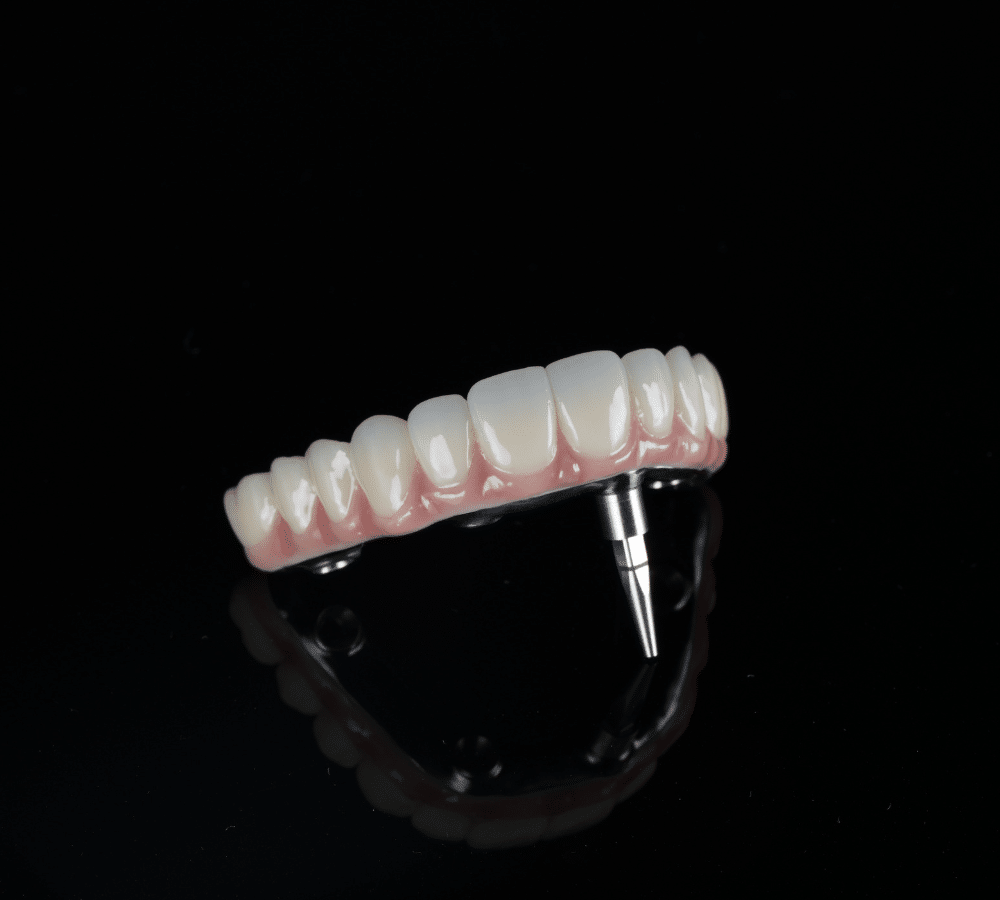
Prosthodontists handle the full range — from single-tooth management through to full arch rehabilitations and All-on-4 dental implants. As a rule of thumb: the more teeth involved, and the more the bite has to be rebuilt rather than repaired, the stronger the case for a specialist.
A single crown or a straightforward denture does not need one, and a general dentist doing that work well is a reasonable and less expensive choice.
Smile Solutions is at Level 1, 220 Collins Street, Manchester Unity Building, Melbourne CBD.
What prosthodontists treat
- All-on-4 dental implants — full-arch fixed replacement. See All-on-4 Dental Implants
- Dental implants — single tooth through to multiple. See Dental Implants
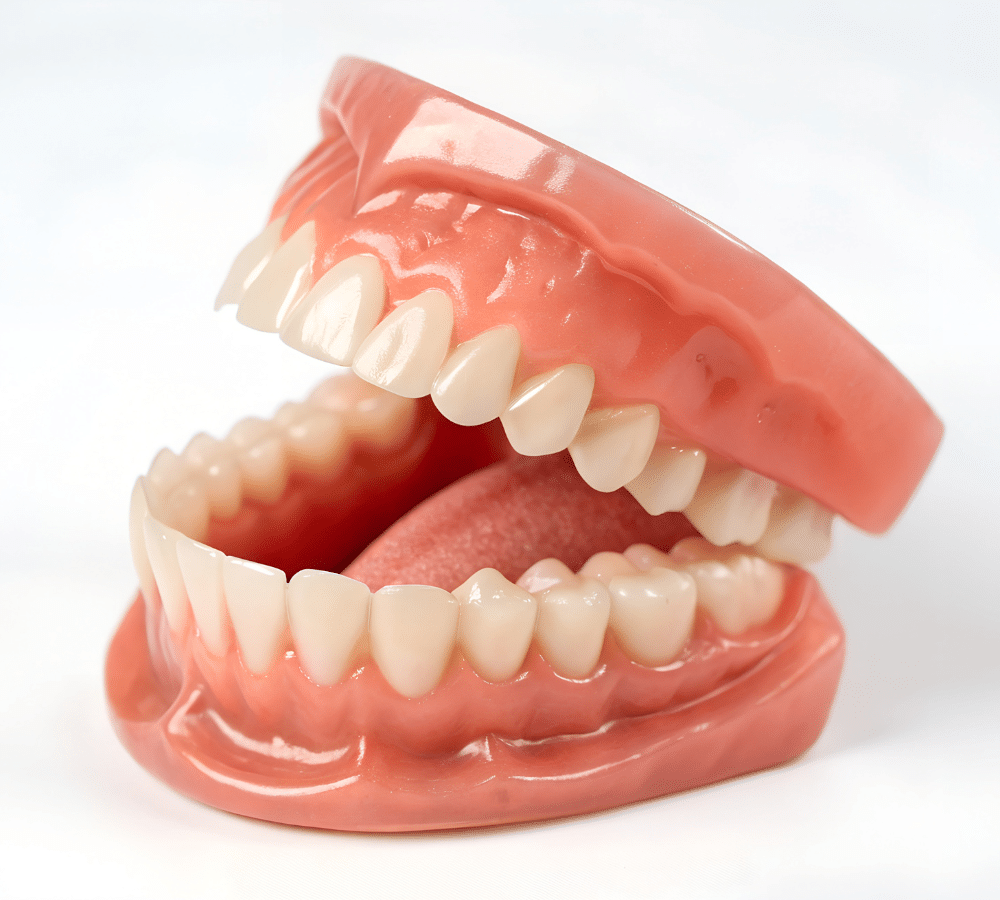
- Dentures — partial and full. See Dentures
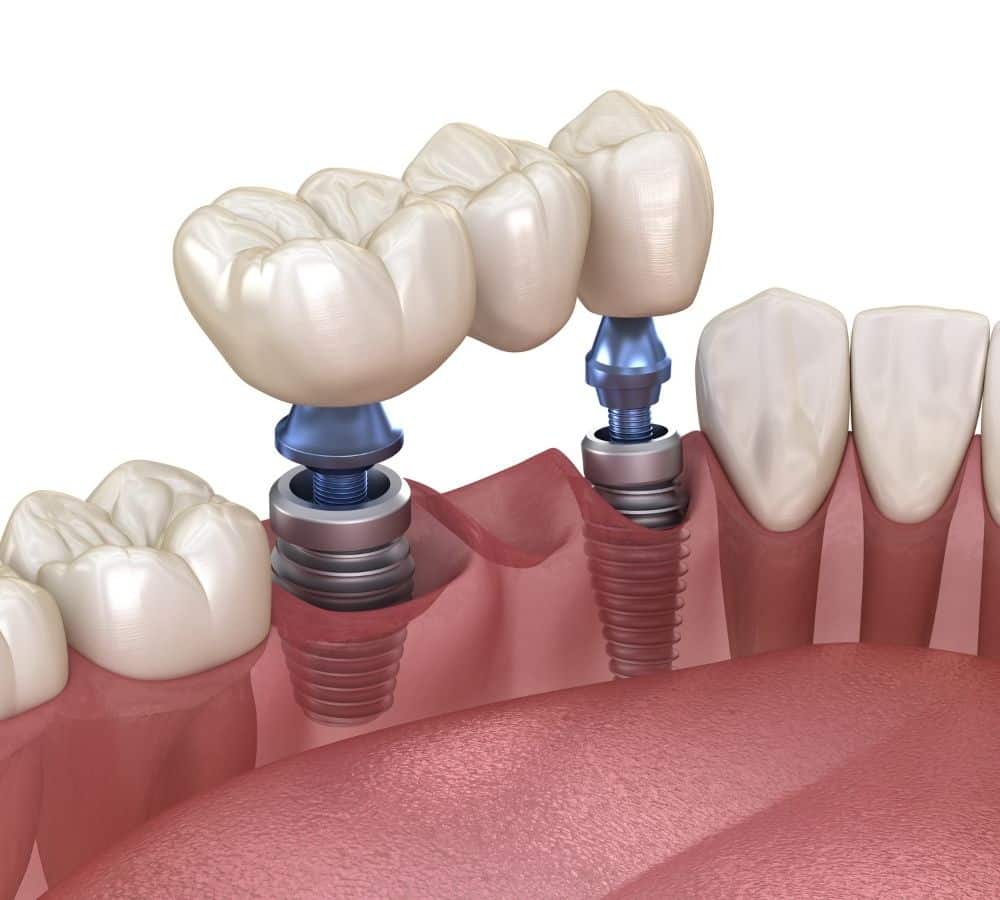
- Dental bridges — including implant-supported
- Complex cosmetic dentistry — veneers, crowns, and cases where appearance and function must be rebuilt together. See Porcelain Veneers and Dental Crowns
Why a specialist for restorative work
A single crown is routine dentistry. A full arch is a different problem: every restoration has to work with every other one, the bite has to be re-established from scratch, and mistakes compound across the whole mouth rather than affecting one tooth.
Prosthodontists spend their additional training on exactly that — occlusion, materials, and the sequencing of complex restorative cases. They also work closely with dental technicians, so the design and the manufacture are considered together rather than in sequence.
What “rebuilding the bite” actually means
This is the part that distinguishes the specialty, and it is rarely explained.
When teeth wear down over decades, the face shortens slightly and the muscles adapt. Restoring those teeth to a proper length means deciding where the jaw should close — not simply copying what is there, because what is there is the worn version.
Three ideas do most of the work:
- Vertical dimension — how far the jaw closes when the teeth meet. Worn teeth reduce it; restoring them often means opening it slightly, which has to be planned and tested rather than guessed.
- A reproducible jaw position. Where a bite has collapsed, the position the patient habitually closes into may not be the right one to build to, so the specialist records a stable, repeatable relationship instead.
- Anterior guidance — how the front teeth guide the jaw as it moves sideways and forward. Get this right and the back teeth are protected as you chew; get it wrong and the new work chips within a year.
This is why full-mouth work takes months and starts with records rather than drilling. Models mounted on an articulator, photographs and a facebow record let the whole plan be built and tested outside the mouth before anything irreversible happens.
The stages of a full rehabilitation
- Records and diagnosis. Photographs, scans or impressions, radiographs, mounted models, and an assessment of the joints and muscles.
- The diagnostic wax-up. The proposed result modelled in wax — the blueprint everything else is copied from. See Mock-up Reveal.
- Provisional restorations. Temporary versions of the planned teeth, worn for weeks or months.
- Testing and refinement. Adjustments to the provisionals until speech, chewing, comfort and appearance are all right.
- The definitive restorations, made to copy the approved provisionals.
- Maintenance — hygiene recalls, a splint where indicated, and review.
Step 3 is the one patients underestimate. The provisional phase is not a placeholder while the lab works; it is the trial of the new bite, and it is where problems are found while they are still cheap to fix. Living with a proposed vertical dimension for a few months is the only reliable way to know the jaw accepts it. A plan that skips straight to the final restorations is transferring that risk to you.
Worn teeth, and the space problem
A large share of prosthodontic work is worn dentitions, and there is a specific difficulty people find counterintuitive.
As teeth wear, the teeth and bone drift to keep them in contact — so a worn tooth is short, but there is no gap above it to rebuild into. Restoring length requires creating space, and there are three ways to do it: open the bite slightly, move teeth orthodontically, or reduce other teeth — each with different costs and consequences.
Establishing the cause comes first, because rebuilding into an ongoing process fails. Grinding, acid erosion and heavy brushing produce different wear patterns and different answers. See TMD & Teeth Grinding, and Composite Bonding, which is frequently the conservative way to restore worn edges before anything more is considered.
Replacing a single tooth
The most common prosthodontic question, and it has three legitimate answers:
| Implant | Bridge | Removable partial denture | |
|---|---|---|---|
| Neighbouring teeth touched | None | Both are cut down permanently | None, but clasps rest on them |
| Time | Months, including healing | Weeks | Weeks |
| Surgery | Yes | No | No |
| Cleaning | Like a natural tooth | Under the bridge, with threaders | Taken out and brushed |
| Preserves bone in the gap | Yes | No | No |
| Upfront cost | Highest | High | Lowest |
| If it fails | Usually replaceable | Often two teeth are then compromised | Remade |
The row that decides most cases is the first one. A bridge means permanently preparing healthy teeth either side; an implant does not. Where the neighbouring teeth already need crowns, that argument disappears and a bridge can be the better choice. See implant versus bridge for a single tooth and bridges, implants or dentures.
Dentures, honestly
Dentures are often treated as the option of last resort. For many people they are a sound, affordable and entirely appropriate answer — but the trade-offs deserve stating.
- Upper full dentures are usually well retained, because the palate provides suction. Lower full dentures are considerably harder, because the tongue and a smaller ridge give little to hold onto. This is the single most common source of denture disappointment, and it is anatomy rather than workmanship.
- Two implants can transform a lower denture by clipping it into place — the overdenture. It remains removable and cleanable, costs far less than a fixed full-arch bridge, and it is the option most often left out of the conversation.
- Adaptation takes weeks. Speech, chewing and saliva flow all change at first, and reading aloud and starting with soft food genuinely helps.
- The ridge continues to shrink once teeth are gone, so dentures need relining periodically and eventually remaking. A denture that has become loose after some years is doing what dentures do.
- Partial dentures must be designed around cleaning, because they trap plaque against the remaining teeth.
See Dentures and the different types of dentures.
The materials, and why one gets chosen over another
- Lithium disilicate — excellent appearance with good strength. A common choice for single crowns and veneers in the visible zone.
- Zirconia — the strongest of the ceramics and metal-free, at some cost in translucency. Favoured for heavy loads, long spans and grinders.
- Metal-ceramic — porcelain over a metal substructure. Long track record, very reliable, though the metal can eventually show as a dark line if gums recede.
- Gold — unfashionable and still exceptional where it is not visible: kind to the opposing teeth, and able to work in very thin sections, which means removing less tooth.
- Composite — repairable, reversible where added without preparation, and the most conservative option for many cases.
Strength and beauty pull in opposite directions, and the choice depends on where the tooth sits, how hard you bite and how much tooth remains. It is a fair question to ask why a particular material was chosen for your case. See Same-Day CEREC Restorations.
What restorative work involves accepting
Worth understanding before a large plan begins, because much of this is permanent:
- Crown and veneer preparation removes tooth structure and cannot be undone. Once a tooth is prepared it will always need a restoration of some kind.
- Nothing is permanent. Crowns, bridges, veneers and implant restorations all have a service life, and the figures quoted anywhere are typical ranges rather than guarantees. They chip, wear, debond, and eventually need replacing.
- A prepared tooth can lose its nerve, sometimes years later, needing root canal treatment through the new restoration. See Specialist Endodontists.
- Implants can fail to integrate, or be lost later to peri-implantitis, and implant surgery carries its own risks. Dental Implants at Smile Solutions.
- Full-arch treatment takes many months and involves a provisional phase in which appearance and function are not yet final.
- The result depends on maintenance — ongoing hygiene care, and often a night splint if you grind. See Dental Cleans & Hygienists.
- Aesthetic outcomes are a matter of judgement, which is why shade, shape and try-in stages exist. Say what you think at the try-in, not after it is cemented.
Ask what the expected service life of the proposed work is, what happens if something fails, and what is covered if a restoration needs redoing — get that answer in writing. See Understanding Your Treatment.
Living with extensive restorative work
The work is a long-term commitment rather than a finished event:
- Hygiene appointments more often, commonly three- to six-monthly where there are implants or extensive margins
- A night splint where grinding is present — the cheapest insurance on an expensive rebuild
- Cleaning under bridges and around implants daily, with threaders, interdental brushes or a water flosser
- Reporting anything that changes — a rough edge, a high spot, floss shredding, a gum that stays sore
- Gums matter more, not less, once there are restorations at the margin. See Bleeding Gums
Your prosthodontists
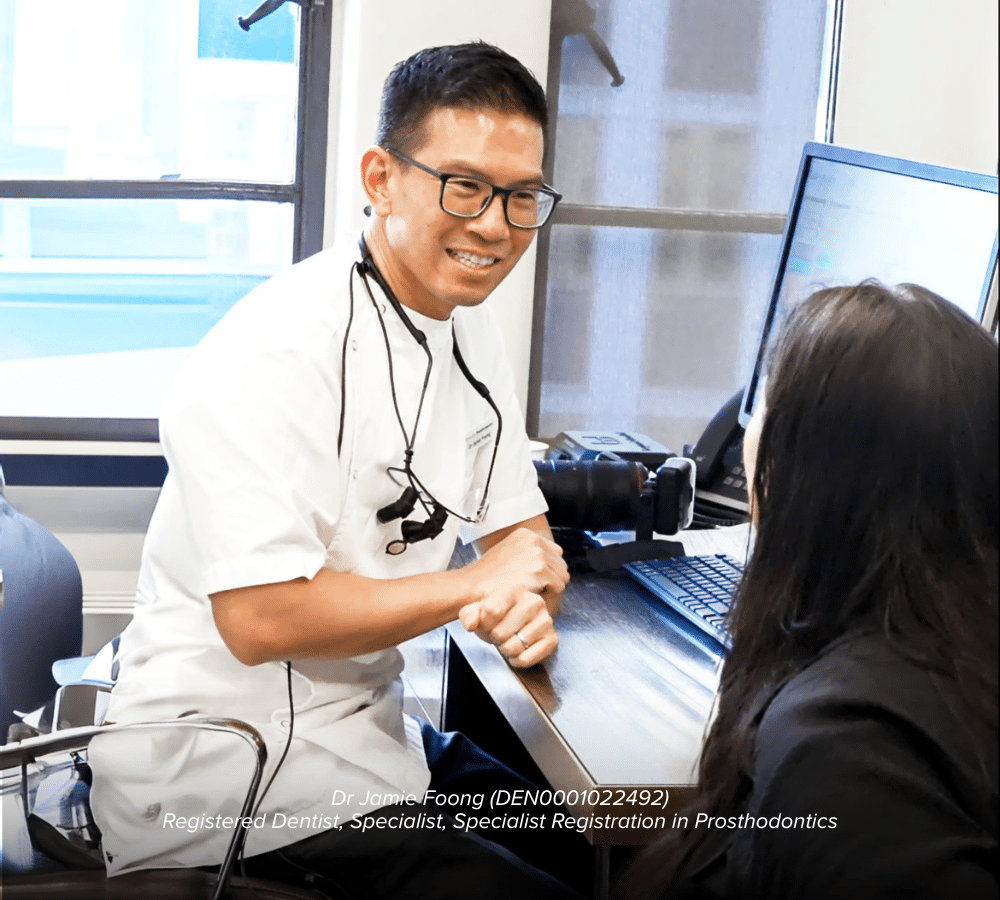
All prosthodontic treatment at we are carried out by board-registered specialist prosthodontists.
To use the title in Australia, a practitioner must hold a dental degree and then complete a further three or more years of full-time postgraduate training in prosthodontics, and hold specialist registration with the Dental Board of Australia. “Prosthodontist” is a protected title.
| Clinician | Role | Qualifications |
|---|---|---|
| Dr Fotios Angelis | Specialist Prosthodontist | BDS (Hons) (Melb), DClinDent (Melb) |
| Prof. Vasileios Chronopoulos | Specialist Prosthodontist | DDS, MS, PhD (Pros) |
| Dr Jamie Foong | Specialist Prosthodontist | BDSc (Melb), DClinDent (Melb) |
| Dr Simon Hinckfuss | Specialist Prosthodontist and Specialist Periodontist | BDSc, DCD (Pros), Cert.Perio MS (Minn) |
Dr Simon Hinckfuss holds dual specialist registration in both prosthodontics and periodontics — relevant in implant cases, where the surgical placement and the restoration are two halves of the same problem.
You can verify any clinician free on the AHPRA public register at ahpra.gov.au, or by calling 1300 419 495. See Dentists & Registered Specialists and Our Team.
Working with the other specialists
Prosthodontists collaborate with:
- periodontists, on implant placement and gum health around restorations
- endodontists, where a tooth can be saved with root canal treatment and then restored
- oral and maxillofacial surgeons, on extractions, bone grafting and complex implant surgery
- orthodontists, where teeth need repositioning before restoration
- the in-house ceramic studio, on the manufacture of every restoration
Because all of these are in the same building, a rehabilitation plan is agreed by everyone involved before treatment starts. Complex Dentistry and Specialist Care.
Orthodontics before restoration is the collaboration most worth knowing about. Moving a tooth into the right position first frequently means the restoration afterwards can be far more conservative — a veneer instead of a crown, or nothing at all. See Orthodontics.
The in-house laboratory
Restorations are designed and manufactured in the practice's own Melbourne laboratory. No work is sent offshore, and only TGA-approved materials are used.
For patients this means the ceramist can see you directly for shade and character matching rather than working from photographs — which is the usual reason a technically sound restoration still looks wrong. See Smile Solutions Laboratory.
Comparing quotes
When comparing a prosthodontist's quote with one from elsewhere, compare a specialist quote with another specialist quote, not with a general dentist's. The services are not equivalent.
Check what each quote includes: any extractions, provisional restorations, implant components, laboratory fees, review appointments and a night splint are all items that appear in one quote and not another. Price Guide.
On health funds: most restorative items attract a rebate against the item number regardless of who provides the treatment, but a large plan will exceed an annual limit, so it is worth asking whether staging the work across two calendar years makes sense. Ask for item numbers in writing and check them with your fund before starting.
Payment plans are available through Payright for treatment from $150 to $20,000, over 3 to 30 months. Other finance options may also be available; provider eligibility, fees and terms can change. Where a plan is advertised as interest free, that describes the plan term only — a deposit may be required, an establishment fee and ongoing account fees may apply, and charges can apply if the balance is not cleared within the agreed period. Approval and the applicable terms are set by the finance provider and depend on the amount financed; they are set out in writing before you commit — ask what the deposit and the establishment fee are, in dollars, and what the total will be by the end. Payment Plans.
Questions worth asking
- What is the minimum treatment that would solve my actual problem?
- Is my bite being changed, and how will that be tested first?
- How long will I be in provisionals?
- Which material, and why that one for this tooth?
- What is the expected service life, and what does replacement cost?
- Should anything be moved orthodontically first?
- What maintenance does this commit me to, and at what annual cost?
Related pages: Dental Implants, All-on-4 Dental Implants, Dentures, Dental Crowns, Porcelain Veneers, Complex Dentistry, Specialist Periodontists, Smile Solutions Laboratory, Specialist Care.
Common questions
Does seeing a prosthodontist mean I need a full-mouth reconstruction?
No. The assessment may concern one difficult tooth, an existing restoration or a broader problem involving several teeth and the bite. Ask the specialist to separate what needs attention now from what can be monitored, and to explain conservative alternatives. A consultation should establish the problem and the options; it should not turn an isolated concern into an assumed commitment to extensive treatment.
How often do implants actually fail, and when?
Rarely overall, and mostly early. A published analysis of 158,824 implants placed in 53,874 patients reported an overall survival rate of 97.79%, with a total failure rate of 2.21% — of which 1.56% failed during the osseointegration phase, before the restoration was even fitted, and 1.59% of all failures occurred within the first year. The authors note that the highest failure incidence occurred within the first year after placement.
Where the implant sits matters more than most patients are told. In the same dataset, failure reached 3% in the maxillary molar region and 3.37% in the central incisor region — approximately double the rates seen at other sites. Failures were also higher where a closed sinus lift was involved (3.96%) and lowest where there was no sinus lifting or bone grafting at all (2.01%). A separate systematic review of implants supporting single crowns over at least five years found early loss of 0.8% before the crown was placed, then a further 2% to 2.5% loss during five years of function.
So the useful question is not “do implants work” but “what is the risk profile of this site.” Ask which region your implant is going into, whether grafting or a sinus procedure is involved, and what the plan is if it does not integrate — because that is the scenario the numbers say is most likely, and it happens before you have paid for the crown.
Should an implant ever be joined to a natural tooth?
It can be done, and the long-term figures are noticeably worse, which is why it is worth asking about specifically. Consensus figures for implants supporting a fixed bridge on implants alone give a cumulative survival of 95.4% after 5 years and 92.8% after 10 years, with the bridges themselves at 95.0% and 86.7%. For implant-and-tooth-supported bridges, the implants came in at 90.1% after 5 years and 82.1% after 10 years, and the bridges at 94.1% after 5 years and 77.8% after 10 years.
The gap widens with time rather than closing: at five years the two designs are within a few points of each other, and by ten years roughly one implant-and-tooth bridge in five has failed against about one in seven of the implant-only design. The usual explanation is that a natural tooth moves slightly within its ligament and an implant does not, so the connection is loaded unevenly. None of that makes the design wrong — sometimes it is the only way to avoid a second surgical site — but if it is proposed, ask why, and ask what the alternative would be.
How long will a denture last, and is an implant-retained one more reliable?
On conventional dentures the honest answer is that we can find no independent source that publishes a survival rate or a lifespan for them — not for adaptation, not for relining intervals, not for years in service. What is well established is the mechanism described above: the ridge continues to resorb once the teeth are gone, so a denture that becomes loose after some years is behaving normally and needs relining or remaking. Anyone quoting you a figure in years for a conventional denture is going beyond what we can verify, and we would rather say so than repeat it.
For implant-retained dentures there is real data, and it qualifies the enthusiasm above rather than contradicting it. The same systematic review that found 2% to 2.5% implant loss over five years under single crowns reported, for overdentures, 2.5% implant loss before the denture was fitted and nearly 6% during five years of function — roughly double. The large registry points the same way: implants carrying removable restorations failed at 9.32% against 3.74% for fixed crowns and bridges, described as a failure rate up to twice as high as for fixed partial prostheses, although removable cases were only about 4% of that cohort.
The overdenture remains a genuinely good option for a loose lower denture, and it costs far less than a fixed full-arch bridge. The trade is that its implants are worked harder and are lost more often, so budget for the possibility of replacing one, and do not skip the maintenance appointments.
I have osteoporosis. Does that rule out implants?
On the evidence available, no — but it is a matter for individual assessment rather than a general reassurance. A systematic review of osteoporosis and implant osseointegration, drawing on studies with follow-up from one month to 25 years and including four studies following implants beyond ten years, found that survival was above 90% in every study, including in patients with osteoporosis, and that most studies found no difference between osteoporotic and healthy patients in marginal bone loss, bone-to-implant contact or the other measures examined.
What that does not cover is medication. Bring a complete and current list of everything you take to the consultation, including anything prescribed for bone density, and say who prescribed it — some medicines change how jaw bone heals after surgery, and that assessment belongs with your treating specialist and your doctor together, not with a website. Do not stop or change any medication on your own account.
Can a complex restoration plan be completed in stages?
Often a plan can be discussed in stages, but the sequence must be clinically workable. Ask which problems need stabilising first, what can safely wait, and whether temporary restorations will be needed between stages. Request costs and decision points for each stage, including any consequences of a long interruption. Staging should be planned before irreversible work begins, so the interim teeth and bite remain manageable if circumstances change.
What if I dislike the appearance or feel of the provisional teeth?
Tell the prosthodontist while the work is still provisional. Describe specific concerns about shape, colour, speech, chewing or comfort and ask which can be adjusted before final manufacture. Clarify how approval of the proposed result will be recorded. A provisional phase allows useful feedback, but it does not guarantee that every desired change is clinically possible or included in the fee. Do not assume an unresolved problem will disappear with the definitive material.
If an old crown or implant bridge fails, must the whole restoration be replaced?
Not necessarily. The clinician first needs to identify whether the problem involves the restoration, a connector, the supporting tooth or implant, or the surrounding tissues. Bring previous treatment records and implant details if you have them. Ask whether repair is feasible, what its limitations would be and how its expected maintenance compares with replacement. A remote description or the age of the work alone is not enough to settle that decision.
Practical details
| Address | Level 1, 220 Collins Street, Manchester Unity Building, Melbourne VIC 3000 |
| Phone | 13 13 96 |
| theteam@smilesolutions.com.au | |
| Monday – Friday | 8.00am – 6.00pm |
| Saturday | 8.30am – 1.30pm |
| Sunday | By appointment |
| Specialist training | Three or more years beyond the dental degree |
| Referral needed | No |
| Full rehabilitation | Many months, including a provisional phase |
| Laboratory | In-house, Melbourne; TGA-approved materials only |
| Parking | Wilsons Parking, Flinders Lane (between Swanston and Russell) |
Prosthodontics is one of the thirteen recognised dental specialties in Australia, and specialist registration can be verified free on the AHPRA public register at ahpra.gov.au.
General information only — it is not a diagnosis, a treatment plan, a quote or a promise of any particular clinical outcome, and it does not replace advice from your treating practitioner. Crown and veneer preparation is irreversible, restorations have a finite service life, and implant and surgical components carry their own risks, discussed with the treating specialist before consent. Suitability, appearance and longevity vary between individuals and can only be assessed after examination and records. Survival and failure figures quoted above are drawn from published research on other populations, apply at the time points stated, and are not predictions about any individual case. Fees and health fund rebates are indicative and subject to change; confirm at your consultation and with your fund. Payment plan terms are set by the credit provider and change; confirm current terms directly before you commit.
Smile Solutions trades under ABN 28 193 514 103.
Images on This Page
-
https://www.facebook.com/tr?id=800557773428361&ev=PageView&noscript=1
(no alt text)
-
https://www.smilesolutions.com.au/wp-content/uploads/2025/10/calendar_month.svg
(no alt text)
-
https://www.smilesolutions.com.au/wp-content/themes/arcadian-wordpress-theme/assets/images/smile_solutions_logo_white.png
Smile Solutions Logo
-
https://www.smilesolutions.com.au/wp-content/themes/arcadian-wordpress-theme/assets/images/smile_solutions_logo_purple.png
Smile Solutions Logo
-
https://www.smilesolutions.com.au/wp-content/uploads/2025/11/Smile-Solutions-4.png
Smile Solutions - Melbourne CBD
-
https://www.smilesolutions.com.au/wp-content/uploads/2025/11/Board-registered-specialists.png
Smile Solutions Dentist Melbourne Specialist Prosthodontist
-
https://www.smilesolutions.com.au/wp-content/uploads/2025/11/All-on-4-at-Smile-Solutions.png
All-on-4 at Smile Solutions Portrait
-
https://www.smilesolutions.com.au/wp-content/uploads/2025/09/Immediate-Dental-Implants-2-1.jpg
Dental Implants
-
https://www.smilesolutions.com.au/wp-content/uploads/2025/09/Dentures-Smile-Solutions.png
Realistic model of human dentures
-
https://www.smilesolutions.com.au/wp-content/uploads/2026/01/Implant-supported-dental-bridge.jpg
Dental bridge supported by implants
-
https://www.smilesolutions.com.au/wp-content/uploads/2025/09/Dental-Crown-at-Smile-Solutions.jpg
Complex Cosmetic Dentistry
-
https://www.smilesolutions.com.au/wp-content/uploads/2025/08/69a44c30c93ce196d539cc5520080df52a5f3f88-scaled.jpg
69a44c30c93ce196d539cc5520080df52a5f3f88 scaled
-
https://www.smilesolutions.com.au/wp-content/themes/arcadian-wordpress-theme/assets/images/family_owned_bussiness.png
Family Owned Business
-
https://www.smilesolutions.com.au/wp-content/themes/arcadian-wordpress-theme/assets/icons/icon--phone.svg
Smile Solutions Contact
-
https://www.facebook.com/tr? id=800557773428361&ev=PageView&noscript=1
(no alt text)
-
https://bat.bing.com/action/0?ti=25148060&tm=gtm002&Ver=2&mid=53db9fe7-e69c-4d09-a04a-a6776c6cd558&bo=1&sid=accbe870ab2711f18855695396a7a7d1&vid=accc2a80ab2711f1920bff297001a2f2&vids=1&msclkid=N&pi=918639831&lg=en-US&sw=800&sh=600&sc=24&nwd=1&tl=Prosthodontists%20Melbourne%20-%20Smile%20Solutions&p=https%3A%2F%2Fwww.smilesolutions.com.au%2Fspecialist-care%2Fprosthodontists%2F&r=<=3051&evt=pageLoad&sv=2&cdb=AQAQ&rn=312163
(no alt text)