What CEREC is
CEREC — Chairside Economical Restorations of Esthetic Ceramic — is a method of fabricating dental restorations using CAD/CAM technology (computer-assisted design and computer-aided manufacturing). See Same-Day CEREC Restorations and Technology.
It offers single-visit ceramic restorations for crowns, onlays and veneers.
The difference from conventional ceramic work
Laboratory-made ceramic restorations require two visits, with a waiting period of 10 to 14 days between appointments, during which the tooth is covered by a temporary material. See Dental Crowns and Smile Solutions Laboratory.
CEREC restorations are made in house by the clinician and bonded to the tooth the same day — removing the wait, the temporary, and the second round of anaesthetic. The same single-visit logic applied to front teeth is Same-Day Porcelain Veneers — see The case for same-day porcelain veneers.
They are conservative, natural-looking and tooth coloured, restoring aesthetics, function and strength.
The temporary phase is worth understanding, because removing it is most of the benefit. A temporary crown is held on with weak cement so it can be taken off again. It comes loose, it leaks, it is sensitive, and if it detaches over a weekend the prepared tooth is exposed and the neighbouring teeth can start to drift. None of that happens when the final restoration goes on the same day.
The process
1. Comprehensive oral examination
See your dentist for a full check-up first, after which a treatment plan is formulated for your needs. If a CEREC restoration is suitable for your tooth, the process is discussed with you in detail. See General Dentistry.
2. Removing decay and shaping the tooth
Not every tooth is a candidate. The factors considered:
- how much healthy tooth structure remains
- the presence of any underlying fractures — see Chipped and Cracked Teeth
- the presence of any unsatisfactory existing fillings — see Tooth Fillings
- the alignment of the teeth — see Orthodontics
- your bite
To prepare, any decay or defective fillings are removed and the tooth is shaped to the ideal form required by the CEREC software. That last requirement is specific — the design software needs particular geometry to produce a restoration that seats and seals properly.
This step is irreversible. Once a tooth has been prepared for a ceramic restoration it will always need a restoration of some kind. That is true of any crown or onlay, laboratory-made or chairside, and it is the reason the decision is made before the drill rather than during.
3. A 3D digital impression
The tooth and the bite are scanned digitally, replacing conventional impression material.
For anyone who has gagged through a tray of impression putty, this is not a small thing. It also allows the scan to be checked and retaken in seconds if it is not clean. See Dental Anxiety.
4. Designing the restoration
The CAD/CAM system builds a three-dimensional virtual model of your teeth from the scan.
The restoration is then designed for your tooth based on:
- the shape and position of the adjacent teeth
- the opposing teeth
- the way your upper and lower teeth contact one another
That third factor is why the design is not simply a copy of the missing shape — it has to work in function, not just at rest. A restoration that looks right on screen and is a fraction high in the bite will make the tooth ache for weeks. See TMD and Teeth Grinding.
5. Milling
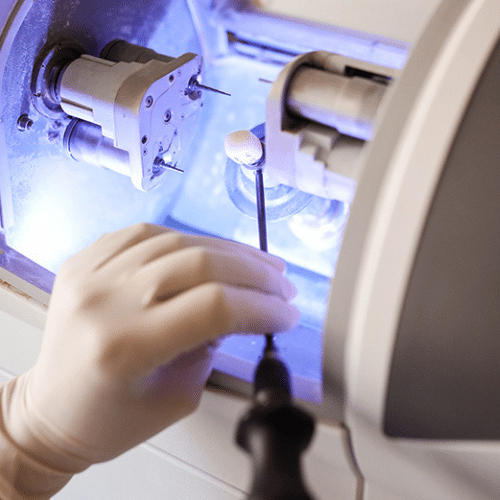
The design is sent to the milling unit, which produces the restoration from a ceramic block within a few minutes. Depending on the material, it may then be crystallised or glazed in a furnace, which adds time.
6. Bonding
The restoration is bonded to your tooth, then adjusted and polished. Expect the bite to be checked carefully at this point — tell your dentist if anything feels high before you leave, while the anaesthetic is wearing off enough to judge it.
What the appointment is actually like
- Allow longer than a filling appointment — typically one and a half to two hours, because the milling happens while you wait.
- Local anaesthetic is used for the preparation. You are numb for the scan and design stages, which are not uncomfortable.
- There is a gap in the middle while the unit mills. Most people read or use a phone.
- You leave with the final restoration in place and can eat normally once the anaesthetic wears off — unlike a temporary, which has to be treated carefully for a fortnight.
- Watch a numb lip and cheek, and avoid very hot food until sensation returns. Why do I bite my cheek after a filling?.
What you get
- Much stronger than a large direct filling
- Protects the tooth and the remaining tooth structure, because it covers rather than fills — which is why it is often the restoration of choice after root canal treatment
- Greater longevity than large composite restorations in most situations — see Composite bonding: will it look natural and how long will it last?
Published studies of chairside CAD/CAM restorations report survival in the order of 90 per cent or more at ten to fifteen years. Those are population figures from studies, not a warranty on your tooth. How long any restoration lasts depends on its size, the tooth, your bite, whether you grind, and your home care. See Dental Cleans & Hygienists.
What can go wrong
Worth hearing in advance, because none of it means the work was poor:
- Sensitivity to cold or biting for a few weeks afterwards, particularly with deeper preparations — see Tooth Pain & Ache
- A restoration that feels high, which needs a quick adjustment rather than tolerating
- Chipping or fracture of the ceramic, more likely in grinders and very large restorations — ceramic cannot be repaired the way composite can, so a damaged one is usually replaced
- Debonding, needing re-cementation or remaking
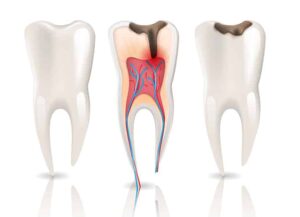
- Loss of the nerve in a deeply prepared tooth, sometimes years later, requiring root canal treatment through the restoration — see Endodontists
If you grind your teeth, ask about a night splint. It is the single most useful thing protecting a large ceramic restoration. See Night-time tooth grinding and clenching.
The honest qualification
Not every tooth is suitable for a CEREC restoration.
In some cases composite resin filling material, or a laboratory-made crown, will be recommended instead — based on your dentist's clinical judgement and the circumstances of the particular tooth.
Single-visit convenience is a real benefit, but it is not the criterion that decides the treatment.
Two situations where the laboratory is the better route:
- Front teeth where appearance is critical. A ceramist working by hand can build in the colour gradation, translucency and individual character of a natural front tooth in a way a milled monolithic block cannot match. Some aesthetic cases should go to the lab, and a good clinician will say so. See Porcelain Veneers and Improving your smile with porcelain veneers and crowns
- Multi-unit work, bridges, and cases where the bite is being rebuilt across several teeth — see Prosthodontists and Complex Dentistry
And one situation where neither is right: a small cavity does not need a ceramic restoration at all. Composite resin is appropriate, cheaper, and removes less tooth. The case for ceramic strengthens as the restoration gets larger — it is not automatically the better option because it is the newer one. See Composite Bonding and Cosmetic dentistry options.
Cost
A CEREC restoration is priced as a ceramic restoration rather than as a filling, and it costs considerably more than composite. Ask for the item numbers so you can check with your health fund; ceramic restorations usually fall under major dental, with annual limits and waiting periods. Price Guide and Payment Plans.
Payment plan options are available. Where a plan is advertised as interest free, that describes the plan term only — a deposit may be required, an establishment fee and ongoing account fees may apply, and charges can apply if the balance is not cleared within the agreed period. The applicable terms depend on the provider and the amount financed, and are set out in writing before you commit — ask what the deposit and the establishment fee are, in dollars, and what the total will be by the end. Payment Plans.
Common questions
Is doing it all in one visit actually better, or just faster?
Both are defensible, and the trade-off is real rather than rhetorical. It is worth understanding before you choose, particularly if the tooth has been sore.
The European Society of Endodontology describes the choice directly in its 2024 position statement on cracked teeth. A single-stage approach means an immediate definitive restoration — what a chairside ceramic restoration is. A multiple-stage approach means interim treatment, such as a temporary crown or a bonded composite splint, followed by review of the pulp's condition before the definitive restoration is made.
The case for waiting, in the ESE's words: "interim treatment allows pulpal healing and confirms initial diagnosis prior to definitive restoration". If the nerve is going to give up, you find out before the expensive restoration goes on.
The case against waiting, from the same sentence: "pulp vitality may be compromised due to microleakage, cement breakdown, and/or further definitive treatment". A temporary leaks, and every additional intervention on the tooth carries its own risk to the nerve.
There is no general answer, which is the point. Where the tooth is symptom-free and the diagnosis is clear, a same-day restoration avoids a fortnight of leaking temporary. Where the tooth has had spontaneous pain, or the nerve's condition is genuinely uncertain, staging it has a purpose beyond caution. Ask which situation yours is, and why.
Will I still need a root canal later?
Sometimes, and it is more common than most people are told — though it is a property of the tooth's starting condition rather than of the restoration technique.
Where a tooth is being restored because it is cracked, the ESE reports that across the literature between 7.7% and 20% of cracked teeth went on to need endodontic intervention after restorative management, whichever restoration was chosen. That is one in five at the top of the range.
The same statement notes that cracked teeth managed with direct bonded composite restorations "may be more likely to require root canal treatment and/or further repair of fractured restorations" than those managed with a restoration that caps the cusps — which is the case for a ceramic onlay or crown on a cracked tooth, and it is a stronger argument than convenience.
What raises the risk in your particular tooth: how deep the preparation had to go to remove the decay, whether the tooth had spontaneous pain beforehand, and whether a crack runs into the root. None of those are known precisely until the decay is out, which is why the answer you get before treatment is a probability rather than a promise. If the nerve does fail later, the restoration usually does not have to be replaced — the root canal can be done through it. See Endodontists.
Was the 3D scan an x-ray? How much radiation am I getting?
The intra-oral scan is not an x-ray at all. It is an optical scan — a small camera and a light source building a surface model of the teeth. There is no ionising radiation in that step.
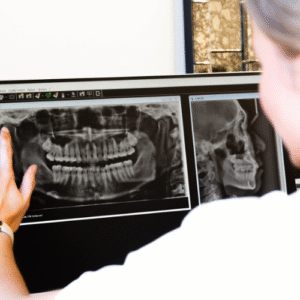
The radiographs, where they are needed, are separate, and the doses involved are small and published. The International Atomic Energy Agency gives typical effective doses for dental imaging as:
- intraoral dental x-ray: 1–8 μSv
- panoramic examination: 4–30 μSv
- cephalometric examination: 2–3 μSv
- cone beam CT: 50 μSv or below for small or medium scanning volumes, and around 100 μSv for large volumes (median values from the literature)
The IAEA puts those in context itself: doses from intraoral and cephalometric procedures are "usually less than one day of natural background radiation", and panoramic doses, even at the high end, are "equivalent to a few days of natural background radiation, which is similar to that of a chest radiograph". CBCT is the outlier — it "may be tens or even hundreds of μSv of effective dose higher than conventional radiographic techniques", and the IAEA notes that rapid equipment improvements mean these ranges are likely to change.
The practical point is that CBCT is not a routine part of restoring a tooth, and should be justified individually. You are entitled to ask why any particular image is being taken and what it will change. See How safe are dental x-rays?
How much tooth gets removed for a crown, compared with something smaller?
More than most people expect, and the gap between preparation designs is the thing worth arguing about.
The measurement most often cited is Edelhoff and Sorensen's 2002 study in the Journal of Prosthetic Dentistry, which weighed the tooth structure removed by each preparation design. An important limitation: it was a laboratory study on artificial typodont teeth, and it measured front teeth — a central incisor, a canine and a lower incisor. So the figures below do not transfer to a molar. What transfers is the ranking, and the size of the gaps:
| Preparation (anterior teeth, laboratory study) | Mean coronal tooth structure removed |
|---|---|
| Partial porcelain veneer | 8.2% |
| Traditional veneer, facial surface only | 16.7% |
| Extended veneer | 22.1% |
| Complete veneer | 30% |
| All-ceramic crown | 64–70% |
| Metal-ceramic crown | 71.9% |
The authors concluded that veneer preparations required "approximately one-quarter to one-half the amount of tooth reduction of conventional complete-coverage crowns" — and that a metal-ceramic crown preparation removed 4.3 times as much tooth as a facial-surface-only veneer.
The reason this matters for a CEREC appointment is that the software's geometry requirements are part of what determines how much is cut. So the question to ask before the drill is not crown or filling but how conservative a design will work here — an onlay that covers the weak cusps and leaves the sound ones alone, rather than a full crown by default. That conversation has to happen first, because the preparation cannot be undone.
Practical details
Written by Dr Rojina Fadaei, Smile Solutions.
CEREC restorations are designed and milled on site, and the practice's own laboratory also makes conventional laboratory work in Melbourne using TGA-approved materials.
Smile Solutions, Level 1, 220 Collins Street, Manchester Unity Building, Melbourne VIC 3000. Phone 13 13 96, or theteam@smilesolutions.com.au. Monday–Friday 8.00am–6.00pm, Saturday 8.30am–1.30pm, Sunday by appointment. Full details on Contact Us.
Related: CEREC Restorations, Dental Crowns, Tooth Fillings, Chipped or Cracked Teeth, Our Technology, Cosmetic Dentistry.
Registration for any practitioner can be verified free on the AHPRA public register at ahpra.gov.au; the clinicians are listed on Our Team.
Published 28 April 2022. General information only — it is not a diagnosis, a treatment plan, a quote or a promise of any particular clinical outcome, and it does not replace advice from your treating practitioner. Preparing a tooth for a ceramic restoration is irreversible, ceramic can chip or debond, and restoration lifespans vary with the individual, the size of the restoration and oral habits — survival figures are typical ranges from published studies rather than guarantees. Whether a tooth is suitable can only be determined after examination. Figures attributed to the International Atomic Energy Agency, the European Society of Endodontology and the Journal of Prosthetic Dentistry are those publishers' own; tooth-reduction figures were measured on artificial anterior teeth in a laboratory and are a ranking rather than a prediction for any individual tooth. Fees are indicative and subject to change; confirm at your consultation. Payment plan terms are set by the credit provider and change; confirm current terms directly before you commit.
Smile Solutions trades under ABN 28 193 514 103.
Images on This Page
-
https://www.facebook.com/tr?id=800557773428361&ev=PageView&noscript=1
(no alt text)
-
https://www.smilesolutions.com.au/wp-content/uploads/2025/10/calendar_month.svg
(no alt text)
-
https://www.smilesolutions.com.au/wp-content/themes/arcadian-wordpress-theme/assets/images/smile_solutions_logo_white.png
Smile Solutions Logo
-
https://www.smilesolutions.com.au/wp-content/themes/arcadian-wordpress-theme/assets/images/smile_solutions_logo_purple.png
Smile Solutions Logo
-
https://www.smilesolutions.com.au/wp-content/uploads/2021/03/Rojina-150x150.jpg
Dr Rojina Fadaei
-
https://www.smilesolutions.com.au/wp-content/uploads/2025/09/CEREC-restorations-Smile-Solutions.png
CEREC Restoration Smile Solutions
-
https://www.smilesolutions.com.au/wp-content/uploads/2025/09/Smile-Solutions-Level-10-300x270.png
Smile Solutions Level 10
-
https://www.smilesolutions.com.au/wp-content/uploads/2025/09/Root-Canal-2-300x217.jpg
Root Canal
-
https://www.smilesolutions.com.au/wp-content/uploads/2023/11/SS-Tooth-1-1-150x150.png
Smile Solutions
-
https://www.smilesolutions.com.au/wp-content/uploads/2025/09/Wisdom-Teeth-Smile-Solutions-300x300.png
Smile Solutions Dentist Melbourne
-
https://www.smilesolutions.com.au/wp-content/uploads/2025/11/Kia-150x150.jpg
Dr Kia Pajouhesh
-
https://www.smilesolutions.com.au/wp-content/themes/arcadian-wordpress-theme/assets/images/family_owned_bussiness.png
Family Owned Business
-
https://www.smilesolutions.com.au/wp-content/themes/arcadian-wordpress-theme/assets/icons/icon--phone.svg
Smile Solutions Contact
-
https://www.facebook.com/tr? id=800557773428361&ev=PageView&noscript=1
(no alt text)
-
https://bat.bing.com/action/0?ti=25148060&tm=gtm002&Ver=2&mid=178b3572-2b54-4fce-8913-aa8948c41a9d&bo=1&sid=dd9df200ab2511f1ab65a72f61d98a98&vid=dd9e4360ab2511f1bf5d5da91fb0a3bd&vids=1&msclkid=N&pi=918639831&lg=en-US&sw=800&sh=600&sc=24&nwd=1&tl=Everything%20you%20need%20to%20know%20about%20Smile%20Solutions%20superior%20CEREC%20technology%20-%20Smile%20Solutions&p=https%3A%2F%2Fwww.smilesolutions.com.au%2Fdental-articles%2Farticle%2Feverything-you-need-to-know-about-smile-solutions-superior-cerec-technology%2F&r=&evt=pageLoad&sv=2&cdb=AQAQ&rn=451898
(no alt text)