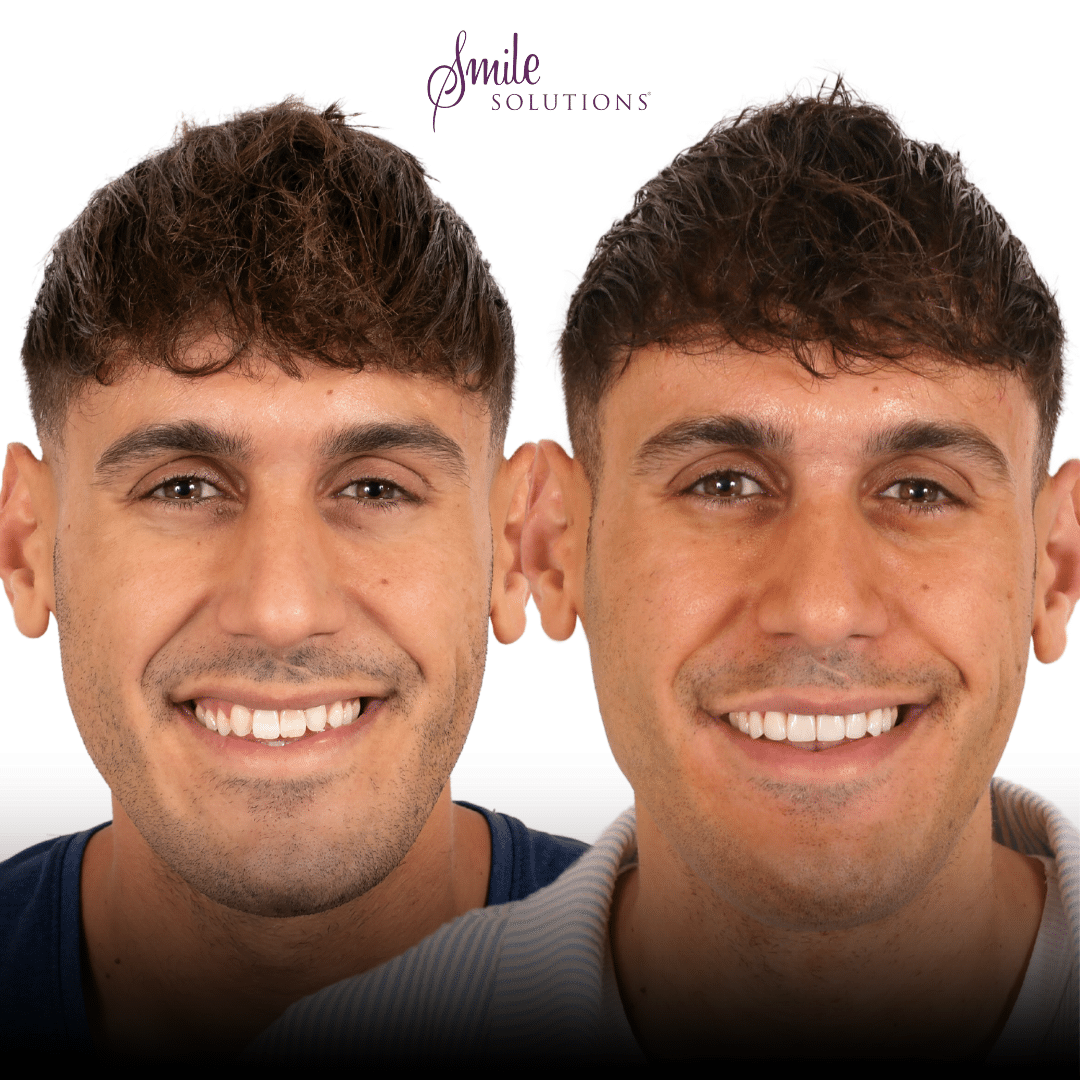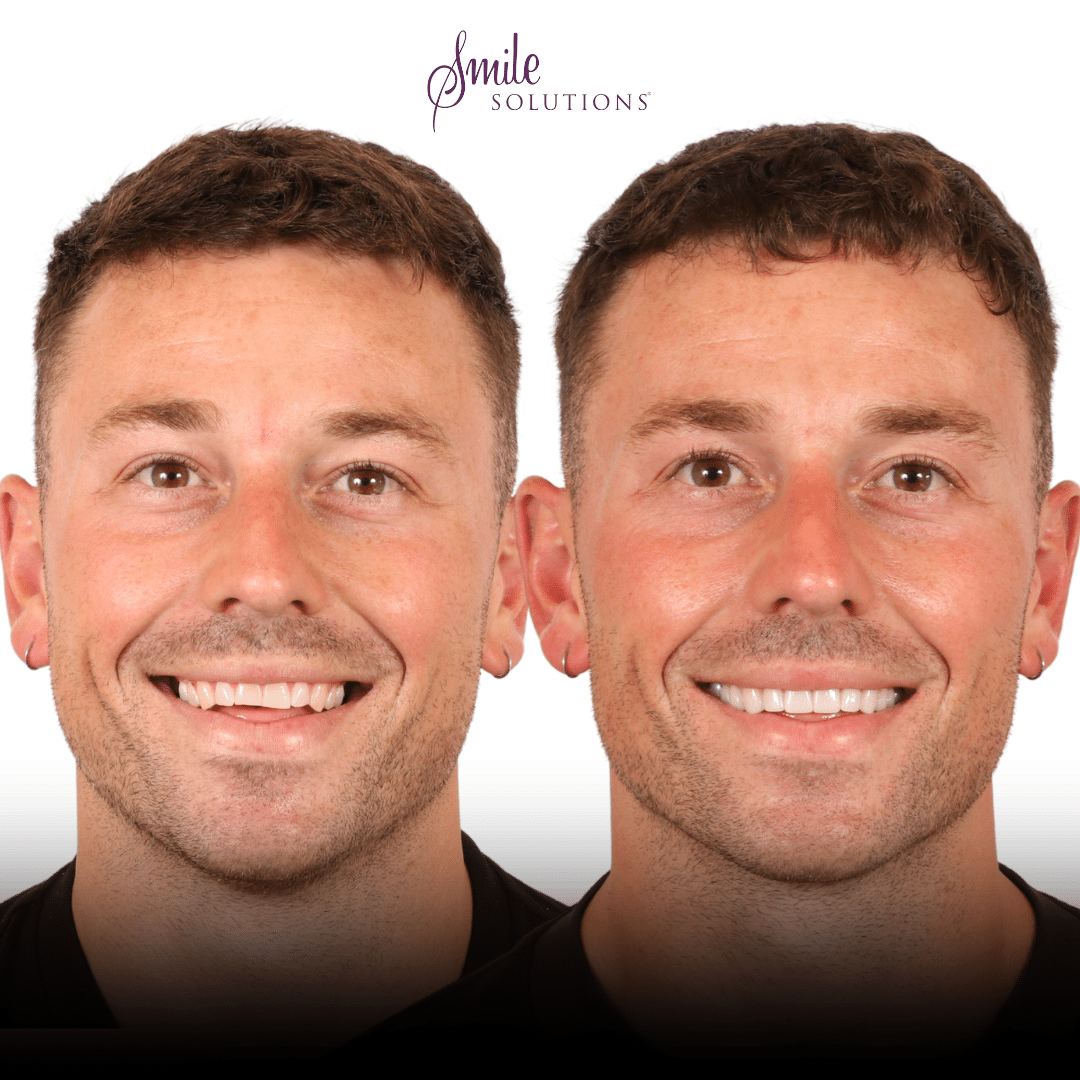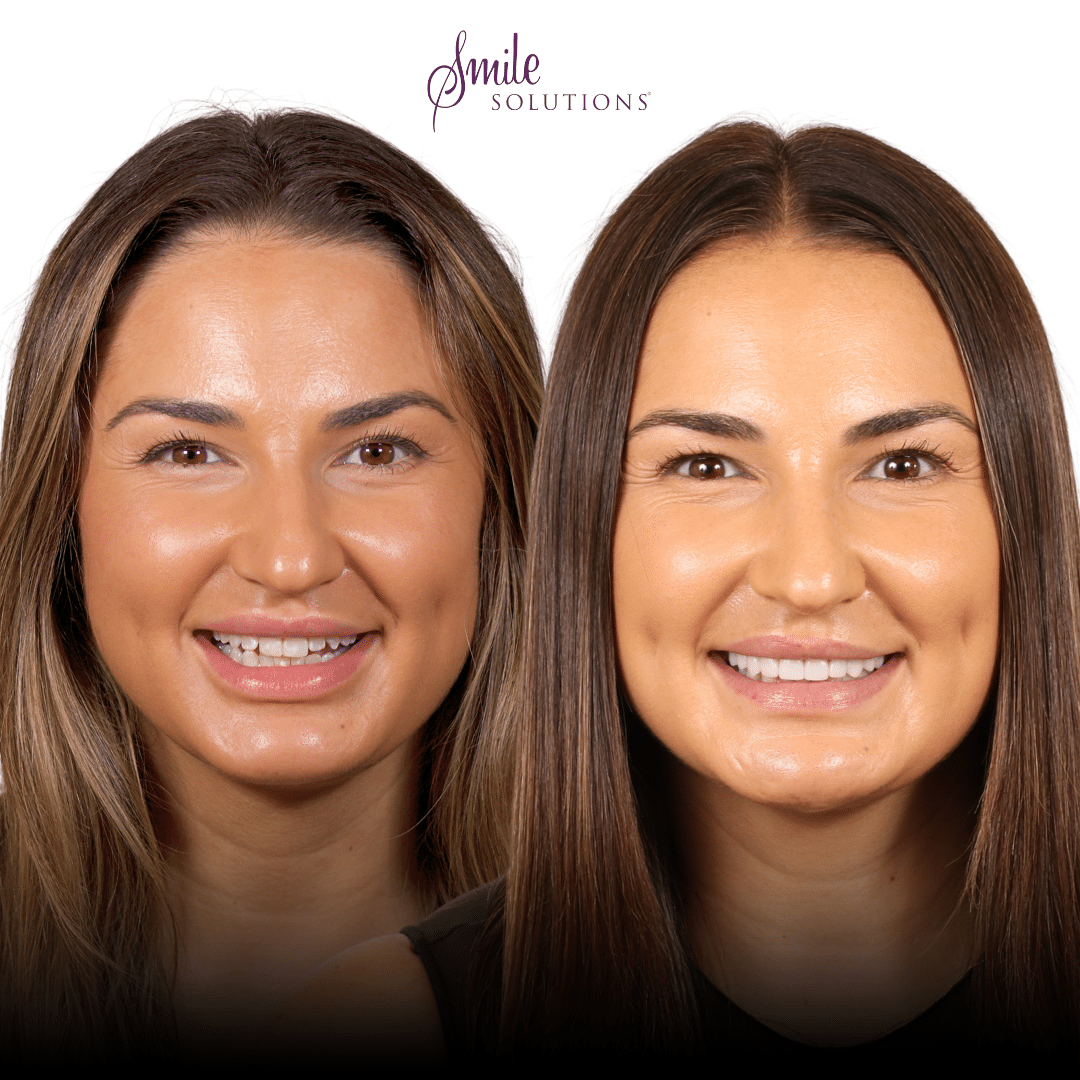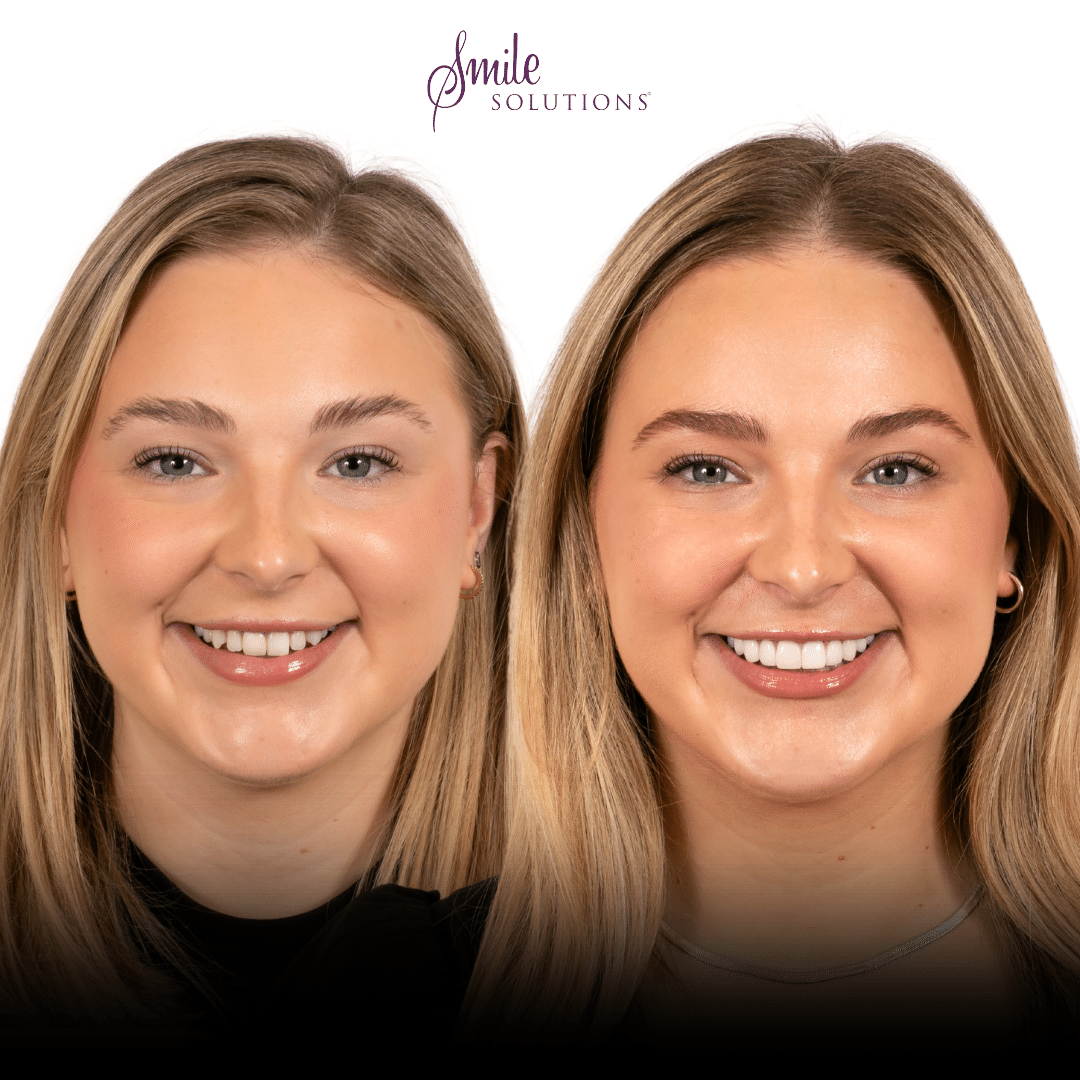
Same Day Porcelain Veneers™
Can porcelain veneers really be fitted in a single day?
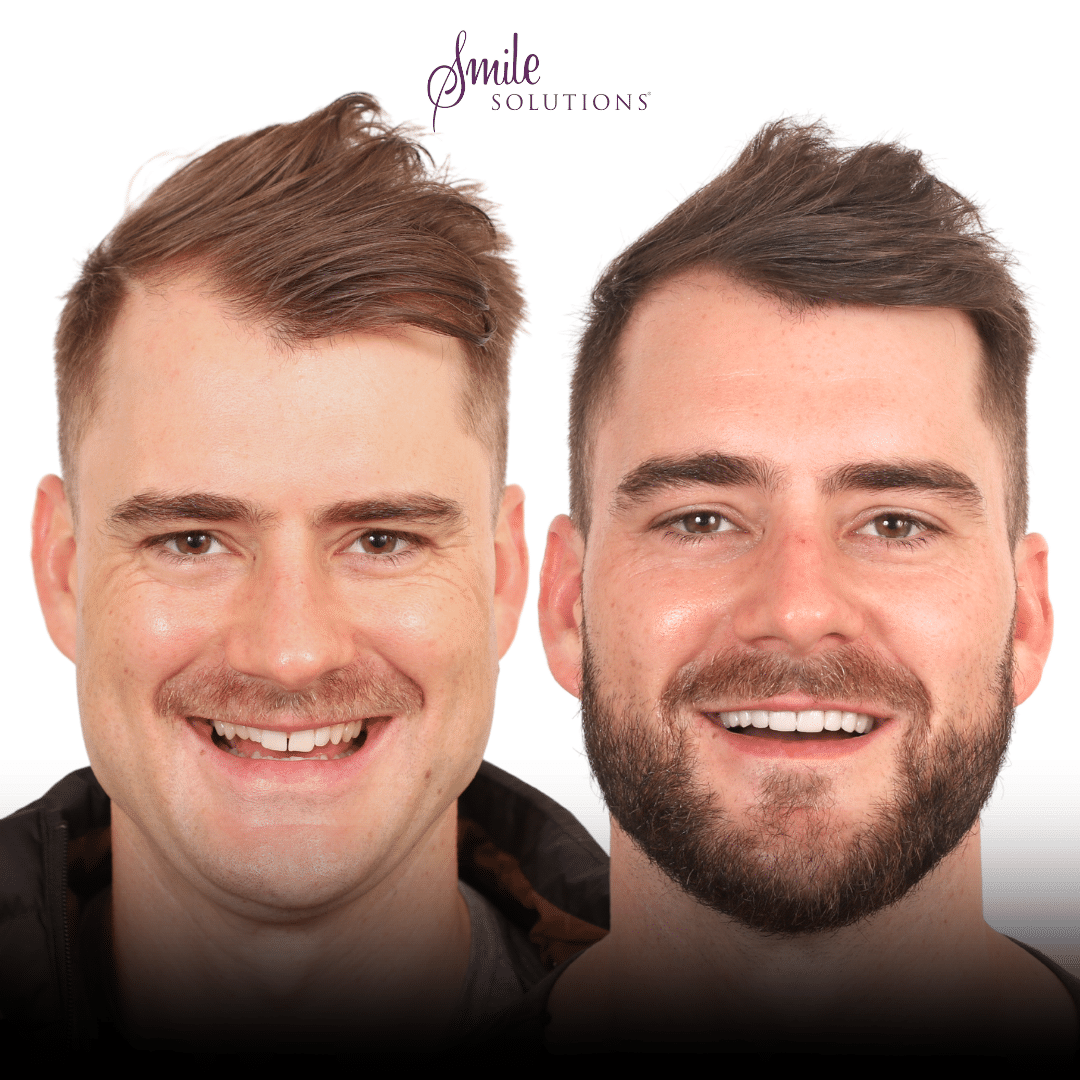
At Smile Solutions, yes. Same Day Porcelain Veneers™ compresses preparation, manufacture and insertion of bespoke porcelain veneers into one day, in the practice's on-site ceramic studio. The practice describes it as an Australian first.
The thing it removes is the two-to-three week gap in the middle of conventional veneer treatment — and with it, the temporary veneers.
It also removes something else, and that trade-off is covered further down. Both sides are worth understanding before choosing between same-day and conventional treatment.
We are at Level 1, 220 Collins Street, Manchester Unity Building, Melbourne CBD.
Why removing temporary veneers matters
In conventional treatment, once your teeth are prepared you are sent away with temporary plastic veneers until the final ones are inserted two to three weeks later. This interval is the part of veneer treatment patients find hardest.
Temporary veneers are not fully sealed to your teeth. During that period you are advised to:
- avoid certain foods and drinks
- treat them gently so they do not chip, stain or fall out
If a temporary chips, falls out or causes pain, it can lead to increased sensitivity and you have to return to the dentist to have it fixed — more travel, more chair time, more discomfort. They can also be difficult to eat with, which many people find socially awkward for the weeks they are worn.
Same Day Porcelain Veneers™ eliminates them entirely. That means:
- less time in the dental chair overall
- only one round of mouth numbing
- no time spent having temporaries made, fitted, and later removed
It also makes the treatment practical for regional, interstate and international patients, who otherwise face two trips separated by weeks.
The trade-off nobody mentions
Here is the other side, stated plainly, because it is the thing worth weighing.
In conventional treatment, the temporary phase is also a test drive. For two or three weeks you live with the proposed shape, length and bite. You eat with them, speak with them, see them in your own mirror and your own photographs. If the edges are too long, if an “s” whistles, if the shape does not suit your face, that is discovered while it is still cheap and easy to change — the ceramist adjusts the design before the porcelain is made.
Same-day treatment compresses that feedback into a single try-in appointment. Adjustments are made on the spot, and the practice's process includes an optional mock-up at the planning stage, which substitutes for part of it. But a try-in in the chair is not the same as three weeks of ordinary life.
This matters most when:
- the length of your front teeth is changing significantly, which is what affects speech
- many teeth are involved — eight or ten rather than two
- your bite is being altered, not just the appearance
- you are unsure what you want, as opposed to knowing precisely
For a small number of teeth with modest changes, the same-day route gives up very little. For a full smile redesign with a significant change in tooth length, the conventional route with a proper temporary phase is genuinely worth the inconvenience — and a good clinician will say so.
Ask which one your case calls for, and why. Both are offered here, and the answer should be about your teeth rather than the schedule.
Before the day: what has to be sorted first
Same-day treatment compresses the manufacture, not the planning. Several things belong before it, and skipping them is what produces work that has to be redone:
- Gum health. Veneer margins sit at or near the gum, so inflamed gums bleed during bonding and recede afterwards, exposing the edges. Gums are stabilised first. See Bleeding Gums and Dental Cleans & Hygienists.
- Decay and failing restorations, treated beforehand.
- Whitening, if you want it. The shade is fixed the moment the porcelain is made, so any lightening of your other teeth happens first and is allowed to settle for about two weeks. See Teeth Whitening.
- Alignment, where teeth are significantly out of position. Straightening first usually means thinner veneers and less enamel removed — sometimes none at all. This is the single most common way to convert an aggressive plan into a conservative one. See Invisalign and Orthodontics.
- Grinding, assessed and planned for, including a nightguard.
The nine steps
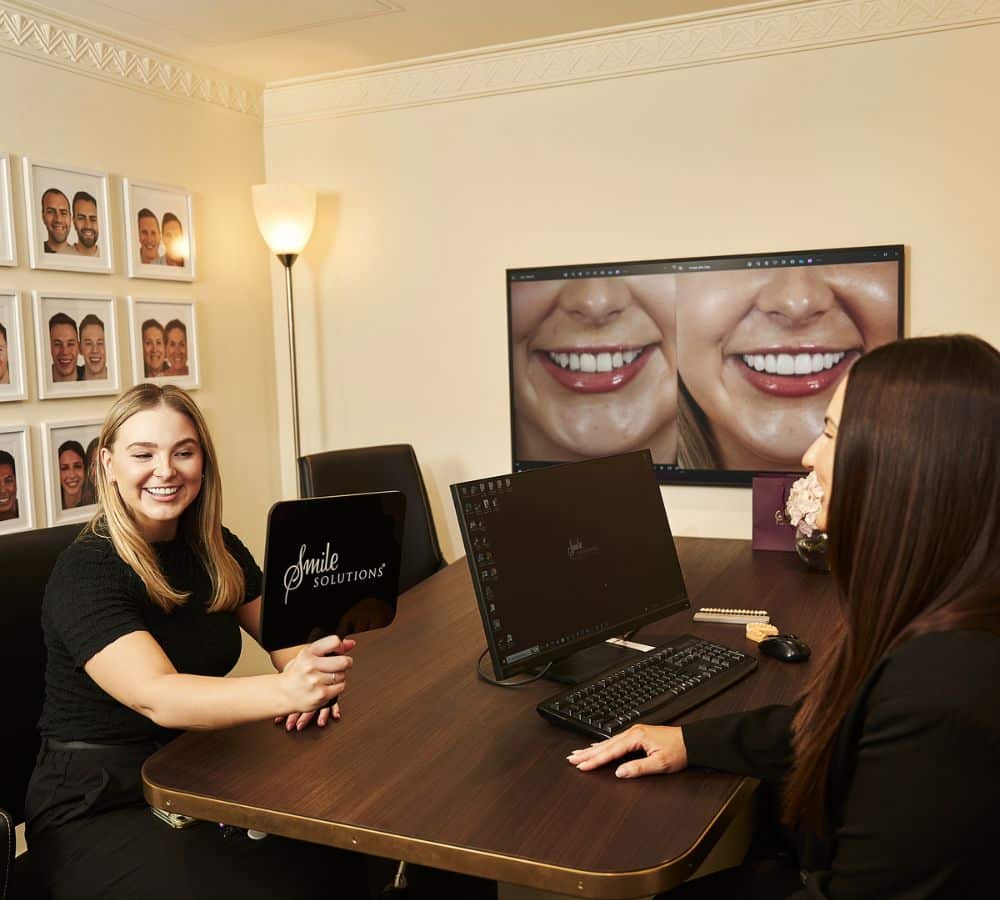
1. Complimentary consultation with an experienced treatment coordinator, who remains your point of contact throughout.
2. Dental appointment — full examination, personalised treatment plan and discussion of your options. You also meet the lead ceramist who will craft your veneers.
3. Digital scans of your teeth are taken and sent to the in-house ceramic studio.
4. Optional mock-up — a reversible preview using temporary resin over your natural teeth, commonly used to demonstrate the proposed changes before treatment proceeds. Take this option if it is offered. It is the closest thing to a trial in a same-day workflow, and it costs you nothing irreversible. See Mock-Up Reveal.
5. Scheduling of your same-day veneers appointment, once you are satisfied with the plan.
6. Early morning appointment — your dentist prepares your teeth for the new veneers.
7. You wait at a nearby 5-star hotel while the lead ceramist dedicates the day to handcrafting your veneers.
8. Try-in — you return to try the new smile. Any adjustments required are made on the spot. This is your decision point. Look at the length, the midline, the edges, and say something if anything is not right, because after insertion changes mean remaking.
9. Insertion that same afternoon by your cosmetic dentist, once you are happy with the result.
What the day actually looks like
A practical note, since people ask:
- Start early — preparation is a morning appointment
- You are out for most of the day between preparation and try-in, so bring work or something to occupy you. Your teeth will be prepared during that time, so plan food accordingly and expect some sensitivity
- Two further appointments the same day — try-in, then insertion
- You leave with the final veneers bonded, and can eat normally that evening within the usual sensible limits
Being honest about the middle of the day: prepared teeth are smaller and more angular than your own, they feel unfamiliar to the tongue and lip, and they are often sensitive to cold air and cold drinks. Some people are comfortable in public during that window and some would rather not be. Soft, room-temperature food is the practical answer, and it is worth knowing in advance rather than discovering at lunchtime.
How to judge the try-in
The try-in is where your say counts, and it lasts minutes rather than weeks — so use it deliberately. What to check, in roughly this order:
- Look in daylight, not only under the surgery light, and ask for a hand mirror at arm's length rather than close up
- The length of the upper front teeth. Do the edges follow the curve of your lower lip when you smile?
- The midline — does the centre line sit where your face expects it?
- Symmetry between left and right, tooth by tooth
- The shade, and whether it looks like teeth or like a uniform block of white
- Say “F” and “V”. These sounds are made where the upper teeth meet the lower lip, which tests the edge position.
- Count “sixty-six, sixty-seven”. Whistling or lisping on an “s” usually means the teeth are slightly too long or too thick behind, and it is far easier to correct now.
- Bite together and slide side to side. Nothing should feel like it hits first.
- Bring someone whose opinion you trust, and take a photograph on your own phone — the camera you will actually be looking at yourself in.
“I am not sure” is a complete and acceptable answer at this stage. It is far better to pause than to bond something you have doubts about.
The irreversible part
This applies to all porcelain veneers, same-day or not, and it is the single most important thing to understand before consenting.
Preparing a tooth for a porcelain veneer usually removes a layer of enamel — commonly a few tenths of a millimetre, more where teeth are being brought forward or significantly reshaped. Enamel does not grow back.
The practical consequence: once prepared, the tooth will need a veneer or crown on it for the rest of your life. When a veneer eventually fails, the option is replacement rather than removal. That is a lifelong maintenance commitment, and it is a reasonable thing to accept with open eyes — but not something to discover afterwards. Australia's national health service, healthdirect, puts the same point in four words: “You can't take veneers off.”
How much is “a layer”? The measurement most often cited is Edelhoff and Sorensen's 2002 study in the Journal of Prosthetic Dentistry, which weighed the tooth structure removed by each preparation design. A traditional facial-surface porcelain veneer removed about 16.7% of the coronal tooth by weight, the most extensive veneer design about 30%, and a metal-ceramic crown 71.9% — roughly 4.3 times as much as the traditional veneer. Read those numbers for exactly what they are: anterior teeth, in the laboratory, on typodont models, ten preparations per design. They are a sound comparison between veneer and crown as designs; they are not a prediction of what will come off your tooth. The authors' own reason for caring is the useful one — “the conservation of sound tooth structure helps preserve tooth vitality and reduce postoperative sensitivity”.
There is also a technical reason to preserve enamel, not just an ethical one. Porcelain veneers bond far more strongly and durably to enamel than to the dentine underneath it, and the size of that difference has been measured. A 2025 systematic review and meta-analysis in the Journal of Prosthetic Dentistry (Alqutaibi and colleagues, six clinical studies) reported survival of 99% (range 98–100%) for veneers bonded to enamel, 95% (91–100%) with minimal dentine exposure and 91% (84–98%) with severe dentine exposure. Veneers bonded onto an existing composite filling survived at 94%, but their success rate — meaning no further intervention was needed — was only 70% (60–80%). One caveat belongs with those figures: of the pooled comparisons, only the extra need for clinical intervention with severe rather than minimal dentine exposure reached statistical significance (risk difference −0.16, 95% CI −0.31 to −0.01), and the pooled estimates for outright failure did not, on six studies. So enamel bonding is associated with the best outcomes; it would overstate the evidence to say it proves veneers into dentine fail more often. A veneer bonded mostly to dentine is the weaker restoration — so a preparation that cuts through the enamel layer costs you longevity as well as tooth. It is one of the strongest arguments against over-preparation, and the reason a conservative plan is usually also the more durable one.
Ask how much enamel will be removed, and whether a no-preparation or minimal-preparation approach is possible in your case. Sometimes it is; often it is not. Where you mainly want a colour change rather than a shape change, Teeth Whitening removes nothing at all, and Composite Bonding can sometimes be done additively. Where a tooth is already heavily broken down, a crown may be the more appropriate restoration.
On having it done overseas: the recurring problem reported by Australian dentists is not poor porcelain but excessive preparation — full crowns placed where veneers would have done — and that cannot be undone. The Australian Dental Association's Policy Statement 2.2.6 on elective overseas dental treatment states that Australian residents “should only seek elective dental care in Australia to ensure Australian standards are met, complications are managed promptly, and good oral health is maintained”, and makes one point that bears on veneers specifically: “Optimal ongoing oral health cannot be achieved in a single episode or short course of treatment and requires regular maintenance.” Read it as a professional-body position rather than as evidence — the policy publishes no complication rate and cites no cohort, and no Australian dataset quantifying overseas-veneer complication rates could be found when this was checked. See the real risks of getting veneers overseas.
How many teeth, and why
People usually arrive with a number in mind, and the number is a design decision rather than a preference.
What drives it: how many teeth actually show when you smile (often more than you think, and it differs between people), whether the teeth at the edges of your smile would look obviously different if left, and whether the shade change is large enough that an untreated neighbour would stand out.
Fewer teeth is not automatically more conservative if the result looks patched. Equally, treating ten teeth when six would do is exactly the over-treatment this page warns about. The right answer comes from looking at your smile in photographs, which is what the planning stage is for.
The porcelain itself
Not all veneer porcelain is the same, and the choice is a trade-off between beauty and strength:
- Feldspathic porcelain — built up in layers by hand. The most lifelike, capable of the finest translucency and characterisation, and the thinnest. It demands the most skill.
- Lithium disilicate — stronger, milled or pressed, excellent appearance. The common choice where durability matters or the veneer must be slightly thicker.
Worth knowing that the 25-study review discussed below found non-feldspathic veneers performed better than feldspathic ones, and veneers with incisal coverage failed less often than those without — so the beauty-versus-strength trade-off is real and measured, not a matter of taste.
Thickness is the constraint that governs everything. A very dark or discoloured tooth has to be masked, and masking needs opacity, which needs thickness, which needs more tooth reduction. That is why whitening first can genuinely change how much enamel comes off — a lighter starting shade allows a thinner, more translucent, more natural veneer.
The ceramic studio
The studio is small-scale and exists only to service Smile Solutions patients. Its ceramists do not work with any other business, which is what makes a one-day turnaround possible — the ceramist's whole day is given to a single patient's case.
The supporting technology — iTero scanners, 3Shape Trios scanners and a fleet of 3D printers — is what compresses the digital workflow into hours rather than weeks. See Our Technology.
You meet the person making your veneers, on site, rather than dealing with an off-site or overseas provider. See Smile Solutions Laboratory.
Your ceramist
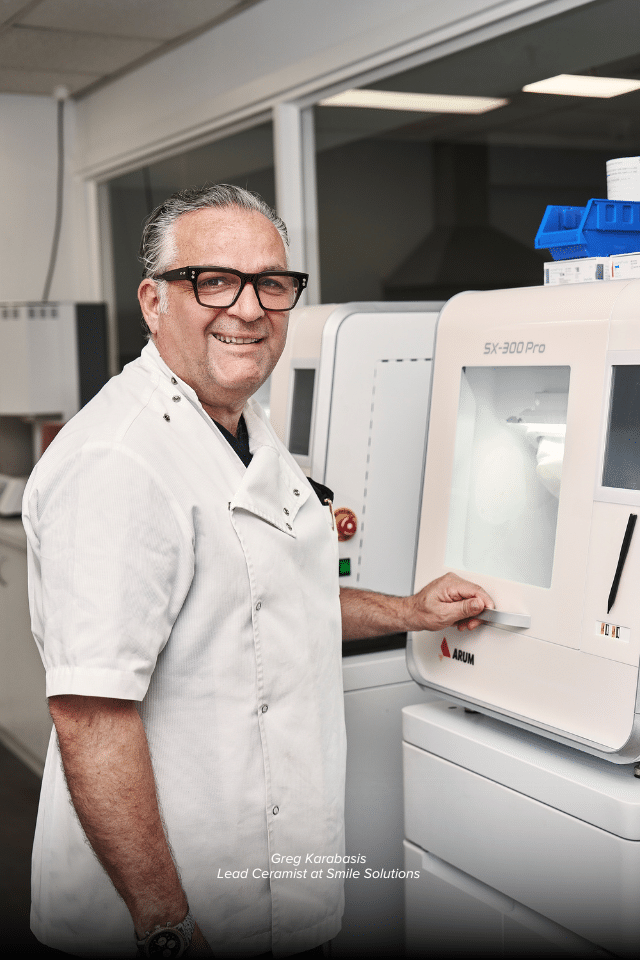
Greg Karabasis, Lead Ceramist — 32 years in the dental industry.
Greg was founder and Company Director of one of Australia's largest dental laboratories for 28 years. He is a qualified and experienced Master Ceramist with extensive knowledge across dental restorations, and a particular interest in cosmetic veneers and digital smile design.
He holds accreditations with Noritake, Ivoclar, Straumann, Sirona and Exocad, and has presented his work to colleagues in Australia, South Korea and China. He is a former Vice President of the Victorian Crown and Bridge Society.
Outside work, Greg is a former board director of South Melbourne Football Club, with interests in AFL, golf and motorsport.
How long veneers last — what the evidence actually says
Same-day veneers are the same porcelain restorations as conventional ones — the difference is the schedule, not the material or the standard. So the published survival evidence for porcelain laminate veneers applies to both.
It is reported as survival at stated time points, not as a lifespan in years, and that is the honest way to read it. A systematic review of 25 studies covering 6,500 porcelain laminate veneers on natural teeth (Alenezi and colleagues, Journal of Clinical Medicine, 2021) estimated a 10-year cumulative survival rate of 95.5%, counting fracture, debonding, secondary decay and the need for root canal treatment together as failure — 433 of the 6,500 failed on that definition. Read the definition carefully: slight marginal defects and slight marginal discolouration were not counted as failures, “since they have more to do with the appearance of the PLV, and can be easily repolished or repaired”. So 95.5% does not mean 95.5% still looked new. Fracture was the most common complication, then debonding, and the review found both “more commonly happening within the first years after PLV cementation”.
Beyond ten years the evidence thins quickly. An Australian prospective cohort from one private practice — 499 veneers in 155 patients, reported by Layton and Walton and summarised in a 2021 systematic review in the European Journal of Dentistry — recorded Kaplan–Meier survival of 98% at 5 years, 96% at 10 years, 91% at 15 years and 91% at 20 years. Two selection caveats travel with those numbers and the review states both: patients with extensive tooth-structure loss from grinding and clenching were excluded, and only teeth with at least 80% of their enamel remaining were veneered. They are a best-case figure for ideal candidates bonded to enamel, from a single operator. The same authors' earlier series reported only 73% at 15 to 16 years, and the review's own conclusion is blunt about the reason the long-term picture is unsettled: “the most critical observation that was made in all three of the studies was the small number of restorations evaluated beyond 20 years.”
The short version: strong and stable at ten years in well-chosen cases, and genuinely uncertain after that. Veneers are strong and resistant to breaking, but like natural teeth they can chip or fracture under trauma or excessive force, and can wear if you grind or clench. healthdirect puts no number on longevity at all — its strongest statement is that veneers “should last for years”, and it warns that they “may need to be replaced due to chips, fractures or changes in colour over time”. The usual reasons for replacement in practice are gum recession exposing the edges, or staining at the margins.
The porcelain cannot decay, but the tooth underneath still can, particularly at the margins. Brush twice daily, floss, and keep regular hygienist appointments. See Dental Cleans & Hygienists.
Aftercare
- A nightguard if you grind or clench. This is the most effective single thing you can do to protect the investment. See TMD & Teeth Grinding
- Do not bite hard objects — ice, nails, packaging, bottle tops
- Floss daily, and carefully at the margins where veneer meets tooth
- Sensitivity for a few days to a few weeks after preparation is common and usually settles
- The shade is now fixed. Whitening will lighten your other natural teeth and not the veneers, so whiten before, not after
- Book the review, usually a week or two later, so the bite and the gums can be checked once everything has settled
- Tell the hygienist you have veneers — some polishing pastes and ultrasonic technique are adjusted around porcelain margins
Risks and limitations
- Permanent enamel removal, as above
- Sensitivity after preparation, usually temporary
- Debonding — a veneer coming loose, usually re-bondable
- Chipping or fracture, particularly with grinding or trauma; a fractured veneer usually needs remaking rather than repair
- Margin staining or a visible line if gums recede over the years
- Nerve irritation in a small number of cases, occasionally leading to a tooth needing root canal treatment afterwards
- The colour cannot be changed once the porcelain is bonded
- Speech adaptation for a few days where the length or thickness of the front teeth has changed
healthdirect's own list of possible risks is worth reading alongside that one: “jaw pain; the veneer could crack or fall off; your teeth could become more sensitive because some enamel is removed; if your gum shrinks, the edges of the veneers may be seen; the colour of your veneers can't be changed after they've been applied; your other teeth may become discoloured, no longer matching your veneers”.
Outcomes, longevity and recovery vary between individuals, and no result can be guaranteed.
Who it suits
Same Day Porcelain Veneers™ particularly suits people who:
- travel from regional Victoria, interstate or overseas
- cannot spare two separate treatment periods weeks apart
- want to avoid wearing temporaries in public or at work
- have a fixed date to work toward
- are making a modest change to a small number of teeth, where the trial period matters less
And the cases it does not suit. healthdirect states plainly that “Veneers may not be suitable if you grind or clench your teeth or if you have gum disease”, and that “Veneers don't straighten your teeth or fix your bite” — they can improve how worn teeth look, but they are not a treatment for damage or for a bite problem. Its list of alternatives is worth reading in full, because the first item is the one practices rarely put first: “An alternative to veneers is to continue to live with your teeth as they are.” After that it lists resin repair of a small section, a crown, whitening, orthodontic treatment such as braces, and clip-on veneers. The Australian Dental Association's consumer site adds a related point of fact: cosmetic treatments of this kind can be done by a general dentist or by a prosthodontist, and “a dentist cannot be registered as a Cosmetic Dentist in Australia” — it is not a registration category, so treat it as a description of the work rather than a credential.
It is still elective cosmetic treatment. Suitability is assessed at the examination stage, and your dentist will review alternative options where appropriate.
If you are travelling in, a few practical points: plan the planning appointment and scans as a separate earlier visit or remote consultation, allow the full day for treatment with nothing scheduled after it, stay the night rather than flying out that evening, and agree in advance who reviews you afterwards and what happens if an adjustment is needed once you are home. That last question is the one most worth settling before you book flights.
If the treatment itself worries you rather than the schedule, say so when booking. See Dental Anxiety.
Costs
Cost varies with the complexity of the case and who performs the treatment, and cannot be quoted exactly until your teeth have been examined. Pricing and payment plans are discussed at the complimentary consultation. See Price Guide.
What a complete quote should cover: the planning stage and any mock-up, the number of veneers, the treatment day itself, the review appointment, a nightguard where indicated, and what a single veneer costs to replace later. Purely cosmetic veneers are generally not claimable from a health fund, though a veneer restoring a broken or worn tooth sometimes is — ask which item numbers apply to your quote.
Interest-free payment plans are available through Payright for treatment from $150 to $20,000, over 3 to 30 months. Other finance options may also be available; provider eligibility, fees and terms can change. Fees and terms apply; ask for them in writing. See Payment Plans.
The complimentary consultation is a discussion only — no check-up, x-rays, scans or clinical treatment — and a $50 refundable deposit secures the appointment. See Complimentary Cosmetic Consultation.
Common questions
Can porcelain veneers really be prepared and fitted on the same day?
In a suitable, fully planned case, yes. The teeth are prepared and scanned in the morning, the veneers are made in the on-site ceramic studio, and they are tried in and bonded later that day. The assessment, design decisions and any necessary preliminary treatment happen before that day.
Who is suitable for the same-day approach?
Suitability depends on dental health, bite, the amount of enamel available for bonding, the complexity of the design and whether preliminary whitening or orthodontics would produce a more conservative result. Same-day treatment should not be used to bypass diagnosis or planning. healthdirect notes that veneers may not be suitable at all if you grind or clench your teeth or have gum disease.
Do I have to wear temporary veneers?
No. Avoiding temporary veneers is one of the main reasons for the same-day workflow. It also means that shape, shade and surface detail must be assessed carefully at the try-in before the final veneers are bonded.
What happens if I am unhappy at the try-in?
The veneers should not be bonded until you and the treating team have assessed the proposed appearance. Raise concerns about length, shape, shade or speech at the try-in so adjustments or remaking can be discussed before the irreversible bonding step.
Is enamel removal still permanent?
Yes. Same-day manufacture does not make the preparation reversible. Ask how much enamel will be removed from each tooth, whether the veneers will mainly be bonded to enamel and whether straightening, whitening or bonding could reduce the preparation needed. The substrate matters measurably: the 2025 Journal of Prosthetic Dentistry meta-analysis reported 99% survival for veneers bonded to enamel against 91% where dentine was severely exposed.
Can I preview the result before treatment day?
A reversible resin mock-up may be used to preview shape and proportion before you commit. It is a planning aid rather than a guarantee, but it gives you a better basis for discussing changes than photographs alone.
Is same-day treatment better than conventional veneers?
It is faster and avoids temporaries, but conventional treatment gives the laboratory more time and may suit cases requiring more complex layering, characterisation or planning. Your clinician and ceramist should explain why one workflow fits your case.
How long do same-day veneers last?
No individual lifespan can be promised, and the published evidence is not expressed as one. It is expressed as survival at stated time points: a 2021 systematic review of 25 studies and 6,500 porcelain laminate veneers estimated 95.5% cumulative survival at ten years, and an Australian cohort that excluded grinders and veneered only teeth retaining at least 80% of their enamel reported 96% at ten years and 91% at twenty. Preparation, bonding substrate, bite forces, grinding, gum health, maintenance and accidents all affect the result. Ask what one replacement would cost later.
Practical details
| Address | Level 1, 220 Collins Street, Manchester Unity Building, Melbourne VIC 3000 |
| Phone | 13 13 96 |
| theteam@smilesolutions.com.au | |
| Monday – Friday | 8.00am – 6.00pm |
| Saturday | 8.30am – 1.30pm |
| Sunday | By appointment |
| Treatment day | Early morning preparation, same-afternoon insertion |
| Temporary veneers | None |
| Anaesthetic | One round |
| Your decision point | The try-in, before bonding |
| Published survival | 95.5% at 10 years (25 studies, 6,500 veneers) |
| Enamel removal | Permanent |
| Review appointment | Usually one to two weeks later |
| Manufactured | On-site ceramic studio, Melbourne |
| Parking | Wilsons Parking, Flinders Lane (between Swanston and Russell) |
Results, recovery times and potential risks vary for each individual and procedure. Survival figures quoted above are population estimates from published studies with their own inclusion criteria and definitions of failure, not predictions for an individual tooth. This information is general in nature and intended for people over 18. Seek independent advice from a qualified, AHPRA-registered practitioner before proceeding, and you are entitled to seek a second opinion before consenting to irreversible treatment.
Smile Solutions trades under ABN 28 193 514 103.
Images on This Page
-
https://www.facebook.com/tr?id=800557773428361&ev=PageView&noscript=1
(no alt text)
-
https://www.smilesolutions.com.au/wp-content/uploads/2025/10/calendar_month.svg
(no alt text)
-
https://www.smilesolutions.com.au/wp-content/themes/arcadian-wordpress-theme/assets/images/smile_solutions_logo_white.png
Smile Solutions Logo
-
https://www.smilesolutions.com.au/wp-content/themes/arcadian-wordpress-theme/assets/images/smile_solutions_logo_purple.png
Smile Solutions Logo
-
https://www.smilesolutions.com.au/wp-content/uploads/2025/11/Smile-Solutions-4.png
Smile Solutions 4
-
https://www.smilesolutions.com.au/wp-content/uploads/2026/01/Cosmetic-Consult.jpg
Consultation at a cosmetic clinic.
-
https://www.smilesolutions.com.au/wp-content/uploads/2025/09/GK-Smile-Solutions-In-House-Lab.png
GK Smile Solutions In House Lab
-
https://www.smilesolutions.com.au/wp-content/uploads/2026/01/Ryan3.png
Ryan3
-
https://www.smilesolutions.com.au/wp-content/uploads/2026/01/Ryan7.png
Ryan7
-
https://www.smilesolutions.com.au/wp-content/uploads/2026/01/Ryan6.png
Ryan6
-
https://www.smilesolutions.com.au/wp-content/uploads/2026/01/Casey1.png
Casey1
-
https://www.smilesolutions.com.au/wp-content/uploads/2025/11/23.png
23
-
https://www.smilesolutions.com.au/wp-content/uploads/2026/01/Ryan10.png
Ryan10
-
https://www.smilesolutions.com.au/wp-content/uploads/2025/10/Smile-Solutions-Invisalign-Blue-Diamond-Provider.png
Smile Solutions Invisalign Blue Diamond Provider
-
https://www.smilesolutions.com.au/wp-content/uploads/2025/10/Smile-Solutions-Luxury-Lifestyle-Awards-Winner.png
Smile Solutions Luxury Lifestyle Awards Winner
-
https://www.smilesolutions.com.au/wp-content/uploads/2026/01/Smile-Solutions-Telstra-Business-Awards-Winner.png
Smile Solutions Telstra Business Awards Winner
-
https://www.smilesolutions.com.au/wp-content/uploads/2026/01/WEBSITE-Smile-Solutions-Award-Tiles.png
WEBSITE Smile Solutions Award Tiles
-
https://www.smilesolutions.com.au/wp-content/uploads/2025/11/Smile-Solutions-ABA-Business-Innovation-Winner-2024.png
Smile Solutions ABA Business Innovation Winner 2024
-
https://www.smilesolutions.com.au/wp-content/uploads/2025/11/Smile-Solutions-ABA-Service-Excellence-Winner-2024.png
Smile Solutions ABA Service Excellence Winner 2024
-
https://www.smilesolutions.com.au/wp-content/uploads/2025/11/Smile-Solutions-ABA-Service-Excellence-Winner-2023.png
Smile Solutions ABA Service Excellence Winner 2023
-
https://www.smilesolutions.com.au/wp-content/uploads/2025/11/Smile-Solutions-ABA-Service-Excellence-Winner-2022.png
Smile Solutions ABA Service Excellence Winner 2022
-
https://www.smilesolutions.com.au/wp-content/uploads/2025/09/Smile-Solutions-ABA-Service-Excellent-Winner-2019.png
Smile Solutions ABA Service Excellent Winner 2019
-
https://www.smilesolutions.com.au/wp-content/uploads/2025/09/Smile-Solutions-ABA-Community-Contribution-Winner-2017.png
Smile Solutions ABA Community Contribution Winner 2017
-
https://www.smilesolutions.com.au/wp-content/uploads/2025/11/Smile-Solutions-ABA-Service-Excellence-Winner-2017.png
Smile Solutions ABA Service Excellence Winner 2017
-
https://www.smilesolutions.com.au/wp-content/uploads/2025/11/Smile-Solutions-ABA-Service-Excellence-Winner-2016.png
Smile Solutions ABA Service Excellence Winner 2016
-
https://www.smilesolutions.com.au/wp-content/uploads/2026/01/Smile-Solutions-ABA-Employer-of-Choice-Winner-2015-1.png
Smile-Solutions-ABA-Employer-of-Choice-Winner-2015
-
https://www.smilesolutions.com.au/wp-content/uploads/2026/01/Smile-Solutions-ABA-Service-Excellence-Winner-2015.png
Smile-Solutions-ABA-Service-Excellence-Winner-2015
-
https://www.smilesolutions.com.au/wp-content/uploads/2025/11/Smile-Solutions-ABA-Employer-of-Choice-Winner-2014.png
Smile Solutions ABA Employer of Choice Winner 2014
-
https://www.smilesolutions.com.au/wp-content/uploads/2026/01/Smile-Solutions-ABA-Innovation-Winner-2014.png
Smile Solutions ABA Innovation Winner 2014
-
https://www.smilesolutions.com.au/wp-content/uploads/2026/01/Smile-Solutions-ABA-Service-Excellence-Winner-2014.png
Smile Solutions ABA Service Excellence Winner 2014
-
https://www.smilesolutions.com.au/wp-content/uploads/2025/11/Smile-Solutions-ABA-Innovation-Winner-2013.png
Smile Solutions ABA Innovation Winner 2013
-
https://www.smilesolutions.com.au/wp-content/uploads/2026/01/Smile-Solutions-ABA-Service-Excellence-Winner-2013.png
Smile Solutions ABA Service Excellence Winner 2013
-
https://www.smilesolutions.com.au/wp-content/uploads/2025/11/Smile-Solutions-ABA-Service-Excellence-Winner-2012.png
Smile Solutions ABA Service Excellence Winner 2012
-
https://www.smilesolutions.com.au/wp-content/uploads/2025/09/Porcelain-Veneers-Smile-Solutions-1024x1024.png
Porcelain Veneers Smile Solutions
-
https://www.smilesolutions.com.au/wp-content/uploads/2025/08/69a44c30c93ce196d539cc5520080df52a5f3f88-scaled.jpg
69a44c30c93ce196d539cc5520080df52a5f3f88 scaled
-
https://www.smilesolutions.com.au/wp-content/themes/arcadian-wordpress-theme/assets/images/family_owned_bussiness.png
Family Owned Business
-
https://www.smilesolutions.com.au/wp-content/themes/arcadian-wordpress-theme/assets/icons/icon--phone.svg
Smile Solutions Contact
-
https://www.facebook.com/tr? id=800557773428361&ev=PageView&noscript=1
(no alt text)