Cosmetic dentistry options
Thinking about improving your smile? There are several ways to do it. The overview is Cosmetic Dentistry.
The first step is a complete examination to determine what improvements can be made. That order matters: the right cosmetic option depends on the condition of the teeth underneath, and disease has to be addressed before appearance. See General Dentistry and I want to improve my smile but don't know where to start.
That sequence is not a house preference. The ADA's position on whitening is that it “should only be performed if the treatment can be justified, and after a comprehensive dental examination has been conducted by a Dental Practitioner”, because only a practitioner “can assess whether it is safe for individual patients” to proceed. The same logic applies to the rest of the list. (Source: ADA Policy Statement 2.2.8.)
The options are teeth whitening, veneers, dental crowns, CEREC and composite fillings, and orthodontics.
Teeth whitening
A simple and effective way to make immediate improvements. See Teeth Whitening.
It starts with having your teeth cleaned to remove daily stains — which sometimes achieves enough on its own. See Dental Cleans & Hygienists and How can I improve the whiteness of my teeth?. Then there are two processes:
At-home whitening
Impressions are taken and a set of customised bleach trays made. Over 10 to 14 days you wear the trays filled with whitening solution, and the teeth gradually whiten.
This is a gentle way to whiten, and can be used regularly to maintain brightness — which is the practical advantage: you keep the trays. See The do's and don'ts of home teeth whitening.
In-chair whitening
Done in a 90-minute appointment. A whitening solution is applied and a specialised light accelerates the process, giving immediate results.
You can add an at-home kit to keep the brightness for longer. The difference between in-chair and take-home whitening compares the two, and How long do the effects of teeth whitening last? covers longevity.
Why whitening is regulated, and what that means for you
This is the one cosmetic option with a published legal framework around it, and it is worth understanding before you compare a dental quote against a shopping-centre kiosk.
The concentrations. Hydrogen peroxide is the active agent in most professional products. The ADA notes that effective concentrations range “as low as 3-6% for some products supplied to patients for home use to 35% in some office-based bleaching products”. Many products use carbamide peroxide instead, where one-third of the concentration is equivalent to hydrogen peroxide — so 18% carbamide peroxide approximates 6% hydrogen peroxide.
The two schedules. The Poisons Standard recognises hydrogen peroxide 3–6% and carbamide peroxide 9–18% as Schedule 5 substances requiring “Caution” — these can be sold direct to consumers if labelled with the stipulated safety warnings. Above that line, Schedule 10 restricts products containing more than 6% hydrogen peroxide or 18% carbamide peroxide to sale, supply and use by registered dental practitioners as part of their dental practise. The ADA records that “these provisions are formalised in all state and territory poisons legislation”. In August 2021 the Dental Board of Australia published guidance for practitioners on using and supplying whitening products, stating that “you can only use teeth whitening products in line with your training and the law”.
That is the substantive difference between a dental whitening service and an unregulated one: not marketing, but which schedule the product sits in and who is lawfully allowed to hold it.
The known side effects. The ADA's summary of the peer-reviewed evidence is that peroxide-containing products “are safe and effective when used by or under the supervision of a dentist and according to the professional directions for use”, and that “the most common side-effects are transient tooth sensitivity and soft tissue irritation during or immediately following treatment”. If you already have sensitive teeth, raise it before rather than after — see what to do if you suffer from sensitive teeth.
The light. Where heat or light is used to accelerate the process, the ADA warns that incorrect application of energy — it names light from a plasma arc lamp or a high-power (Class 4) laser — “may cause nerve damage to the tooth and burns to adjacent soft tissues”, and that failure to use appropriate protective eyewear “may also cause irreversible injury”. The applicable standard is **AS/NZS 4173:2018, *Safe use of lasers and intense light sources in health care***. It also notes that Western Australian, Queensland, Victorian and Tasmanian legislation requires practitioners to hold a state licence before using Class 4 lasers.
On what to expect. The ADA asks that risks and costs be explained and documented along with informed consent, and that practitioners “ensure that patients have realistic and reasonable expectations regarding the results”. It is separately critical of consumer marketing that “encourages unrealistic expectations about whitening results and promotes regular ongoing use to maintain desired effects” — a concern it grounds in “the lack of clinical data supporting frequent home use of such products over long periods”.
On salon and kiosk whitening. The ADA observes that many non-dental whitening services claim their operators are “teeth whitening specialists”, and states that only registered dental practitioners have the expertise to assess whether bleaching is safe for an individual, to recommend the technique and materials, and to work to regulated standards. It asks that the ACCC monitor the advertising and supply of these products and services. Home whitening and charcoal whitening: does it work, is it safe? covers the at-home end of the same market. (Source for this section: ADA Policy Statement 2.2.8, Teeth Whitening (Bleaching) By Persons other than Dental Practitioners.)
Veneers
A very thin layer of porcelain or composite resin placed over the front of the tooth. See Porcelain Veneers and Composite Bonding.
Veneers are used to:
- change the colour and/or shape of teeth
- make teeth match better
- make a smile more even
A single veneer can help one mismatched tooth blend with the rest in colour or shape. Multiple veneers can achieve a complete cosmetic change.
They are most commonly used on the front teeth, as those are most visible when we smile.
Two things to understand before choosing them: porcelain veneers require permanent removal of tooth structure, and they have a finite lifespan. See What is the difference between composite veneers and porcelain veneers?, How long do porcelain veneers last? and, for a caution about having them done cheaply overseas, Turkey teeth: the real risks of getting veneers overseas.
Where the change needed is small, edge work and composite bonding can achieve it without that preparation — see What are the differences between dental bonding and veneers?.
Dental crowns
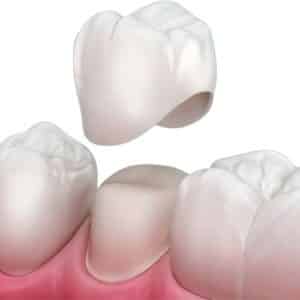
A crown — also called a cap — normally covers the tooth completely. Crowns can also be joined together to form a bridge, used where teeth are missing. See Dental Crowns.
The purpose is not only cosmetic. A crown restores the health and function of the bite, which is why crowns are used in situations veneers cannot handle. What is the difference between porcelain crowns and veneers? sets out where the line falls.
Materials
Pure porcelain, porcelain with metal inside, or pure gold. In cosmetic dentistry today, pure porcelain crowns are the most often used.
When they are used
- Where teeth are broken down, missing, or previously heavily restored — see Chipped and Cracked Teeth
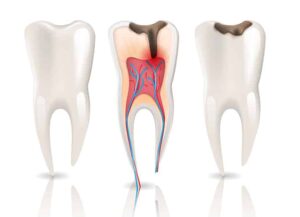
- Often on the posterior teeth, where the bite is much stronger and full coverage is needed for strength — particularly after root canal treatment
- On front teeth where a tooth is heavily restored, needs a major change in position or shape, or where gaps need filling
- To replace a very large amalgam filling — an immediate cosmetic improvement that strengthens the tooth at the same time
With implants
Where a tooth is missing, a dental implant may be required. Implants are titanium posts inserted into the jawbone, with a crown placed on top to replace the missing tooth. See Bridges, implants or dentures for the comparison, and Prosthodontists for who does the restorative work.
CEREC and composite fillings
Fillings can be made from composite resin or porcelain. They improve the appearance of the smile while dealing with dental disease, and tend to be used where the tooth needs a smaller restoration or a small cosmetic change. See Tooth Fillings.
Composite resin fillings
A very common procedure. Tooth-coloured resin bonded to the tooth, completed in one visit, and it leaves much of the natural tooth in position — which is its main advantage. See Composite bonding: will it look natural and how long will it last?.
CEREC fillings
Normally porcelain, also completed in one visit. Used where a much larger restoration is required. CEREC restorations are bonded to the tooth surface and can substantially improve the tooth's strength as well as its appearance. See Same-Day CEREC Restorations and Everything you need to know about CEREC technology.
Both are matched to your tooth colour and restore the health, shape and aesthetics of the tooth.
Orthodontics
Sometimes teeth need straightening to achieve a cosmetic improvement. See Orthodontics.
Veneers, crowns and fillings can make subtle changes in position. But if the teeth are severely out of position, the only way to get a great result is orthodontic treatment with a specialist orthodontist.
That is an important limit to understand. Disguising significantly misaligned teeth with veneers means removing more tooth structure to do it, and the result is usually a compromise.
Options include Invisalign — hard for other people to detect, a discreet way to straighten teeth — and braces, with tooth-coloured versions also popular. See Conventional braces vs lingual braces vs Invisalign.
One caution on the word discreet, from the ADA: ceramic braces are “not completely invisible but are less obvious than metal braces”, and of clear aligners it says plainly that “although the aligners are clear plastic, they are not invisible.” It also does not recommend DIY orthodontic treatment of any kind. See what are the most common complaints associated with conventional braces? (Source: Australian Dental Association, Teeth Straightening and Braces, teeth.org.au.)
And one more thing the list leaves out
Where the concern is how much gum shows rather than the teeth themselves, the treatment is different again — see Gummy Smile and Periodontists.
A note on the evidence behind this page
Whitening and orthodontics have published independent guidance behind them, which is why those sections carry quotations from the ADA. Veneers now do too — the survival figures quoted in the questions below come from peer-reviewed systematic reviews, and they are labelled with their follow-up periods and confidence intervals because that is the only honest way to read them.
The statements about crowns and CEREC restorations above remain the practice's own clinical account. There is no independent source in our reference material addressing chairside-milled ceramic restorations, and nothing has been substituted in its place. Where you want figures for those, ask for them in writing against your own case rather than taking a general number from a web page.
In conclusion
Cosmetic dentistry often involves a mixture of the above options to achieve the best result — whitening first, then restorations matched to the new shade, for instance, since whitening does not change the colour of existing crowns or fillings. See I want to whiten my teeth but one of my front teeth has a porcelain crown.
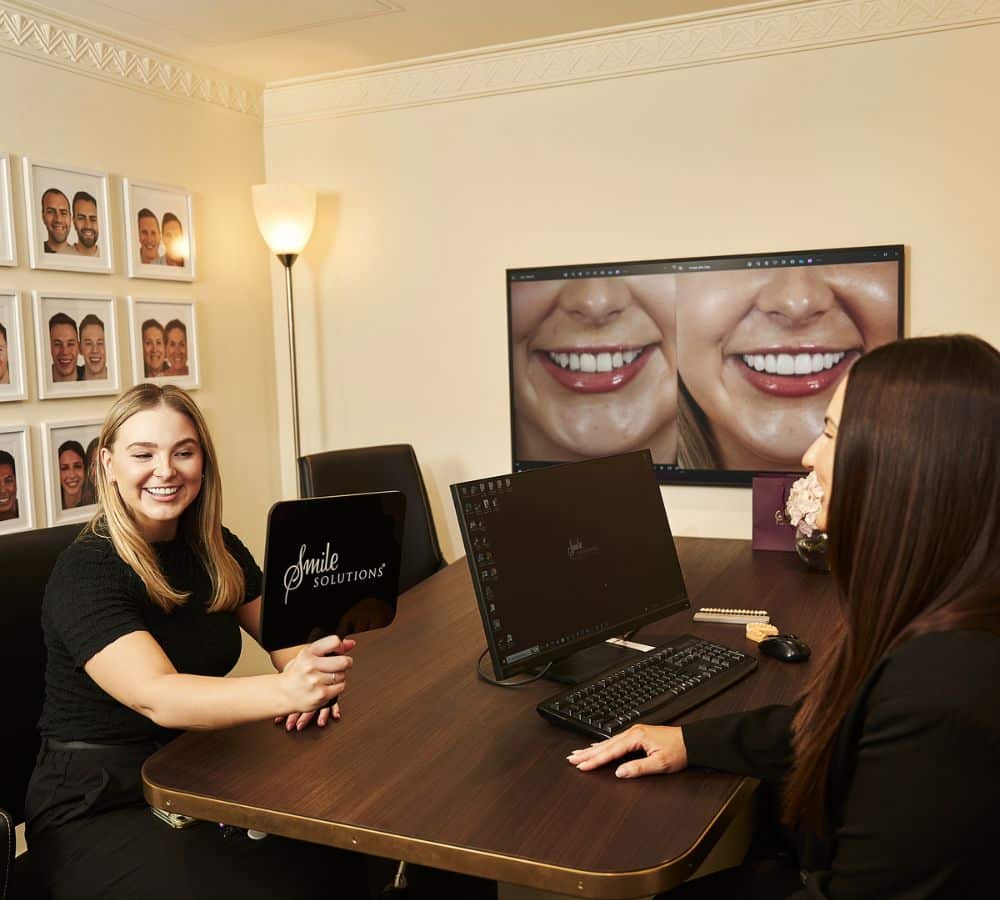
If you are considering any of these procedures, seek a full consultation and diagnosis to determine what is best for you — see Complimentary Cosmetic Consultation, and confirm the current terms, including what the appointment covers, when you book. For complex combined cases, Cosmetic Dentistry Under Specialist Care.
Confirm the current terms when you book — what the appointment includes, whether records such as scans or radiographs are part of it or charged separately, and whether any deposit applies.
Common questions
Which of these should I do first, if I want the biggest change for the least damage to my teeth?
In the order the damage increases, which is not the order most people ask for things.
A professional clean costs the least and removes nothing. Extrinsic staining from tea, coffee, red wine and smoking sits on the surface. A meaningful number of people who book whitening need a clean, not bleach, and the page above says so for a reason.
Whitening removes no tooth structure at all. It works chemically on the tooth you already have. It is also the only item on this list you can stop doing with nothing to undo.
Composite bonding is additive. Resin is built onto the tooth and can be polished off again, so it is close to reversible.
Porcelain veneers are not, and the size of the step is measurable. A laboratory study of preparation designs on front teeth found that a traditional porcelain laminate veneer removed a mean 16.7% of the coronal tooth structure, an extended veneer 22.1%, and a complete veneer 30% — against 64% to 70% for an all-ceramic crown (Edelhoff & Sorensen, Journal of Prosthetic Dentistry, 2002). Once that enamel is gone the tooth will need covering of some kind for the rest of your life.
So a sensible sequence is: treat disease, clean, whiten and let the shade settle, then decide whether bonding closes the gap between what you have and what you wanted. Often it does. If it does not, veneers are still available, and you will have made that decision knowing what it costs in tooth. The reverse sequence — veneers first — closes the cheaper doors permanently. See Edge Work & Composite Bonding and What are the differences between dental bonding and veneers?.
How long do veneers actually last? Is there real evidence, or just claims?
There is real evidence, and the honest form of the answer is a survival percentage at a stated number of years, not a lifespan. Anyone who tells you veneers "last 10 to 15 years" is giving you an average of clinical impressions, not a published figure.
Porcelain laminate veneers. A 2021 systematic review in the Journal of Clinical Medicine pooled 25 studies covering 6,500 veneers with a minimum three-year follow-up and found a 10-year estimated cumulative survival rate of 95.5%, counting fracture, debonding and other irreparable failures as failure. A separate review in the European Journal of Dentistry (2021) shows how much the published figures disagree once you look past the headline: studies under five years report survival from the high 90s downward, while "studies from 10 to 12 years have stated survival rates ranging from 53 to 94.4%". That spread is the real state of the evidence.
Composite veneers, for comparison, pooled at 88% survival (95% CI 81–94%) across trials with mean follow-up of 24 to 97 months (Journal of Evidence-Based Dental Practice, 2023).
Three things those numbers do not tell you, and they matter more than the numbers.
First, survival is not success. The 2021 review is explicit that the 95.5% figure counts veneers that were "repolished or repaired" as surviving. A veneer still in your mouth that needed work is a survivor.
Second, the best figures come from selected patients. In the Australian private-practice cohort reporting 91% survival at 20 years, bruxism and parafunction cases were excluded and only teeth retaining at least 80% enamel were veneered — a best case, from one operator.
Third, the single strongest predictor is what the veneer is bonded to. The literature is consistent that "the survival rate of laminate veneers is negatively affected by veneer preparations extending into dentin", and that "high failure rates have been associated to largely exposed dentin surfaces". In plain terms: the more tooth removed to make room for the veneer, the worse it does. That is the clinical reason the conservative sequence above is also the durable one.
Veneers are a third of the price overseas. What am I actually paying for here?
The Australian Dental Association's position is that Australians "should only seek elective dental care in Australia to ensure Australian standards are met, complications are managed promptly, and good oral health is maintained" (ADA Policy Statement 2.2.6, November 2023). The risks it lists are about what happens afterwards: "lack of recourse for treatment and maintenance problems", "lack of access to treatment records", "possible lack of insurance cover for complications", and the "potential challenge of finding a dental practitioner to continue with, or repair, elective treatment started overseas due to concerns including incompatible product systems, techniques not consistent with Australian standards and materials not approved by the TGA". It also notes such treatment "may not be covered by Australian health funds".
That is a position statement and it carries no numbers. The nearest thing to quantified data comes from the UK: a British Dental Association survey of 1,000 UK dentists (2022), reported in a 2025 British Dental Journal study of media coverage, found that 86% of respondents said they had treated people suffering consequences after treatment abroad, that crowns and implants were the treatments they believed most at risk of failure, and that remedial care cost at least £500 in 65% of cases, with 20% of dentists estimating more than £5,000. Read that for what it is — UK data, self-reported by dentists, not a clinical audit — and note that the same study records the Australian pathway as travel to Indonesia or Thailand rather than Turkey.
The finding most worth carrying home is not a number at all. The same paper quotes an NHS dentist describing what turns up: "They talk about veneers — mouldings bonded to the front of a tooth — but in reality, they are crowns, meaning much more aggressive tooth reduction." Against the preparation figures above — around 16.7% of the crown for a veneer, 64% to 70% for an all-ceramic crown — that substitution is the whole risk in one sentence. You cannot undo it, and you cannot tell from a photograph of the result which one you were given.
So if you are weighing it, the questions to get answered in writing before you go are: is this a veneer or a crown, how much tooth is being removed, what material and bonding system is being used, who repairs it in Australia if it fails, and what records will you be given to bring home. See Turkey teeth: the real risks of getting veneers overseas.
Will Medicare or my health fund pay for any of this?
Medicare does not, and the exclusion is written down. The Child Dental Benefits Schedule is the main Commonwealth dental entitlement for eligible children, and Services Australia states that the services it will not cover are "orthodontic dental work", "cosmetic dental work" and "any dental services in a hospital". Every option on this page that is being done for appearance falls under the second of those.
Where the CDBS is genuinely useful is the work underneath — examinations, x-rays, cleans, fissure sealants, fillings, root canals and extractions, up to $1,158 for each eligible child over 2 consecutive calendar years. Since nothing cosmetic should be done before disease is treated, that entitlement is worth using in its own right. See Child Dental Benefit Schedule.
Private health insurance is more nuanced. Funds generally treat a crown or a filling as restorative and rebate against major dental, while treating the same procedure performed purely for appearance as cosmetic and excluding it. That distinction is made by the fund, not by us, and it usually turns on the item number and the clinical justification recorded. The practical step is to take the written treatment plan with its item numbers to your fund and ask for the rebate in writing before you commit, along with your annual limit and any remaining waiting period. See Price Guide.
I came in about the colour of my teeth and was told the gums need treating first. Why?
Because the cosmetic work will not last on an unhealthy foundation, and because the gum problem is the one with consequences beyond appearance.
On suitability, Healthdirect Australia is direct about veneers: they "may not be suitable if you grind or clench your teeth or if you have gum disease", and they "don't fix tooth decay or problems with your bite." A veneer or crown margin sits at or near the gum line; placed against inflamed, bleeding tissue, it will not seat accurately, the gum will recede away from it, and a dark line will appear where the margin is exposed. That is a remake, at your expense.
On whitening, the ADA's requirement is that it "should only be performed if the treatment can be justified, and after a comprehensive dental examination has been conducted by a Dental Practitioner". Peroxide against an exposed root surface or an untreated cavity is painful and, in the case of decay, actively unhelpful.
And there is the part that has nothing to do with your smile. Gum disease is the most common reason adults lose teeth, and the evidence linking it to general health is strong enough that Diabetes Australia treats it as a two-way relationship — people with diabetes are more prone to periodontal disease, and untreated periodontal disease makes blood glucose harder to control. Being told to treat the gums first is not a delaying tactic or an upsell; it is the one item in this whole conversation that is about health rather than appearance. See What is gum disease?, Dental Cleans & Hygienists and Periodontists.
Cost
Fees are on the Price Guide, with Payment Plans for spreading them. The figure that applies to you comes from the written plan after assessment.
Payment plan options are available. Where a plan is advertised as interest free, that describes the plan term only — a deposit may be required, an establishment fee and ongoing account fees may apply, and charges can apply if the balance is not cleared within the agreed period. The applicable terms depend on the provider and the amount financed, and are set out in writing before you commit — ask what the deposit and the establishment fee are, in dollars, and what the total will be by the end. Payment Plans.
Practical details
Smile Solutions, Level 1, 220 Collins Street, Manchester Unity Building, Melbourne VIC 3000. Phone 13 13 96, or theteam@smilesolutions.com.au. Monday–Friday 8.00am–6.00pm, Saturday 8.30am–1.30pm, Sunday by appointment. Full details on Contact Us.
CEREC restorations are milled on site — see Smile Solutions Laboratory. Orthodontic treatment is provided by registered specialist orthodontists; registration can be verified free on the AHPRA register, or by calling 1300 419 495. The clinicians are listed on Our Team.
Published 9 November 2017. Cosmetic results vary between individuals. General information only; it does not replace advice from your treating practitioner. Material quoted from the Australian Dental Association is that organisation's published policy wording, reproduced for reference; scheduling, concentrations and standards can change, so confirm the current position rather than relying on this page. Survival percentages quoted are group results from published studies with their own selection criteria and follow-up periods; they are not predictions for an individual restoration. Payment plan terms are set by the credit provider and change; confirm current terms directly before you commit.
Smile Solutions trades under ABN 28 193 514 103.
Images on This Page
-
https://www.facebook.com/tr?id=800557773428361&ev=PageView&noscript=1
(no alt text)
-
https://www.smilesolutions.com.au/wp-content/uploads/2025/10/calendar_month.svg
(no alt text)
-
https://www.smilesolutions.com.au/wp-content/themes/arcadian-wordpress-theme/assets/images/smile_solutions_logo_white.png
Smile Solutions Logo
-
https://www.smilesolutions.com.au/wp-content/themes/arcadian-wordpress-theme/assets/images/smile_solutions_logo_purple.png
Smile Solutions Logo
-
https://www.smilesolutions.com.au/wp-content/uploads/2023/11/SS-Tooth-1-1-150x150.png
Smile Solutions
-
https://www.smilesolutions.com.au/wp-content/uploads/2026/01/Cosmetic-Consult.jpg
Consultation at a cosmetic clinic.
-
https://www.smilesolutions.com.au/wp-content/uploads/2025/09/Root-Canal-2-300x217.jpg
Root Canal
-
https://www.smilesolutions.com.au/wp-content/uploads/2026/08/Mouth-Breathing-300x270.jpg
Mouth Breathing
-
https://www.smilesolutions.com.au/wp-content/uploads/2025/09/Dental-Crown-at-Smile-Solutions-300x300.jpg
Dental Crown at Smile Solutions
-
https://www.smilesolutions.com.au/wp-content/themes/arcadian-wordpress-theme/assets/images/family_owned_bussiness.png
Family Owned Business
-
https://www.smilesolutions.com.au/wp-content/themes/arcadian-wordpress-theme/assets/icons/icon--phone.svg
Smile Solutions Contact
-
https://www.facebook.com/tr? id=800557773428361&ev=PageView&noscript=1
(no alt text)