What charcoal whitening claims
Charcoal whitening is marketed as a natural form of teeth whitening.
The claim: activated charcoal is highly absorbent and removes toxins from the body, because toxins adhere to the surface of the charcoal. Applied to teeth, it removes surface stains that bind to it.
Activated charcoal does have a genuine clinical use — in emergency medicine, for certain poisonings, where it binds substances in the gut. That is not the same mechanism as whitening a tooth, and the borrowed credibility is doing a lot of the marketing work here. See Teeth Whitening for what actually changes tooth colour.
The short version, from the published literature rather than from us. A 2021 systematic review of over-the-counter whitening products in Frontiers in Dental Medicine addressed charcoal directly: it “has been included in the composition of these products to improve their whitening effect but there is no evidence supporting it”. The same review's finding on whitening toothpastes generally is the one to keep in mind, because it is the category charcoal belongs to — they “usually present a combination of abrasives that can induce damage to the tooth surface without evidence of promoting real bleaching”.
Stain versus shade — the distinction that settles the question
Before anything else, two different things get called “whitening”.
Extrinsic stain sits on the outside of the enamel — tea, coffee, red wine, tobacco. It can be polished or scrubbed off, and it comes back.
Intrinsic shade is the colour of the tooth itself, largely determined by the dentine beneath the enamel. It darkens with age as enamel thins, and it is affected by trauma, some antibiotics taken during tooth development, and fluorosis. Only a peroxide-based bleaching agent changes intrinsic shade, because only it penetrates the enamel and acts on the compounds inside. See How can I improve the whiteness of my teeth?.
This is not a distinction dentists invented to sell treatment; it is the distinction Australian regulation is written around. The Australian Dental Association's policy statement on teeth whitening defines the treatment as “the use of teeth whitening products designed to penetrate the teeth and bleach intrinsic and/or extrinsic tooth discolourations, as opposed to products such as whitening toothpastes that are intended to remove surface staining”. A whitening toothpaste and a whitening gel are not a weak and a strong version of one thing. They do two different jobs.
Charcoal is an abrasive. It can only touch the first category. Everything people usually want — “my teeth have got darker as I've got older” — is in the second. The Frontiers review reached the same conclusion about over-the-counter products as a group: most “seem to be effective only in removing extrinsic stains or preventing their formation over enamel”.
The first limitation — what it cannot reach
Because it works only by topical, surface contact, it cannot work on teeth discoloured by internal causes — age, trauma, or antibiotics taken while the teeth were forming.
That rules out most of what people actually want to change. Surface stain from tea or coffee is one thing; the underlying shade of the tooth is another, and charcoal does not act on it.
What people see in the first week is real, and it is the same effect you would get from any mild abrasive: polished-off surface film. It plateaus quickly, and the stain returns as soon as the coffee does.
The second limitation — the safety concern
Charcoal dentifrices have not been evaluated or approved by any certified dental association, and there is no meaningful clinical evidence of efficacy or long-term safety. Reviews of charcoal toothpastes in the dental literature have consistently reached the same conclusion: insufficient evidence to support the claims, and reason for caution. The Frontiers systematic review is a fair example, and its overall verdict extends past charcoal to the whole shelf: “there is no sound evidence that any of the described OTC products promote a better bleaching effect than the products indicated for a professional.”
The concerns held by dentists:
- while the substance is absorbent, it is also abrasive
- users cannot be sure of the abrasivity of any charcoal product purchased. Toothpaste abrasivity is measured on the RDA scale, and charcoal products frequently do not publish an RDA figure at all — so two products marketed identically may behave very differently
- most charcoal toothpastes contain no fluoride, which trades a well-evidenced benefit for an unevidenced one. For anyone with any decay risk, that is the most serious problem on this list — see Tooth Fillings
- the particles lodge in places they are not wanted — around the gum margin, in the grooves of teeth, and in the margins of fillings, crowns and veneers, where they can leave grey-black lines
- it does not whiten restorations. Crowns, veneers and white fillings do not change colour, so heavy use around them can worsen a colour mismatch — see I want to whiten my teeth but one of my front teeth has a porcelain crown
An abrasive substance applied to tooth enamel may leave the tooth susceptible to wear and erosion, which leads to sensitivity and decay in the long term. The risk is greatest for people already brushing hard, already suffering acid erosion from reflux or diet, or with exposed root surfaces — dentine is far softer than enamel and abrades several times faster. The Frontiers reviewers make the same point about the wider category of low-cost whitening products, noting that continued use “associated with tooth brushing can increase the enamel abrasion potential promoted by daily tooth brushing”, and that indiscriminate use “especially [by] those with a high risk of developing erosive wear, might increase the enamel and dentin loss”. See Bleeding Gums for why recession exposes that softer surface.
Why that matters more than it sounds
Here is the fact that makes this different from a cosmetic product that simply does not work:
Teeth are the only part of the human ectoderm — which also includes hair, skin and nails — that cannot replenish or repair itself when damaged.
Hair grows back. Skin heals. Nails regrow. Enamel does not.
Any damage to tooth enamel is permanent, and can only be repaired with dental treatment such as fillings or crowns. See Same-Day CEREC Restorations and Composite Bonding for what that repair involves.
So the trade being offered by an abrasive whitener is: a modest, temporary improvement in surface stain, against a permanent and cumulative loss of the layer that protects the tooth. And as enamel thins, the yellower dentine beneath shows through more — producing exactly the appearance the product was bought to fix.
The other home remedies, briefly
The same reasoning disposes of most of them:
- Baking soda — mildly abrasive, and the mainstream toothpastes that contain it are formulated to a controlled abrasivity. Using it neat from the box is not.
- Lemon juice, vinegar or apple cider vinegar — do not put these on your teeth. They are acidic enough to dissolve enamel directly. This is the most damaging remedy circulating.
- Strawberries, bicarb-and-lemon pastes — acid plus abrasion, which is the worst possible combination.
- Oil pulling — no established whitening effect. To be precise about the basis for saying that: we went looking through the independent guidelines, regulator statements and trials we hold on whitening and mouth rinsing, and found no policy statement, no guideline and no trial addressing oil pulling at all. That is an absence of evidence rather than evidence of harm, but it means anyone telling you it whitens teeth is not drawing on a published source we can find.
- Whitening mouthwashes — their active ingredient is hydrogen peroxide at only 1–4%, or agents such as sodium hexametaphosphate that prevent new surface stain rather than bleaching. The Frontiers review's explanation is mechanical: “their limited penetration into teeth structures when compared to the professional bleaching technique with more concentrated peroxide gels”, because the rinse is in contact with the tooth for seconds. Its results were openly contradictory — one 1.5% rinse whitened over six months, a 4% rinse produced “no significant bleaching effect” after 21 days — and rinses with a low pH “can be erosive”.
- Hydrogen peroxide from a pharmacy bottle — uncontrolled concentration, no trays, and a real risk of chemical burns to the gums. The ADA's policy notes that direct exposure of skin, eyes and mucous membranes to hydrogen peroxide “may cause severe irritation or burns”, that ingestion may irritate the oesophagus and stomach, and that WorkSafe Australia designates hydrogen peroxide above 5% a hazardous substance.
- Whitening strips and over-the-counter kits — these at least use the right chemistry, and it is worth understanding why. The Frontiers review found strips to be the one over-the-counter category “able to promote bleaching”, and attributed that “mainly … to the increased contact time with the enamel and higher hydrogen peroxide concentration”. But the strips it describes carry 5–15% hydrogen peroxide, worn for anything from five to sixty minutes a day over weeks or months — concentrations that in Australia sit above the practitioner-only threshold set out below. So do not read overseas strip research as a description of what is on an Australian shelf. The usual problems with retail kits here are ill-fitting trays leaking gel onto gums, and no examination beforehand. See Difference between pharmacy whitening kits and dentist whitening
- Non-dental “whitening” services — salon and kiosk whitening carried out without a dental assessment is where most whitening injuries come from. See What should I know about teeth whitening?
Why retail kits are weak — the actual legal thresholds
This is worth stating concretely rather than as “above a low concentration”, because it explains the whole retail market.
Schedule 10 of the Poisons Standard — the schedule reserved for substances “of such danger to health as to warrant prohibition of their sale, supply and use” outside specified exemptions — lists teeth whitening products containing more than 6% hydrogen peroxide or more than 18% carbamide peroxide as products that may only be sold, supplied and used by registered dental practitioners as part of their dental practice. Products at or below those thresholds, 3–6% hydrogen peroxide and 9–18% carbamide peroxide, sit in Schedule 5 (“Caution”) and can be sold straight to consumers with the required warnings. These provisions are written into every state and territory's poisons legislation, and the ADA records that the Dental Board of Australia issued guidance for practitioners on using and supplying whitening products in August 2021.
The conversion between the two chemicals is worth knowing when comparing labels: the ADA states that one-third of a carbamide peroxide concentration is equivalent to hydrogen peroxide, so “18% carbamide peroxide approximates 6% hydrogen peroxide”. For scale, the policy records practitioner-supplied products running “from concentrations as low as 3–6% for some products supplied to patients for home use to 35% in some office-based bleaching products”.
So a lawful retail kit is not being held back by a trade restriction. It is a genuinely weaker product. The ADA also records that products exceeding Australia's legal limits have from time to time been found on sale online to Australian consumers — which is the other reason to be careful about what arrives in the post.
What is recommended instead
Choose products and treatment provided by a registered dental practitioner:
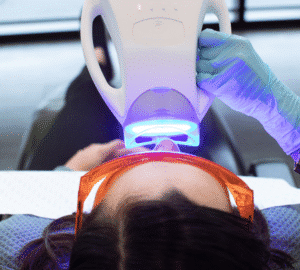
- in-chair dental whitening
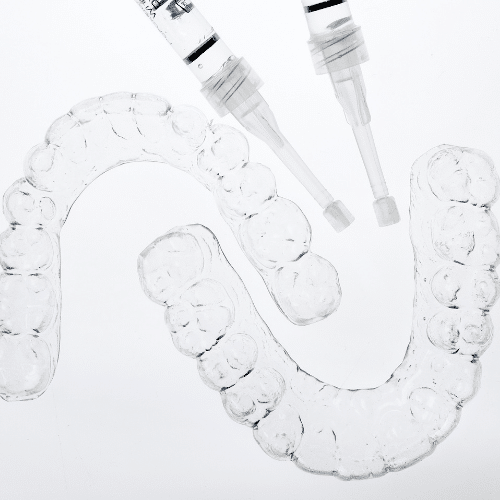
- at-home custom trays provided by your dentist — see Home teeth whitening: what to do and what not to do
Both are supervised, use products of known concentration, and follow an examination confirming your teeth are suitable for whitening in the first place. What teeth whitening options are available at Smile Solutions? and The difference between in-chair whitening and take-home whitening compare them.
That examination is the part that gets skipped by every home product. It checks for decay, leaking fillings, gum disease, cracks and exposed roots — all of which make whitening painful or damaging — and it establishes whether your discolouration is the kind that responds at all. It is also the profession's stated requirement, not a courtesy: the ADA's position is that “teeth whitening should only be performed if the treatment can be justified, and after a comprehensive dental examination has been conducted by a Dental Practitioner”, and that only registered dental practitioners “have the expertise to assess whether bleaching is safe for individual patients, to recommend the most appropriate technique and materials, and to provide treatment that meets regulated safety and quality standards of care”. See General Dentistry and Why should I go to a dentist for teeth whitening?.
And the simplest correction of all: if the problem is surface stain, a professional clean removes it, at lower cost and with no abrasive left in your bathroom. Dental Cleans and Hygienists and Professional Teeth Whitening.
Realistic expectations for proper whitening
So that the alternative is not oversold either:
- Results vary considerably. Some people gain several shades; others one or two. The ADA puts the professional obligation in matching terms: practitioners “should ensure that patients have realistic and reasonable expectations regarding the results of the bleaching treatment”.
- It is not permanent. Teeth re-stain over months to years, and top-up treatment is normal. Do top-ups on advice rather than continuously — the ADA's specific concern about consumer whitening marketing is that it “promotes regular ongoing use to maintain desired effects”, which it calls “a concern given the lack of clinical data supporting frequent home use of such products over long periods”, citing among others the Cochrane review of home-based chemically induced whitening (CD006202, 2018). See How long do the effects of teeth whitening last?
- Sensitivity during and for a day or two afterwards is common, and usually settles. The ADA's summary of the peer-reviewed evidence is that peroxide bleaching products “are safe and effective when used by or under the supervision of a dentist and according to the professional directions for use”, and that “the most common side-effects are transient tooth sensitivity and soft tissue irritation during or immediately following treatment”.
- Existing crowns, veneers and fillings do not whiten, so visible restorations need planning before you start, not discovering afterwards. See Cosmetic dentistry options
- Whitening is generally not provided to under-18s, or during pregnancy or breastfeeding. See Children's Dentistry
Common questions
Does charcoal toothpaste whiten teeth at all?
It can lift some surface film, in the way any mild abrasive can, and that is the extent of it. The 2021 systematic review in Frontiers in Dental Medicine is explicit that charcoal is added to whitening products “to improve their whitening effect but there is no evidence supporting it”, and that whitening toothpastes as a class combine abrasives “that can induce damage to the tooth surface without evidence of promoting real bleaching”. Nothing that stays on the outside of the enamel can change the colour of the dentine underneath, and that is what most people mean when they say their teeth have yellowed.
Is it actually dangerous, or just useless?
The honest answer is that the risk is cumulative rather than dramatic, and it depends on you. The specific concern is abrasion, and three things raise it: brushing hard, existing acid erosion from reflux or diet, and exposed root surfaces where the much softer dentine is uncovered. Most charcoal products publish no RDA abrasivity figure, so you cannot tell how aggressive the one in your bathroom is. The reason dentists are more cautious here than about an ordinary ineffective cosmetic is that enamel does not repair itself — a thinner tooth stays thinner, and looks yellower for it.
Why are pharmacy whitening kits so much weaker than what a dentist uses?
Because of how the chemicals are scheduled, not because of a trade restriction. Schedule 10 of the Poisons Standard restricts whitening products above 6% hydrogen peroxide or 18% carbamide peroxide to sale, supply and use by registered dental practitioners as part of their practice. Below that, 3–6% hydrogen peroxide and 9–18% carbamide peroxide sit in Schedule 5 and can be sold over the counter with warnings. Practitioner-applied in-chair products can run to around 35% hydrogen peroxide. A lawful retail kit is therefore working with a fraction of the active ingredient, whatever the packaging suggests.
Should I try whitening strips instead?
Be careful reading overseas research on this. Strips are the one over-the-counter category the Frontiers review found “able to promote bleaching”, because they hold a higher peroxide concentration against the tooth for much longer than a toothpaste or a rinse. But the strips described in that literature carry 5–15% hydrogen peroxide, which is above the Australian practitioner-only threshold, so the products studied are not the products legally on sale here. The reviewers' overall conclusion still stands and is the more useful one: there is no sound evidence that any over-the-counter product bleaches better than a professionally supplied one.
What about oil pulling, or bicarb and lemon?
Oil pulling has no whitening effect we can source. We searched the independent guidelines, regulator statements and trials we hold and found nothing on it at all — not a policy statement, not a guideline, not a trial. Bicarb and lemon is a different matter, and worse: it combines an abrasive with an acid, which is the most damaging pairing you can put on enamel. Lemon juice, vinegar and apple cider vinegar should not go on your teeth in any form. Acid softens enamel, and anything abrasive applied to softened enamel removes it.
If I just want the coffee stains off, what is the cheapest thing that works?
A professional clean. Surface stain is exactly what scaling and polishing removes, it is removed in one appointment, and it takes nothing off the tooth that matters. It also comes with an examination, which is the step every home product skips — and the step that finds the decay, the leaking filling, the crack or the exposed root that would have made whitening painful. If the colour you want changed turns out to be the shade of the tooth rather than stain on it, that examination is also what tells you whether whitening will do anything.
I have already been using a charcoal product. What should I do?
Stop, and have your enamel looked at rather than assuming either the worst or the best. Early abrasive wear can be identified and managed — the point is that it cannot be reversed, so the sooner it is picked up the less there is of it. Bring the product with you if you still have it; the ingredient list and any abrasivity figure on the packaging are useful. Then switch to a fluoride toothpaste of ordinary abrasivity, because going without fluoride is the part of the charcoal trade-off that carries the clearest documented cost.
Does this article replace an individual dental assessment?
No. It provides general information. Symptoms, suitability, risks and treatment choices depend on examination and, where indicated, imaging or other records from an appropriately registered practitioner.
Practical details
Written by Dr Madeleine Hoopmann, Smile Solutions.
Smile Solutions, Level 1, 220 Collins Street, Manchester Unity Building, Melbourne VIC 3000. Phone 13 13 96, or theteam@smilesolutions.com.au. Monday–Friday 8.00am–6.00pm, Saturday 8.30am–1.30pm, Sunday by appointment. Full details on Contact Us.
If you have already been using an abrasive whitening product, have your enamel assessed — early wear can be managed, and continuing use cannot be undone.
Related: Professional Teeth Whitening, Home teeth whitening: what to do and what not to do, Off-the-shelf teeth whitening — why the results disappoint, How long do teeth whitening effects last?, Dental Cleans and Hygienists, Cosmetic Dentistry.
Registration for any practitioner can be verified free on the AHPRA public register at ahpra.gov.au; the clinicians are listed on Our Team.
Sources named on this page: the Australian Dental Association's Policy Statement 2.2.8 on teeth whitening, which sets out the Poisons Standard thresholds and the safety positions quoted; and de Freitas and colleagues, “Effectiveness and Adverse Effects of Over-the-Counter Whitening Products on Dental Tissues”, Frontiers in Dental Medicine (2021).
Published 18 September 2018. General information only — it is not a diagnosis, a treatment plan, a quote or a promise of any particular clinical outcome, and it does not replace advice from your treating practitioner. Whitening results vary considerably between individuals and depend on the cause of discolouration; whether whitening will work on your teeth can only be established after examination. Scheduling thresholds are quoted as recorded in the ADA's policy statement; poisons scheduling is amended from time to time, so the current Poisons Standard governs. Product formulations and regulatory positions change over time.
Smile Solutions trades under ABN 28 193 514 103.
Images on This Page
-
https://www.facebook.com/tr?id=800557773428361&ev=PageView&noscript=1
(no alt text)
-
https://www.smilesolutions.com.au/wp-content/uploads/2025/10/calendar_month.svg
(no alt text)
-
https://www.smilesolutions.com.au/wp-content/themes/arcadian-wordpress-theme/assets/images/smile_solutions_logo_white.png
Smile Solutions Logo
-
https://www.smilesolutions.com.au/wp-content/themes/arcadian-wordpress-theme/assets/images/smile_solutions_logo_purple.png
Smile Solutions Logo
-
https://www.smilesolutions.com.au/wp-content/uploads/2016/05/Madeleine-150x150.jpg
Dr Madeleine Hoopmann
-
https://www.smilesolutions.com.au/wp-content/uploads/2025/11/Smile-Solutions-Whitening-Trays.png
Professional Take-Home Whitening Trays
-
https://www.smilesolutions.com.au/wp-content/uploads/2026/01/Cosmetic-Consult-300x270.jpg
Consultation at a cosmetic clinic.
-
https://www.smilesolutions.com.au/wp-content/uploads/2021/03/Rojina-1-300x270.jpg
Rojina 1
-
https://www.smilesolutions.com.au/wp-content/uploads/2025/09/Professional-Teeth-Whitening-Smile-Solutions-300x270.png
Professional In-Chair Teeth Whitening Smile Solutions Melbourne
-
https://www.smilesolutions.com.au/wp-content/themes/arcadian-wordpress-theme/assets/images/family_owned_bussiness.png
Family Owned Business
-
https://www.smilesolutions.com.au/wp-content/themes/arcadian-wordpress-theme/assets/icons/icon--phone.svg
Smile Solutions Contact
-
https://www.facebook.com/tr? id=800557773428361&ev=PageView&noscript=1
(no alt text)
-
https://bat.bing.com/action/0?ti=25148060&tm=gtm002&Ver=2&mid=6b1110b1-b1e0-461c-81c7-edcc600cd0e5&bo=1&sid=d28a0380ab2511f1828c27bb9cc958a9&vid=d28a24f0ab2511f1975665306778f1e3&vids=1&msclkid=N&pi=918639831&lg=en-US&sw=800&sh=600&sc=24&nwd=1&tl=Home%20whitening%20and%20charcoal%20whitening%20-%20Does%20it%20work%3F%20Is%20it%20safe%3F%20-%20Smile%20Solutions&p=https%3A%2F%2Fwww.smilesolutions.com.au%2Fdental-articles%2Farticle%2Fhome-whitening-charcoal-whitening-does-it-work-is-it-safe%2F&r=&evt=pageLoad&sv=2&cdb=AQAQ&rn=771168
(no alt text)