Why go to a dentist for teeth whitening?
Four reasons, and only one of them is the strength of the gel:
- An examination finds what would spoil or complicate the result — plaque and tartar, existing restorations, and untreated decay
- Custom trays keep the gel on the teeth rather than on the gums
- Higher-concentration products are restricted to dental practitioners, and the low concentrations sold over the counter often produce very little change
- Someone assesses whether whitening will work on your particular discolouration at all
See Teeth Whitening and General Dentistry.
What the examination finds
Plaque and tartar
Often there is a layer of plaque and hardened plaque — tartar or calculus — sitting over the enamel. It does nothing to protect the teeth from decay, but it does prevent whitening products from reaching the enamel and working effectively.
There is a second effect that catches people out: plaque and tartar respond to the gel differently from enamel, and will change shade. So the teeth appear to lighten — and then when the deposits are eventually removed, it becomes clear the underlying tooth structure did not change at all.
A professional clean before whitening is not an upsell. It is what allows the whitening to reach the tooth. See Dental Cleans & Hygienists and Bleeding Gums.
Existing restorations
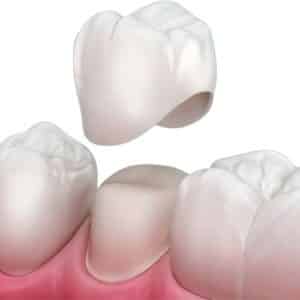
Whitening products work on natural enamel. Any prosthetic or man-made work — tooth-coloured fillings, crowns, caps, veneers, bridges — will not change shade.
This is the single most common cause of disappointment, and it is entirely predictable at an examination. If you have a white filling or a crown on a front tooth, the natural teeth will lighten around it and the restoration will begin to stand out. That may mean replacing it afterwards — a substantial cost, and one worth knowing about before starting rather than after. See I want to whiten my teeth but one of my front teeth has a porcelain crown.
Undetected decay
Without a full examination, areas of early decay go unrecognised. Whitening an area of demineralised or decayed enamel is uncomfortable, and those areas are more vulnerable — what was a small problem can progress. See Tooth Fillings.
This is why many people who use over-the-counter products, or services without a prior dental examination, end up dissatisfied with the outcome. Nothing was wrong with the gel; the mouth was not ready for it. See Difference between pharmacy whitening kits and dentist whitening.
Cracks and exposed dentine
This one is less obvious and more uncomfortable when it is missed. The Australian Dental Association notes that percolation of hydrogen peroxide into the nerve tissues — often accelerated by exposed dentine and enamel fractures — can lead to nerve inflammation (ADA Policy Statement 2.2.8, Teeth Whitening (Bleaching) By Persons other than Dental Practitioners).
In other words a crack, a chip, or a patch of worn-through enamel is not merely cosmetic in this context: it is a route for the gel to reach the nerve. Craze lines and early erosion are exactly the sort of thing a person does not know they have. See Chipped and Cracked Teeth, Why does a cracked tooth hurt so much? and What is dental erosion and how is it addressed?.
Concentration, and why it matters
The two most common actives are hydrogen peroxide (used in in-chair systems and daytime applications) and carbamide peroxide (overnight applications). There has been extensive research into the efficacy and the adverse effects of different concentrations, and dental practitioners work from that evidence.
The two are related by a fixed ratio. The ADA puts it this way: many bleaching products contain carbamide (urea) peroxide, one-third of its concentration being equivalent to hydrogen peroxide — so 18% carbamide peroxide approximates 6% hydrogen peroxide. That is worth knowing when comparing two products whose labels use different actives.
The practical difference:
| Product | Typical concentration |
|---|---|
| Supermarket whitening toothpaste | Around 1% hydrogen peroxide |
| Dentist-supplied take-home gel | Around 9.5% hydrogen peroxide, or 16% carbamide peroxide |
| In-chair whitening | Around 25% hydrogen peroxide, under isolation |
Products at 9.5 per cent and above are not available without dental involvement. In Australia, peroxide concentrations above a low threshold are restricted to registered dental practitioners — a regulatory limit rather than a commercial one. That difference in concentration is a large part of why people see little change from supermarket products.
For scale, the ADA describes the effective concentration of hydrogen peroxide as varying greatly, from as low as 3–6% in some products supplied to patients for home use, to 35% in some office-based bleaching products.
One definitional point that explains the first row of that table: the ADA defines teeth whitening as the use of products designed to penetrate the teeth and bleach intrinsic and/or extrinsic discolourations, as opposed to products such as whitening toothpastes that are intended to remove surface staining. A whitening toothpaste and a whitening gel are not weaker and stronger versions of one thing; they are doing two different jobs.
The difference between in-chair whitening and take-home whitening sets out how to choose between the professional options, and What teeth whitening options are available at Smile Solutions? lists them.
What the law actually says
The threshold referred to above is set out in the Poisons Standard, and it is worth stating precisely, because the bands are what determine what you can legally buy.
- Schedule 5 — “Caution”. The Poisons Standard recognises hydrogen peroxide 3–6% and carbamide peroxide 9–18% as Schedule 5 substances, meaning that teeth whitening products containing up to these concentrations can be sold direct to consumers if they carry the stipulated safety warnings.
- Schedule 10 — prohibited except in specified exempt circumstances. Schedule 10 lists substances of such danger to health as to warrant prohibition of their sale, supply and use other than in specified exempt circumstances. It states that teeth whitening products containing more than 6% hydrogen peroxide or 18% carbamide peroxide may only be sold, supplied and used by registered dental practitioners as part of their dental practice.
The ADA notes that these provisions are formalised in all state and territory poisons legislation — this is not a professional guideline that a retailer can decline to follow. The Dental Board of Australia states the same limit in its own practitioner guidance: Australian laws mean only registered dental practitioners can use or supply high-concentration teeth whitening products, over 18% carbamide peroxide or 6% hydrogen peroxide.
The ADA also records that, from time to time, some products containing concentrations of bleaching agents that exceed legal limits in Australia have been found to be available online to Australian consumers. A product arriving by post is not evidence that it is legal here, or that anyone has assessed it.
What a dentist is obliged to do
The Dental Board of Australia sets out what supplying a take-home whitening product actually requires. Products can be supplied for home use if the patient is assessed as suitable, which includes carrying out an appropriate assessment and examination, considering the patient’s history, and applying the principles of risk minimisation and management. Practitioners must also work within the Board’s scope of practice standard — only providing treatments in which they are educated, trained and competent.
The ADA’s position adds that treatment should only be performed if it can be justified and after a comprehensive dental examination, that risks and costs should be explained and documented along with informed consent, and that practitioners should ensure patients have realistic and reasonable expectations about the results.
So the examination at the start of this page is not a practice preference. It is the condition on which the product may be supplied at all. Understanding your treatment covers what should be explained to you before you agree to anything.
The risks of higher concentrations
Stronger is not simply better, and this is where supervision earns its place.
Higher concentrations can chemically burn the gums. At 9.5 per cent and above, even short contact can bleach and blanch gum tissue — usually painless at first, and producing white patches that resolve over a few days but are alarming and avoidable. Peroxide on inflamed or receded gums is more uncomfortable again.
The underlying hazard is not specific to dentistry. WorkSafe Australia’s guidelines designate hydrogen peroxide at concentrations above 5% as a hazardous substance, and the ADA notes that direct exposure of the skin, eyes and mucous membranes to hydrogen peroxide may cause severe irritation or burns, while ingestion may cause irritation to the oesophagus and stomach. That is the material being placed a millimetre from your gum for half an hour.
This is where tray fit does most of the work. Over-the-counter kits typically use a generic tray softened in hot water and moulded to the teeth. Mouths vary considerably, and a rough fit means that when the tray is seated, much of the gel is displaced off the teeth and onto the gums — which is exactly where it should not be.
Custom trays, made from a scan or an impression, are shaped to the individual and designed to hold the gel against the enamel only. That both improves the result and reduces the risk. See Smile Solutions Laboratory and The do's and don'ts of home teeth whitening.
The side effects to expect even when everything is done properly: the ADA reports that peer-reviewed studies indicate peroxide-containing products are safe and effective when used by or under the supervision of a dentist and according to the professional directions for use, and that the most common side effects are transient tooth sensitivity and soft tissue irritation during or immediately following treatment. Transient is the operative word — but it is a normal part of the procedure rather than a sign something went wrong.
Light and laser systems
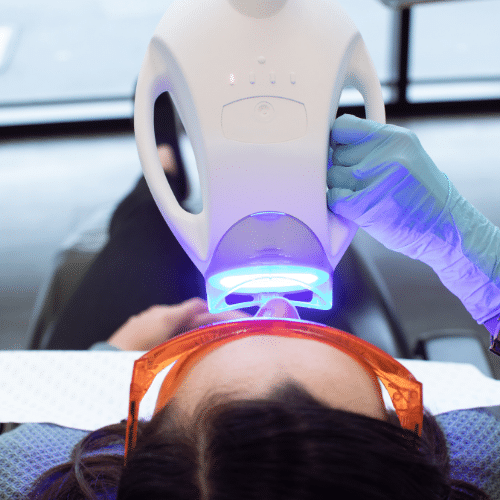
Where a light or heat source is used to shorten the application time, there is a further layer of regulation. The ADA notes that incorrect application of heat and other forms of energy — such as light from a plasma arc lamp or high-power (Class 4) laser — may cause nerve damage to the tooth and burns to adjacent soft tissues, and that failure to use appropriate protective eyewear may cause irreversible injury. The relevant standard is **AS/NZS 4173:2018, *Safe use of lasers and intense light sources in health care***, which specifies requirements for dental practices and the cosmetics industry, including required standards of training.
One detail relevant to anyone being treated in Melbourne: all registered dental practitioners with appropriate training and competence may undertake procedures using Class 4 lasers, but Victorian legislation — along with Western Australian, Queensland and Tasmanian — requires practitioners in those states to first obtain a licence from the appropriate state regulatory authority.
Whitening outside a dental practice
The same reasoning applies to whitening offered in beauty salons and similar settings, and to abrasive home remedies — see What should I know about teeth whitening? and Home whitening and charcoal whitening: does it work? Is it safe?.
The ADA describes the settings concerned directly: teeth whitening services are increasingly offered by unregulated, unqualified non-dental practitioners in settings such as beauty and hair salons, shopping mall kiosks, dedicated teeth whitening salons, or via mobile services that travel to a location convenient to the consumer.
It also flags the wording to watch for. Many such services claim their practitioners are “teeth whitening specialists” with the knowledge or training to perform the procedure safely — but, in the ADA’s position, only registered dental practitioners have the expertise to assess whether bleaching is safe for an individual patient, to recommend the appropriate technique and materials, and to provide treatment meeting regulated safety and quality standards of care. “Specialist” in that advertising is not the regulated dental term; Dentists & Registered Specialists explains what the protected titles actually mean and how to check one.
A related point about marketing generally: the ADA observes that the marketing of some products sold directly to consumers encourages unrealistic expectations about whitening results and promotes regular ongoing use to maintain the effect — and notes this is a concern given the lack of clinical data supporting frequent home use of such products over long periods, citing a Cochrane review of home-based chemically-induced whitening in adults.
What whitening will not fix
Worth knowing before you start, because it determines whether whitening is the right treatment at all:
- Restorations do not lighten, as above
- Tetracycline staining and fluorosis respond poorly and may need a different approach — see How can I improve the whiteness of my teeth? and Cosmetic dentistry options
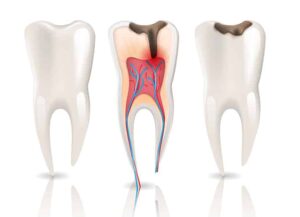
- A single dark tooth after root canal treatment usually needs internal bleaching, not tray whitening
- Results are not permanent — expect to top up, depending on diet and smoking. See How long do the effects of teeth whitening last?
- Sensitivity during and after treatment is common, and usually temporary
And a note on framing: whiter teeth are a cosmetic change. They do not indicate better oral health, and a whitened smile with untreated gum disease underneath is worse off than an unwhitened healthy one. Whitening is a reasonable thing to want; it is not a health measure. See What is periodontal disease?.
Common questions
How white will I actually get?
Nobody can tell you before the examination, and we are not going to put a number on this page. We looked for an independent Australian source publishing an expected shade change for supervised whitening and there is none in the reference material we hold. Any specific figure — here or anywhere else — is worth asking the basis of.
What the regulator requires is the opposite of a promise. The Dental Board of Australia's guidance is that whitening products may be supplied for home use only where the patient is assessed as suitable, after an appropriate assessment and examination, considering the patient's history and applying the principles of risk minimisation. The ADA adds that practitioners should ensure patients have ‘realistic and reasonable expectations' about the results, that treatment should only be performed if it can be justified and after a comprehensive dental examination, and that risks and costs be explained and documented along with informed consent.
Four things decide your answer, and three of them are visible at an examination: what is actually causing the discolouration, how much restorative work is in the front of your mouth, the condition of the enamel, and how thoroughly the deposits have been cleaned off first. Tetracycline staining and fluorosis respond poorly, as noted above; a single dark root-treated tooth needs a different technique entirely.
The most useful thing you can ask for is a shade recorded before you start — photographed against a shade guide — so that the change is measured rather than remembered. Memory is generous about this in both directions.
Will it damage my enamel?
The ADA's position on supervised whitening is reassuring and specific: peer-reviewed studies indicate that peroxide-containing bleaching products ‘are safe and effective when used by or under the supervision of a dentist and according to the professional directions for use', and that ‘the most common side-effects are transient tooth sensitivity and soft tissue irritation during or immediately following treatment'. Sensitivity is expected, not a sign of damage, and it is described as transient.
The qualifiers in that sentence are doing real work, and they are where the risk sits. The same policy notes that hydrogen peroxide percolating into the nerve tissues is often accelerated by exposed dentine and enamel fractures, and that direct exposure of skin, eyes and mucous membranes may cause severe irritation or burns. WorkSafe Australia's guidelines designate hydrogen peroxide above 5% as a hazardous substance. So the material is not benign; what makes it safe is that it is kept on enamel, on a mouth that has been checked for the things that let it go somewhere else.
Where enamel harm is actually documented is at the over-the-counter end. A review in Frontiers in Dental Medicine records, for whitening rinses, enamel erosion from low pH, increased abrasion when combined with brushing, sensitivity and gingival irritation — and reports one study in which a 1.5% hydrogen peroxide rinse used twice daily for 45 days produced a loss of enamel lightness, which is the opposite of the intended effect.
If you are already sensitive, or have receded gums, cracks or worn enamel, say so before rather than after. That is the conversation that changes the concentration, the wear time, or whether it goes ahead at all.
Do whitening toothpastes, charcoal products or whitening rinses do anything?
They are doing a different job, and the ADA draws the line explicitly. It defines teeth whitening as products ‘designed to penetrate the teeth and bleach intrinsic and/or extrinsic discolourations, as opposed to products such as whitening toothpastes that are intended to remove surface staining'. A whitening toothpaste removes stain from the surface. It does not lighten the tooth underneath. Those are different outcomes, not different strengths of the same one.
On the rinses, the review evidence is contradictory and the harms are better documented than the benefits. The Frontiers in Dental Medicine review notes that results in the literature conflict — one 1.5% rinse produced whitening over six months, another 4% rinse produced no significant bleaching effect after 21 days — and identifies the mechanical reason: limited penetration, because contact time is short compared with a tray or a strip. Against that it lists erosion from low pH, increased abrasion when combined with brushing, sensitivity and gingival irritation.
The review's overall conclusion is worth quoting in full, because it answers the question as asked: ‘there is no sound evidence that any of the described OTC products promote a better bleaching effect than the products indicated for a professional.'
On charcoal specifically, we have to report a gap. We could not locate a policy statement, guideline or trial on charcoal-based whitening in the independent reference material we hold. What does apply is the general caution about abrasion: whitening dentifrices ‘usually present a combination of abrasives', and abrasion is the mechanism most charcoal products are sold on. See home whitening and charcoal whitening: does it work? Is it safe?
How long does it last, and can I just keep topping up?
Results are not permanent — the page says that above, and the honest extension is that nobody can tell you your interval. It depends on diet, particularly coffee, tea and red wine, and on smoking. How long do the effects of teeth whitening last? covers that.
The topping-up question has a specific caution attached to it, and it comes from the ADA rather than from us. Its policy observes that the marketing of some directly-available consumer products ‘encourages unrealistic expectations about whitening results and promotes regular ongoing use to maintain desired effects', and states that this ‘is a concern given the lack of clinical data supporting frequent home use of such products over long periods' — citing a Cochrane review of home-based chemically-induced whitening in adults.
So indefinite, unsupervised, ongoing use is the pattern the evidence does not cover. That is not the same as saying it is harmful; it is saying nobody has studied it properly, and the people encouraging it are selling the product.
The practical version: agree a maintenance plan with the practitioner who assessed you, rather than drifting into using a gel every week because the shade has slipped. And have the restorations in your smile reviewed when you do, since those are not changing colour with the rest.
Is whitening in a beauty salon actually illegal?
Not automatically — and the precise answer depends entirely on the concentration, which is why the bands above matter.
Below the threshold, sale to consumers is lawful. The Poisons Standard recognises hydrogen peroxide 3–6% and carbamide peroxide 9–18% as Schedule 5 (‘Caution') substances, so products up to those concentrations can be sold direct to consumers provided they carry the stipulated safety warnings.
Above it, the restriction is absolute. Schedule 10 covers substances of such danger to health as to warrant prohibition of their sale, supply and use other than in specified exempt circumstances, and it provides that whitening products containing more than 6% hydrogen peroxide or 18% carbamide peroxide may only be sold, supplied and used by registered dental practitioners as part of their dental practice. The ADA notes those provisions are formalised in all state and territory poisons legislation, and the Dental Board of Australia states the same limit in its practitioner guidance.
Two things follow that are worth carrying into any salon conversation. First, ask what concentration is being used and in which active — and remember the conversion, that one-third of a carbamide peroxide figure is the hydrogen peroxide equivalent. Second, the ADA's caution about the word ‘specialist': many such services describe their operators as teeth whitening specialists, and in the ADA's position only registered dental practitioners have the expertise to assess whether bleaching is safe for an individual, recommend the technique and materials, and provide treatment meeting regulated standards of care.
And on products bought online: the ADA records that concentrations exceeding Australian legal limits have from time to time been found available to Australian consumers over the internet. Arriving in the post is not evidence that anything has been assessed.
Practical details
Whitening is not recommended during pregnancy or breastfeeding, or generally for children whose teeth are still developing — see Children's Dentistry. Untreated decay and gum disease should be addressed first.
Fees are on the Price Guide; the broader cosmetic options are on Cosmetic Dentistry.
Specialist registration can be verified on the AHPRA register, or by calling 1300 419 495; the clinicians are listed on Our Team, and Dentists & Registered Specialists explains what the titles mean.
Smile Solutions, Level 1, 220 Collins Street, Manchester Unity Building, Melbourne VIC 3000. Phone 13 13 96, or theteam@smilesolutions.com.au. Monday–Friday 8.00am–6.00pm, Saturday 8.30am–1.30pm, Sunday by appointment. Full details on Contact Us.
Published 10 March 2022. General information only; it does not replace advice from your treating practitioner. Outcomes vary between individuals, and all treatment carries risks. Product names are examples; concentrations and regulatory arrangements are subject to change — the scheduling and standards described above are as stated in ADA Policy Statement 2.2.8 and Dental Board of Australia practitioner guidance, and should be checked against the current instruments.
Smile Solutions trades under ABN 28 193 514 103.
Images on This Page
-
https://www.facebook.com/tr?id=800557773428361&ev=PageView&noscript=1
(no alt text)
-
https://www.smilesolutions.com.au/wp-content/uploads/2025/10/calendar_month.svg
(no alt text)
-
https://www.smilesolutions.com.au/wp-content/themes/arcadian-wordpress-theme/assets/images/smile_solutions_logo_white.png
Smile Solutions Logo
-
https://www.smilesolutions.com.au/wp-content/themes/arcadian-wordpress-theme/assets/images/smile_solutions_logo_purple.png
Smile Solutions Logo
-
https://www.smilesolutions.com.au/wp-content/uploads/2023/11/SS-Tooth-1-1-150x150.png
Smile Solutions
-
https://www.smilesolutions.com.au/wp-content/uploads/2025/11/Inchair-Teeth-Whitening-Smile-Solutions.png
In-chair Teeth Whitening Smile Solutions
-
https://www.smilesolutions.com.au/wp-content/uploads/2025/09/Root-Canal-2-300x217.jpg
Root Canal
-
https://www.smilesolutions.com.au/wp-content/uploads/2026/08/Mouth-Breathing-300x270.jpg
Mouth Breathing
-
https://www.smilesolutions.com.au/wp-content/uploads/2025/09/Dental-Crown-at-Smile-Solutions-300x300.jpg
Dental Crown at Smile Solutions
-
https://www.smilesolutions.com.au/wp-content/themes/arcadian-wordpress-theme/assets/images/family_owned_bussiness.png
Family Owned Business
-
https://www.smilesolutions.com.au/wp-content/themes/arcadian-wordpress-theme/assets/icons/icon--phone.svg
Smile Solutions Contact
-
https://www.facebook.com/tr? id=800557773428361&ev=PageView&noscript=1
(no alt text)
-
https://bat.bing.com/action/0?ti=25148060&tm=gtm002&Ver=2&mid=b90de675-1079-4835-a15c-d1c7a181ac4e&bo=1&sid=f6d4dfe0ab2611f1b5c761eb36e0fc85&vid=f6d544e0ab2611f1a742cfb1b64d1700&vids=1&msclkid=N&pi=918639831&lg=en-US&sw=800&sh=600&sc=24&nwd=1&tl=Why%20should%20I%20go%20to%20a%20dentist%20for%20teeth%20whitening%3F%20-%20Smile%20Solutions&p=https%3A%2F%2Fwww.smilesolutions.com.au%2Fdental-articles%2Farticle%2Fwhy-should-i-go-to-a-dentist-for-whitening%2F&r=<=1594&evt=pageLoad&sv=2&cdb=AQAQ&rn=302037
(no alt text)