In-chair or take-home whitening — which is right for me?
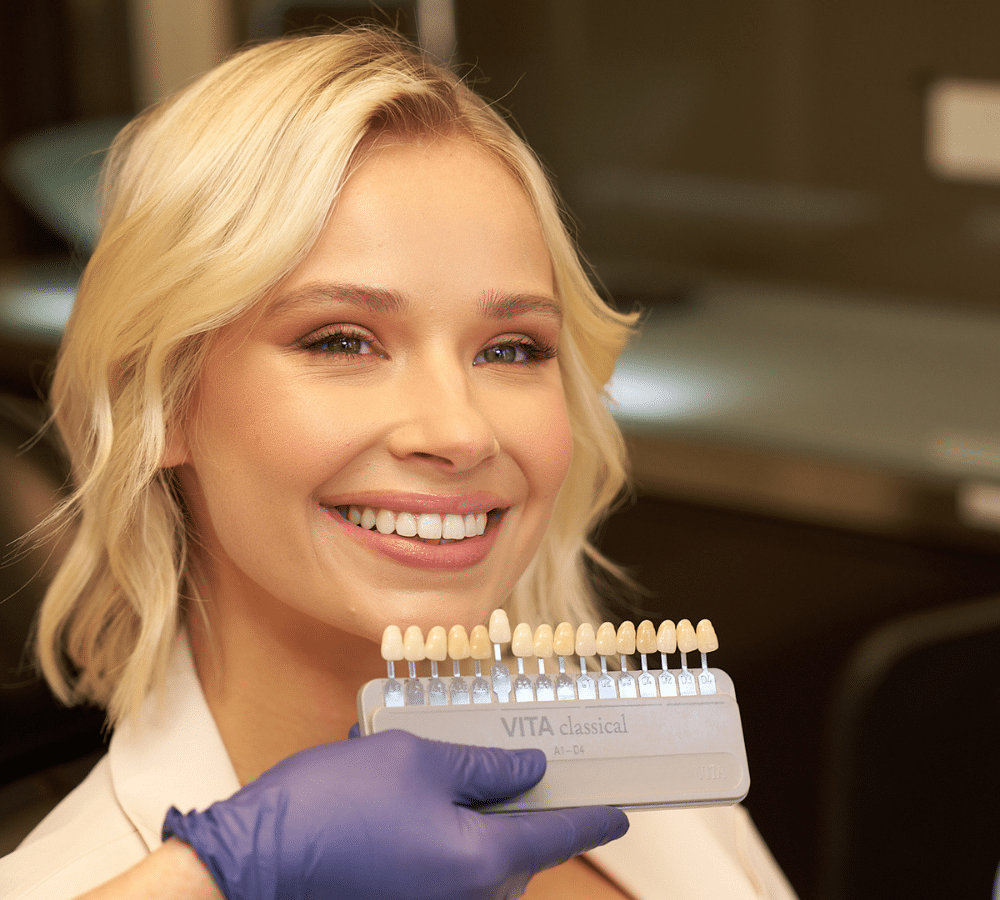
The short version: in-chair whitening is faster and uses a much stronger gel; take-home whitening is slower, gentler, more controllable and easier to top up. If you are short of time or have heavy discolouration, in-chair makes sense. If you have sensitive teeth, or you want to stop at exactly the shade you like, take-home is usually the better fit. See Teeth Whitening.
Many people end up doing both — an in-chair session to get most of the way there, then take-home trays kept for periodic top-ups. See What teeth whitening options are available at Smile Solutions?.
Why the two are not simply strong and stronger
Before the comparison, the reason the two methods exist at all: the law decides what may leave the building.
ADA Policy Statement 2.2.8 sets out the Poisons Standard's two tiers. Hydrogen peroxide 3-6% and carbamide peroxide 9-18% sit in Schedule 5, requiring “Caution” — products up to those concentrations “can be sold direct to consumers if they are labelled with stipulated safety warnings.” Above that, Schedule 10 “specifically states that teeth whitening products containing more than 6% hydrogen peroxide or 18% carbamide peroxide may only be sold, supplied and used by registered dental practitioners as part of their dental practise”, and those provisions are “formalised in all state and territory poisons legislation.”
The conversion matters when you compare labels. The ADA states that carbamide peroxide is equivalent to “one-third of its concentration” in hydrogen peroxide terms — “18% carbamide peroxide approximates 6% hydrogen peroxide.”
Run the concentrations below through that and the picture clarifies. The in-chair gel at around 25 per cent hydrogen peroxide is far above the Schedule 10 line, which is why it is applied in a chair by a practitioner and never handed over. The day gel at around 9.5 per cent hydrogen peroxide is also above the 6 per cent line — supplied to you, but only by a registered dental practitioner. The overnight gel at 16 per cent carbamide peroxide converts to roughly 5 per cent hydrogen peroxide, below the line.
For scale, the ADA records that office-based bleaching products run “to 35% in some office-based bleaching products”, against “as low as 3-6% for some products supplied to patients for home use.”
In-chair whitening
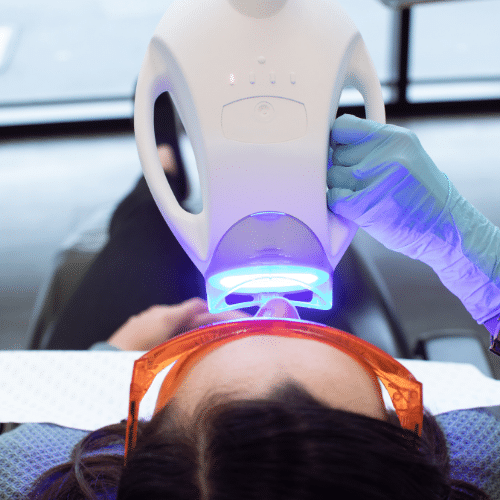
In-chair whitening is the fast route. It uses a much higher concentration of gel than take-home trays — typically around 25 per cent hydrogen peroxide — applied under isolation that protects the gums, in an appointment of around 90 minutes. Typical results are up to around five shades lighter, though the actual change varies considerably with the starting shade and the cause of the discolouration. No particular shade can be promised in advance.
It suits:
- Time-restricted patients who want a visible result quickly
- Patients with heavier discolouration, where the higher-concentration gel achieves a noticeable improvement in a single visit
- Anyone who knows they will not comply with a two-week tray routine
The honest drawbacks:
- Sensitivity is more common than with take-home whitening, and the procedure can be genuinely uncomfortable for someone who already has sensitive teeth
- Less control over the gradient. Because it happens fast, it is harder to monitor and stop at a precise shade
- It is a long appointment with the mouth held open, which some people find hard — see Dental Anxiety
On the light
One correction worth making to a claim commonly seen in whitening marketing: the light used in modern in-chair systems is generally a blue LED, not ultraviolet. And the evidence that light activation meaningfully improves the outcome over the gel alone is weak — several studies find no significant difference, and some suggest the light increases sensitivity. The concentration of the gel and the contact time are doing most of the work. How long do the effects of teeth whitening last? covers what the follow-up research shows about the light and about durability.
There is a safety dimension to light and laser use that is worth knowing about, because it is a real reason to care who is holding the equipment. The ADA notes that “the incorrect application of heat and other forms of energy during teeth whitening procedures, such as light from a plasma arc lamp or high-power (Class 4) laser may cause nerve damage to the tooth and burns to adjacent soft tissues, and failure to ensure use of the appropriate protective eyewear may also cause irreversible injury.”
Requirements for training and safe use are set out in AS/NZS 4173:2018, Safe use of lasers and intense light sources in health care. The ADA also notes that while all registered dental practitioners with appropriate training may undertake procedures using Class 4 lasers, Victorian legislation — along with Western Australian, Queensland and Tasmanian — requires practitioners to obtain a licence from the state regulatory authority first. That is a Melbourne-relevant point: in Victoria this is licensed, and it is a fair question to ask of any provider offering laser or high-intensity light whitening. See White fright: burns and multicoloured teeth and Dentists & Registered Specialists.
Take-home whitening
Take-home whitening starts with a short appointment to take impressions or scans so that personalised trays can be made. The trays are fabricated by a laboratory and fitted, after which you whiten at home over one to two weeks. See Smile Solutions Laboratory and The do's and don'ts of home teeth whitening.
There are two common formats:
| Day formulation | Night formulation | |
|---|---|---|
| Active | Hydrogen peroxide, around 9.5% | Carbamide peroxide, around 16% |
| Wear time | From about 30 minutes a day | Overnight |
| Course | 10–14 days | 10–14 days |
| Suits | Anyone who prefers short daytime sessions | Anyone who prefers to whiten while asleep; gentler on sensitive teeth |
| Note | — | Takes some getting used to, sleeping with trays in |
Carbamide peroxide breaks down more slowly into hydrogen peroxide, which is why the overnight formulation is gentler despite the higher-sounding number — 16 per cent carbamide peroxide is roughly equivalent to about 5.5 per cent hydrogen peroxide in active terms.
The advantages of take-home whitening:
- Lower rates of post-whitening sensitivity
- Control — you can stop when you reach a shade you are happy with
- Top-ups — you keep the trays, so refreshing the result later costs only a syringe of gel
The trade-off: results take longer, and they depend on doing it consistently. Trays worn sporadically produce a patchy, disappointing result. If you know you will not keep to it, be honest about that when choosing.
Custom trays are the whole point. A tray made to your teeth holds gel against the enamel and off the gums; a one-size-fits-all pharmacy tray does neither — see Difference between pharmacy whitening kits and dentist whitening and Home teeth whitening versus having your teeth whitened at the dentist.
What has to happen before a kit is handed over
Because you use a take-home kit unsupervised, the assessment behind it carries more weight, not less. The Dental Board of Australia's position is that whitening products “can be supplied for home use if the patient is assessed as suitable”, and that this includes “carrying out an appropriate assessment and examination”, “considering their history”, and “applying the principles of risk minimisation and management.”
The Board also sets out what a practitioner takes on under the Australian Consumer Law when a product is supplied for home use — consumer guarantees that the product is of acceptable quality, replacing, repairing or refunding it in certain circumstances, and compensating a patient for damages and loss. In practice: it is a supplied product, and you have the normal rights that attach to one. See Understanding Your Treatment.
Sensitivity, and what to do about it
Sensitivity during and shortly after whitening is common with both methods, and it is usually temporary — typically settling within a day or two of stopping. Peroxide passes through the enamel and dentine and irritates the pulp; it does not damage the tooth structure at the concentrations used.
That expectation is consistent with the ADA's summary of the peer-reviewed literature, which reports that peroxide-containing bleaching products “are safe and effective when used by or under the supervision of a dentist and according to the professional directions for use”, and that “the most common side-effects are transient tooth sensitivity and soft tissue irritation during or immediately following treatment.” Note the conditions attached to the first half of that sentence — supervision, and following the professional directions.
Practical measures:
- Start a sensitivity toothpaste a couple of weeks before beginning
- Shorten the wear time rather than abandoning the course
- Skip a day between applications
- A desensitising gel in the trays between whitening sessions
- Tell your dentist — the formulation and regime can be adjusted. Contact Us
See also What to do if you suffer from sensitive teeth.
If the sensitivity is sharp, localised to one tooth, or lingers well beyond the course, that is worth having looked at rather than pushing through — see Tooth Pain & Ache and Chipped and Cracked Teeth.
Why a consultation first actually matters
Whatever whitening route you choose, consult a dentist first. There are several factors that determine whether whitening will work at all, and they are not visible to the person considering it. See General Dentistry and Why should I go to a dentist for teeth whitening?.
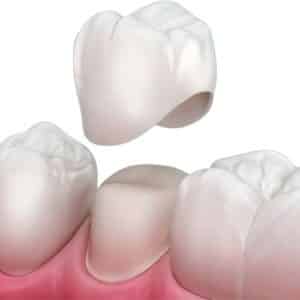
- Whitening does not change crowns, veneers, bridges or composite fillings. If you have a white filling or a crown on a front tooth, the natural teeth will lighten around it and the restoration will start to stand out. That may mean replacing it afterwards — a significant cost, and one you should know about before starting, not after. See I want to whiten my teeth but one of my front teeth has a porcelain crown
- The cause of the discolouration decides the result. Surface staining from coffee, tea and wine responds well. Age-related yellowing responds moderately. Tetracycline staining, fluorosis and a single dark tooth after root canal treatment respond poorly or need a different approach entirely — internal bleaching, bonding or veneers. See How can I improve the whiteness of my teeth?
- Active decay, gum disease, cracks or exposed roots should be treated first. Whitening over those is uncomfortable and can be harmful. The ADA describes the mechanism: peroxide percolating “into the nerve tissues — often accelerated by exposed dentine and enamel fractures — can lead to nerve inflammation.” An untreated crack or an exposed root surface is therefore not a cosmetic footnote; it changes what the gel does. See Tooth Fillings and Bleeding Gums
- Whitening is not recommended during pregnancy or breastfeeding, or generally for children whose teeth are still developing. See Oral health care while pregnant
- Results are not permanent. Expect gradual relapse over months to years depending on diet and smoking, which is exactly why keeping the take-home trays is useful
The professional framing of that consultation is set out in ADA Policy Statement 2.2.8: whitening “should only be performed if the treatment can be justified, and after a comprehensive dental examination has been conducted by a Dental Practitioner”; “risks and costs associated with the treatment should be explained to the patient and documented along with informed consent”; and “practitioners should ensure that patients have realistic and reasonable expectations regarding the results of the bleaching treatment.” The Dental Board and Ahpra guidance adds that consent must be documented “including financial consent” — which is why a total figure, not just a per-item fee, is a reasonable thing to ask for. See What should I know about teeth whitening?.
One more point that gets missed: for many people a professional clean does a surprising amount of the work, because a substantial part of what looks like discolouration is surface staining rather than a change in the tooth itself. It is worth having the clean first and then deciding whether whitening is still needed. See Dental Cleans & Hygienists.
Cost
Fees for both options are on the Price Guide. Where whitening is one step in a larger plan, see Cosmetic dentistry options and Cosmetic Dentistry.
Common questions
A beauty salon quoted me half the price. Can they legally do this?
This is the question the ADA's policy statement exists to answer — its full title is Teeth Whitening (Bleaching) By Persons other than Dental Practitioners — and the legal line is the concentration, not the setting.
Anything above 6 per cent hydrogen peroxide or 18 per cent carbamide peroxide sits in Schedule 10 and “may only be sold, supplied and used by registered dental practitioners as part of their dental practise”, with those provisions “formalised in all state and territory poisons legislation.” A non-dental operator may therefore lawfully apply only a product at or below the Schedule 5 strength — the same band you can buy for yourself at a pharmacy. If a salon is using something stronger than that, it is not a grey area.
The ADA records that whitening “is now also increasingly offered by unregulated, unqualified non dental practitioners in settings such as beauty and hair salons, shopping mall kiosks, dedicated teeth whitening salons, or via mobile services”, and that many such services “claim that their practitioners” have “the knowledge or training to perform teeth whitening procedures safely.” Its position is that “only registered dental practitioners have the expertise to assess whether bleaching is safe for individual patients, to recommend the most appropriate technique and materials, and to provide treatment.”
What that assessment is protecting against is set out in the same document. WorkSafe Australia's guidelines designate hydrogen peroxide above 5 per cent as a hazardous substance; direct exposure of skin, eyes and mucous membranes “may cause severe irritation or burns”, and ingestion “may cause irritation to the oesophagus and stomach resulting in bleeding or sudden distension.” And the mechanism that matters most for the tooth: percolation of peroxide into the nerve tissues, “often accelerated by exposed dentine and enamel fractures”, can cause nerve inflammation. Whether you have an enamel fracture or exposed dentine is not something a kiosk can determine, and it is not something you can see.
The practical questions to ask any provider are therefore concrete: what is the concentration of the product, who is registered and under what name on the Ahpra register, and — if a light or laser is used — whether they hold the Victorian licence the ADA describes as required for Class 4 laser use.
Do whitening toothpastes, strips, rinses or charcoal products actually work?
Mostly not in the way the packaging implies, and a review in Frontiers in Dental Medicine is specific about which do what.
- Toothpastes combine abrasives that “can induce damage to the tooth surface without evidence of promoting real bleaching.”
- Rinses fare no better — “the same was found for rinses, which might present a low pH, with an erosive potential.” Their actives are hydrogen peroxide at 1–4 per cent plus sodium hexametaphosphate, and some contain pyrophosphates, which act “as a preventive staining agent and not as a whitening one.”
- Charcoal “has been included in the composition of these products to improve their whitening effect but there is no evidence supporting it.”
- Strips are the exception: they “present hydrogen peroxide in a variety of concentrations and are the only OTC products able to promote bleaching.”
The review's overall verdict is that most over-the-counter products are “effective only in removing extrinsic stains or preventing their formation over enamel”, and that “there is no sound evidence that any of the described OTC products promote a better bleaching effect than the products indicated for a professional.” It also notes that “indiscriminate use might induce damage and deleterious effects over tooth tissues or gingival tissues.”
There is a regulatory reason for the weakness rather than a conspiracy: over-the-counter products are capped at the low end of the scheduling bands, and the contact time in a rinse or a brushing is far shorter than in a tray. That is also why removing surface stain is a genuine and worthwhile effect to buy — it is simply not the same thing as bleaching, and it is a job a professional clean does more thoroughly in one appointment.
How often can I top up, and does repeating it wear the teeth out?
The honest position is that the sources consulted here do not publish a safe repeat interval, so anyone quoting you one is quoting a product instruction or a house rule rather than established evidence. What the evidence does say is conditional: the ADA reports that peroxide bleaching products “are safe and effective when used by or under the supervision of a dentist and according to the professional directions for use” — the conditions being supervision and the directions, not an unlimited licence.
So the answer in practice comes from three places rather than a number. The directions supplied with your gel set the wear time and course length, and they are the instruction that matters. Your own response is the second: sensitivity that arrives sooner or lasts longer than it did on the previous course is a signal to stop and ask, not to push on. And reassessment is the third — the mouth you were assessed in a year ago is not necessarily the mouth you have now, and recession, a new crack, a new restoration on a front tooth or the start of gum disease all change what the gel will do.
What is well established is the less dramatic risk, which is not the enamel but the restorations. Every top-up lightens your natural teeth and leaves any crown, veneer, bridge or composite exactly where it was, so the mismatch on a front tooth widens with each course. If you have restorations at the front, the cost of eventually replacing them is a real part of the cost of a topping-up habit, and it is worth raising before the trays come out again rather than after.
Can you tell me in advance how white my teeth will go?
No, and a provider who promises a specific shade is telling you something that neither the regulator nor the evidence supports. ADA Policy Statement 2.2.8 puts the obligation the other way around: “practitioners should ensure that patients have realistic and reasonable expectations regarding the results of the bleaching treatment.”
The variables are genuine. The starting shade sets the distance to travel; the cause of the discolouration decides how far the gel can move it, which is why surface staining responds well, age-related yellowing responds moderately, and tetracycline staining, fluorosis and a single dark root-treated tooth respond poorly or need a different approach entirely; and thinning enamel in an older tooth reveals more of the yellower dentine underneath, which bleaching does not reach.
What you can reasonably expect instead of a promise is a process. A shade is recorded before treatment so that the change is measured rather than remembered — memory is unreliable here, and people frequently conclude nothing happened when the record shows otherwise. The risks and costs “should be explained to the patient and documented along with informed consent”, and the Dental Board and Ahpra guidance requires that consent to include financial consent — so ask for the total figure covering the course, any follow-up, and what a replacement restoration would cost if one becomes necessary. Understanding Your Treatment and the Price Guide.
Practical details
Specialist registration can be verified on the AHPRA register, or by calling 1300 419 495; the clinicians are listed on Our Team.
Smile Solutions, Level 1, 220 Collins Street, Manchester Unity Building, Melbourne VIC 3000. Phone 13 13 96, or theteam@smilesolutions.com.au. Monday–Friday 8.00am–6.00pm, Saturday 8.30am–1.30pm, Sunday by appointment.
Quoted regulatory and safety statements are from ADA Policy Statement 2.2.8, Teeth Whitening (Bleaching) By Persons other than Dental Practitioners (Australian Dental Association, reviewed September 2025); the Dental Board of Australia practitioner resource Teeth whitening products; and the Dental Board and Ahpra fact sheet Using and supplying teeth whitening products. Over-the-counter product findings are from Effectiveness and Adverse Effects of Over-the-Counter Whitening Products on Dental Tissues, Frontiers in Dental Medicine, 2021. Scheduling classifications can change — check the current Poisons Standard for the position at any given date.
Published 12 April 2022. General information only; it does not replace advice from your treating practitioner. Outcomes vary between individuals, and all treatment carries risks.
Smile Solutions trades under ABN 28 193 514 103.
Images on This Page
-
https://www.facebook.com/tr?id=800557773428361&ev=PageView&noscript=1
(no alt text)
-
https://www.smilesolutions.com.au/wp-content/uploads/2025/10/calendar_month.svg
(no alt text)
-
https://www.smilesolutions.com.au/wp-content/themes/arcadian-wordpress-theme/assets/images/smile_solutions_logo_white.png
Smile Solutions Logo
-
https://www.smilesolutions.com.au/wp-content/themes/arcadian-wordpress-theme/assets/images/smile_solutions_logo_purple.png
Smile Solutions Logo
-
https://www.smilesolutions.com.au/wp-content/uploads/2023/11/SS-Tooth-1-1-150x150.png
Smile Solutions
-
https://www.smilesolutions.com.au/wp-content/uploads/2025/11/Teeth-Whitening-at-Smile-Solutions.png
Teeth Whitening at Smile Solutions
-
https://www.smilesolutions.com.au/wp-content/uploads/2025/11/Inchair-Teeth-Whitening-Smile-Solutions.png
In-chair Teeth Whitening Smile Solutions
-
https://www.smilesolutions.com.au/wp-content/uploads/2025/09/imgi_9_Whitening2.png
Payment Plans Smile Solutions
-
https://www.smilesolutions.com.au/wp-content/uploads/2025/09/Root-Canal-2-300x217.jpg
Root Canal
-
https://www.smilesolutions.com.au/wp-content/uploads/2026/08/Mouth-Breathing-300x270.jpg
Mouth Breathing
-
https://www.smilesolutions.com.au/wp-content/uploads/2025/09/Dental-Crown-at-Smile-Solutions-300x300.jpg
Dental Crown at Smile Solutions
-
https://www.smilesolutions.com.au/wp-content/themes/arcadian-wordpress-theme/assets/images/family_owned_bussiness.png
Family Owned Business
-
https://www.smilesolutions.com.au/wp-content/themes/arcadian-wordpress-theme/assets/icons/icon--phone.svg
Smile Solutions Contact
-
https://www.facebook.com/tr? id=800557773428361&ev=PageView&noscript=1
(no alt text)
-
https://bat.bing.com/action/0?ti=25148060&tm=gtm002&Ver=2&mid=7b24df78-e850-4f29-bdb8-3166d9fcc49f&bo=1&sid=d41bb2c0ab2711f1920a6b20f289c692&vid=d41bfed0ab2711f1b06aa35ccf6f6d56&vids=1&msclkid=N&pi=918639831&lg=en-US&sw=800&sh=600&sc=24&nwd=1&tl=The%20difference%20between%20in-chair%20whitening%20and%20take-home%20whitening,%20and%20how%20I%20choose%20which%20one%20is%20right%20for%20me%3F%20-%20Smile%20Solutions&p=https%3A%2F%2Fwww.smilesolutions.com.au%2Fdental-articles%2Farticle%2Fthe-difference-between-in-chair-whitening-and-take-home-whitening-and-how-i-choose-which-one-is-right-for-me%2F&r=<=1659&evt=pageLoad&sv=2&cdb=AQAQ&rn=688684
(no alt text)