What should I know about teeth whitening?
Start with the expectations
Teeth whitening is one of the most frequently requested treatments in cosmetic dentistry — at Smile Solutions it runs at several procedures a day. See Teeth Whitening.
Every case starts with a consultation to establish what the patient is expecting, followed by a complete dental assessment confirming the teeth are healthy and sound and ready for the process, and then a discussion of the expected outcome and the systems available. See General Dentistry.
That order is not a practice preference. The Australian Dental Association's Policy Statement 2.2.8 states that whitening “should only be performed if the treatment can be justified, and after a comprehensive dental examination has been conducted by a Dental Practitioner”, and that “practitioners should ensure that patients have realistic and reasonable expectations regarding the results of the bleaching treatment.”
The honest number to know before you begin:
Whitening results typically last 18 to 24 months, and some rebound — loss of whiteness — should be expected during the initial treatment.
That rebound catches people out. Teeth are at their lightest immediately after treatment and settle back somewhat over the following days. It is normal, it is not the treatment failing, and knowing it in advance prevents a great deal of unnecessary disappointment. How long do the effects of teeth whitening last? sets out what the follow-up research shows.
What cannot honestly be offered is a promised shade. Results depend on the cause of the discolouration, the starting shade, the state of the enamel and how a given person's teeth respond. Anyone quoting you a guaranteed outcome before examining your teeth is quoting you a marketing number.
The two methods
The difference between in-chair whitening and take-home whitening compares them in detail; What teeth whitening options are available at Smile Solutions? lists what is offered. Home teeth whitening versus having your teeth whitened at the dentist covers the same ground from the other direction.
Take-home whitening in a custom tray
Probably the most often requested option.
How it works:
- Impressions are taken of your teeth
- Custom-fitted trays are made
- You are given a whitening gel to apply at home, for around 30 to 60 minutes each day
- Some gel formulations are worn overnight, depending on the product
- The course usually runs two to three weeks
The custom tray is the part that matters. It holds the gel against the teeth and keeps it off the gums — which is precisely what a one-size-fits-all tray cannot do. See Difference between pharmacy whitening kits and dentist whitening and The do's and don'ts of home teeth whitening.
Supplying a kit for home use carries its own obligations on the practitioner. The Dental Board of Australia's position is that whitening products “can be supplied for home use if the patient is assessed as suitable”, which includes “carrying out an appropriate assessment and examination”, “considering their history”, and “applying the principles of risk minimisation and management”.
In-chair bleaching
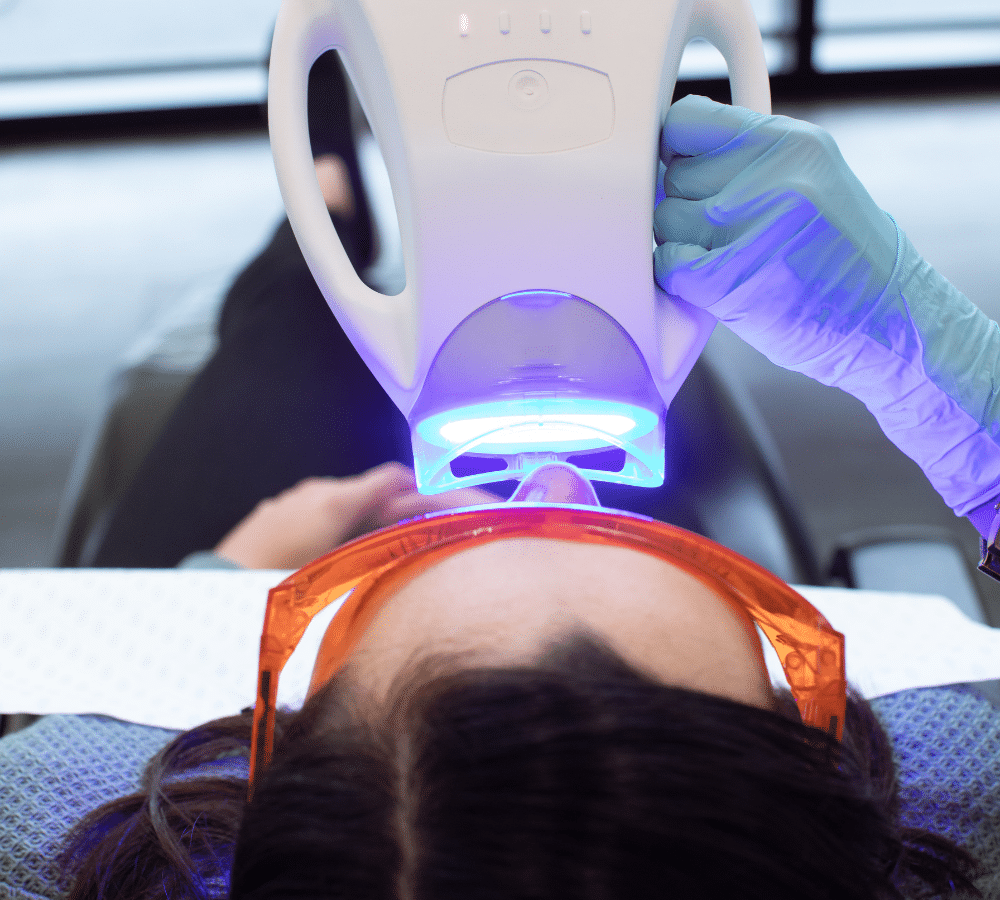
The whitening is performed at the practice.
A stronger peroxide is used, which achieves a slightly greater immediate effect than the take-home kit can produce.
The gap between the two is largely a matter of what the law permits to leave the building. The ADA records that effective hydrogen peroxide concentrations “vary greatly from concentrations as low as 3-6% for some products supplied to patients for home use to 35% in some office-based bleaching products.”
The combination
The approach many clinicians favour is both: in-chair bleaching for the initial result, maintained over time with at-home whitening.
The logic is straightforward given the 18-to-24-month figure. The in-chair treatment gets you to the shade; the take-home trays let you top up periodically rather than repeating the whole process.
Why the dental assessment comes first
This is not a formality, and no whitening should be offered without it. See Why should I go to a dentist for teeth whitening?.
The ADA puts the reason plainly: “appropriate examination to diagnose and treat any dental or oral health problems is required to minimise any potential discomfort or health risks associated with exposure to bleaching agents.”
Before any whitening, a clinician checks:
That there are no open cavities. Peroxide reaching the inside of a tooth through a cavity is a route to significant sensitivity and pain — and whitening does not treat decay, it sits on top of it. See Tooth Fillings.
That there is sufficient enamel to prevent prolonged sensitivity. Where enamel is thin or worn, the dentine beneath is closer to the surface and responds far more sharply. The ADA describes the mechanism: peroxide percolating “into the nerve tissues — often accelerated by exposed dentine and enamel fractures — can lead to nerve inflammation.” Grinding is a common cause of that wear — see TMD and Teeth Grinding — and so are untreated cracks, see Chipped and Cracked Teeth.
That the peroxide strength is tailored to your tolerance. For people with a high level of sensitivity, a lower concentration is used. See What to do if you suffer from sensitive teeth.
Gum health is part of the same check — see Bleeding Gums and Dental Cleans & Hygienists, since a professional clean alone removes surface staining and sometimes achieves enough.
This is the part that separates supervised whitening from unsupervised whitening, and it is the reason the assessment is not skippable. A great deal of research has gone into the science of whitening. It is not as simple as it is sometimes made out.
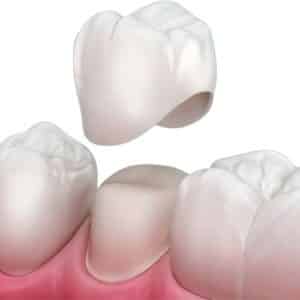
One thing an assessment also establishes: existing crowns, veneers and composite fillings do not whiten. If you have restorations on your front teeth, whitening the natural teeth around them will change how well they match — which is worth knowing before, not after. See I want to whiten my teeth but one of my front teeth has a porcelain crown, Dental Crowns and Porcelain Veneers.
And it establishes the cause. Trauma discolouration, tetracycline staining and fluorosis behave quite differently from coffee stain — see How can I improve the whiteness of my teeth?.
What consent should cover
Informed consent for whitening is expected to be broader than a signature. The ADA states that “risks and costs associated with the treatment should be explained to the patient and documented along with informed consent” — costs included, deliberately. The Dental Board and Ahpra guidance for practitioners is more specific still: “You must have and document their informed consent, including financial consent.”
So it is reasonable, and expected, to ask before you begin:
- What is causing my discolouration, and is peroxide the right tool for it?
- What range of change is realistic for my starting shade — not a promise, a range
- What will this cost in total, including any follow-up gel or replacement restorations
- What are the likely side effects, how long do they usually last, and what do we do if they don't settle
- Do I have any restorations on show that will end up mismatched
See Understanding Your Treatment and, on fees, the Price Guide.
What over-the-counter products actually do
Many are relatively safe — because the level of peroxide they contain is very low or non-existent.
Instead, they generally contain abrasives that remove external staining from the teeth.
That is a meaningful distinction, and it is built into the ADA's own definition. It defines teeth whitening as “the use of teeth whitening products designed to penetrate the teeth and bleach intrinsic and/or extrinsic tooth discolourations, as opposed to products such as whitening toothpastes that are intended to remove surface staining.”
Removing surface stain is not the same as whitening the tooth. These products can make teeth look cleaner. They do not change the intrinsic colour of the tooth the way peroxide does.
Where a consumer product does contain peroxide, the Poisons Standard caps how much. As set out in ADA Policy Statement 2.2.8, hydrogen peroxide 3-6% and carbamide peroxide 9-18% are Schedule 5 substances requiring “Caution”, which “can be sold direct to consumers if they are labelled with stipulated safety warnings” — while anything above 6% hydrogen peroxide or 18% carbamide peroxide falls under Schedule 10 and “may only be sold, supplied and used by registered dental practitioners as part of their dental practise.” Carbamide peroxide converts at roughly one third: 18% carbamide peroxide approximates 6% hydrogen peroxide.
The ADA also warns that “from time to time, some products containing concentrations of bleaching agents that exceed legal limits in Australia have been found to be available online to Australian consumers” — worth remembering when a listing promises results a compliant product could not deliver.
Are the abrasives harmful?
Any abrasive can cause wear and tear to tooth enamel if not used properly.
Off-the-shelf products are generally safe in this regard, but should be used with caution and strictly according to the manufacturer's instructions. See Home whitening and charcoal whitening: does it work? Is it safe?.
The greater concern is people buying these products online or over the counter without a clean bill of dental health and without the supervision of a qualified dentist — and the unpredictability of the outcome they produce.
There is also the expectation problem. The ADA notes that marketing of some consumer whitening products “encourages unrealistic expectations about whitening results and promotes regular ongoing use to maintain desired effects”, which is “a concern given the lack of clinical data supporting frequent home use of such products over long periods.”
Whitening outside a dental setting
A greater risk is presented by the high concentrations of peroxide sometimes used in beauty salons and solariums.
The ADA describes the trend directly: whitening services are “increasingly offered by unregulated, unqualified non dental practitioners in settings such as beauty and hair salons, shopping mall kiosks, dedicated teeth whitening salons, or via mobile services that travel to a location convenient to the consumer”, and many such services “claim that their practitioners are ‘teeth whitening specialists' with the knowledge or training to perform teeth whitening procedures safely.”
The ADA's answer to that claim: “only registered dental practitioners have the expertise to assess whether bleaching is safe for individual patients, to recommend the most appropriate technique and materials, and to provide treatment that meets regulated safety and quality standards of care.” Beyond expertise, it is a question of law — Schedule 10 restricts the higher-concentration products to registered dental practitioners.
Strong products can cause damage when administered by people without appropriate training and experience in dentistry. Chemical burns and gum damage following whitening performed in non-dental settings have been reported, and remedial dental care is sometimes required afterwards. See White fright: burns and multicoloured teeth.
Where a light or laser is involved there is a further hazard. The ADA notes that “the incorrect application of heat and other forms of energy during teeth whitening procedures, such as light from a plasma arc lamp or high-power (Class 4) laser may cause nerve damage to the tooth and burns to adjacent soft tissues, and failure to ensure use of the appropriate protective eyewear may also cause irreversible injury.” The relevant training and equipment standard is AS/NZS 4173:2018, Safe use of lasers and intense light sources in health care, and in Victoria — as in Western Australia, Queensland and Tasmania — practitioners must obtain a licence from the state regulatory authority before using Class 4 lasers.
There is also a simpler problem: people who have had whitening done in a salon or solarium frequently report disappointment with the result. Without the pre-treatment assessment, nobody has established what was causing the discolouration or whether peroxide would address it.
The advice is to play it safe: see a qualified dentist before embarking on any teeth whitening treatment. Registration can be verified free on the AHPRA register — see Dentists & Registered Specialists.
If whitening is not the answer
Where the colour cannot be changed chemically, the options are porcelain veneers, composite bonding or crowns — see Cosmetic dentistry options and Cosmetic Dentistry. Fees are on the Price Guide.
Common questions
Does it hurt, and does it damage the enamel?
The honest answer on comfort is that sensitivity is common, usually temporary, and the main reason people stop a course early.
The Australian Dental Association's summary of the published evidence is worth quoting in full, because it says both halves: peroxide-containing bleaching products “are safe and effective when used by or under the supervision of a dentist and according to the professional directions for use,” and “the most common side-effects are transient tooth sensitivity and soft tissue irritation during or immediately following treatment.” Transient is the operative word — sensitivity during and shortly after treatment, settling afterwards.
What that sentence also does is attach the safety finding to two conditions: supervision, and the professional directions for use. It is not a general statement about peroxide applied any way at all.
The practical levers if it does bite are concentration and contact time rather than gritting your teeth. A lower-concentration gel, shorter daily wear, or a break of a day or two between applications are all ordinary adjustments, and a desensitising regimen can be used alongside. Tell whoever is supervising the course rather than abandoning it — and if sensitivity is severe or does not settle after treatment ends, that needs looking at rather than waiting out. See what to do if you suffer from sensitive teeth.
Does the light or laser actually make it whiter?
This is the part of in-chair whitening people most often assume is doing the work, and the claim made for it is narrower than the theatre suggests.
The ADA describes light and heat sources as being used “sometimes with the aid of a light or heat source that may shorten the application time required.” Shorten the application time — not produce a whiter result. That is the claim in the Australian professional position, and it is a claim about speed.
Against that, energy applied to teeth carries a specific risk the gel alone does not: the ADA warns that incorrectly applied heat or light, including from a plasma arc lamp or a high-power Class 4 laser, “may cause nerve damage to the tooth and burns to adjacent soft tissues,” and that failing to use proper protective eyewear “may also cause irreversible injury.” That is why the training and licensing requirements described above exist.
None of which makes light-assisted whitening wrong. It makes it a reasonable question to ask: what is the light contributing in my case, and what is it adding to the cost?
The salon says their staff are ‘teeth whitening specialists'. Does that mean anything?
Not as a qualification, no — and the word is doing more work in that sentence than it is entitled to.
In Australia, specialist is a protected title under the Health Practitioner Regulation National Law. The Dental Board of Australia recognises 13 dental specialties, approved by the Australian Health Workforce Ministerial Council: dento-maxillofacial radiology, endodontics, forensic odontology, oral and maxillofacial pathology, oral and maxillofacial surgery, oral medicine, oral surgery, orthodontics, paediatric dentistry, periodontics, prosthodontics, public health dentistry and special needs dentistry. Teeth whitening is not among them, and there is no register of whitening specialists to check anyone against.
The ADA flags precisely this usage, noting that many non-dental whitening services “claim that their practitioners are ‘teeth whitening specialists' with the knowledge or training to perform teeth whitening procedures safely,” and answers it: “only registered dental practitioners have the expertise to assess whether bleaching is safe for individual patients.”
What you can verify, in about a minute and for nothing, is registration. Search the person's name on AHPRA's public register: it will tell you whether they hold current registration as a dental practitioner, what division that registration is in, whether any conditions apply, and whether they hold specialist registration in one of the 13 fields. If the name is not on the register at all, that is the answer to the question.
Can I just buy the stronger gel online?
You can, which is not the same as it being a good idea, and the risks are chemical rather than theoretical.
Anything above 6 per cent hydrogen peroxide or 18 per cent carbamide peroxide sits in Schedule 10 of the Poisons Standard — the schedule the ADA describes as covering substances “of such danger to health as to warrant prohibition of their sale, supply and use other than in specified exempt circumstances.” The exemption is registered dental practitioners in practice. A seller shipping that strength to a consumer is outside the scheme, and the ADA confirms products exceeding Australian legal limits do turn up online.
What the higher concentration actually does if it goes wrong is set out in the same ADA policy. WorkSafe Australia designates hydrogen peroxide above 5 per cent a hazardous substance; direct contact with skin, eyes or the lining of the mouth “may cause severe irritation or burns,” and swallowing it “may cause irritation to the oesophagus and stomach resulting in bleeding or sudden distension.” A gel that is not held off the gums by a fitted tray is a gel in contact with soft tissue for the duration.
There is also no one checking the things the assessment checks — an open cavity, a crack, thin enamel, a front crown that will not change colour with everything around it. The cheap kit stays cheap right up until the point where it is not.
How often can I top up, and can I overdo it?
This is the place where the evidence is genuinely thin, and it is more useful to say so than to invent a schedule.
The ADA's position on consumer products is that their marketing “promotes regular ongoing use to maintain desired effects,” and calls that “a concern given the lack of clinical data supporting frequent home use of such products over long periods.” In other words: the open question is not whether one course is safe — that is reasonably well supported — but whether repeating it indefinitely is, and the studies to answer that have not been done.
So the sensible approach is the one built around the figure at the top of this page. Results typically hold for 18 to 24 months; a short top-up in existing custom trays when the shade drifts is a proportionate response; a permanent nightly habit is not, and nobody can tell you it is safe because nobody has measured it.
Two practical markers that you are overdoing it and should stop and be seen: sensitivity that arrives sooner and lasts longer with each course, and gums that are sore or blanched after wearing the tray. Neither is something to push through.
Practical details
Smile Solutions, Level 1, 220 Collins Street, Manchester Unity Building, Melbourne VIC 3000. Phone 13 13 96, or theteam@smilesolutions.com.au. Monday–Friday 8.00am–6.00pm, Saturday 8.30am–1.30pm, Sunday by appointment. Full details on Contact Us; the clinicians are listed on Our Team.
Quoted regulatory and safety statements are from ADA Policy Statement 2.2.8, Teeth Whitening (Bleaching) By Persons other than Dental Practitioners (Australian Dental Association, reviewed September 2025); the Dental Board of Australia practitioner resource Teeth whitening products; the Dental Board and Ahpra fact sheet Using and supplying teeth whitening products; and, for the list of recognised dental specialties, the Dental Board of Australia's registration information. Scheduling classifications can change — check the current Poisons Standard for the position at any given date.
Published 13 June 2018. Results, duration and sensitivity vary between individuals; whitening is not suitable for everyone. General information only; it does not replace advice from your treating practitioner.
Smile Solutions trades under ABN 28 193 514 103.
Images on This Page
-
https://www.facebook.com/tr?id=800557773428361&ev=PageView&noscript=1
(no alt text)
-
https://www.smilesolutions.com.au/wp-content/uploads/2025/10/calendar_month.svg
(no alt text)
-
https://www.smilesolutions.com.au/wp-content/themes/arcadian-wordpress-theme/assets/images/smile_solutions_logo_white.png
Smile Solutions Logo
-
https://www.smilesolutions.com.au/wp-content/themes/arcadian-wordpress-theme/assets/images/smile_solutions_logo_purple.png
Smile Solutions Logo
-
https://www.smilesolutions.com.au/wp-content/uploads/2023/11/SS-Tooth-1-1-150x150.png
Smile Solutions
-
https://www.smilesolutions.com.au/wp-content/uploads/2025/09/Professional-Teeth-Whitening-Smile-Solutions.png
Professional In-Chair Teeth Whitening Smile Solutions Melbourne
-
https://www.smilesolutions.com.au/wp-content/uploads/2025/09/Root-Canal-2-300x217.jpg
Root Canal
-
https://www.smilesolutions.com.au/wp-content/uploads/2026/08/Mouth-Breathing-300x270.jpg
Mouth Breathing
-
https://www.smilesolutions.com.au/wp-content/uploads/2025/09/Dental-Crown-at-Smile-Solutions-300x300.jpg
Dental Crown at Smile Solutions
-
https://www.smilesolutions.com.au/wp-content/themes/arcadian-wordpress-theme/assets/images/family_owned_bussiness.png
Family Owned Business
-
https://www.smilesolutions.com.au/wp-content/themes/arcadian-wordpress-theme/assets/icons/icon--phone.svg
Smile Solutions Contact
-
https://www.facebook.com/tr? id=800557773428361&ev=PageView&noscript=1
(no alt text)
-
https://bat.bing.com/action/0?ti=25148060&tm=gtm002&Ver=2&mid=0203e7db-0497-4a45-898a-8a75d40f3e61&bo=1&sid=e87b6a00ab2611f194d0a17784e7b370&vid=e87bd6c0ab2611f1ac244591fafbc213&vids=1&msclkid=N&pi=918639831&lg=en-US&sw=800&sh=600&sc=24&nwd=1&tl=What%20should%20I%20know%20about%20teeth%20whitening%3F%20-%20Smile%20Solutions&p=https%3A%2F%2Fwww.smilesolutions.com.au%2Fdental-articles%2Farticle%2Fknow-teeth-whitening%2F&r=&evt=pageLoad&sv=2&cdb=AQAQ&rn=308591
(no alt text)