What makes teeth whitening work?
The products available range from whitening toothpaste, adhesive strips and fitted trays to in-chair whitening performed by a dentist — varying enormously in price and result. See Teeth Whitening.
Successful whitening depends on two things: the percentage of whitening agent applied, and the method of application. Everything below follows from those two variables.
The point to understand before starting
All forms of tooth whitening involve an irreversible chemical change to the teeth. For that reason a dentist should be consulted before the procedure. See General Dentistry and Why should I go to a dentist for teeth whitening?.
Whitening does not cause decay, but it can facilitate the process, and it can cause sensitivity.
You may not be a good candidate if you have:
- decayed teeth — see Tooth Fillings
- infected gums — see Bleeding Gums
- white spots on your teeth
- multiple tooth-coloured fillings or crowns on the front teeth — because these will not whiten, and will end up mismatched. See I want to whiten my teeth but one of my front teeth has a porcelain crown
The difference: how much bleaching agent
Hydrogen and carbamide peroxide are the common active agents. (Carbamide peroxide breaks down into hydrogen peroxide and urea, with hydrogen peroxide the active whitening ingredient.)
The conversion between the two is worth knowing, because it stops the numbers on a box from being misleading. The Australian Dental Association's Policy Statement 2.2.8 states that many bleaching products contain carbamide peroxide, “one-third of its concentration being equivalent to hydrogen peroxide, e.g., 18% carbamide peroxide approximates 6% hydrogen peroxide.” A tube labelled 16% carbamide peroxide is therefore not twice as strong as one labelled 9% hydrogen peroxide — it is weaker.
Effective concentrations of hydrogen peroxide range from as low as 3% to as high as 25%.
Most over-the-counter pharmacy products contain 5.5% hydrogen peroxide.
The ADA describes the wider range in the same terms: effective hydrogen peroxide concentration “varies greatly from concentrations as low as 3-6% for some products supplied to patients for home use to 35% in some office-based bleaching products.”
Where the legal line actually sits
This is the part that explains the gap in results, and it is worth stating precisely because it is frequently stated loosely.
The restriction comes from the Poisons Standard, and it is enforced through state and territory poisons legislation. ADA Policy Statement 2.2.8 sets out both tiers:
- Schedule 5 — “Caution”. The Poisons Standard “recognises hydrogen peroxide 3-6% and carbamide peroxide 9-18% as Schedule 5 substances requiring ‘Caution’, meaning that teeth whitening products containing up to these concentrations can be sold direct to consumers if they are labelled with stipulated safety warnings.”
- Schedule 10 — restricted to dental practitioners. Schedule 10 “lists substances of such danger to health as to warrant prohibition of their sale, supply and use other than in specified exempt circumstances”, and it “specifically states that teeth whitening products containing more than 6% hydrogen peroxide or 18% carbamide peroxide may only be sold, supplied and used by registered dental practitioners as part of their dental practise.” Those provisions are “formalised in all state and territory poisons legislation.”
The Dental Board of Australia states the same rule from the practitioner's side: “Australian laws mean only registered dental practitioners can use or supply high-concentration teeth whitening products (over 18% carbamide peroxide or 6% hydrogen peroxide).”
The Australian Competition and Consumer Commission has a role here, but it is a different one. The ADA's position is that the ACCC “should continually monitor the advertising and supply of teeth whitening products and services to assess and enforce compliance with relevant legislation, including state and territory poisons laws”, along with labelling standards and the product safety and advertising provisions of the Competition and Consumer Act 2010. So the concentration limit is set by the Poisons Standard; the ACCC is one of the bodies policing compliance and the claims made in advertising.
That regulation is the whole explanation for the gap in results. A pharmacy product legally cannot contain what a dentist can apply.
Put the numbers side by side and it stops being abstract. A pharmacy kit at 5.5% hydrogen peroxide sits inside the Schedule 5 band — which is exactly why you can pick it up yourself. The 9.5% hydrogen peroxide day gel described below is above the 6% line, which is why it can only reach you through a registered dental practitioner. The 16% carbamide peroxide night gel sits below the 18% line, and the Dental Board's position is nonetheless that products “can be supplied for home use if the patient is assessed as suitable” — the assessment is a professional obligation, not a formality attached to the strongest products only.
Why the line is drawn where it is
The thresholds are not arbitrary. The ADA sets out the reasoning:
- WorkSafe Australia's guidelines designate hydrogen peroxide at concentrations above 5% as a hazardous substance.
- “Direct exposure of the skin, eyes and mucous membranes to hydrogen peroxide may cause severe irritation or burns, while ingestion may cause irritation to the oesophagus and stomach resulting in bleeding or sudden distension.”
- “Percolation of hydrogen peroxide into the nerve tissues — often accelerated by exposed dentine and enamel fractures — can lead to nerve inflammation.”
That last point is the one most directly relevant to a home kit used without an examination. A tooth with worn enamel, an untreated crack or exposed root surface is a different proposition from an intact one, and nothing on the packaging can tell the difference. See Chipped and Cracked Teeth and How is dental erosion addressed?.
By contrast, the ADA records that weak solutions “(<3%) of hydrogen peroxide have been used in the oral cavity in the form of mouthwashes and toothpaste for many years with few problems”, and that “the potential for adverse effects on the oral tissues is increased when higher concentrations are used.” The risk scales with concentration, which is precisely why the schedules are graded.
One more thing worth knowing before buying online: the ADA notes that “from time to time, some products containing concentrations of bleaching agents that exceed legal limits in Australia have been found to be available online to Australian consumers.” An overseas listing is not subject to an Australian pharmacist or an Australian label.
Three risks with pharmacy kits
Beyond often failing to achieve a significant change in colour, they carry specific risks:
1. No check-up first. Whitening happens without any assessment of whether the teeth are healthy and can safely be whitened. Not all teeth have suitable enamel structure for whitening — that has to be assessed by a practitioner. A dark single tooth after trauma, for instance, usually needs a different treatment entirely: see Root Canal and How can I improve the whiteness of my teeth?.
2. Trays that don't fit. Pharmacy trays are not custom-fitted, so they rarely cover the teeth adequately. That risks burning the gums and patchy colouring across the teeth.
3. Abrasion. Pharmacy whitening gels and toothpastes can be abrasive, wearing the teeth away as they remove staining. Over time that wear becomes severe enough to expose the dentine underneath — which is both yellow and very sensitive.
Once dentine is exposed, no whitening technique will be effective. That is the outcome worth avoiding: a permanent problem created in pursuit of a temporary one. The same argument applies to abrasive home remedies — see Home whitening and charcoal whitening: does it work? Is it safe? and The do's and don'ts of home teeth whitening.
There is a fourth, quieter risk: expectation. The ADA observes that the marketing of some consumer whitening products “encourages unrealistic expectations about whitening results and promotes regular ongoing use to maintain desired effects”, and that this is “a concern given the lack of clinical data supporting frequent home use of such products over long periods.” Buying repeatedly because the result keeps fading is a business model, not a treatment plan.
Whitening done outside a dental practice
A separate category again is whitening offered by people who are not dental practitioners. The ADA notes these services are “increasingly offered by unregulated, unqualified non dental practitioners in settings such as beauty and hair salons, shopping mall kiosks, dedicated teeth whitening salons, or via mobile services”, and that many such services “claim that their practitioners are ‘teeth whitening specialists’”.
The ADA's position on that claim is unambiguous: “only registered dental practitioners have the expertise to assess whether bleaching is safe for individual patients, to recommend the most appropriate technique and materials, and to provide treatment that meets regulated safety and quality standards of care.” And under Schedule 10 the higher-concentration products may lawfully be used only by a registered dental practitioner in the first place.
There is a related hazard where a light or laser is used. The ADA records that “the incorrect application of heat and other forms of energy during teeth whitening procedures, such as light from a plasma arc lamp or high-power (Class 4) laser may cause nerve damage to the tooth and burns to adjacent soft tissues, and failure to ensure use of the appropriate protective eyewear may also cause irreversible injury.” Training standards for this equipment are set out in AS/NZS 4173:2018, Safe use of lasers and intense light sources in health care, and the ADA notes that Victorian legislation — along with Western Australian, Queensland and Tasmanian — requires practitioners to obtain a licence from the state regulatory authority before undertaking dental procedures with Class 4 lasers.
If you are choosing a provider, you can check registration free on the Ahpra register — see Dentists & Registered Specialists — and it is worth reading White fright: burns and multicoloured teeth.
The professional options
Take-home
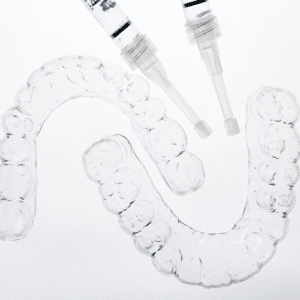
Custom-fitted trays, professionally designed to fit your teeth precisely. They are more effective than stock trays because they hold the bleach gel correctly over the teeth while keeping it away from the gums.
After consultation, the dentist determines the appropriate gel:
- “Day White” — worn one hour a day, containing 9.5% hydrogen peroxide
- “Night White” — worn overnight, containing 16% carbamide peroxide
Because these are supplied for you to use unsupervised at home, a further set of obligations applies. The Dental Board expects the practitioner to determine suitability by “carrying out an appropriate assessment and examination”, “considering their history”, and “applying the principles of risk minimisation and management”. Consent must be documented, and Ahpra's guidance specifies that this includes “financial consent”. The Board also sets out the practitioner's obligations under the Australian Consumer Law when a product is supplied for home use — consumer guarantees that the product is of acceptable quality, replacing, repairing or refunding it in certain circumstances, and compensating a patient for damages and loss. See Understanding Your Treatment.
In-chair
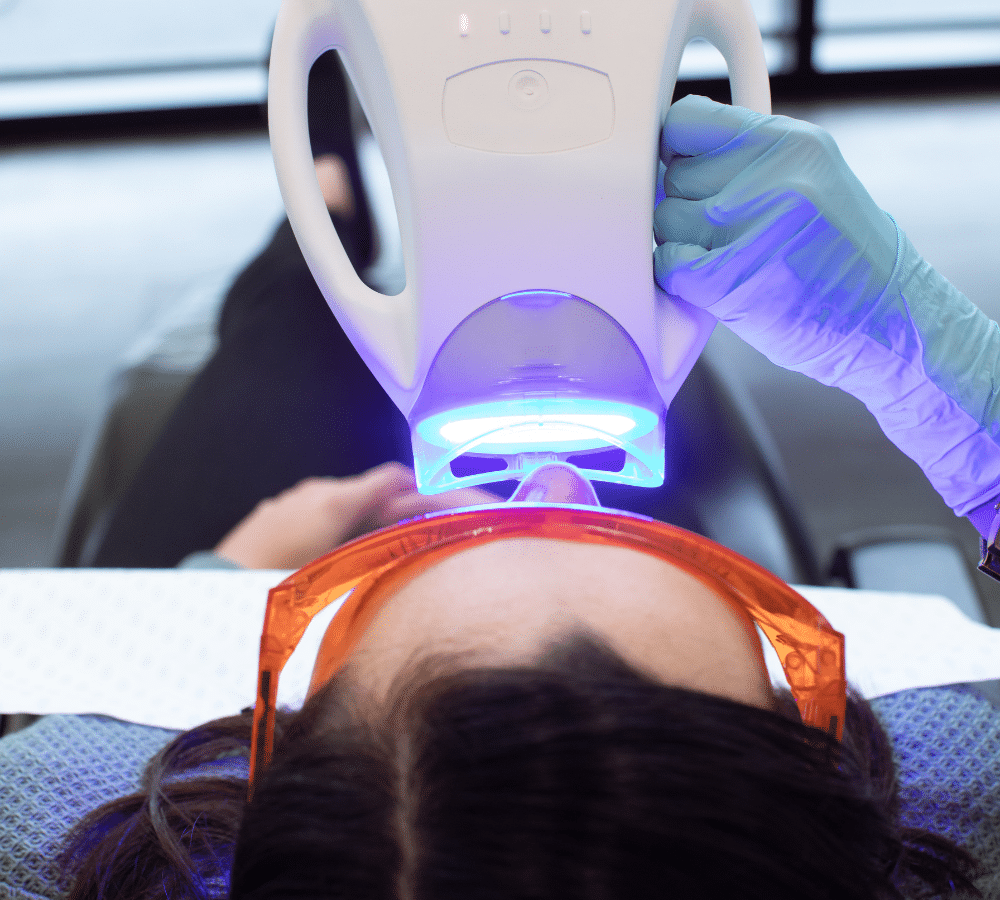
- A protective barrier is placed on the gums
- 25% hydrogen peroxide paste is applied to the teeth
- A light accelerates the action of the hydrogen peroxide
- The paste is removed and reapplied two to three times, depending on your sensitivity
The procedure can achieve about four to six shades of whitening in a single forty-minute treatment.
The difference between in-chair whitening and take-home whitening sets out how to choose, and What teeth whitening options are available at Smile Solutions? lists what is offered.
Why go to a dentist
The greatest possible colour change, because practitioners have access to much higher-strength products than pharmacies can sell.
And greater safety, because:
- a consultation and check-up confirm your teeth are healthy and suitable
- the approach is tailored to you rather than generic
- in-chair treatment is supervised, so it can be adjusted on the day
- take-home kits come with consultation and counselling, plus custom trays that give consistent colour change and reduce the risk of burning the gums
- stronger concentrations yield a more reliable and effective result
- the dentist can monitor and treat sensitivity, and modify the procedure where results are not coming
- other options can be explored — porcelain or resin veneers, tooth-coloured fillings, gum lifts and tooth shaping via edge work and composite bonding, with or without whitening
That last point matters more than it sounds. Sometimes whitening is not the treatment that achieves the result you actually want. See Cosmetic dentistry options and Cosmetic Dentistry.
On sensitivity specifically, the ADA's summary of the peer-reviewed evidence is that peroxide-containing bleaching products “are safe and effective when used by or under the supervision of a dentist and according to the professional directions for use”, and that “the most common side-effects are transient tooth sensitivity and soft tissue irritation during or immediately following treatment.” Both halves of that sentence matter. Supervision is doing work in it, and side effects are expected rather than exceptional. See What to do if you suffer from sensitive teeth.
No shade outcome can be promised in advance, by us or by anyone else. What a consultation can give you is a realistic idea of what your particular teeth are likely to do.
How long it lasts
Whitening is not permanent, and the same habits that stained the teeth will stain them again. See How long do the effects of teeth whitening last? and What should I know about teeth whitening?. A professional clean on schedule does more for day-to-day brightness than most people expect — Dental Cleans & Hygienists.
Cost
Fees are on the Price Guide.
Common questions
Does whitening toothpaste actually whiten anything?
Not in the sense the word is being used everywhere else on this page — and the Australian Dental Association's own definition draws the line explicitly.
ADA Policy Statement 2.2.8 defines the term this way: “TEETH WHITENING is the use of teeth whitening products designed to penetrate the teeth and bleach intrinsic and/or extrinsic tooth discolourations, as opposed to products such as whitening toothpastes that are intended to remove surface staining.”
Read the second half of that sentence carefully. A whitening toothpaste is defined by the ADA as a stain-removal product, and it is placed in deliberate contrast to the bleaching products the rest of the policy is about. It works on what has settled on the outside of the tooth — tea, coffee, red wine, tobacco. It does not change the colour of the tooth itself.
Which has two practical consequences.
If your teeth are stained on the surface, a whitening toothpaste may do something useful, and so will a professional clean — often considerably more, and without the abrasion. If the colour you dislike is the tooth's own shade, or a single tooth that darkened after an injury, no toothpaste will touch it, and continuing to buy them is money spent on the wrong problem.
The abrasion point is the one to take seriously. As the section above sets out, whitening gels and toothpastes can be abrasive, wearing the teeth away as they remove staining — and once that wear exposes the dentine underneath, the tooth is both yellower and more sensitive, and no whitening technique will be effective. A product marketed on the strength of its polishing action is not a neutral choice for daily, long-term use.
If surface staining is the problem, book the clean and ask which toothpaste suits your enamel rather than choosing by the claim on the front of the tube. See Dental Cleans & Hygienists and how can I improve the whiteness of my teeth?
The salon calls their operator a “teeth whitening specialist”. Is that a real qualification?
No. It is a marketing phrase, and the ADA names the practice directly.
Policy Statement 2.2.8 records that many non-dental whitening services “claim that their practitioners are ‘teeth whitening specialists’ with the knowledge or training to perform teeth whitening procedures safely”, and answers it plainly: “only registered dental practitioners have the expertise to assess whether bleaching is safe for individual patients, to recommend the most appropriate technique and materials, and to provide treatment that meets regulated safety and quality standards of care.”
The regulatory position makes it sharper still. In Australia, specialist titles in dentistry are protected titles under the National Law, and the Dental Board of Australia recognises 13 dental specialties, approved by the Australian Health Workforce Ministerial Council. Teeth whitening is not one of them, and no such specialty exists. So the phrase is not describing a registration category — there is nothing behind it to check.
There is something you can check, in about a minute. Search the person's name on the Ahpra register at ahpra.gov.au. If they are a registered dental practitioner, the register will show the division they are registered in and any conditions on their registration. If they do not appear at all, they are not a registered dental practitioner — and under Schedule 10 they cannot lawfully use or supply products above 6% hydrogen peroxide or 18% carbamide peroxide in the first place.
If something goes wrong, there is a reporting pathway. The ADA's position is that regulatory authorities should educate the public about the risks of whitening undertaken by people other than dental practitioners and “encourage them to report any concerns they have about teeth whitening products or services to the appropriate authorities.” It also looks to the ACCC to monitor advertising and supply for compliance with poisons laws, labelling standards, and the product safety, product liability and “mandatory reporting of adverse events causing consumer harm” provisions of the Competition and Consumer Act 2010. A concern about a registered practitioner goes to Ahpra; a concern about a product, an advertisement or an unregistered operator goes to the ACCC and your state's consumer affairs or health complaints body.
See Dentists & Registered Specialists.
How do I tell what I am actually buying? What should be on the box?
Three things, and they take a few seconds each.
First, find the active ingredient and its concentration. It will be given as either hydrogen peroxide or carbamide peroxide, and the two are not interchangeable — the ADA's conversion is that one-third of a carbamide peroxide concentration is equivalent to hydrogen peroxide, so 18% carbamide peroxide approximates 6% hydrogen peroxide. Divide any carbamide figure by three before comparing it with anything.
Second, check it against the schedule boundaries. Anything up to 6% hydrogen peroxide or 18% carbamide peroxide sits in Schedule 5 and can lawfully be sold direct to you. Above those figures, the product “may only be sold, supplied and used by registered dental practitioners as part of their dental practise.” So a consumer product claiming a concentration above the line is either mislabelled or should not be reaching you that way.
Third, look for the safety warnings. Schedule 5 classification requires “Caution” labelling — the ADA's wording is that products up to those concentrations can be sold direct to consumers “if they are labelled with stipulated safety warnings.” A product with no concentration stated and no warnings is telling you something by omission.
Two specific traps. Online and overseas listings are the main route by which non-compliant product reaches Australians — the ADA notes that “from time to time, some products containing concentrations of bleaching agents that exceed legal limits in Australia have been found to be available online to Australian consumers.” An international seller is not bound by the Australian label. And a low concentration is not the same as low risk for you specifically: the hazard that scales with concentration is chemical burn and nerve irritation, and the ADA notes that percolation into the nerve tissues is “often accelerated by exposed dentine and enamel fractures.” A mild product on a cracked or worn tooth is not a mild situation.
The short version: the number on the box tells you what the product can do; only an examination tells you what your teeth can take.
What should I be told before I agree — and what if the result disappoints me?
There is a published expectation about the conversation, and it is worth knowing so you can tell whether you have had it.
ADA Policy Statement 2.2.8 sets out four things. Whitening “should only be performed if the treatment can be justified, and after a comprehensive dental examination has been conducted by a Dental Practitioner.” The “risks and costs associated with the treatment should be explained to the patient and documented along with informed consent.” Practitioners “should ensure that patients have realistic and reasonable expectations regarding the results of the bleaching treatment.” And only practitioners educated, trained and competent in whitening “can assess whether it is safe for individual patients to undergo teeth whitening.”
So the consultation should tell you what is causing your discolouration, whether bleaching is the right treatment for that cause, what result is realistically achievable on your teeth, what it will cost, and what the side effects are. The ADA's own summary of the evidence is that “the most common side-effects are transient tooth sensitivity and soft tissue irritation during or immediately following treatment” — expected, in other words, rather than a sign something has gone wrong.
On disappointment, two honest points.
No shade can be promised in advance, and this page does not promise one. Teeth respond differently depending on the cause of the discolouration, and existing crowns, veneers and tooth-coloured fillings do not change colour at all — which is the most common reason a result looks uneven afterwards. That is a reason to raise your restorations before treatment, not after.
But a supplied product is also a consumer transaction. The Dental Board sets out that practitioners who supply or sell whitening products for home use must meet the Australian Consumer Law, which includes consumer guarantees that the product is of acceptable quality, obligations to replace, repair or refund in certain circumstances, and to compensate for damages and loss. Ahpra's guidance also specifies that documented consent includes “financial consent.”
Practically: ask for the plan and the fee in writing before you start, ask what happens if the result falls short of what was discussed, and ask whether a review appointment is included. See Understanding Your Treatment and the Price Guide.
Practical details
Written by Dr Madeleine Hoopmann, Smile Solutions. Registration can be verified free on the AHPRA register, or by calling 1300 419 495; the clinicians are listed on Our Team.
Smile Solutions, Level 1, 220 Collins Street, Manchester Unity Building, Melbourne VIC 3000. Phone 13 13 96, or theteam@smilesolutions.com.au. Monday–Friday 8.00am–6.00pm, Saturday 8.30am–1.30pm, Sunday by appointment. Full details on Contact Us.
Quoted regulatory and safety statements are from ADA Policy Statement 2.2.8, Teeth Whitening (Bleaching) By Persons other than Dental Practitioners (Australian Dental Association, reviewed September 2025); the Dental Board of Australia practitioner resource Teeth whitening products; and the Dental Board and Ahpra fact sheet Using and supplying teeth whitening products. Scheduling classifications can change — check the current Poisons Standard for the position at any given date.
Published 20 August 2018. Product concentrations and regulatory limits are as at that date. Whitening results vary between individuals and depend on the cause of discolouration. General information only; it does not replace advice from your treating practitioner.
Smile Solutions trades under ABN 28 193 514 103.
Images on This Page
-
https://www.facebook.com/tr?id=800557773428361&ev=PageView&noscript=1
(no alt text)
-
https://www.smilesolutions.com.au/wp-content/uploads/2025/10/calendar_month.svg
(no alt text)
-
https://www.smilesolutions.com.au/wp-content/themes/arcadian-wordpress-theme/assets/images/smile_solutions_logo_white.png
Smile Solutions Logo
-
https://www.smilesolutions.com.au/wp-content/themes/arcadian-wordpress-theme/assets/images/smile_solutions_logo_purple.png
Smile Solutions Logo
-
https://www.smilesolutions.com.au/wp-content/uploads/2016/05/Madeleine-150x150.jpg
Dr Madeleine Hoopmann
-
https://www.smilesolutions.com.au/wp-content/uploads/2025/09/Professional-Teeth-Whitening-Smile-Solutions.png
Professional In-Chair Teeth Whitening Smile Solutions Melbourne
-
https://www.smilesolutions.com.au/wp-content/uploads/2026/01/Cosmetic-Consult-300x270.jpg
Consultation at a cosmetic clinic.
-
https://www.smilesolutions.com.au/wp-content/uploads/2021/03/Rojina-1-300x270.jpg
Rojina 1
-
https://www.smilesolutions.com.au/wp-content/uploads/2025/11/Smile-Solutions-Whitening-Trays-300x300.png
Professional Take-Home Whitening Trays
-
https://www.smilesolutions.com.au/wp-content/themes/arcadian-wordpress-theme/assets/images/family_owned_bussiness.png
Family Owned Business
-
https://www.smilesolutions.com.au/wp-content/themes/arcadian-wordpress-theme/assets/icons/icon--phone.svg
Smile Solutions Contact
-
https://www.facebook.com/tr? id=800557773428361&ev=PageView&noscript=1
(no alt text)
-
https://bat.bing.com/action/0?ti=25148060&tm=gtm002&Ver=2&mid=00d490ec-8ac1-4675-9371-355bf75afc32&bo=1&sid=2c344cf0ab2711f1b3904bfa1380b207&vid=2c347960ab2711f180c5a1656e1eea1c&vids=1&msclkid=N&pi=918639831&lg=en-US&sw=800&sh=600&sc=24&nwd=1&tl=Difference%20between%20pharmacy%20whitening%20kits%20and%20dentist%20whitening%3F%20-%20Smile%20Solutions&p=https%3A%2F%2Fwww.smilesolutions.com.au%2Fdental-articles%2Farticle%2Fdifference-pharmacy-whitening-kits-dentist-whitening%2F&r=<=2093&evt=pageLoad&sv=2&cdb=AQAQ&rn=171180
(no alt text)