I want to whiten my teeth, but one front tooth has a porcelain crown. What are my options?
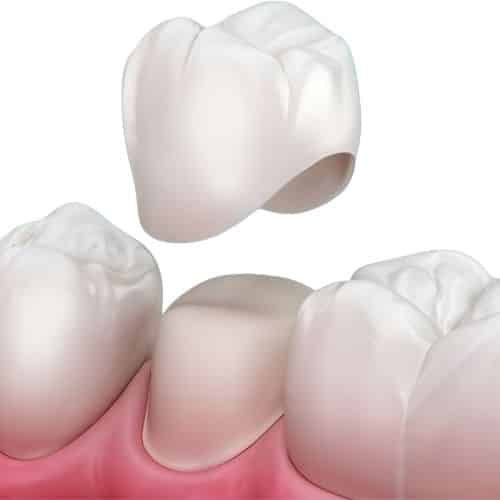
The governing fact: porcelain does not bleach. Once a crown is cemented, its colour cannot be changed. So there are only two workable approaches, and which applies depends on whether the crown is currently lighter or darker than the natural teeth around it. See Teeth Whitening.
- If the crown is lighter than the surrounding teeth — whiten the natural teeth up to the crown's shade, and stop.
- If the crown is darker, or you want to go lighter than the crown — whiten the natural teeth first, then replace the crown to match.
That second option is a significant undertaking, and it is worth understanding what it involves before committing.
The same reasoning applies to porcelain veneers, composite bonding and tooth-coloured fillings on front teeth — none of them lighten.
Scenario 1: the crown is lighter than your natural teeth
This is the more common and much simpler situation. The natural teeth have discoloured over time through diet and age, while the crown has stayed the shade it was made. See How can I improve the whiteness of my teeth?.
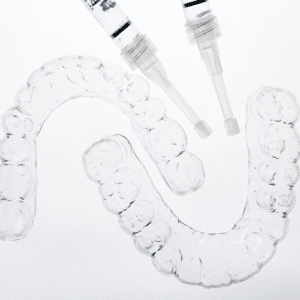
Take-home whitening is ideal here, because it is gradual and controllable. Custom-made trays are fabricated for you, and you wear them with whitening gel over a period of around 10 to 14 days. See Home teeth whitening: what to do and what not to do.
The reason gradual matters: because the change happens slowly, you can monitor the colour and stop at the shade that matches the crown. In-chair whitening moves faster and is harder to stop at a precise point, which is the wrong characteristic when you have a fixed target to match. The difference between in-chair whitening and take-home whitening sets out that contrast.
This is the outcome to aim for wherever it is achievable — it costs a fraction of the alternative and involves no drilling.
Before either scenario, have a clean and an examination. Some of what looks like discolouration is surface stain, which comes off without any whitening at all — see Dental Cleans & Hygienists and Why should I go to a dentist for teeth whitening?.
That examination is also a professional requirement rather than a scheduling convention. ADA Policy Statement 2.2.8 states that whitening “should only be performed if the treatment can be justified, and after a comprehensive dental examination has been conducted by a Dental Practitioner.” Where a kit is supplied for you to use at home, the Dental Board of Australia adds that products “can be supplied for home use if the patient is assessed as suitable”, which includes “carrying out an appropriate assessment and examination”, “considering their history”, and “applying the principles of risk minimisation and management.”
The gel itself is not something you can substitute from a chemist. Under the Poisons Standard, as set out by the ADA, Schedule 10 “specifically states that teeth whitening products containing more than 6% hydrogen peroxide or 18% carbamide peroxide may only be sold, supplied and used by registered dental practitioners as part of their dental practise” — while hydrogen peroxide 3-6% and carbamide peroxide 9-18% sit in Schedule 5, sellable direct to consumers with the stipulated safety warnings. See Difference between pharmacy whitening kits and dentist whitening.
Scenario 2: the crown is too dark, or you want to go lighter than it
Where you are unhappy with the natural teeth and think the crown is too dark, the approach is:
- In-chair whitening, which achieves the greatest change in the natural teeth in the shortest time
- Wait two weeks
- The crown is removed and a new one fabricated to match the newly whitened natural teeth — see Smile Solutions Laboratory
- Take-home trays are made after the new crown is placed, so you can maintain the shade of the natural teeth at home
The two-week wait is not administrative. Some rebound in shade is expected after whitening — teeth are slightly dehydrated immediately afterwards, which makes them look lighter than they will settle at. Matching a permanent crown to a temporary shade produces a crown that is too light for the rest of your life. Two weeks lets the true shade settle. See How long do the effects of teeth whitening last?.
The final step matters too: since porcelain does not change colour but natural teeth do, the natural teeth will gradually drift away from the crown again. Keeping the trays lets you top up and hold the match.
It is also worth being clear-eyed about what the whitening step itself can deliver. No specific shade can be promised in advance, and the ADA's expectation of practitioners is explicit on this point: they “should ensure that patients have realistic and reasonable expectations regarding the results of the bleaching treatment.” In a matching exercise that matters more than usual, because the whole plan is built around where the natural teeth actually end up. See What should I know about teeth whitening?.
In-chair whitening options
We offer two in-chair systems. Both take approximately 90 minutes and give immediate results. See What teeth whitening options are available at Smile Solutions?.
| System | Characteristics |
|---|---|
| Zoom | Produces the greater degree of change, but can cause short-term sensitivity |
| Brite Smile | Produces good results with reduced sensitivity |
Which suits you depends largely on how sensitive your teeth already are. Sensitivity after in-chair whitening is common and usually settles within a day or two. The ADA's summary of the peer-reviewed evidence is that “the most common side-effects are transient tooth sensitivity and soft tissue irritation during or immediately following treatment”, and that peroxide-containing bleaching products “are safe and effective when used by or under the supervision of a dentist and according to the professional directions for use.” See Tooth Pain & Ache if it does not settle.
Both systems use a light to accelerate the gel. That is worth one note on safety, because it is a genuine reason the procedure belongs in a dental practice. The ADA records that “the incorrect application of heat and other forms of energy during teeth whitening procedures, such as light from a plasma arc lamp or high-power (Class 4) laser may cause nerve damage to the tooth and burns to adjacent soft tissues, and failure to ensure use of the appropriate protective eyewear may also cause irreversible injury.” Training and equipment requirements are set out in AS/NZS 4173:2018, Safe use of lasers and intense light sources in health care, and in Victoria — as in Western Australia, Queensland and Tasmania — practitioners must hold a licence from the state regulatory authority to undertake dental procedures using Class 4 lasers. Registration is free to check on the Ahpra register: see Dentists & Registered Specialists and White fright: burns and multicoloured teeth.
On cost
The original version of this article quoted, as at June 2018: $395 for the complete take-home Day White treatment including trays and gel, with additional gel at $95; $695 for Zoom in-chair whitening; and $795 for Brite Smile.
Those are historical figures from 2018 and should not be relied on as current — see the Price Guide. Fees for crown replacement are separate and depend entirely on the individual case. Ask for a written quote covering the whole sequence — whitening, crown removal, the new crown, and the take-home trays afterwards — before starting, because the total for scenario 2 is many times the cost of the whitening alone. Payment Plans covers spreading it.
Asking for that total is not an imposition; it is what the professional standards contemplate. The ADA states that “risks and costs associated with the treatment should be explained to the patient and documented along with informed consent”, and the Dental Board and Ahpra guidance for practitioners is more specific again: “You must have and document their informed consent, including financial consent.” Costs are inside the consent, not alongside it. See Understanding Your Treatment.
Payment plan options are available. Where a plan is advertised as interest free, that describes the plan term only — a deposit may be required, an establishment fee and ongoing account fees may apply, and charges can apply if the balance is not cleared within the agreed period. The applicable terms depend on the provider and the amount financed, and are set out in writing before you commit — ask what the deposit and the establishment fee are, in dollars, and what the total will be by the end. Payment Plans.
The part to think hardest about: removing the crown
This is the section that should carry the most weight in the decision.
Removing a crown can be difficult and destructive to natural tooth structure. A crown is cemented onto a tooth that has already been substantially reduced. Taking it off usually means cutting it off, and doing so risks removing more of what remains. In some cases a tooth that was restorable with a crown before is no longer straightforwardly restorable afterwards. See What is the difference between porcelain crowns and veneers?.
Each case must be assessed individually. Factors that influence planning include:
- The state of the remaining tooth and root structure — see Chipped and Cracked Teeth
- Whether the tooth has been root treated — see Root Canal and Endodontists
- Whether there is a post and core beneath the crown — these can be very difficult to remove without fracturing the root
- The state of the surrounding gums and bone — see Bleeding Gums and Periodontists
A consultation with your general dentist, including a radiograph, is what establishes your circumstances and guides an individual plan. See General Dentistry; for complex restorative planning, Prosthodontists.
Worth asking explicitly: “What happens if the tooth is damaged during removal?” The honest answer is that it may need a post, or in the worst case an extraction and an implant. That risk is real, it is small, and it should be weighed against a cosmetic gain — which is exactly why scenario 1, whitening to match the crown rather than replacing it, is the better outcome whenever it is available.
Other questions worth asking before you agree to scenario 2
- Has the crown itself been assessed? A crown that is sound and well-fitting is a different proposition from one that is already failing and due for replacement anyway — in which case the whitening simply sets the shade for a crown you were going to need.
- Is the shade difference actually the problem? Shape, length and gum level affect how a front tooth reads as much as colour does.
- What is the contingency if the natural teeth do not lighten as far as hoped — do you stop, or does the plan change?
- Who fabricates the new crown, and will you see it tried in before it is cemented?
The general rule this page illustrates
Whiten before restoring, never after. Any crown, veneer or white filling is colour-matched on the day it is made and cannot be lightened later. Doing the whitening first sets the target; doing it second creates a mismatch you then pay to correct. See Cosmetic dentistry options and Cosmetic Dentistry.
Common questions
How do I know in advance whether my natural teeth will lighten enough to match the crown?
You do not, and anyone who tells you otherwise is overpromising. The ADA's expectation of practitioners is that they “should ensure that patients have realistic and reasonable expectations regarding the results of the bleaching treatment” — which exists precisely because the response varies between people and cannot be predicted from looking.
What makes the uncertainty manageable is doing it in the order this page recommends:
- Record the starting shades first — both the natural teeth and the crown, with a shade guide and a photograph. Without a record, nobody can later say how much changed.
- Use take-home whitening where the target is fixed. Gradual change lets you stop at the match rather than sail past it, which is the whole argument of scenario 1.
- Agree the stopping rule before you start. If the natural teeth reach the crown's shade, you stop and you are finished. If they plateau short of it, you have a decision — live with a smaller difference than you have now, or move to scenario 2 with its cost and its risk to the tooth.
That third point is the one to settle in advance, because it is much harder to think about clearly once whitening has begun and the mismatch is more visible than it was.
One practical note: have the clean first. Some of what you are looking at is surface stain, and the shade you are trying to match may be closer than it appears today.
Could I save the trouble with a whitening toothpaste, rinse or charcoal product?
Almost certainly not, and a 2021 systematic review of over-the-counter whitening products in Frontiers in Dental Medicine is unusually blunt about it. Its overall conclusion: “there is no sound evidence that any of the described OTC products promote a better bleaching effect than the products indicated for a professional.”
By category, in the review's own words:
- Toothpastes. They “usually present a combination of abrasives that can induce damage to the tooth surface without evidence of promoting real bleaching.” What they do is remove and limit surface stain.
- Rinses. The same finding, with an added caution — they “might present a low pH, with an erosive potential.” One study found a decrease in the lightness of enamel exposed to a 1.5% hydrogen peroxide rinse twice a day for 45 days, because of the product's acidity. The review notes this information is “usually not described in the product.”
- Charcoal. Included “to improve their whitening effect but there is no evidence supporting it.”
The reason is mechanical rather than mysterious: bleaching needs peroxide at sufficient concentration held against the tooth for long enough, and a rinse gives neither. Most of these products, the review concludes, are “effective only in removing extrinsic stains or preventing their formation over enamel.”
There is an Australian layer on top. Anything above 6% hydrogen peroxide or 18% carbamide peroxide is practitioner-only here under Schedule 10, and consumer products sit in the 3–6% hydrogen peroxide / 9–18% carbamide peroxide band of Schedule 5. Products you read about in overseas reviews are not necessarily on the same regulatory footing as what you can buy in Australia — which is another reason to compare like with like before concluding that a supermarket product will do the job. See difference between pharmacy whitening kits and dentist whitening.
Is whitening itself bad for my enamel?
Professionally supervised whitening has a good safety record, and the ADA's summary of the peer-reviewed evidence is the one to weigh: peroxide-containing bleaching products “are safe and effective when used by or under the supervision of a dentist and according to the professional directions for use,” with “transient tooth sensitivity and soft tissue irritation during or immediately following treatment” as the most common side effects. Transient means it settles.
The risks that are documented sit mostly at the two ends the supervision is there to manage. At one end, the energy sources used to accelerate in-chair gel: the ADA notes that incorrect application of heat, plasma arc light or a high-power laser “may cause nerve damage to the tooth and burns to adjacent soft tissues,” and that failing to use appropriate protective eyewear “may also cause irreversible injury.” At the other end, unsupervised repeated use of acidic over-the-counter products, where the review quoted above records enamel erosion from low pH, “even greater damage to exposed dentin,” increased abrasion when combined with brushing, sensitivity and gum irritation.
Two practical points from that same review. It records “a recommendation to avoid alcohol and smoking during at-home and self-care bleaching treatments.” And it is candid that on long-term safety of low-concentration products “clinical evidence is scarce.”
If your teeth are already sensitive, say so before starting rather than after: it is one of the factors that decides which system is used, and the sensitivity question is the reason the two in-chair options on this page differ at all.
One of my natural teeth is much darker than the rest. Is that the same problem?
No — and it is worth separating, because whitening the whole arch is often the wrong answer to it.
A single dark tooth among otherwise even teeth usually has its own cause: a past knock, a tooth whose nerve has died, a large old filling behind an otherwise intact front surface, or an existing crown or veneer that has been on the page's problem list all along. Each of those has a different remedy, and external whitening addresses only some of them.
So the first step is a diagnosis rather than a product. The questions the examination answers are whether the tooth is still vital, whether the discolouration is inside the tooth or on it, whether there is a restoration involved, and whether a radiograph shows anything at the root. Until those are answered, nobody can say whether whitening will help, do nothing, or make the difference more obvious by lightening every tooth except that one.
If the tooth darkened after an injury, mention the injury even if it was decades ago — see what should I do if I have a chipped tooth? and what causes white spots on teeth? for the other end of the same conversation, where the problem is a mark that is lighter rather than darker.
Practical details
Product names are those of the whitening systems used. Whitening will not change the colour of crowns, veneers, bridges or composite fillings; existing restorations may need replacing to match after whitening.
Specialist registration can be verified on the AHPRA register, or by calling 1300 419 495; the clinicians are listed on Our Team. Current fees are available from us on request.
Smile Solutions, Level 1, 220 Collins Street, Manchester Unity Building, Melbourne VIC 3000. Phone 13 13 96, or theteam@smilesolutions.com.au. Monday–Friday 8.00am–6.00pm, Saturday 8.30am–1.30pm, Sunday by appointment. Full details on Contact Us.
Quoted regulatory and safety statements are from ADA Policy Statement 2.2.8, Teeth Whitening (Bleaching) By Persons other than Dental Practitioners (Australian Dental Association, reviewed September 2025); the Dental Board of Australia practitioner resource Teeth whitening products; and the Dental Board and Ahpra fact sheet Using and supplying teeth whitening products. The over-the-counter product findings quoted are from a 2021 systematic review in Frontiers in Dental Medicine. Scheduling classifications can change — check the current Poisons Standard for the position at any given date.
Published 3 June 2018, by Dr Madeleine Hoopmann; fees quoted are historical. General information only; it does not replace advice from your treating practitioner. Outcomes vary between individuals, and all treatment carries risks. Payment plan terms are set by the credit provider and change; confirm current terms directly before you commit.
Smile Solutions trades under ABN 28 193 514 103.
Images on This Page
-
https://www.facebook.com/tr?id=800557773428361&ev=PageView&noscript=1
(no alt text)
-
https://www.smilesolutions.com.au/wp-content/uploads/2025/10/calendar_month.svg
(no alt text)
-
https://www.smilesolutions.com.au/wp-content/themes/arcadian-wordpress-theme/assets/images/smile_solutions_logo_white.png
Smile Solutions Logo
-
https://www.smilesolutions.com.au/wp-content/themes/arcadian-wordpress-theme/assets/images/smile_solutions_logo_purple.png
Smile Solutions Logo
-
https://www.smilesolutions.com.au/wp-content/uploads/2016/05/Madeleine-150x150.jpg
Dr Madeleine Hoopmann
-
https://www.smilesolutions.com.au/wp-content/uploads/2025/09/Dental-Crown-at-Smile-Solutions.jpg
I want to whiten my teeth but one of my front teeth has a porcelain crown. What are my options?
-
https://www.smilesolutions.com.au/wp-content/uploads/2026/01/Cosmetic-Consult-300x270.jpg
Consultation at a cosmetic clinic.
-
https://www.smilesolutions.com.au/wp-content/uploads/2021/03/Rojina-1-300x270.jpg
Rojina 1
-
https://www.smilesolutions.com.au/wp-content/uploads/2025/11/Smile-Solutions-Whitening-Trays-300x300.png
Professional Take-Home Whitening Trays
-
https://www.smilesolutions.com.au/wp-content/themes/arcadian-wordpress-theme/assets/images/family_owned_bussiness.png
Family Owned Business
-
https://www.smilesolutions.com.au/wp-content/themes/arcadian-wordpress-theme/assets/icons/icon--phone.svg
Smile Solutions Contact
-
https://www.facebook.com/tr? id=800557773428361&ev=PageView&noscript=1
(no alt text)