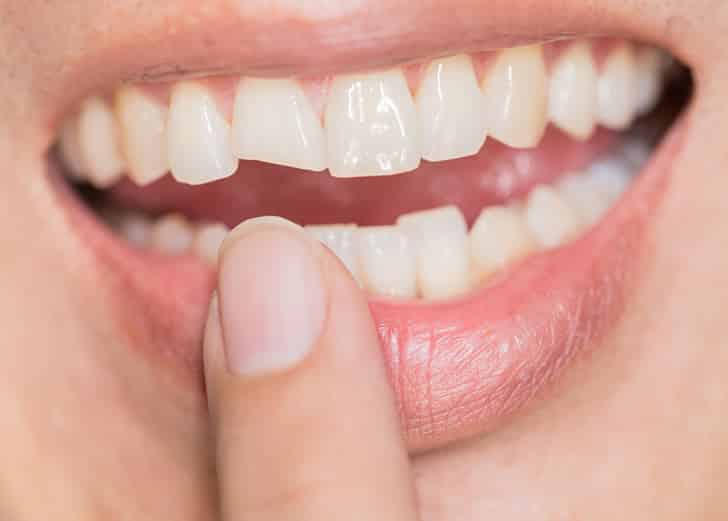
What should I do if I have a chipped tooth?
Three things: keep the broken piece, see a dentist, and work out why it chipped so it does not happen again.
A chip can happen for any number of reasons — biting down on a hard almond, a knock during sport, or waking up with one after a night of grinding. It is usually followed by the same sinking feeling: what do I do now?
Keep the fragment
If the chip is large enough and you still have the piece, keep it. Depending on the case, your dentist may be able to bond the fragment back onto the original tooth, which can produce an excellent result — the colour and translucency are, by definition, a perfect match.
Store it in milk or saline to stop it drying out, and take it with you. If you cannot find it, that is not a disaster; the tooth can still be restored. But if it might have gone into your airway rather than onto the floor, say so — that needs medical assessment, not a dental one.
Before the appointment
- Rinse with warm salty water
- Cover a sharp edge with a piece of sugar-free gum or orthodontic wax if it is cutting your tongue or cheek
- Chew on the other side
- Avoid very hot and very cold food and drink if the tooth is sensitive
- Take over-the-counter pain relief per the packet if needed
When it is more urgent
See a dentist promptly, rather than at your convenience, if:
- The nerve is exposed — a pink or red spot in the middle of the broken surface, usually with sharp pain to air and cold
- There is significant pain, or pain on biting
- The tooth is loose or has moved — and if it has come out altogether, what should I do when a tooth is knocked out? is the page to open, because minutes matter
- The chip involves a front tooth after trauma — other injuries need excluding
- There is bleeding from the tooth itself
If the tooth was chipped in an accident rather than on a nut, treat it as an injury and read What should I do in a dental emergency? — a blow hard enough to break a tooth can loosen its neighbours, and Emergency Dentistry covers being seen quickly. What is considered a dental emergency? draws the line between what needs seeing today and what can wait.
The Australian Dental Association's policy on oral injuries is worth having in mind while you decide whether to wait. It states that “oral damage is often irreversible, frequently complex, difficult, and costly to repair”, and that persons who have suffered an oral injury should be promptly assessed by a dentist and be treated and reviewed as recommended — with dentists working to the International Association of Dental Traumatology guidelines for traumatic dental injuries. A chip that does not hurt is still an injury, and the assessment is about what is underneath it.
What happens at the appointment
Establishing the cause. You and your dentist work out why the fracture happened, so it can be avoided in future. This matters more than the repair: a tooth that chipped because of grinding will chip again, and so will the restoration.
Assessing what remains. The integrity of the remaining tooth is examined — often with a radiograph — to see whether the damage goes further than it looks.
Planning the restoration, with your preferences and the dentist's recommendations both playing a part.
If the chip is small
Small chips are usually straightforward restorations. Bonded composite can be shaped and polished to match the surrounding tooth, and in skilled hands the result can be as good as the original — sometimes better, if the tooth was already uneven. This is typically a single appointment, often without anaesthetic. See Composite Bonding, and will composite bonding look natural and how long will it last? for the honest answer on durability.
If it is more extensive
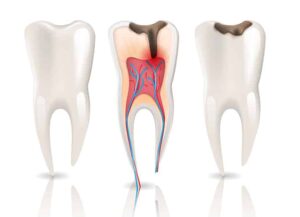
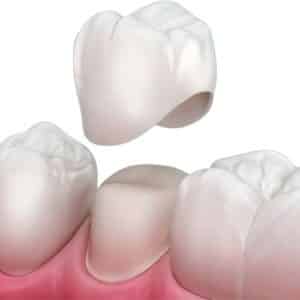
If the chip is more extensive than it appears, or a crack is undermining the remaining tooth structure, your dentist will discuss a range of options aimed at the longevity of the tooth as well as its appearance. Depending on the case that might mean a larger bonded restoration, a veneer, an onlay, or a crown — what a crown costs, by material sets out that end of the scale, and the price guide the rest. Where the crack has reached the nerve, root canal treatment may be needed first, and difficult cases go to an endodontist. Where a laboratory-made restoration can be milled in the practice, same-day CEREC restorations avoid the temporary stage.
Differences between dental bonding and veneers is worth reading before you choose between the two, and Getting a chipped tooth fixed walks through the appointment itself.
Cracks are the reason a chip should be assessed rather than ignored. A visible chip is a symptom; a crack running under it is the problem, and cracks propagate. A crack that reaches below the gumline can make a tooth unrestorable — which turns a filling appointment into an extraction. Why does a cracked tooth hurt so much? explains the mechanism, and Can a cracked tooth be treated? covers what can be done at each stage. Chipped and Cracked Teeth is the fuller treatment page.
Preventing a recurrence
Once the tooth is restored, a prevention plan matters, because restored teeth are generally weaker than sound tooth structure.
That is not a sales line; it is the NHMRC's own statement of the problem. In its questions and answers on fluoridation and tooth decay, the NHMRC puts it plainly: once a tooth is filled, it becomes structurally weaker and will almost certainly require further treatment in the future. Every restoration starts a replacement cycle, and the point of a prevention plan is to slow that cycle down rather than to pretend it does not exist.
Usually prevention involves:
- A night guard for nocturnal grinding — see TMD and Teeth Grinding and How can I stop grinding my teeth when I sleep?
- A custom-fitted sports mouthguard for anyone playing contact sport — worn at training as well as matches
- Avoiding excessive load on the restored tooth: no ice, popcorn kernels, hard lollies, or opening things with your teeth
If grinding is the cause, the splint is not an optional extra. It costs a fraction of what repeatedly restoring worn and chipped teeth costs, and it is the difference between a restoration lasting years and lasting months.
There is measured support for that, though it is narrower than it sounds and worth reading precisely. A long-term cohort study of primary root canal treatment published in PMC found that among its 312 patients — 119 of whom (38.1%) were diagnosed with bruxism — use of a night guard was a protective factor for tooth survival (odds ratio 0.34; 95% CI 0.13–0.86), and that lack of occlusal protection was among the most significant factors associated with a tooth eventually being extracted. Those figures describe root-canal-treated teeth in one cohort, not chipped teeth generally, and they say nothing about jaw symptoms. What they support is the specific claim above: in people who grind, occlusal protection is associated with heavily restored teeth lasting longer.
On the mouthguard, specifically
The ADA does not treat all mouthguards as equivalent. Its position is that the most effective protection against oral damage is a custom-fitted mouthguard, where precision fit and quality materials offer maximum comfort and injury prevention. Over-the-counter guards provide better protection than no mouthguard, but their protection varies with design, comfort, adaptation and thickness, and the ADA notes that quality control of at-home custom adaptation is not achievable — the boil-and-bite process can leave parts of the guard thinner than others. It also holds that protective equipment should be used during training as well as competition, and makes the economic argument directly: the cost of an injury to the teeth or jaw far exceeds the cost of a mouthguard. Should I wear a mouthguard while playing sports? goes further.
If you are wondering whether your sport qualifies, the ADA's list of activities where mouthguard use is strongly recommended is broader than most people assume: off-road bike riding, skateboarding, rock climbing, white-water rafting, trampolining, combat sports, football, basketball, squash and field hockey.
Two causes people rarely consider
Your job. The ADA's oral injury policy identifies occupational hazards in two distinct forms: physical impact from work equipment where fracturing of teeth is likely — labourers, tradespeople and riggers — and tooth abrasion where abrasive dust or particles may enter the mouth — miners, bricklayers and tilers. If you work in one of those trades and your teeth are chipping without an obvious incident, that is worth raising, and the policy's recommended workplace controls include dust extraction or filtration where abrasive particles are generated.
Acid. Acid erosion thins the enamel and makes chipping far more likely. If several teeth are chipping, or the edges are becoming thin and translucent, the underlying issue may be dietary acid or reflux rather than force. The ADA's diet and nutrition policy is explicit that exposure to acid from acidic or sugar-sweetened foods and drinks can lead to softening and loss of tooth structure, and that the combination of sugar and food acid can be particularly destructive. It names the circumstances where this does most damage — poor oral hygiene, low or no fluoride exposure, reduced salivary flow from a condition or a medication, exertion that dries the mouth, and sipping anything other than water during interrupted sleep. See How does acidic food affect your teeth? and what dental erosion is and how it is addressed.
Common questions
It does not hurt at all. Do I still need to do anything?
Yes, and pain is a poor guide here. The Better Health Channel, produced in consultation with and approved by the Victorian Department of Health and Oral Health Victoria, puts it in one sentence: ‘Teeth that have been chipped or cracked may or may not be painful. Either way, you should see an oral health professional as soon as possible because early repair can improve the survival of a damaged tooth.'
The numbers behind that are worth seeing. In a practice-based study of 2,858 cracked teeth from 209 dentists in the United States, cited by the European Society of Endodontology in its 2024 position statement, 45% of the cracked teeth were symptomatic — meaning most were not. The commonest symptoms where they occurred were pain to cold (37%), biting pain (16%) and spontaneous pain (11%).
And a crack does not reliably show on an x-ray either. The same position statement reports that only 2% of cracked teeth with living pulps had evidence of a crack on a radiograph, and that cone beam CT ‘is not predictable in detecting cracks'. So the absence of pain and a clear x-ray, together, are not evidence that nothing is happening. The assessment is a clinical one.
Milk, saliva, saline or water — what do I actually put the piece in?
Two different steps are being described, which is why the advice sounds inconsistent.
Getting it to the surgery: the Better Health Channel says that if the broken piece is intact, ‘store it in milk or the saliva of the person with the broken tooth and seal it in a container or plastic wrap, and see an oral health professional as soon as possible.'
Preparing it for bonding, at the chair: the International Association of Dental Traumatology's guidance for crown fractures is that where the fragment is available and intact it can be bonded back on, and that ‘the fragment should be rehydrated by soaking in water or saline for 20 min before bonding.'
The rule both share is the only one you need to remember: do not let it dry out. A dried fragment goes chalky and opaque and stops matching. Anything that keeps it wet and clean on the way in is better than a tissue or a pocket.
I cannot find the piece. Does that matter?
Usually not for the repair — but tell the dentist if your lip or cheek was cut. The IADT's guidance is explicit that missing fragments should be accounted for, and that ‘if fragment is missing and there are soft tissue injuries, radiographs of the lip and/or cheek are indicated to search for tooth fragments and/or foreign materials.' A piece of tooth buried in a lip will not settle on its own.
Without the fragment, the tooth is still restorable. The IADT's own option for an uncomplicated fracture where no fragment is available is to cover the exposed dentine and restore with composite resin. You lose the perfect colour match, not the tooth.
Can I just have the sharp edge smoothed off and leave it there?
Sometimes, yes — it is a recognised option rather than a shortcut. For an uncomplicated crown fracture the IADT lists, as alternatives to bonding the fragment back on, that ‘depending on the extent and location of the fracture, the tooth edges can be smoothed, or a composite resin restoration placed.' For a mere craze line with no tooth lost, its position is that beyond sealing a severe one with bonding resin ‘to prevent discoloration and bacterial contamination', ‘no treatment is necessary'.
What decides it is which layer is now exposed, and that is not something you can judge by looking. Once the fracture is through enamel into dentine, the IADT's guidance is to cover the exposed dentine rather than leave it open. Smoothing an edge that should have been sealed is the version of this that costs you later.
Will the repair show?
A bonded-back original fragment matches because it is the tooth — the shade and translucency came out of your own mouth. A composite restoration is shaded and layered to blend with the tooth around it, and on a small chip the result is usually very hard to pick.
What we will not tell you is that it will be undetectable, because that depends on things nobody can promise in advance — how much tooth was lost, where the margin falls, how translucent your enamel is at the biting edge, and the light you are standing in. Front teeth are the hardest place to match, because the incisal edge is semi-transparent.
It is also worth knowing what changes with time. Composite is not porcelain: its margins can pick up stain, particularly with coffee, tea, red wine and smoking, and it may need repolishing or eventual replacement rather than lasting untouched. Ask to see the shade match in daylight before you leave.
How long will the repair last, and will I end up needing a root canal?
The honest answer on materials is that the profession has not settled it. The European Society of Endodontology's 2024 position statement says directly that ‘there is no clear evidence on the most suitable restorative treatment approach to manage' cracked teeth. It does report a pattern: cracked teeth managed with direct bonded composite restorations ‘may be more likely to require root canal treatment and/or further repair of fractured restorations compared with' those managed with cuspal coverage — a crown or onlay that caps the cusps rather than filling between them.
On root canal treatment, there is a measured figure. The same statement reports the incidence of endodontic intervention after restorative management of a cracked tooth as between 7.7% and 20%. That range describes cracked teeth, not every chip, and it is the reason a chip with a crack under it is treated more cautiously than a chip without one.
The practical consequence: ask which of the two approaches is being proposed and why, particularly on a back tooth that takes heavy biting load.
What follow-up should I expect afterwards?
More than most people are told, and it is worth asking for. For an uncomplicated crown fracture — enamel, or enamel and dentine, with no pulp exposure — the IADT's schedule is clinical and radiographic evaluation after 6 to 8 weeks and again after 1 year. Where the pulp was exposed and treated, it adds reviews at 3 months and 6 months as well.
What is being looked for is the thing that would not announce itself: a nerve that was bruised by the original impact and dies quietly months later. The IADT's markers for an unfavourable outcome include pulp necrosis and infection, discolouration, and breakdown or loss of the restoration.
If the tooth darkens, becomes tender to bite on, or an old chip starts aching months later, that is the review appointment brought forward — not a new problem.
Where to go next
- The treatment options in full — Chipped and Cracked Teeth
- The most conservative repair — Composite Bonding
- If appearance is the main concern — Cosmetic Dentistry and Porcelain Veneers
- If it hurts to bite — Tooth Pain and Ache
- If it happened to a child — Children's Dental Emergencies
Practical details
Smile Solutions accommodates emergency dental appointments at short notice.
The statements attributed above to the Australian Dental Association and the NHMRC are from those organisations’ own published material; the cohort figures are from a peer-reviewed long-term study of primary root canal treatment published in PMC. The crack and fracture figures are from the European Society of Endodontology's 2024 position statement on longitudinal cracks and fractures of teeth, and the management and follow-up schedules from the International Association of Dental Traumatology's 2020 guidelines on fractures and luxations. All remain the primary source.
Specialist registration can be verified on the AHPRA register, or by calling 1300 419 495.
Smile Solutions, Level 1, 220 Collins Street, Manchester Unity Building, Melbourne VIC 3000. Phone 13 13 96, or theteam@smilesolutions.com.au. Monday–Friday 8.00am–6.00pm, Saturday 8.30am–1.30pm, Sunday by appointment. Full details on Contact Us.
Published 28 April 2022. General information only; it does not replace advice from your treating practitioner. Outcomes vary between individuals.
Smile Solutions trades under ABN 28 193 514 103.
Images on This Page
-
https://www.facebook.com/tr?id=800557773428361&ev=PageView&noscript=1
(no alt text)
-
https://www.smilesolutions.com.au/wp-content/uploads/2025/10/calendar_month.svg
(no alt text)
-
https://www.smilesolutions.com.au/wp-content/themes/arcadian-wordpress-theme/assets/images/smile_solutions_logo_white.png
Smile Solutions Logo
-
https://www.smilesolutions.com.au/wp-content/themes/arcadian-wordpress-theme/assets/images/smile_solutions_logo_purple.png
Smile Solutions Logo
-
https://www.smilesolutions.com.au/wp-content/uploads/2023/11/SS-Tooth-1-1-150x150.png
Smile Solutions
-
https://www.smilesolutions.com.au/wp-content/uploads/2025/09/general-dentistry-chipped-or-cracked-tooth.jpg
What should I do if I have a chipped tooth?
-
https://www.smilesolutions.com.au/wp-content/uploads/2025/09/Root-Canal-2-300x217.jpg
Root Canal
-
https://www.smilesolutions.com.au/wp-content/uploads/2026/08/Mouth-Breathing-300x270.jpg
Mouth Breathing
-
https://www.smilesolutions.com.au/wp-content/uploads/2025/09/Dental-Crown-at-Smile-Solutions-300x300.jpg
Dental Crown at Smile Solutions
-
https://www.smilesolutions.com.au/wp-content/themes/arcadian-wordpress-theme/assets/images/family_owned_bussiness.png
Family Owned Business
-
https://www.smilesolutions.com.au/wp-content/themes/arcadian-wordpress-theme/assets/icons/icon--phone.svg
Smile Solutions Contact
-
https://www.facebook.com/tr? id=800557773428361&ev=PageView&noscript=1
(no alt text)
-
https://bat.bing.com/action/0?ti=25148060&tm=gtm002&Ver=2&mid=a7a923c9-b2f3-4205-9b4d-b4bd6a849926&bo=1&sid=d2ff5300ab2711f1a1488bdaffb70605&vid=d2ff7af0ab2711f19ed53f5fced64d44&vids=1&msclkid=N&pi=918639831&lg=en-US&sw=800&sh=600&sc=24&nwd=1&tl=What%20should%20I%20do%20if%20I%20have%20a%20chipped%20tooth%3F%20-%20Smile%20Solutions&p=https%3A%2F%2Fwww.smilesolutions.com.au%2Fdental-articles%2Farticle%2Fwhat-should-i-do-if-i-have-a-chipped-tooth%2F&r=&evt=pageLoad&sv=2&cdb=AQAQ&rn=420499
(no alt text)