Should I wear a mouthguard while playing sport?
If there is a risk of collision, yes
If you or your child play contact sport, it pays to protect your teeth.
Sports carrying a collision risk include:
Football, boxing, rugby, basketball, hockey, water polo, lacrosse, netball, baseball, softball, squash, soccer, BMX riding, horse riding, skateboarding, in-line skating and trampolining.
Some of those surprise people. Basketball and netball are non-contact on paper and produce a substantial number of dental injuries — elbows, heads and the ball itself. Skateboarding and trampolining involve falls onto hard surfaces with nothing between the face and the ground.
The ADA sorts sports into four risk levels, not two
That list is more useful with the structure the Australian Dental Association gives it. Policy Statement 2.2.5 on the prevention and management of oral injuries divides sports into four risk levels, each with a different answer:
- Sports where the ADA says mouthguard use is *strongly recommended*** — its examples are **off-road bike riding, skateboarding, rock climbing, white-water rafting, trampolining, combat sports, football, basketball, squash and field hockey.
- Sports where head protection is worn and may therefore remove the need for a mouthguard — its examples are full-face helmets in ice hockey, goalkeepers in field hockey, cricket, rollerblading and cycling.
- Sports where a guard is not normally worn but could be justified in some circumstances — high diving, surfboarding, skiing.
- Sports where a guard would be impractical or unwarranted because injury risk is low — swimming, athletics, aerobics, rowing.
Two things follow that the usual list does not tell you. Skateboarding and trampolining are in the ADA's strongest category, alongside combat sports — so the surprise above is the ADA's position, not an opinion. And the ADA's overall test is individual: it states that “the need to wear a mouthguard should be assessed by a dentist based on risk factors, including an individual's sporting or occupational activities and dental anatomy.”
It is not only sport
The same ADA policy identifies occupations that expose people to oral injury, through two distinct mechanisms: physical impact from work equipment where fracturing teeth is likely — it names labourers, tradespeople and riggers — and tooth abrasion where abrasive dust or particles enter the mouth, naming miners, bricklayers and tilers. It also notes that oral piercing jewellery may increase the risk and degree of oral injury.
The ADA's broader point is that “oral damage is often irreversible, frequently complex, difficult, and costly to repair”, and that young children and teenagers are high-risk groups, particularly when learning to walk and when new or high-risk activities are involved.
For children specifically, see Should my child wear a mouthguard?.
What a mouthguard does
A sports mouthguard helps absorb the shock of a blow to the face, which might otherwise result in injury to the mouth or jaw. The ADA puts it the same way: a custom-fitted guard “helps to absorb and spread the impact of a blow to the face, which may otherwise result in an injury to the teeth, mouth or jaw.”
Heavy collisions can cause:
- Chipped or broken teeth
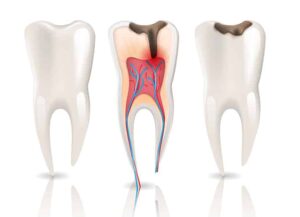
- Internal damage to a tooth — the nerve can die from an impact even where the tooth looks intact, which is how an injury ends in root canal treatment
- Tooth loss
- Injuries to the soft tissue of the mouth — lips and cheeks cut against your own teeth
- In severe cases, concussion or a broken jaw
These injuries can require costly treatment to repair. The ADA's own framing is blunt: “the cost of an injury to the teeth or jaw far exceeds the cost of a mouthguard”, and dental injuries “can result in time off school or work to recover, can be painful and disfiguring, may involve lengthy and complex dental treatment.” A lost front tooth is not a single repair — it is a lifetime of restorations. The real cost of replacing two front teeth follows one footballer's bill through.
How it works
Three separate mechanisms, which is why thickness and coverage matter:
- It spreads the load. A blow that would concentrate on one or two front teeth is distributed across the whole arch.
- It absorbs and slows the impact. The material deforms, extending the time over which the force is delivered and lowering the peak.
- It separates the jaws and cushions soft tissue. Most lip and cheek lacerations in sport are caused by the person's own teeth. A guard puts a barrier between them.
What “a lifetime of restorations” actually means
Worth spelling out, because the phrase is easy to skim past.
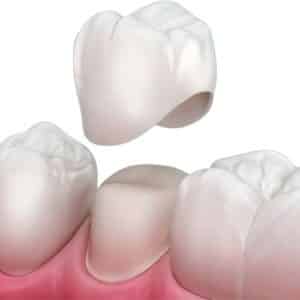
A front tooth lost at fifteen is not fixed once. The usual sequence runs: an immediate temporary replacement; a definitive bridge or denture through the growing years, because an implant cannot be placed until jaw growth has finished; then an implant in the early twenties at the earliest, and replacement of the crown on that implant every ten to fifteen years or so for the rest of life. The bone in the gap also recedes over time and may need grafting.
That is not only a cost argument. Implants are maintained restorations: the ITI Academy consensus statements record connection-related complications, such as a screw loosening or fracturing, in 7.3% of implant-supported bridgework over five years, and note that biologic and technical complications occurred in about half the cases after five years of function. A guard avoids entering that cycle at all.
A tooth that is cracked or that loses its nerve from impact follows a similar path — root canal treatment, then a crown, then replacement of that crown periodically. See also how a cracked tooth is treated.
Set against that, a custom guard is inexpensive, and it is the only measure available.
An honest note on head injury
Mouthguards are often described as preventing concussion. The evidence for that is not established. Some work suggests a guard may reduce force transmitted through the jaw, but research has not shown that wearing one prevents concussion.
Worth being precise about the basis for that caution: the ADA's policy on oral injuries makes no claim about concussion in either direction, and we hold no independent source that establishes one. So this is an absence of evidence rather than evidence of absence — which is exactly why it should not be relied on.
Wear a mouthguard for your teeth, gums and jaw — that protection is well supported. Do not treat it as head protection, or as a substitute for a helmet.
Concussion is managed by the recognised sporting protocols — if in doubt, sit out, and follow the return-to-play guidance from the relevant sporting body and a medical practitioner. No dental appliance changes that.
Custom-fitted versus over-the-counter
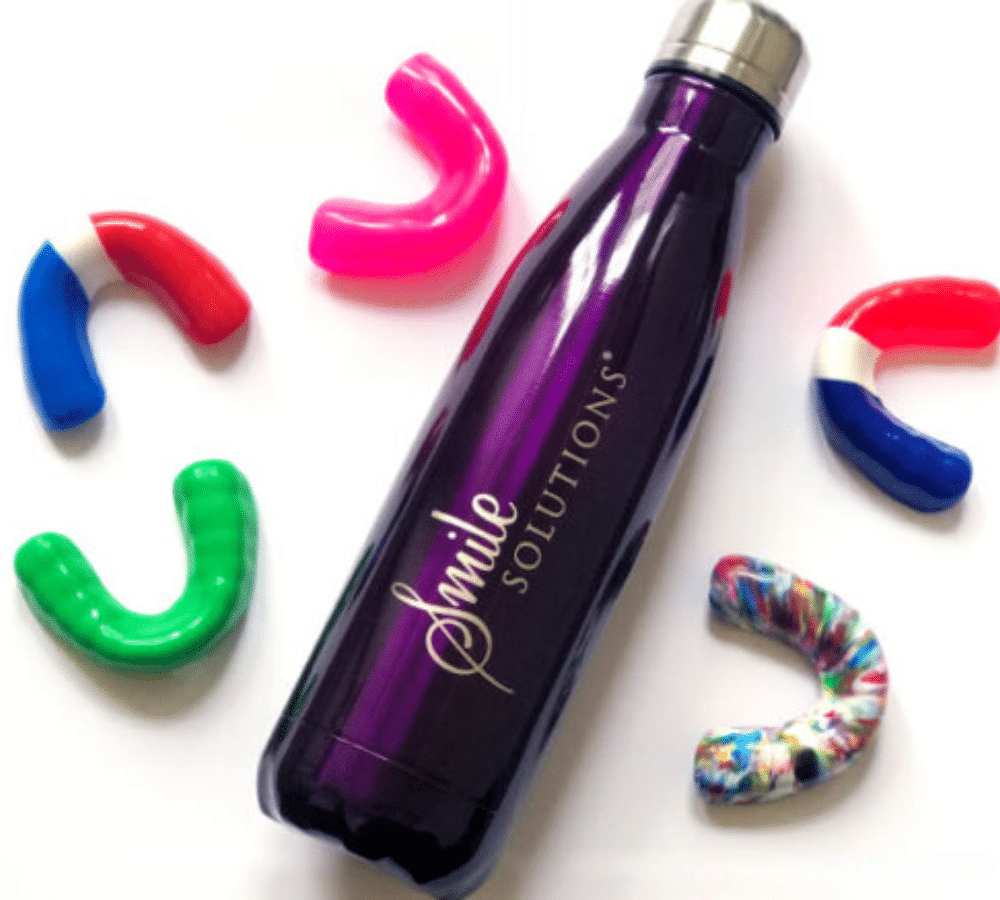
At Smile Solutions a custom-fitted guard is made by a dentist, using an impression of your teeth and a plaster model — the work is done in the on-site laboratory.
That custom-fitting procedure allows accurate assessment of your mouth, and the right fit, size and coverage for you.
Custom-fitted guards are preferable to over-the-counter ones, which are shaped by softening in hot water and biting into them — producing an uneven fit, uneven thickness where protection is most needed, and a tendency to move or be pushed out of position on impact. A trip to the chemist or the dentist? sets the two side by side.
The ADA's position on this is unambiguous: “the most effective protection against oral damage is a custom fitted mouthguard, where precision fit and quality materials offer maximum comfort & injury prevention”, and custom guards “provide the best protection fit and comfort for all levels of sport.” On the home-fitted alternative it makes a point that is easy to miss and hard to argue with: “quality control of at-home custom adaptation is not achievable.” The ADA also refers practitioners to Australian Standard HB209-2003, the handbook of guidelines for the fabrication, use and maintenance of sports mouthguards — there is a published standard for this, which is not true of a blank bought in a chemist.
A guard that fits poorly protects less than one that fits well, and it is more likely to be removed mid-game — at which point it protects nothing at all.
Where the ADA contradicts itself, and what to do about it
Worth surfacing rather than smoothing over, because the two statements sit in the same document and point different ways.
In the body of Policy Statement 2.2.5, the ADA says over-the-counter mouthguards “provide better protection than no mouthguard, however their protection varies depending on the design, comfort, adaptation and thickness of the final product.”
In Appendix 1 of the same policy — its model mandatory-mouthguard policy for clubs — it says over-the-counter and boil-and-bite guards “offer little or no protection and can dislodge during play but may be appropriate during orthodontic treatment.”
Those are not the same claim. “Better than nothing, with variable protection” and “little or no protection” cannot both be the whole truth, and we are not in a position to adjudicate between two statements by the same body in the same document. What both versions agree on is the ranking: a custom-fitted guard is the ADA's recommendation, and a boil-and-bite is at best a compromise. If you can only get a boil-and-bite before this weekend's game, wear it — and get a custom one made.
The three types, compared
| Type | How it is made | The problem with it |
|---|---|---|
| Stock | Bought ready-formed in small, medium, large | Not fitted to anyone. Must be clenched to stay in, which interferes with breathing and speech. The least protective option. |
| Boil-and-bite | Softened in hot water and bitten into at home | Thins exactly where you bite hardest — over the front teeth — because the material is displaced sideways. Fit loosens with use. |
| Custom-fitted | Made by a dentist from an impression or digital scan of your own teeth | Cost and a wait of about a week. |
The thinning problem with boil-and-bite guards is the substantive one. The protection a guard offers depends largely on the thickness of material over the front teeth, and biting into a softened blank is precisely the action that reduces it there. The ADA names thickness and adaptation among the variables that determine how much protection an over-the-counter guard gives.
Custom guards can also be made in different thicknesses for different sports, and layered or reinforced for high-impact codes. A guard for hockey or boxing is not the same specification as one for netball. What kind of mouth guard should I use? goes through the choice.
Special situations
- Braces. A mouthguard is more important with braces, not less — brackets turn a lip impact into a serious laceration. A guard made for a mouth in orthodontic treatment is designed differently, to accommodate tooth movement. Ask your orthodontist; a standard custom guard made over braces may need remaking as teeth move. Note that this is the one situation in which the ADA says an over-the-counter guard “may be appropriate” — because the teeth are moving and a rigid custom fit stops fitting. That is a judgement for the clinician managing your treatment, not a general downgrade. Orthodontic braces, and for younger patients children's braces and Invisalign.
- Removable aligners are not mouthguards. They are thin, rigid and made for tooth movement, not impact. Take them out and wear a proper guard. Invisalign, and how to protect your aligners while you do.
- Children and teenagers. The mouth changes constantly while teeth are erupting. Expect to remake the guard regularly — annually at minimum, sometimes more often. The ADA also flags a related point worth acting on early: children with prominent front teeth may be at higher risk of injury and may benefit from orthodontic assessment and early treatment to reduce that risk. Children's Dentistry
- Implants, crowns, bridges and veneers. All are vulnerable to impact and expensive to replace. Mention them when the guard is made.
- A night splint for grinding is a different appliance and is not designed for impact. Do not use one for sport, or a sports guard for grinding. TMD and teeth grinding, how a night guard treats TMD, and night-time grinding and clenching.
Practical points
Wear it at training as well as on game day. This is explicit ADA policy, not a suggestion: “protective equipment such as helmets and mouthguards should be used during training as well as competition”, and the club policy the ADA publishes for adoption requires guards “during training and games” on a “strict ‘No Mouthguard, No Play’ policy without exception”, with coaches checking compliance.
Have it checked or remade every 12 months, especially for children and teenagers — growing jaws and erupting teeth change the fit.
Store it in a firm container away from heat. A guard left in a hot car warps and no longer fits.
Rinse it before and after use, clean it with cool water and a brush, and let it dry before it goes in the case. Do not use hot water or a dishwasher — heat distorts it.
Bring it to your dental appointments so the fit and condition can be checked. Replace it if it is torn, thin, smells, or no longer clicks into place.
Allow about a week for a custom guard to be made — not the week the season starts.
If cost is the obstacle, say so. The ADA's own position is that “all dental care funding schemes should allow for the provision of custom-made mouthguards”, which is a recommendation to funders rather than a promise that yours does — but it is worth asking your health fund whether a custom guard is claimable under your extras cover before you settle for a blank from the chemist.
While you are training, two other sporting hazards are worth knowing about: what sports drinks do to teeth and the dry mouth that comes with running, both of which raise decay risk in athletes.
If a tooth is knocked out
What should I do when a tooth is knocked out?
The thing that decides the outcome is how long the root stays DRY — not how long ago the accident happened. That distinction is the single most useful thing on this page, and it is not what most people have been told.
The International Association of Dental Traumatology guidelines state that minimising dry time is critical for survival of the ligament cells on the root surface, and that after about 30 minutes of extra-alveolar dry time, most of those cells are no longer viable. Dehydration of the root surface “starts to happen in a matter of a few minutes.” A tooth carried in milk for an hour is in far better shape than one carried dry in a tissue for fifteen minutes.
An adult tooth — put it back in.
- Hold it by the crown, never the root.
- If dirty, rinse it gently in milk, saline or the person's own saliva — do not scrub it.
- Reinsert it into the socket the right way round and bite gently on a clean cloth. The IADT calls immediate replantation at the scene “the best treatment at the place of the accident.”
- If you cannot reinsert it, get it into a liquid immediately. The IADT's order of preference is milk, then Hank's Balanced Salt Solution, then saliva spat into a container, then saline. On water it is specific: “although water is a poor medium, it is better than leaving the tooth to air-dry.” So if milk is not to hand, water beats a dry pocket.
- Get to a dentist immediately — and tell them how long the tooth was dry, separately from when the accident happened. The IADT treats dry time as important history, and only the person who was there can supply it.
- Do not decide it is too late. The IADT's position is that “the decision to replant a permanent tooth is almost always the correct decision even if the extra-oral dry time is more than 60 minutes” — replanting preserves the bone contour and keeps future options open, and the tooth can always be removed later if it has to be.
A baby tooth — do NOT put it back. The IADT is explicit that primary teeth should not be replanted: reinserting one can damage the permanent tooth developing above it. Control the bleeding and see a dentist. My child has a knocked out baby tooth: what do I do?
Also see a dentist promptly for a tooth that is chipped, loosened, pushed out of line, or simply painful after a knock — a tooth can look intact and still lose its nerve, sometimes months later. The ADA's position is that anyone who has suffered an oral injury should be promptly assessed by a dentist and treated and reviewed as the dentist recommends, and it directs dentists to the IADT guidelines for that management.
Call 000 or go to an emergency department for loss of consciousness, a suspected concussion or head injury, a suspected jaw fracture, difficulty breathing or swallowing, or uncontrolled bleeding. Otherwise, what to do in a dental emergency.
Children's dental emergencies · Emergency dentistry
Common questions
My sport is not on any list. How do I decide?
Use the ADA's test rather than the list: it says the need for a guard should be assessed by a dentist based on your sporting or occupational activities and your dental anatomy. Two people in the same sport can get different answers — someone with prominent front teeth, or with crowns, veneers or implants at the front, has more to lose from the same impact.
The ADA's four risk bands are a starting point, and the second one is the one people forget: if your sport already requires full-face head protection, that may remove the need for a guard. Ask rather than assume in either direction.
Is a boil-and-bite guard really better than nothing?
The ADA says both things in the same policy, and we are not going to pretend otherwise. Its main text says over-the-counter guards “provide better protection than no mouthguard” but that protection varies with design, comfort, adaptation and thickness. Its model club policy says they “offer little or no protection and can dislodge during play.”
What is consistent across both is that a custom-fitted guard is what the ADA recommends, and that “quality control of at-home custom adaptation is not achievable.” The practical answer: if the choice tonight is boil-and-bite or nothing, wear it. Do not let it become the permanent arrangement.
Does a mouthguard protect against concussion?
Do not rely on it. Some research suggests a guard may reduce force transmitted through the jaw, but it has not been shown to prevent concussion, and the ADA's oral-injury policy makes no claim about concussion at all. We hold no independent source that establishes an effect either way.
A guard is for teeth, gums and jaw. Concussion is a medical matter, managed under the protocols of your sporting body and a medical practitioner — if in doubt, sit out.
How much protection am I actually buying?
Honestly, nobody in our sources puts a percentage on it. The ADA states that a custom guard offers “maximum comfort & injury prevention” and that oral damage is “often irreversible, frequently complex, difficult, and costly to repair” — a qualitative case, strongly put, without a risk-reduction figure attached.
So treat a mouthguard as risk reduction, not immunity. Teeth are still broken through guards. What a guard changes is how often, and how badly.
Do I need one for work as well as sport?
Possibly, and it is the question nobody asks. The ADA identifies two occupational mechanisms: impact from work equipment where fracturing teeth is likely, naming labourers, tradespeople and riggers; and abrasion from dust or particles entering the mouth, naming miners, bricklayers and tilers. Its recommendation for the second is environmental — dust extraction or filtration when generating abrasive particles — rather than an appliance.
If your trade is on that list, raise it at your next appointment along with your sport.
I have a plate, a bridge or implants at the front. Does that change anything?
Yes, and say so when the guard is made. Crowns, bridges, veneers and implants are all vulnerable to impact and expensive to replace, and an implant in particular cannot be replaced like a natural tooth — the ITI Academy complication data shows implant restorations need maintenance across their life even without a blow to the face.
A guard made over existing dental work needs to account for it, and a guard made before the work was done may no longer fit properly over it.
How do I know when to replace it?
Replace it if it is torn, thin, smells, or no longer clicks firmly into place — and have it checked at every dental appointment rather than judging it yourself. For children and teenagers, expect to remake it at least annually while teeth are erupting and the jaw is growing.
A guard that has gone loose is the one most likely to be taken out mid-game, which is the point at which it stops protecting anything.
Related reading
Sports mouthguards · Chipped or cracked teeth · What is considered a dental emergency? · What are sports drinks really doing to your teeth? · What is bruxism and how is it managed? · Getting a footballer's teeth fixed at Smile Solutions
Practical details
Smile Solutions, Level 1, 220 Collins Street, Manchester Unity Building, Melbourne VIC 3000. Phone 13 13 96, or theteam@smilesolutions.com.au. Monday–Friday 8.00am–6.00pm, Saturday 8.30am–1.30pm, Sunday by appointment. See Contact Us.
Registration for any practitioner can be verified free on the AHPRA public register at ahpra.gov.au.
Published 20 November 2014; the note on head injury evidence has been added, the risk categories and custom-versus-over-the-counter guidance have been sourced to Australian Dental Association Policy Statement 2.2.5 (document version April 2024), and the knocked-out-tooth guidance has been updated to the International Association of Dental Traumatology position on extra-oral dry time.
General information only — it is not a diagnosis, a treatment plan, a quote or a promise of any particular clinical outcome, and it does not replace advice from your treating practitioner. A mouthguard reduces the risk of dental injury; it does not eliminate it, and no guard prevents every injury. Nothing here should be read as a claim that a mouthguard prevents concussion or head injury — concussion is a medical matter, managed under the protocols of the relevant sporting body and a medical practitioner. Which type and specification suits you can only be determined after examination. Where the Australian Dental Association's own policy states two different positions on over-the-counter mouthguards, both are quoted above rather than reconciled. Fees are indicative and subject to change; confirm at your consultation.
Smile Solutions trades under ABN 28 193 514 103.
Images on This Page
-
https://www.facebook.com/tr?id=800557773428361&ev=PageView&noscript=1
(no alt text)
-
https://www.smilesolutions.com.au/wp-content/uploads/2025/10/calendar_month.svg
(no alt text)
-
https://www.smilesolutions.com.au/wp-content/themes/arcadian-wordpress-theme/assets/images/smile_solutions_logo_white.png
Smile Solutions Logo
-
https://www.smilesolutions.com.au/wp-content/themes/arcadian-wordpress-theme/assets/images/smile_solutions_logo_purple.png
Smile Solutions Logo
-
https://www.smilesolutions.com.au/wp-content/uploads/2023/11/SS-Tooth-1-1-150x150.png
Smile Solutions
-
https://www.smilesolutions.com.au/wp-content/uploads/2025/09/WEBSITE-Images-2.png
Custom Made Dual Laminated Sports Mouthguard
-
https://www.smilesolutions.com.au/wp-content/uploads/2025/09/Root-Canal-2-300x217.jpg
Root Canal
-
https://www.smilesolutions.com.au/wp-content/uploads/2026/08/Mouth-Breathing-300x270.jpg
Mouth Breathing
-
https://www.smilesolutions.com.au/wp-content/uploads/2025/09/Dental-Crown-at-Smile-Solutions-300x300.jpg
Dental Crown at Smile Solutions
-
https://www.smilesolutions.com.au/wp-content/themes/arcadian-wordpress-theme/assets/images/family_owned_bussiness.png
Family Owned Business
-
https://www.smilesolutions.com.au/wp-content/themes/arcadian-wordpress-theme/assets/icons/icon--phone.svg
Smile Solutions Contact
-
https://www.facebook.com/tr? id=800557773428361&ev=PageView&noscript=1
(no alt text)