How can a night guard be used to treat TMD?
What TMD is
TMD — temporomandibular disorder — affects the joint that enables movement of the jaw.
It can have effects well beyond that joint, on:
- your teeth
- the muscles you use to chew
- accessory muscles in your neck and shoulders
That spread is why TMD is often treated in pieces by different practitioners without anyone addressing the cause.
A useful clarification: TMD is not one condition. It is an umbrella term covering muscle problems (by far the most common), joint problems — disc displacement, with or without the jaw locking — and degenerative joint change such as arthritis. They present similarly and are managed differently, which is why diagnosis precedes any appliance. The United States National Academies of Sciences, Engineering, and Medicine describes TMDs in its 2020 consensus report as "a set of more than 30 health disorders" that "often co-occur with a number of overlapping medical conditions, including headaches, fibromyalgia, back pain and irritable bowel syndrome". The BMJ's 2023 clinical practice guideline puts the scale of it plainly: TMD are "the second most common musculoskeletal chronic pain disorder after low back pain, affecting 6-9% of adults globally". What is the difference between TMD, TMJ and bruxism? and TMD vs TMJ vs bruxism separate the terms; is TMD serious? answers the question most people arrive with.
The tell-tale signs
- clicking and locking of the jaw
- grinding of the teeth — see what is bruxism and how is it managed? and night time tooth grinding and clenching
- overall tenderness of the teeth and the muscles used for chewing — particularly on waking
The on-waking pattern is the most useful clue. Pain that is worst first thing points to something happening overnight.
Others worth knowing: headaches in the temples, earache with normal ears, a jaw that tires while eating, limited opening, and scalloped indentations along the edge of the tongue. What are the most common symptoms of TMD? takes them one at a time, and what is the cause of my jaw pain? and what causes TMJ pain and how is it treated? approach it from the pain side.
A clicking jaw with no pain and full movement is common and usually needs no treatment at all. The click alone is not a disease.
What a night guard does
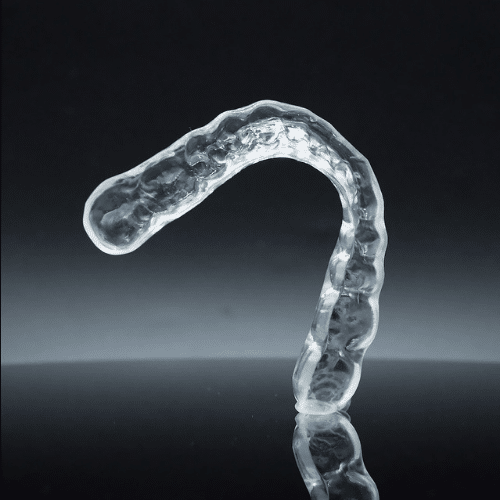
A night guard has several roles, providing therapeutic benefit to the teeth, the joints and the muscles.
Worn while sleeping, it acts as a barrier between the upper and lower teeth. That produces two effects:
1. Protection. With the teeth separated by the guard, they are protected from further damage caused by bruxism. Grinding wear is permanent, so preventing it is the more valuable half of the job. Enamel does not grow back, grinding wear is a different process from acid erosion, and grinding is the single largest patient-side variable in how long a restoration survives — see how long do dental fillings last?, what types of dental crowns are available? and teeth and aging. If restorative or cosmetic work is planned, a guard belongs in the plan rather than after it: understanding your treatment.
The forces involved have been measured, though only in small studies. Nishigawa, Bando and Nakano recorded nocturnal bite force in 10 subjects over three nights each and found the mean bruxism event reached 22.5 kgf, lasting a mean of 7.1 seconds, with the ratio of night-time to daytime maximum averaging 53.1% (range 17.3–111.6%). In other words, a typical grinding event is about half of what you can bite with deliberately when awake — but at the top of that range it exceeded the daytime maximum, and it happens repeatedly while you are unconscious of it.
2. Relief. It relieves tension and pressure from the jaw joint and the surrounding muscles.
And what it does not do, stated plainly: it does not stop you grinding. Bruxism is largely centrally driven — sleep, stress, medication, airway — rather than caused by tooth contacts, and current international consensus treats it as a motor behaviour rather than a disorder, something assessed rather than diagnosed. A guard protects the teeth while the causes are addressed. Judged as protection it works well; judged as a cure it can look like a failure. How can I stop grinding my teeth when I sleep? is honest about how much of the grinding itself is within reach.
What the guideline evidence says about splints for jaw pain
This deserves stating directly, because it is the part a practice selling appliances has least incentive to mention.
The BMJ's 2023 international clinical practice guideline, developed with GRADE methodology by a panel of patients, clinicians and methodologists, covers adults with chronic TMD pain of three months or more. For that group it makes strong recommendations in favour of cognitive behavioural therapy with or without biofeedback or relaxation therapy, therapist-assisted mobilisation, and usual care such as home exercises, stretching, reassurance and education. It makes a conditional recommendation against reversible occlusal splints, and a strong recommendation against irreversible oral splints and discectomy.
Two limits on that, both important. The recommendations, in the guideline's own words, "do not apply to the management of acute TMD pain" — pain of less than three months. And they assess treatments for pain; they do not address protecting teeth from grinding wear, which is the other and better-established reason a guard is fitted. So a guard prescribed to stop enamel being lost is not what the guideline is recommending against. A guard prescribed as the treatment for long-standing jaw pain, on its own, is closer to what it is cautioning about — and its strongly recommended alternatives are behavioural and physical, not dental appliances.
How the treatment actually runs
This is the part that differs from buying an appliance.
- A thorough consultation with the TMD specialist
- A diagnosis is made — a night guard is prescribed only if it is the right treatment for your case; EMG muscle mapping and bite force analysis and our technology describe what that assessment measures
- The guard is made and inserted a couple of weeks later — in the practice’s own on-site laboratory
- It is adjusted over a series of appointments, until the position is right for your joints and muscles
Step 4 is the whole argument for a custom guard. A chemist guard is a single fixed shape. A custom guard is made for you specifically, then refined until the joints and muscles settle — and that adjustment sequence is what a stock appliance cannot offer. Getting a new mouthguard — a trip to the chemist or the dentist? sets the two side by side.
A boil-and-bite guard worn nightly can also move teeth, because an ill-fitting appliance applies uncontrolled force for eight hours. That is the risk nobody mentions when selling them — and it is the same mechanism described in why do teeth shift?.
Living with the guard
- Wear it nightly. In a drawer it does nothing.
- Expect it to wear out. That wear is damage that would otherwise have gone into your teeth — which is the point.
- Go back if the bite feels different after wearing it, or if it stops seating properly.
- Clean it daily — rinse, brush with mild soap rather than abrasive toothpaste, and store it dry, away from heat. A guard left in a hot car distorts permanently. The same rule applies to dentures.
- It is not a sports mouthguard, and the two are not interchangeable in either direction. A sports mouthguard is thick and cushioned, made to absorb an impact; a night guard is thin and hard, made to manage grinding. A sports guard worn overnight is unhygienic and can alter the bite; a splint offers no impact protection on a field. See what kind of mouthguard should I use?, should I wear a mouthguard while playing sports? and, for children, should my child wear a mouthguard?.
What is used alongside it
A specialised TMD physiotherapist is often involved in conjunction with the guard, to relieve any lingering inflammation.
A guard changes the mechanics overnight; physiotherapy addresses the muscles that have been holding tension for months. Neither alone does the whole job in more involved cases.
Other measures with genuine support:
- Jaw exercises and self-management — soft diet during a flare, avoiding wide opening, not chewing gum, and heat over the muscles. Where tongue posture and breathing pattern are part of it, orofacial myofunctional therapy and mouth breathing are the relevant pages.
- Daytime awareness. At rest, lips together and teeth apart. Most people clench while concentrating or driving without knowing it.
- Reducing alcohol, caffeine and nicotine, particularly in the evening
- Sleep and stress. Cognitive behavioural approaches and exercise both have evidence behind them for bruxism — and, as above, CBT is one of the few things the BMJ panel recommended strongly in favour of for chronic TMD pain. See seven ways stress can affect your mouth, and, if the appointment itself is the stressor, dental anxiety.
- Reviewing medications with the prescriber where a drug is a likely contributor. Do not stop any medication on your own. Muscle relaxants for jaw clenching covers the injectable option and its limits.
The one that changes the plan: airway
If you grind, snore, wake unrefreshed, or your partner has noticed you stop breathing during sleep, say so.
Sleep bruxism and obstructive sleep apnoea are often mentioned together, and healthdirect notes that a dentist who finds sleep bruxism "may refer you to be checked by a doctor for sleep apnoea". The causal link, however, is not established. A 2024 meta-analysis by Błaszczyk and colleagues in Sleep Medicine Reviews reported that "the odds of SB presence in OSA did not differ from the control group (OR: 1.23, 95% CI: 0.47–3.20)", with no gradient across mild, moderate or severe apnoea. So grinding is a reason to mention your sleep to a clinician — not evidence that you have apnoea, and not a reason to treat the two as one problem.
Where apnoea is present it is a medical condition with cardiovascular consequences, diagnosed by a sleep study ordered through a medical practitioner — not by a dentist and not by an appliance.
Fitting a splint to someone with undiagnosed apnoea protects the teeth while leaving the more serious problem untouched, and some appliance designs are not appropriate in that situation. See Snoring & Sleep Apnoea.
What should not happen first
Worth stating because it protects people from expensive, irreversible treatment.
Current thinking favours conservative, reversible treatment first — splints, physiotherapy, exercises, heat, and addressing habits and sleep. What is the best way to treat TMJ? and can TMD be fixed? set out that order in full.
Permanently adjusting the bite by grinding down teeth, or extensive restorative work to ‘correct’ an occlusion, is not a first-line treatment for TMD, and the evidence does not support it as one. The National Academies report reviewed the question at length and concluded that "current experimental evidence, reviews, and weak occlusal theory indicate that occlusion should not be considered a contributing cause for the common TMDs" and that "treatment of the occlusion for TMDs also has no supporting evidence". Its recommendation to the profession is blunt: "efforts to move away from the focus on occlusion — as either a cause of TMD or a treatment objective — are needed in clinical practice and in dental training and education". Orthodontics is not a first-line TMD treatment either — see what is malocclusion of the teeth? and orthodontics for what orthodontic treatment is actually for. If any of these is proposed early, ask why, and ask what a conservative trial would involve first — second opinions and corrective dentistry exists for that conversation. Published fees are in the price guide.
When to seek help sooner
- The jaw locks open, or locks closed and will not open normally
- Pain that is increasing, or preventing eating
- A sudden change in how the teeth meet
- Swelling over the joint, or fever
- Symptoms after a blow to the face — which needs assessment for fracture; see emergency dentistry and what is considered a dental emergency?
Related pages: TMD & Teeth Grinding, Snoring & Sleep Apnoea, Chipped or Cracked Teeth, Sports Mouthguards.
Common questions
I sleep alone. How would I even know whether I grind?
Often you would not, and that is the ordinary situation rather than an unusual one. Healthdirect states it plainly: "if you grind your teeth while asleep, you may not be aware that you are doing it", and adds that "some people do not get any symptoms from grinding their teeth" at all. Where there is a bed partner, they are usually the one who notices — the noise is often what brings people in.
Without a partner, the evidence is circumstantial but readable. The symptom list healthdirect gives is cracked, chipped or loose teeth; damaged fillings; painful jaw muscles, especially in the morning; headaches or toothaches; sensitive teeth; sleep disturbance; and temporomandibular joint dysfunction. It also notes that people sometimes see a doctor about headaches or a sore neck and find grinding is the cause.
The more reliable route is the one that costs nothing extra: your dentist checks for signs of bruxism, such as tooth wear and damage, at regular check-ups, and if grinding is suspected will examine further and ask about symptoms, sleep habits, general health and medicines. Flat, polished wear facets that match between upper and lower teeth are visible to someone looking for them, and comparing photographs or models taken years apart is the closest thing to proof available.
How good is the evidence that a splint actually helps the pain?
Weak — and it is better to know that before paying for one than afterwards.
The current Cochrane review of occlusal interventions, published in 2024, is the most complete answer available. It included 57 randomised trials with 2,846 participants, and judged only one of them to be at low risk of bias. Its single most positive finding is that a full hard stabilisation splint may reduce muscle pain when chewing compared with no treatment (mean difference −1.97, 95% CI −2.37 to −1.57) — but that rests on one study of 84 participants, and the reviewers rated the certainty very low. For joint pain on chewing, muscle pain at rest, and the frequency of joint noises, they found little to no difference, again very uncertain. Notably, orofacial myofunctional therapy may reduce the severity of joint noise compared with a splint, on one 20-participant study.
Their conclusion does not hedge: "we found insufficient evidence to reach conclusions regarding the effectiveness of occlusal interventions for managing symptoms of TMD, despite the available studies including almost 3000 participants".
So the honest position is the one set out earlier on this page. The case for a guard as protection against grinding wear is a mechanical one and does not depend on this literature. The case for a guard as a treatment for jaw pain is not well supported, and if that is the reason it is being offered, it is reasonable to ask what else is being offered alongside it.
How long should I give it before deciding it is not working?
The trial evidence gives a rough window rather than a rule. In the Cochrane review the studies ran from 5 weeks to 84 months, and the key results were measured between about 4.4 weeks and 4 months. For psychological approaches, the shortest treatment was 4 weeks, with follow-up from 3 to 12 months.
A few weeks is therefore a reasonable point at which to expect something — not necessarily resolution. What matters more than the calendar is that the appliance is being adjusted rather than simply worn: the sequence of review appointments described above exists because the first fit is a starting position, not a finished one.
What should prompt a call rather than patience is a change for the worse — the bite feeling different after wearing it, new pain, or the guard no longer seating properly.
Does it matter which type of splint I get, or whether it goes on the top or the bottom?
The evidence does not settle it, which is an unsatisfying but accurate answer.
Cochrane classifies occlusal splints as stabilisation, reflex or repositioning designs, and notes that most of the 57 studies evaluated the full hard stabilisation splint — so that design carries most of what evidence exists. Where one splint was compared against another with a different mechanism of action, the review found little to no difference in the frequency of joint noise, but the comparison rested on nine participants, with a confidence interval running from 0.07 to 9.18. That is not a finding; it is an absence of one.
Which arch it sits on is a practical judgement — what your teeth and your jaw movement allow, whether you have restorations or missing teeth, and what you can tolerate sleeping in. It is worth asking which design is being proposed for you and why, but not worth agonising over: no published comparison currently supports one over another.
The guideline recommends psychological therapy. Does that mean my pain is imagined?
No — and the confusion is understandable enough that it is worth separating two different things.
The pain is real and physical. What cognitive behavioural approaches act on is how a nervous system that has been in pain for months handles it, alongside sleep, stress and the muscle tension that accompanies both. That is why the internationally standardised diagnostic system for these conditions, the DC/TMD, is deliberately two-axis: Axis I describes the physical disorder, and Axis II assesses the person who has it — pain-related disability and distress — because both affect how someone recovers. Neither axis replaces the other.
The evidence itself is modest, and worth seeing in full rather than in summary. The 2022 Cochrane review of psychological therapies for painful TMD included 22 randomised trials and 2,001 participants. At the end of treatment there was no evidence of a benefit of CBT on pain intensity against either alternative treatment (SMD 0.03, 95% CI −0.21 to 0.28) or control (SMD −0.09, 95% CI −0.30 to 0.12). At follow-up there was a small benefit — SMD −0.29 (95% CI −0.50 to −0.08) against alternative treatment, and −0.30 (95% CI −0.51 to −0.09) against control. The reviewers rated the certainty low to very low.
So why did the BMJ panel recommend it strongly when Cochrane rates the same evidence as low certainty? Because a strong recommendation weighs more than certainty alone: it also weighs harms, which here are minimal, and what patients value, which includes small gains in a condition that is otherwise hard to shift. Both statements are accurate. What cannot honestly be said is that CBT is proven to work.
Related reading
- TMD and teeth grinding — the service page
- What is bruxism and how is it managed?
- Night time tooth grinding and clenching
- What are the most common symptoms of TMD?
- Why does a cracked tooth hurt so much?
- Why would I need to see a dental specialist?
- Specialist care
- General dentistry
Practical details
Written by Dr Natasha Hremias, Smile Solutions. The full team and the practice’s registered specialists are listed by name.
Smile Solutions runs a dedicated TMD clinic with diagnostic equipment including EMG muscle mapping and bite force analysis, an on-site physiotherapist and osteopath, and splints made in the practice's own laboratory across several designs.
If you recognise the symptoms above, book a consultation for an assessment.
Smile Solutions, Level 1, 220 Collins Street, Manchester Unity Building, Melbourne VIC 3000 — getting here. Phone 13 13 96, contact us, or theteam@smilesolutions.com.au. Monday–Friday 8.00am–6.00pm, Saturday 8.30am–1.30pm, Sunday by appointment.
Every practitioner's registration can be verified free on the AHPRA public register at ahpra.gov.au.
Published 3 May 2024. Individual outcomes vary. General information only; it does not replace advice from your treating practitioner. Obstructive sleep apnoea is a medical diagnosis made on a sleep study arranged through a medical practitioner. No medication should be started or stopped on the basis of this page.
Smile Solutions trades under ABN 28 193 514 103.
Images on This Page
-
https://www.facebook.com/tr?id=800557773428361&ev=PageView&noscript=1
(no alt text)
-
https://www.smilesolutions.com.au/wp-content/uploads/2025/10/calendar_month.svg
(no alt text)
-
https://www.smilesolutions.com.au/wp-content/themes/arcadian-wordpress-theme/assets/images/smile_solutions_logo_white.png
Smile Solutions Logo
-
https://www.smilesolutions.com.au/wp-content/themes/arcadian-wordpress-theme/assets/images/smile_solutions_logo_purple.png
Smile Solutions Logo
-
https://www.smilesolutions.com.au/wp-content/uploads/2024/02/Natasha-150x150.jpg
Dr Natasha Hremias
-
https://www.smilesolutions.com.au/wp-content/uploads/2025/11/Speciality-Splints.png
Speciality Splints
-
https://www.smilesolutions.com.au/wp-content/uploads/2025/11/TMD-Teeth-Grinding-Smile-Solutions-300x270.png
Woman holding her face, looking concerned.
-
https://www.smilesolutions.com.au/wp-content/uploads/2025/09/Porcelain-Veneers-Smile-Solutions-300x300.png
Porcelain Veneers Smile Solutions
-
https://www.smilesolutions.com.au/wp-content/uploads/2025/09/Root-Canal-2-300x217.jpg
Root Canal
-
https://www.smilesolutions.com.au/wp-content/uploads/2023/11/SS-Tooth-1-1-150x150.png
Smile Solutions
-
https://www.smilesolutions.com.au/wp-content/themes/arcadian-wordpress-theme/assets/images/family_owned_bussiness.png
Family Owned Business
-
https://www.smilesolutions.com.au/wp-content/themes/arcadian-wordpress-theme/assets/icons/icon--phone.svg
Smile Solutions Contact
-
https://www.facebook.com/tr? id=800557773428361&ev=PageView&noscript=1
(no alt text)