TMJ, TMD, bruxism — what is the difference?
TMJ is a joint. TMD is a disorder of that joint or its muscles. Bruxism is a behaviour. They are three different things, they overlap, and treating them as interchangeable is why so many people conclude that “nothing works” for their jaw. TMD and teeth grinding is the service page; what is the difference between TMD, TMJ and bruxism? is the short version of this page.
If you have ever searched for help with jaw pain, clicking or grinding, you will have met all three terms used as though they meant the same thing. “I have TMJ.” “My bruxism is causing TMD.” “Is TMJ the same as grinding?” The confusion is understandable — these conditions overlap, coexist and influence one another. But lumping them together makes an accurate diagnosis harder, and the treatment follows the diagnosis.
1. TMJ: the joint itself
TMJ stands for temporomandibular joint. It is an anatomical structure, not a disease. You have two, one on each side of the face, just in front of the ears. Everyone has TMJs, in the same way everyone has knees.
The TMJ is where the lower jaw (mandible) meets the temporal bone of the skull. It is a genuinely complex joint — a combined hinge and sliding mechanism, with a fibrocartilaginous disc between the two bony surfaces. That disc cushions the joint and allows the smooth, multi-directional movement that makes chewing, speaking and yawning possible.
When someone says “I have TMJ”, what they mean is “I have a problem with my TMJ”. What they are describing is TMD. For the pain itself, see what causes TMJ pain and how is it treated? and what is the cause of my jaw pain?.
This is not pedantry. “Having TMJ” sounds binary — you either have it or you do not. In reality temporomandibular problems exist on a spectrum, and the specific type of problem determines the appropriate treatment.
2. TMD: the disorder
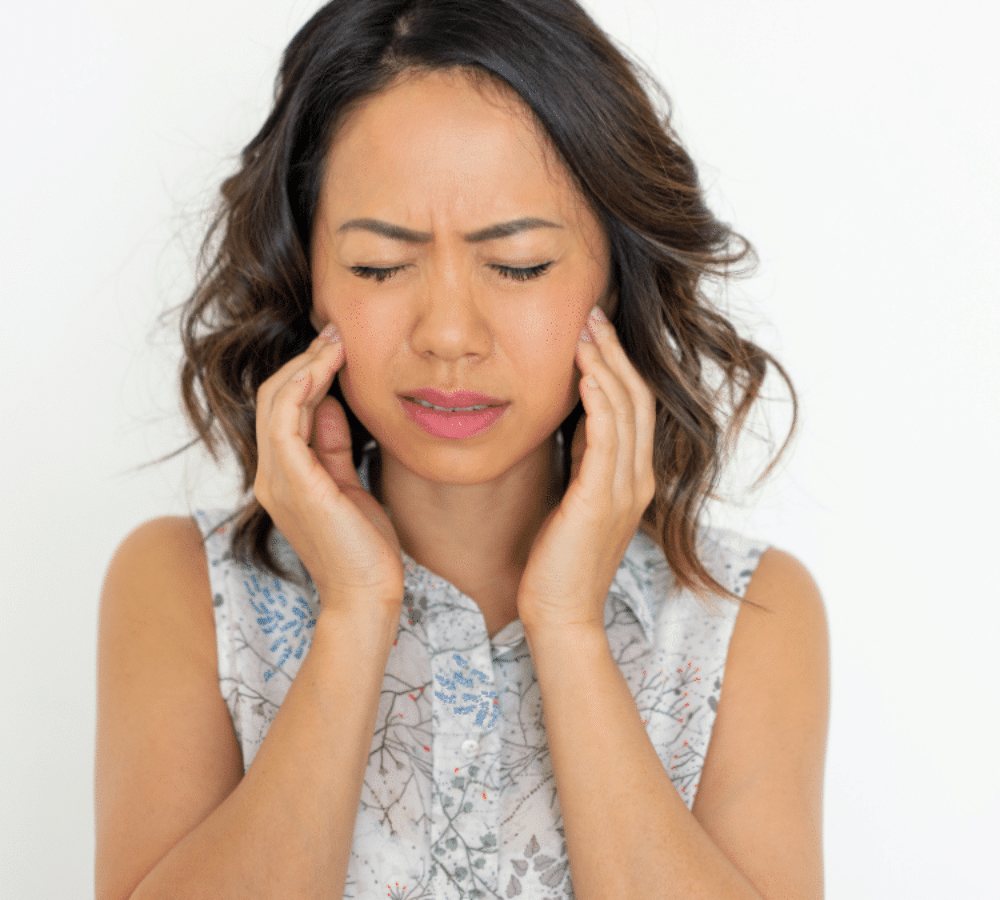
TMD stands for temporomandibular disorder — an umbrella term covering a range of conditions affecting the joint, the muscles of mastication (the chewing muscles), or both. TMD is the diagnosis; TMJ is just the joint. What are the most common symptoms of TMD? and is TMD serious? cover the presentation and the prognosis.
The Diagnostic Criteria for Temporomandibular Disorders (DC/TMD), the internationally recognised classification, divides TMD into categories.
Joint disorders
- Disc displacement with reduction — the disc slips out of position but snaps back during opening. This is what produces the clicking or popping.
- Disc displacement without reduction — the disc is permanently displaced, often causing limited opening or “locking”.
- Degenerative joint disease (osteoarthritis) — breakdown of the joint surfaces, causing pain, crepitus (a grating sound), and progressive dysfunction.
- Joint hypermobility — excessive looseness, sometimes with subluxation (partial dislocation).
Muscle disorders
- Myalgia — pain from the chewing muscles, typically a dull ache in the jaw, temple or face.
- Myofascial pain — pain with referral patterns, where trigger points send pain elsewhere: teeth, ears, forehead. This is why jaw problems are so often mistaken for toothache or ear infection — see what are the causes of toothache and what are their symptoms?, tooth pain and ache and I have a toothache. Should I see my GP for antibiotics?.
- Muscle spasm — sudden involuntary contraction, often severely painful.
Combined disorders
Many people have both. A disc displacement causes compensatory muscle guarding, which becomes chronic myofascial pain. Or chronic muscle overactivity from bruxism overloads and degrades the joint itself.
Why the classification matters. Different types need different treatment. Disc displacement may call for a repositioning splint or arthrocentesis. Myofascial pain may respond to physiotherapy, trigger point therapy and stress management. Treating every TMD patient with the same generic night guard is like treating every headache with the same medication — sometimes it helps, often it does not, and occasionally it makes things worse. What is the best way to treat TMJ? and can TMD be fixed? take that further.
3. Bruxism: the behaviour
Bruxism is habitual, involuntary clenching or grinding of the teeth. Unlike TMD, which is a diagnostic category, bruxism is a parafunctional activity — a movement pattern serving no functional purpose. What is bruxism and how is it managed? is the dedicated page.
It comes in two forms, and the distinction is clinically critical.
Sleep bruxism
Now classified as a sleep-related movement disorder. The forces involved are routinely overstated, and what was actually measured is more interesting than the myth.
The one study to measure bite force directly during sleep bruxism recorded a highest nocturnal amplitude per subject of 42.3 kgf (range 15.6–81.2 kgf), against a daytime maximum voluntary bite force of 79.0 kgf (51.8–99.7 kgf) — a mean nocturnal-to-daytime ratio of 53.1 per cent, range 17.3 to 111.6 per cent (Nishigawa K, Bando E, Nakano M, Quantitative study of bite force during sleep associated bruxism, Journal of Oral Rehabilitation 2001;28(5):485–491). So the average sleeping clench is about half of what you can manage awake. At the top of the range one subject marginally exceeded their own conscious maximum, which is why the authors conclude that nocturnal bite force during bruxism can exceed the daytime maximum — not that it usually does.
An earlier University of Adelaide study monitored nocturnal clenching by EMG, which measures muscle electrical activity rather than bite force and is not the same quantity. It found that all ten subjects tested bruxed, and two reached intensities of effort while asleep that exceeded their maximal conscious clenches (Clarke NG, Townsend GC, Carey SE, Bruxing patterns in man during sleep, Journal of Oral Rehabilitation 1984;11:123–127).
So the damage is not done by superhuman force. It is done by ordinary force, applied over and over for hours, without the feedback that stops you when you are awake — nothing tells you it is sore, nothing prompts you to reposition or stop, and you have no idea in the morning that it happened. That is also why the wear is cumulative and why it is so often noticed first by a dentist rather than by the person doing it. Night time tooth grinding and clenching and how can I stop grinding my teeth when I sleep? cover living with it.
Sleep bruxism is often associated with micro-arousals — brief shifts from deeper to lighter sleep. Those can be triggered by sleep-disordered breathing such as obstructive sleep apnoea, periodic limb movements, or other disturbances. Which is why sleep bruxism cannot be managed properly without considering sleep quality.
On the airway hypothesis, the evidence does not support the popular version. It is widely said that sleep bruxism is a compensatory response to a compromised airway — that people clench or protrude the jaw to keep the airway open, so that the bruxism is a symptom rather than the disease. It is a plausible mechanism and it may hold for some individuals, but a 2024 meta-analysis found that the odds of sleep bruxism in people with obstructive sleep apnoea did not differ from controls — odds ratio 1.23, 95% CI 0.47 to 3.20 — with no dose-response gradient across mild, moderate or severe apnoea. The two conditions can occur together, and either is a reason to be assessed properly, but the airway should not be presented as the explanation for grinding, and an airway diagnosis should not be inferred from the grinding. Sleep apnoea requires a sleep study, and that pathway is set out at snoring and sleep apnoea; see also mouth breathing and orofacial myofunctional therapy.
Awake bruxism
Occurs during waking hours, and is more commonly associated with stress, anxiety, concentration or habit. It tends to involve sustained clenching rather than the rhythmic grinding of sleep bruxism. Seven ways stress can affect your mouth sets out the wider picture, and dental anxiety covers the specific case where the dental appointment is the stressor.
It is more amenable to behavioural intervention, because the person is conscious and can learn to notice and interrupt the habit. Cognitive behavioural strategies, biofeedback and mindfulness techniques can be effective.
Consequences
Whether asleep or awake, sustained bruxism can cause:
- Tooth wear, fracture and eventual tooth loss — enamel does not grow back, and grinding wear is a different process from acid erosion
- Muscle hypertrophy — enlargement of the jaw muscles, particularly the masseters, which visibly widens the lower face
- Muscle pain and fatigue
- TMJ overloading, potentially leading to disc displacement or degenerative change
- Headaches, particularly in the temples
- Disrupted sleep — for the person, and where grinding is audible, for their partner
There is a restorative consequence too, and it is the one that shows up in the price of the next decade. Grinding is the single largest patient-side variable in how long any restoration survives — the lifespans quoted in how long do dental fillings last?, what types of dental crowns are available? and teeth and aging all assume a mouth that is not grinding through them. Also see why does a cracked tooth hurt so much? and chipped or cracked teeth.
How they overlap, and how they do not
TMD and bruxism frequently coexist, but they are not the same condition, and one does not always cause the other.
| Scenario | What it means |
|---|---|
| Bruxism causes TMD | Chronic heavy grinding overloads the joint, damages the disc, and causes muscle pain. The most commonly assumed relationship — real, but not the only one. |
| TMD without bruxism | Disc displacement can result from trauma, hypermobility or inflammatory conditions with no bruxism at all. Myofascial pain can arise from postural dysfunction, stress-related tension, or referred pain from the cervical spine. |
| Bruxism without TMD | Many people grind in their sleep without developing joint or muscle disorders — muscles adapt, joints tolerate the load. The tooth wear is still cumulative and progressive, but bruxism alone is not enough to diagnose TMD. |
| Shared underlying causes | Sleep-disordered breathing, psychosocial stress and certain medications — particularly SSRIs and stimulants — can contribute to both. Treating the underlying cause may improve both at once. |
Why the terminology decides the treatment
The pathway for each of these is completely different:
- Disc displacement without pain — observation and monitoring
- Chronic myofascial pain driven by awake bruxism — behavioural therapy, physiotherapy, splint therapy
- Sleep bruxism alongside diagnosed obstructive sleep apnoea — sleep study, airway management, mandibular advancement device
- Degenerative joint disease of the TMJ — anti-inflammatory management, possible arthrocentesis, joint protection
Calling all four “TMJ” and issuing a standard night guard is why so many people feel that nothing works for their jaw. The treatment did not fail; it was aimed at a different condition. How can a night guard be used to treat TMD? explains what a splint is and is not for.
And one more distinction, because it causes real confusion at the chemist. A night guard is a thin, hard occlusal splint for grinding. A sports mouthguard is a thick, cushioned appliance for impact. They are different appliances for different jobs and are not interchangeable in either direction. See what kind of mouthguard should I use?, getting a new mouthguard — chemist or dentist? and, for children, should my child wear a mouthguard?.
How the diagnosis is worked out
At a dedicated TMD clinic, the diagnostic process is built to distinguish between these overlapping conditions:
- Detailed history — separating sleep bruxism from awake bruxism, identifying contributing factors (sleep quality, stress, medications, postural habits), and mapping the timeline and pattern of symptoms.
- Structured clinical examination following the DC/TMD criteria, identifying the specific joint disorder (disc displacement, degeneration, hypermobility) and muscle disorder (myalgia, myofascial pain, spasm).
- EMG muscle mapping — objective data on muscle activity patterns, distinguishing hyperactive muscles from normal function.
- Bite force analysis — revealing force distribution imbalances contributing to joint overloading or muscle compensation.
- CBCT imaging — three-dimensional assessment of joint anatomy, condylar shape and airway dimensions, which matters for identifying both structural TMD and sleep-disordered breathing behind the bruxism.
EMG muscle mapping and bite force analysis describes that work in detail; how safe are dental x-rays covers the imaging question, and our technology lists the equipment.
The output should not be a vague diagnosis of “TMJ” or “bruxism”, but a specific, data-supported one that drives a targeted plan. Depending on the finding that might involve splint therapy, physiotherapy, osteopathy, muscle relaxant injectables, orthodontics, referral to sleep medicine, or a combination — and where several disciplines are involved, complex dental cases describes how that is coordinated. Specialist care and why would I need to see a dental specialist? cover referral.
A note on injectables: muscle relaxant injectables are prescription-only medicines in Australia. Whether they are appropriate, at what dose, and what the risks are is a clinical decision made by a qualified prescriber after assessment. They are not a first-line treatment for jaw pain, and they treat muscle overactivity rather than joint pathology. Muscle relaxants for jaw clenching: when they help, when they don’t goes through that decision in full.
The takeaway
- TMJ is a joint. Everyone has one — two, in fact. It is not a diagnosis.
- TMD is a disorder, or group of disorders, affecting the joint, the chewing muscles, or both. It is the diagnosis.
- Bruxism is a behaviour — involuntary grinding or clenching. It is a risk factor for TMD and for tooth damage, but it is a separate condition with its own classification and its own treatment considerations.
They overlap. They interact. They can coexist. But treating them as interchangeable produces generic treatment that misses the mark.
If you have jaw pain, clicking, grinding, headaches, or any of the symptoms above, an accurate diagnosis is the first step — not a device. Understanding your treatment explains how a plan and a written quotation are put together, published fees are in the price guide, and second opinions and corrective dentistry exists if something irreversible has already been proposed to you.
Common questions
Will this go away on its own if I wait?
Often, yes — and that is a genuinely important thing to know before agreeing to anything irreversible.
The RACGP's clinical article on temporomandibular dysfunction states that “for the majority of patients, a conservative approach to TMD management should be adopted”, because “up to 40% of symptomatic patients have spontaneous resolution of their symptoms without any treatment, and 50–90% of patients have relief with conservative therapy.”
Read those two figures together. A large proportion of people get better with nothing done at all, and most of the rest improve with measures that cost little and risk nothing. The non-pharmacological list the same article gives is deliberately unglamorous: “patient education and reassurance, jaw rest, a soft diet, warm compress over the region of pain and passive stretching exercises.”
That has two consequences worth holding on to. First, it is reasonable to start conservatively and see. Second — and this is the one that protects you — a high spontaneous recovery rate means that almost any intervention will appear to work in a proportion of cases, simply because the condition was going to settle anyway. That is precisely why irreversible treatment for jaw pain deserves a high standard of justification, and why the two questions below matter.
None of that applies to a jaw that is locking, to a sudden inability to open or close, or to pain that is severe and escalating rather than fluctuating. Those warrant assessment now rather than a watch-and-wait.
Does a night guard actually work, or does it just protect the teeth?
Mostly the second, and the honest version of this answer differs sharply from how splints are usually sold.
On protecting the teeth, the case is straightforward: healthdirect describes a custom-made occlusal splint as an appliance “to protect your teeth”, and that is the defensible indication — it puts a replaceable layer between surfaces that would otherwise wear each other away.
On treating the pain, the evidence is much weaker than most people assume. The 2024 Cochrane review of occlusal interventions for TMD concluded that an occlusal splint “may reduce pain in muscles when chewing compared to receiving no treatment, but the results are very uncertain”, and that “there is little or no evidence that occlusal splints can give other benefits, but these results are also uncertain.” Across the specific outcomes it found “little to no difference” in self-reported joint pain when chewing, in muscle pain at rest, and in the severity of joint noise. The review states plainly that “it is important to note that we have very low certainty in the evidence for all” of its comparisons, and calls for “further research… to find clear evidence of whether occlusal splints or occlusal adjustments (i.e. grinding down teeth) are beneficial or harmful.”
So the reasonable expectation to set is: a splint is a good bet for protecting tooth structure from grinding, it may help muscle pain on chewing, and it is not established as a treatment for joint pain or clicking. Note also that a splint does not stop the behaviour — the appliance is framed as protecting the teeth, not as ending the grinding. If a splint is proposed, it is fair to ask which of those two purposes it is for in your case, and what the plan is if the pain does not change.
Should my bite be adjusted, or do I need braces to fix my jaw?
Be slow about both, and be especially slow about anything that removes tooth structure.
On grinding the teeth to adjust the bite, the position is that the evidence is not there. The Cochrane review that covers occlusal adjustment calls for further research “to find clear evidence of whether occlusal splints or occlusal adjustments (i.e. grinding down teeth) are beneficial or harmful” — note or harmful. It supersedes an earlier review whose conclusion was blunter still: “there is an absence of evidence, from RCTs, that occlusal adjustment treats or prevents TMD.” Enamel removed to adjust a bite does not grow back, and combining an irreversible procedure with an absence of evidence and a 40% spontaneous resolution rate is a poor trade.
On orthodontics, the RACGP is direct: “malocclusion of the teeth should be noted if present; however, this does not contribute to the manifestation of TMD and orthodontic referral is not recommended for this finding alone.” The operative words are for this finding alone — if you want orthodontic treatment for crowding, appearance or function, that is a separate and legitimate decision. What is not supported is being told that straightening your teeth is the treatment for your jaw pain.
If either has been proposed to you as the fix, that is exactly the situation the second opinions and corrective dentistry page exists for, and asking for the diagnosis in writing — which DC/TMD category, based on what findings — before consenting is entirely reasonable.
My jaw problem is clearly stress. Does psychological therapy help?
It is a reasonable thing to try, and the evidence is weaker than the confidence with which it is usually recommended.
A Cochrane review of psychological therapies for TMD — covering cognitive behavioural therapy, behaviour therapy and acceptance and commitment therapy, with most studies evaluating CBT and follow-up from three to twelve months — found that at treatment completion there was no evidence of a benefit of CBT on pain intensity. The review rates this body of evidence as low to very low certainty. Clinical guidelines do recommend CBT for TMD, so the defensible statement is that guidelines recommend it while the trial evidence supporting it is weak — not that it is proven to work.
That is not an argument against trying it. A low-risk intervention with uncertain evidence is a very different proposition from an irreversible one with uncertain evidence, and the tools it teaches — noticing the clench, interrupting the habit, managing the load — apply directly to awake bruxism, where the person is conscious and can act. Sleep bruxism is less accessible to that approach for the obvious reason.
The practical version, for the period before or alongside any therapy: notice what your jaw is doing when you are concentrating, driving or scrolling; keep the teeth apart and the lips together at rest, since teeth should only meet when you swallow or chew; and treat jaw rest, a soft diet and a warm compress as real measures rather than as a holding pattern. Seven ways stress can affect your mouth.
Related reading
- TMD and teeth grinding — the service page
- What is the difference between TMD, TMJ and bruxism?
- Is TMD serious?
- Can TMD be fixed?
- What is the best way to treat TMJ?
- What is malocclusion of the teeth?
- General dentistry
Practical details
Specialist registration can be verified on the AHPRA register, or by calling 1300 419 495. The practice’s registered specialists and the full team are listed by name.
Smile Solutions, Level 1, 220 Collins Street, Manchester Unity Building, Melbourne VIC 3000 — getting here. Phone 13 13 96, contact us, or theteam@smilesolutions.com.au. Monday–Friday 8.00am–6.00pm, Saturday 8.30am–1.30pm, Sunday by appointment.
Published 20 July 2026, by Dr Kia Pajouhesh. Bite force and EMG findings are attributed to the studies named. Prognosis and orthodontic-referral statements are quoted from the RACGP's Australian Journal of General Practice; occlusal splint, occlusal adjustment and psychological therapy findings are quoted from Cochrane systematic reviews. General information only; it does not replace advice from your treating practitioner. Obstructive sleep apnoea requires medical diagnosis via a sleep study. Outcomes vary between individuals, and all treatment carries risks.
Smile Solutions trades under ABN 28 193 514 103.
Images on This Page
-
https://www.facebook.com/tr?id=800557773428361&ev=PageView&noscript=1
(no alt text)
-
https://www.smilesolutions.com.au/wp-content/uploads/2025/10/calendar_month.svg
(no alt text)
-
https://www.smilesolutions.com.au/wp-content/themes/arcadian-wordpress-theme/assets/images/smile_solutions_logo_white.png
Smile Solutions Logo
-
https://www.smilesolutions.com.au/wp-content/themes/arcadian-wordpress-theme/assets/images/smile_solutions_logo_purple.png
Smile Solutions Logo
-
https://www.smilesolutions.com.au/wp-content/uploads/2025/11/Kia-150x150.jpg
Dr Kia Pajouhesh
-
https://www.smilesolutions.com.au/wp-content/uploads/2025/11/TMD-Teeth-Grinding-Smile-Solutions.png
Woman holding her face, looking concerned.
-
https://www.smilesolutions.com.au/wp-content/uploads/2025/09/Wisdom-Teeth-Smile-Solutions-300x300.png
Smile Solutions Dentist Melbourne
-
https://www.smilesolutions.com.au/wp-content/uploads/2026/07/Photography-and-Facial-Analysis-300x270.jpg
Photography and Facial Analysis
-
https://www.smilesolutions.com.au/wp-content/uploads/2013/04/Dental-Tourism-300x270.jpg
Dental Tourism
-
https://www.smilesolutions.com.au/wp-content/themes/arcadian-wordpress-theme/assets/images/family_owned_bussiness.png
Family Owned Business
-
https://www.smilesolutions.com.au/wp-content/themes/arcadian-wordpress-theme/assets/icons/icon--phone.svg
Smile Solutions Contact
-
https://www.facebook.com/tr? id=800557773428361&ev=PageView&noscript=1
(no alt text)