Complex dental cases: what happens when multiple specialists collaborate
Behind every successful complex dental outcome is a planning process most patients never see — one that determines whether the result lasts five years or a lifetime.
When a patient has a single cavity, the plan is straightforward: clean out the decay, place a filling, polish, done.
But what happens when a patient has worn-down teeth, a shifting bite, gum disease, missing teeth, failing old dental work, and a jaw joint that clicks and aches — all at the same time?
This is more common than people think. Years of gradual deterioration, deferred treatment and piecemeal dental work accumulate until the individual problems cannot be separated from each other:
- You cannot crown a tooth until the gum disease is treated
- You cannot place an implant until the bite is corrected
- You cannot correct the bite until you know which teeth you are keeping
These cases turn on getting the order right, which means the disciplines involved have to agree on one plan before any of it starts. However that is organised, the work is the same: gather the input, settle the sequence, and keep everyone working from the same version of it. That is what the complex dentistry service exists to do; why would I need to see a dental specialist? explains what each discipline contributes.
What makes a case “complex”
Not every case involving multiple procedures is complex. A patient needing a few fillings and a clean has multiple procedures but a straightforward plan.
Complexity arises when:
Multiple disciplines are involved — input is required from two or more specialist fields: periodontics, endodontics, orthodontics, prosthodontics, oral surgery.
The problems are interdependent — you cannot solve one without addressing or accounting for another. The treatment sequence matters enormously.
The bite (occlusion) needs changing — altering how the upper and lower teeth meet affects every restoration in the mouth. The new bite position has to be right before any teeth are prepared. What is malocclusion of the teeth? and why do teeth shift? cover how a bite gets into this state in the first place.
There are structural deficiencies — insufficient bone for implants, inadequate tooth structure for crowns, or gum tissue needing rebuilding before definitive restorations. See bone grafting.
There are medical complications — diabetes, bleeding disorders, bisphosphonate therapy, immunosuppression, or a history of head and neck radiation all affect planning and sequencing. The diabetes interaction in particular runs both ways — see diabetes and dental health.
Previous treatment has failed — failed root canals, failing implants, broken crowns, or poorly fitting dentures. Second opinions and corrective dentistry is where most of these cases start.
The planning process
Step 1: Comprehensive diagnostic assessment
This goes well beyond a standard examination:
Clinical examination. Every tooth assessed individually — structural integrity, condition of existing restorations, nerve health (pulp vitality testing), periodontal status (probing depths, bleeding, mobility, recession), and its strategic importance in the overall plan.
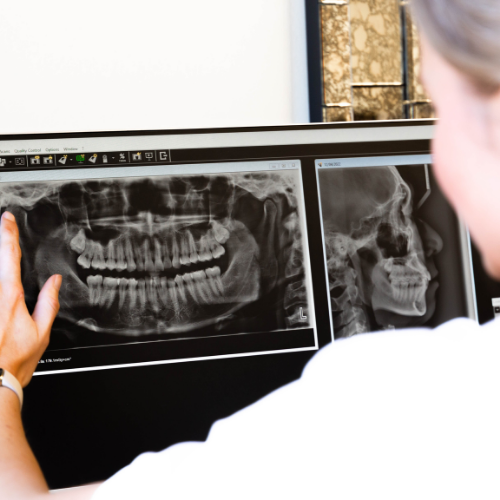
Radiographic assessment. A full-mouth series of periapical radiographs, a panoramic radiograph (OPG), and in many cases a cone beam CT (CBCT) — giving detailed views of root anatomy, bone levels, sinus proximity, nerve positions and the extent of pathology. On dose and indication, see how safe are dental x-rays?; the imaging equipment itself is listed under technology.
Photographs. Clinical photographs of every tooth, the gum line and the bite from multiple angles — a permanent record allowing specialists to review the case without the patient needing to be present.
Study models or digital scans. Impressions or intraoral scans capturing the exact shape and position of every tooth, so the bite can be analysed on mounted models or in digital planning software.
Facebow recording. A facebow records the spatial relationship between the patient’s upper jaw and their skull, allowing models to be mounted on an articulator in the exact position they occupy in the patient’s head. Essential where bite height or jaw relationship will change.
Bite analysis. Recording how the teeth meet in various jaw positions — not just biting down, but sliding left, right and forward — which is what reveals where the problems actually are. EMG muscle mapping and bite force analysis describes the measurement side of this.
TMJ assessment. Evaluating the jaw joints for clicks, pops, pain or limited opening. Any TMJ issues must be addressed or stabilised before irreversible dental treatment begins. TMD vs TMJ vs bruxism untangles the three terms, which are routinely confused.
Step 2: Problem list and prioritisation
The lead clinician — typically a prosthodontist for restorative-focused cases — catalogues every issue:
- Teeth with active decay
- Teeth with failing restorations
- Teeth requiring root canal treatment or retreatment
- Teeth with periodontal compromise
- Missing teeth and their replacement options
- Occlusal (bite) problems
- Aesthetic concerns
- TMJ issues
- Soft tissue deficiencies
- Bone deficiencies at implant sites
Each is prioritised and assigned to the discipline that will address it.
Step 3: The case conference
This is the step that turns a list of opinions into a plan: the relevant specialists review the case together, looking at the same records. The argument for that arrangement is made at length in Is a bigger dental practice better? Part 1 and Part 2.
A typical conference:
- The prosthodontist presents the case and their vision for the final result
- The periodontist advises which teeth have viable periodontal support and which are hopeless, and what preparatory gum treatment or grafting is needed
- The endodontist assesses which teeth need root canal treatment or retreatment, and their prognosis — see why the microscope matters and the risk of broken files during retreatment
- The oral surgeon discusses implant feasibility, bone grafting requirements and surgical sequencing
- The orthodontist advises whether tooth movement would improve conditions for restoration or implant placement
The discussion is iterative. The prosthodontist may propose keeping a tooth the periodontist judges hopeless. The oral surgeon may note that implant placement would be more predictable if the orthodontist first uprighted a tilted adjacent molar. Each contribution refines the plan.
The output is a unified, sequenced plan that every team member understands and has contributed to. The test of any arrangement is whether that document exists and whether everyone treating you is working from it — which is a reasonable thing for a patient to ask to see.
Step 4: Treatment plan presentation
Presented in clear terms, covering:
- The current situation — what was found and why it matters
- The proposed treatment — each phase, what it involves, who performs it, and why it is sequenced that way
- Alternatives — including doing nothing, and what the consequences would be
- Timeline — complex cases may span 12 to 24 months
- Costs — itemised by phase, with health fund estimates where applicable; indicative ranges for individual items are in the price guide, and the larger components are broken down in dental implant costs in Melbourne, how much a dental crown costs in Melbourne and, where sedation is used, what sedation adds to the bill
- Payment options — including staged payments aligned with treatment phases
Payment plan options are available. Where a plan is advertised as interest free, that describes the plan term only — a deposit may be required, an establishment fee and ongoing account fees may apply, and charges can apply if the balance is not cleared within the agreed period. The applicable terms depend on the provider and the amount financed, and are set out in writing before you commit — ask what the deposit and the establishment fee are, in dollars, and what the total will be by the end. Payment Plans. The wider argument about how patients finance long-horizon dentistry is in patient dental payment plans.
Patients should never feel rushed. The plan is documented in writing, and patients are encouraged to take it home, consider it, discuss it with family, and return with questions. Understanding your treatment describes what that written plan should contain.
Step 5: Sequential execution
Every case differs, but a common order:
Phase 1 — Emergency and urgent treatment. Active pain, infection, or functional problems needing immediate attention — see emergency dentistry.
Phase 2 — Disease control. Periodontal treatment, removal of hopeless teeth, management of active decay. The goal is a stable, healthy foundation. When do you need deeper cleaning? covers the periodontal half.
Phase 3 — Orthodontic treatment, if indicated. Repositioning teeth before restorative work — uprighting a tilted molar to make space for an implant, or aligning crowded teeth before veneers. See orthodontics.
Phase 4 — Surgical procedures. Implant placement, bone grafting, sinus lifts, soft tissue grafting — performed once the mouth is disease-free and teeth are in optimal positions. Where sedation is preferred for the surgical phase, see sleep dentistry.
Phase 5 — Healing and integration. Implants integrate with bone, typically three to six months; grafted tissue matures. What do I need to know about dental implants? sets out the staging in detail, and implant versus bridge for a single tooth the alternative where waiting is unattractive.
Phase 6 — Provisional restorations. Temporary crowns, bridges or veneers to “test drive” the new bite position, aesthetics and function. This is a critical phase: it lets both patient and clinicians evaluate the plan before committing to permanent restorations. The aesthetic version of the same idea is the mock-up reveal — why you should see your new smile before any treatment begins.
Phase 7 — Definitive restorations. Once the provisionals have been validated and adjusted, the final restorations are fabricated and placed — at Smile Solutions, in the in-house Smile Lab, where the ceramist and prosthodontist collaborate directly. What restorative dentistry is covers the components.
Phase 8 — Maintenance. A tailored schedule, typically more frequent than standard, to protect the completed work — see how often should I go to the dentist?.
What makes these cases hard to coordinate
None of the following is a criticism of any practitioner or any kind of practice. They are the practical problems that interdependent treatment creates, and they have to be solved somehow in every arrangement:
Breadth of input. A genuinely complex case draws on several disciplines at once — periodontal, endodontic, surgical, orthodontic and restorative judgement, each bearing on the others. However that input is obtained, somebody has to gather it and somebody has to hold the resulting plan. Where that role is unassigned, a plan tends to become a series of separate opinions that were never reconciled. Endodontist or dentist for a root canal? takes up one version of that question, and why would I need to see a dental specialist? describes what each discipline contributes.
Records and communication. Coordination across separate practices runs on letters, emails and phone calls, and images and scans have to travel with the plan. Information can be delayed or arrive incomplete, and a plan that needs revising partway through is harder to revise when the people revising it are in different buildings. This is a logistics problem rather than a clinical one, but it has clinical consequences. How important is communication in dentistry? takes it up directly.
Sequencing errors. Without one agreed plan, phases can be performed in a suboptimal order. An implant placed before orthodontic alignment can end up in a position that compromises the final restoration. A crown made before a bite discrepancy is corrected may need redoing.
Skipping the provisional stage. The provisional phase is sometimes left out for speed or cost, which removes the only opportunity to test the new bite and appearance before the restorations become permanent — and by then they are permanent.
Who the patient asks. Across a 12 to 24 month plan involving several clinicians, it is worth knowing from the outset who holds the plan, who you ring when something breaks or hurts, and who decides if a finding changes the sequence. If nobody has that role, ask for it to be assigned.
A representative case
The patient: a 52-year-old woman presenting with:
- worn, chipped and discoloured upper front teeth
- two upper back teeth missing, extracted years ago
- a lower molar with a failing root canal and recurrent infection
- moderate gum disease with bone loss around several teeth
- a bite that has deepened as the back teeth wore
- night-time grinding
The challenge: every problem is connected. The missing back teeth caused the front teeth to take more biting force, accelerating the wear. The deepening bite follows from the posterior tooth loss and wear. The grinding contributes to all of it — see night-time tooth grinding and clenching and what is bruxism and how is it managed?. Wear from acid, as distinct from wear from force, is a separate contributor worth ruling in or out — what is acid wear? and dental erosion.
You cannot simply veneer the front teeth without addressing the missing back teeth and the altered bite — the veneers would fail. If enamel is the hardest substance in the body, why do teeth break? explains why load, not material, is usually the deciding factor.
The team plan:
- Periodontist treats the gum disease across the mouth (two to three visits)
- Endodontist retreats the failing root canal on the lower molar
- Oral surgeon places two implants in the upper arch where the molars were
- During healing, the prosthodontist places provisional restorations to establish a corrected bite height and test the new tooth positions
- After integration, the prosthodontist delivers the definitive restorations — porcelain crowns on the implants, veneers or crowns on the worn front teeth, a crown on the retreated molar
- A night guard — an occlusal splint — is made to protect the new restorations from grinding; how a night guard is used to treat TMD sets out what the splint does and how it is fitted. A sports mouthguard is a different appliance and is not a substitute for a splint — what kind of mouth guard should I use? covers the sports version, which is worn for impact protection during sport
- Maintenance: three-monthly hygiene visits for the first two years
Total treatment time: approximately 14 months from first specialist appointment to completion.
The outcome: a restored bite at the correct height, full posterior support protecting the front teeth, resolved infection, healthy gums, and an appearance the patient is happy with — because the plan was developed collaboratively, every component supports every other component.
If your own situation is less involved than this but still spans several teeth, I need a smile makeover — what’s involved? is the shorter version of the same planning logic.
Where this model comes from
Smile Solutions in Melbourne’s CBD brings registered specialists across the disciplines, an in-house dental laboratory and the full range of sedation options together in one location. The model was designed from the ground up by founding principal Dr Kia Pajouhesh to enable exactly this kind of collaborative planning.
Not every patient needs this level of care. Many come in for routine check-ups and leave 30 minutes later.
But when a case is genuinely complex — when the problems are interconnected and the order of treatment matters — what it needs is coordination: one agreed plan, records every clinician can see, and somebody accountable for the sequence. Co-location is one way of arranging that, and there are things it makes easier: a conversation in a corridor rather than a letter, and a plan that can be revised on the spot when a finding changes it. It is not the only way, and well-coordinated care is delivered in plenty of other arrangements. What matters is that the coordination actually happens — which is a fair thing to ask about wherever you are treated. Everything under one roof describes how it is arranged here.
Common questions
How do I know my case is genuinely complex, and not just being made to sound that way?
It is a fair question to ask out loud, and the page above gives you the test to apply.
Complexity is not the number of procedures. As stated above, a patient needing a few fillings and a clean has multiple procedures but a straightforward plan. What makes a case complex is interdependence — that you cannot solve one problem without addressing another, so the order matters. The three examples given are the clearest illustration: you cannot crown a tooth until the gum disease is treated, you cannot place an implant until the bite is corrected, and you cannot correct the bite until you know which teeth you are keeping.
Four questions that will settle it quickly:
- "Which of these problems depend on each other, and how?" If the answer is a genuine chain of dependencies, the case is complex. If it is a list of separate items, it is a long plan rather than a complex one — and a long plan can often be done in any order, or in stages, or partly.
- "What happens if we do nothing?" A treatment plan should include this, and this page says so: alternatives presented should include doing nothing, and what the consequences would be. If that option was not discussed, ask for it.
- "What is the smallest thing that would fix the problem I actually came in about?" Sometimes the answer is genuinely "nothing, on its own, for long". Sometimes it is a filling.
- "What are you proposing to do that cannot be undone?" Preparing a tooth for a crown or veneer, extracting a tooth, and adjusting the biting surfaces are all irreversible. They deserve more scrutiny than the reversible steps.
And take the plan away with you. This page's own standard is that the plan is documented in writing and that patients are encouraged to take it home, consider it, discuss it with family, and return with questions. A plan that cannot survive a fortnight on the kitchen table is worth being cautious about. Second opinions and corrective dentistry exists precisely because second opinions are a normal part of this.
Do I have to commit to the whole plan at once?
Not to the whole cost, and usually not to the whole timetable — but some parts genuinely cannot be separated, and it is worth understanding which.
The phases that are usually separable. Phase 1 (emergency and urgent treatment) and Phase 2 (disease control) stand on their own. Treating active infection and getting gums healthy is worth doing whether or not anything else ever follows, and nothing later is wasted by starting there. If budget or nerve is the constraint, this is where to begin — it is also the phase that stops things getting worse while you decide.
The phases that are not separable. Once the bite is being altered, the sequence becomes load-bearing. This page gives the two failure modes plainly: "an implant placed before orthodontic alignment can end up in a position that compromises the final restoration," and "a crown made before a bite discrepancy is corrected may need redoing." Stopping midway through that group is how people end up paying twice.
Three questions to ask before you agree to anything:
- Where are the natural stopping points in this plan? Every good plan has some.
- If I stop after phase two, what am I left with, and is it stable?
- How long can the gap be between phases before something has to be redone? Provisional restorations, in particular, are not designed to last indefinitely.
On cost, this page's standard is that costs are itemised by phase, with health fund estimates where applicable, and that staged payments aligned with treatment phases are among the options. Ask for the itemised version rather than a single total, because that is the document that tells you where you can pause.
How do I check that all these specialists really are registered specialists?
On the AHPRA public register, yourself, in a few minutes — and it is worth doing when a plan involves this many people.
The register lists all dental practitioners and records the specialty or specialties for those who hold specialist registration. Every discipline named on this page is a recognised one: there are 13 dental specialties in Australia approved by the Australian Health Workforce Ministerial Council, and they include periodontics, endodontics, orthodontics, prosthodontics, oral surgery, oral and maxillofacial surgery and paediatric dentistry, among others (Dental Board of Australia).
What sits behind the title. To hold specialist registration, a dentist must hold a qualification in the specialty, have completed a minimum of two years general dental practice, and have met all other requirements for general registration as a dentist.
One extra thing to check if sedation is part of your plan. Conscious sedation is a separate endorsement on a dentist's registration, not part of general or specialist registration, and the Dental Board is explicit: "Only dentists, including dental specialists, whose registration is endorsed for conscious sedation can use this technique in their practice." That endorsement appears on the register too.
What the register does not tell you is how often someone does the particular procedure you need, what their fee is, or who will be doing each part on the day. Those are questions for the practice — and with a five-person team and a 12 to 24 month timeline, ask for the plan to name who is doing what, and what happens if one of them is unavailable partway through.
Which of my medical conditions actually change the plan?
The ones listed above — diabetes, bleeding disorders, bisphosphonate therapy, immunosuppression, and a history of head and neck radiation — and the reason is that they change healing, not just comfort.
Diabetes is the one with the most published detail, and it runs in both directions. Diabetes Australia describes "increasing evidence of a two-way relationship between periodontitis and diabetes": the risk of periodontitis is greater in people with diabetes, particularly when blood glucose sits outside the recommended 4 to 7 mmol/L range, and people with periodontitis have poorer glycaemic status and a higher chance of developing prediabetes and diabetes. It also gives the encouraging half — with optimum blood glucose management, "the risk is the same as for a person without diabetes."
That matters here because Phase 2 of the plan above is disease control, and gum disease is the usual content of it. Diabetes Australia's warning about what is at stake is worth quoting: periodontitis "causes recession of the gum and/or bone surrounding affected teeth, and these changes are irreversible." It also notes that professional periodontal treatment has been shown to produce a mild improvement in blood glucose levels, though in the studies to date that improvement lasted only about three months — so treating gums is not a diabetes treatment, and should not be sold as one.
For the others, the corpus behind this page does not carry specific figures, and we are not going to invent them. What we can say is what they change: bleeding disorders and anticoagulant medicines affect the surgical phases, bisphosphonate therapy and immunosuppression affect bone healing and therefore implant and extraction planning, and a history of head and neck radiation affects both. These are matters for your treating team in conversation with your doctor.
What you should do about all of this is simple: bring a current, complete list of your medicines and conditions to the assessment, mention anything that changed since your last visit, and do not stop or alter a prescribed medicine because of anything on this page — that is a decision for the doctor who prescribed it.
Related reading
- Why would I need to see a dental specialist?
- What are the replacement options for missing teeth?
- Bridges, implants or dentures?
- What does restorative dentistry involve?
- The mock-up reveal
- Is it important to have a family dentist?
- Specialist care and complex dentistry
Practical details
Written by Dr Kia Pajouhesh, founding principal of Smile Solutions.
To start, book a comprehensive assessment — contact us.
Smile Solutions, Level 1, 220 Collins Street, Manchester Unity Building, Melbourne VIC 3000. Phone 13 13 96, or theteam@smilesolutions.com.au. Monday–Friday 8.00am–6.00pm, Saturday 8.30am–1.30pm, Sunday by appointment.
You can verify any practitioner’s specialist registration on the AHPRA register, or by calling 1300 419 495 — the practice’s own are listed on dentists and registered specialists and our team.
Published 18 August 2026. The case above is a representative scenario, not an individual patient. Treatment times and outcomes vary between individuals. Payment plan terms are set by the credit provider and change; confirm current terms directly before you commit. Specialty and registration requirements are attributed to the Dental Board of Australia; the periodontitis and diabetes material to Diabetes Australia. General information only; it does not replace advice from your treating practitioner, and nothing here is a reason to stop or change a prescribed medicine.
Smile Solutions trades under ABN 28 193 514 103.
Images on This Page
-
https://www.facebook.com/tr?id=800557773428361&ev=PageView&noscript=1
(no alt text)
-
https://www.smilesolutions.com.au/wp-content/uploads/2025/10/calendar_month.svg
(no alt text)
-
https://www.smilesolutions.com.au/wp-content/themes/arcadian-wordpress-theme/assets/images/smile_solutions_logo_white.png
Smile Solutions Logo
-
https://www.smilesolutions.com.au/wp-content/themes/arcadian-wordpress-theme/assets/images/smile_solutions_logo_purple.png
Smile Solutions Logo
-
https://www.smilesolutions.com.au/wp-content/uploads/2025/11/Kia-150x150.jpg
Dr Kia Pajouhesh
-
https://www.smilesolutions.com.au/wp-content/uploads/2025/09/Wisdom-Teeth-Smile-Solutions.png
Smile Solutions Dentist Melbourne
-
https://www.smilesolutions.com.au/wp-content/uploads/2025/11/TMD-Teeth-Grinding-Smile-Solutions-300x270.png
Woman holding her face, looking concerned.
-
https://www.smilesolutions.com.au/wp-content/uploads/2026/07/Photography-and-Facial-Analysis-300x270.jpg
Photography and Facial Analysis
-
https://www.smilesolutions.com.au/wp-content/uploads/2013/04/Dental-Tourism-300x270.jpg
Dental Tourism
-
https://www.smilesolutions.com.au/wp-content/themes/arcadian-wordpress-theme/assets/images/family_owned_bussiness.png
Family Owned Business
-
https://www.smilesolutions.com.au/wp-content/themes/arcadian-wordpress-theme/assets/icons/icon--phone.svg
Smile Solutions Contact
-
https://www.facebook.com/tr? id=800557773428361&ev=PageView&noscript=1
(no alt text)
-
https://bat.bing.com/action/0?ti=25148060&tm=gtm002&Ver=2&mid=8642d683-04bb-4762-a6f4-3446fad13362&bo=1&sid=cfc969e0ab2711f1870e49e8e7517ab3&vid=cfc9a450ab2711f18d38578dcdcf2991&vids=1&msclkid=N&pi=918639831&lg=en-US&sw=800&sh=600&sc=24&nwd=1&tl=Complex%20Dental%20Cases%3A%20What%20Happens%20When%20Multiple%20Specialists%20Need%20to%20Collaborate%20-%20Smile%20Solutions&p=https%3A%2F%2Fwww.smilesolutions.com.au%2Fdental-articles%2Farticle%2Fcomplex-dental-cases-what-happens-when-multiple-specialists-need-to-collaborate%2F&r=<=1543&evt=pageLoad&sv=2&cdb=AQAQ&rn=285880
(no alt text)