What kind of mouthguard should I use?
This page is about sports mouthguards — the guard you wear to absorb an impact. If what you are after is a night guard for grinding, that is a different appliance entirely: see TMD and teeth grinding and how can a night guard be used to treat TMD?, and the section below on why the two are not interchangeable.
If you play contact sport, this is not optional
If you regularly play any kind of contact sport, a well-fitted mouthguard is essential to protecting your teeth. Sports mouthguards is the service page, and should I wear a mouthguard while playing sports? answers the question for adults who are still deciding. For children, see should my child wear a mouthguard?.
The reason it deserves that framing: a knocked-out or fractured front tooth is not a one-off cost. It is a lifetime of restorations — a crown replaced every 10 to 15 years, potentially an implant, potentially root canal treatment. A mouthguard is the cheapest dentistry you will ever pay for. (The 10-to-15-year replacement interval is this practice’s own estimate from its clinical experience, not a published figure.)
The Australian Dental Association makes the same argument in its policy on oral injuries, and puts it more starkly: “oral damage is often irreversible, frequently complex, difficult, and costly to repair,” and “the cost of an injury to the teeth or jaw far exceeds the cost of a mouthguard.” It also notes the human cost — dental injuries “can result in time off school or work to recover, can be painful and disfiguring, may involve lengthy and complex dental treatment.”
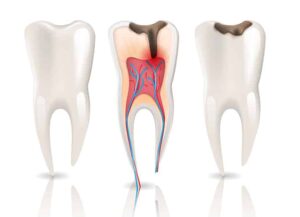
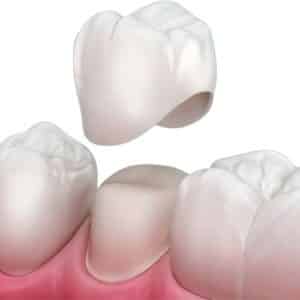
To see what that endpoint actually looks like: what types of dental crowns are available? and how much does a dental crown cost in Melbourne? for the crown, dental implants and how much do dental implants cost? for the implant, root canal and everything you need to know about root canal treatment for the nerve treatment, and bridges, implants or dentures? for the comparison. Published fees are in the price guide.
What a mouthguard protects against
Four distinct injuries:
- Knocked-out teeth — see what should I do when a tooth is knocked out?; this is the most time-critical situation in dentistry
- Soft tissue injuries — lips, cheeks and tongue cut against the teeth
- Tooth displacement — teeth driven out of position without being lost
- Tooth fractures — see what should I do if I have a chipped tooth?, why does a cracked tooth hurt so much? and chipped or cracked teeth
That second one is often overlooked. Much of the damage in a facial impact is caused by your own teeth cutting your own lip or tongue. A guard puts a cushioned layer between them.
The ADA describes the mechanism the same way: a sports mouthguard “helps to absorb and spread the impact of a blow to the face, which may otherwise result in an injury to the teeth, mouth or jaw,” protecting against “broken jaws, fractured, cracked or knocked-out teeth, cut lips and tongues.”
If an injury does happen, emergency dentistry, what should I do in a dental emergency? and, for children, children’s dental emergencies are the pages to have bookmarked before the season starts, not after. If the tooth belongs to a young child, my child has knocked out a baby tooth — what do I do? covers the different situation a baby tooth presents.
Which sports, and who else is at risk
People tend to picture a football field. The ADA’s risk categories are broader than that, and it sorts sports into four levels with “oral protective measures appropriate to the risk”:
- Mouthguard use strongly recommended — the ADA lists “off-road bike riding, skateboarding, rock climbing, white-water rafting, trampolining, combat sports, football, basketball, squash, and field hockey.”
- Head protection worn, which may thus obviate the need for a mouthguard — “full-face helmets in ice hockey and goalkeepers in field hockey cricket, rollerblading, and cycling.”
- Not normally worn, but justifiable in some circumstances — “high diving, surfboarding, and skiing.”
- Impractical or not warranted due to low risk — “swimming, athletics, aerobics, and rowing.”
Skateboarding and trampolining sitting in the top category surprises most parents. The consumer version from the ADA makes the same point: “it is not only contact sports like rugby union, rugby league, AFL, hockey and boxing can lead to these injuries. Sports such as cricket, basketball, netball, touch football, skateboarding and soccer can also cause damage to the teeth and mouth.”
The ADA is explicit that the decision should be individual rather than generic: “the need to wear a mouthguard should be assessed by a dentist based on risk factors, including an individual’s sporting or occupational activities and dental anatomy.”
Occupational is the word most people skip. The ADA identifies two work hazards: “physical impact from work equipment where fracturing of teeth is likely, including labourers, tradespeople, and riggers,” and “tooth abrasion where abrasive dust or particles may enter the mouth, including miners, bricklayers, and tilers.” It also notes that “oral piercing jewellery may also increase the risk and degree of oral injury.”
One more risk factor worth raising at a check-up, because it is fixable: the ADA observes that “children with prominent front teeth may be a higher risk of injury and may benefit from orthodontic assessment and early treatment to reduce this risk.” See orthodontics and paediatric dentists.
The two types
There are two in common use:
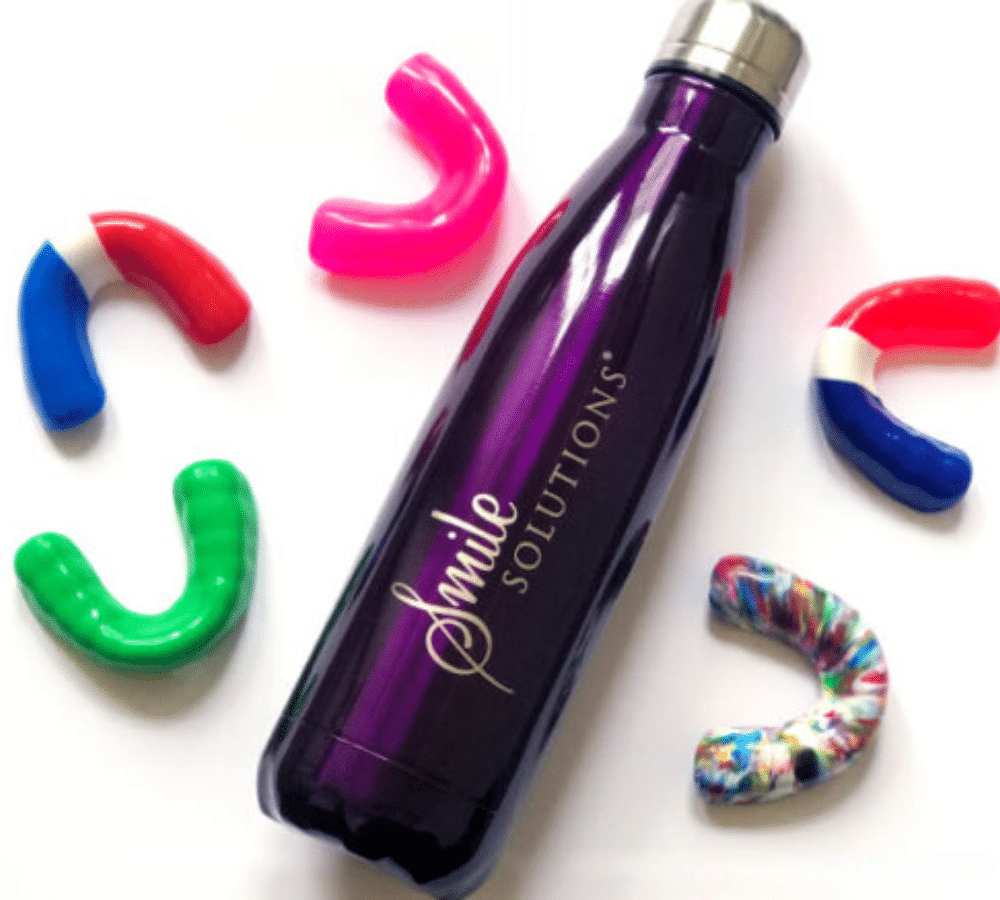
- Over-the-counter (boil-and-bite) mouthguards
- Professionally made, custom-fitted mouthguards
The Australian Dental Association strongly recommends wearing a custom-fitted mouthguard to ensure maximum protection. Its policy position is that “the most effective protection against oral damage is a custom fitted mouthguard, where precision fit and quality materials offer maximum comfort & injury prevention.” Getting a new mouthguard — a trip to the chemist or the dentist? compares the two directly.
Custom-fitted mouthguards
Made by your dentist, who takes an impression and creates a plaster model of your teeth. The ADA describes the same process, adding that a 3D scan may be used in place of a mould, and recommends “a check-up to make sure no other dental treatment is needed before your mouthguard is made.” At Smile Solutions the guard is then made in the practice’s own on-site laboratory; our technology covers the scanning side.
That process does two things. It produces an accurate guard, and it allows the dentist to assess your mouth and provide the guard most appropriate for you — which varies with your sport, your age, and whether you are in orthodontic treatment. If you are in braces or wearing aligners, say so when the guard is made: a guard has to be designed around a fixed appliance, and aligners have their own handling rules — see children’s braces and Invisalign and how to protect your aligners and your smile. The ADA notes that a boil-and-bite guard “may be appropriate during orthodontic treatment”, which is the one circumstance where the cheaper option has a genuine rationale.
A custom guard provides a better and more comfortable fit, and it will not shift around, fall out, or restrict your breathing. The ADA’s consumer material says the same: custom guards are “designed to fit the shape of your teeth and mouth only,” and “allow you to breathe and speak easily compared to mouthguards bought from sports stores and chemists.”
That list is the practical case, and it is worth being blunt about why. A mouthguard that is uncomfortable, loose or hard to breathe through gets left in the bag. A guard in a bag protects nothing. Comfort is not a luxury feature here — it is the mechanism by which the guard actually gets worn.
Over-the-counter mouthguards
Far less effective than custom-fitted guards.
The reason is in how they are made: they are stock guards that do not require fitting. They are placed in hot water and then self-fitted by biting into the mould, which creates an imperfect fit.
An imperfect fit means uneven thickness where protection is needed, movement on impact, and the tendency to loosen and be pushed out of position — which is when people start holding them in place with their teeth, or removing them. The ADA describes exactly that failure: the do-it-yourself fitting process “can cause some parts of the mouthguard to be thinner than others,” which “can affect how well the mouthguard protects your teeth.”
Some protection is better than none, so a boil-and-bite guard is not worthless — and the ADA agrees, with a caveat that is the whole point: “over-the-counter mouthguards provide better protection than no mouthguard, however their protection varies depending on the design, comfort, adaptation and thickness of the final product. Quality control of at-home custom adaptation is not achievable.” You cannot check whether you did it right.
A sports mouthguard is not a night guard
This is the confusion worth clearing up, because the two appliances are sold under overlapping names.
A sports mouthguard is thick and cushioned, and its job is to absorb and spread an impact. A night guard — properly an occlusal splint — is a hard, thin appliance whose job is to protect the teeth from grinding during sleep and to unload the jaw muscles and joint.
They are different appliances for different jobs and are not interchangeable in either direction. A sports guard worn overnight is unhygienic and can alter the bite; a splint offers no impact protection on a field.
If grinding is your problem rather than sport, the pages you want are how can a night guard be used to treat TMD?, what is bruxism and how is it managed?, night time tooth grinding and clenching and how can I stop grinding my teeth when I sleep?. If your jaw hurts as well, start with what are the most common symptoms of TMD? and what is the best way to treat TMJ?.
Training as well as game day
A guard that only comes out on Saturdays covers a minority of the exposure. The ADA’s position is that “protective equipment such as helmets and mouthguards should be used during training as well as competition,” and its consumer material repeats it: “mouthguards should be worn during sports training and games.”
At club level, the ADA and Sports Medicine Australia promote a ‘No Mouthguard, No Play’ policy, and the ADA publishes a model version for clubs to adopt — a “strict ‘No Mouthguard, No Play’ policy without exception”, with coaches and managers checking compliance. The ADA states that “all Australian sports clubs are encouraged to sign up and make wearing mouthguards mandatory for their players,” and that “where a risk of oral injury exists, sporting bodies should adopt a mandatory mouthguard policy.”
If you want the technical reference, the ADA points to Australian Standard HB209-2003, “Handbook: Guidelines for the Fabrication, Use and Maintenance of Sports Mouthguards.”
Looking after it
A guard is a piece of thermoplastic that lives in a sports bag. It needs a little care.
Always rinse it in cold water after use, and occasionally rinse it in mouthwash. Two cautions on that: toothpaste is abrasive and is the wrong thing to scrub a guard with, and mouthwash is a rinse rather than a substitute for cleaning — see the truth and myths about mouthwashes.
Store it in a rigid plastic container — not loose in a bag, where it will be crushed.
Keep it out of direct sunlight, because mouthguards change shape in high temperatures. This is the one that catches people out: a guard left in a car on a hot day, or on a windowsill, will warp — and a warped guard no longer fits, which returns you to the problems of the boil-and-bite.
The ADA’s own care list is short and worth following alongside the above: “do not store your mouthguard in direct sunlight; wash it in cool or warm water; store it dry and safely in a protective case; write your name on both the mouthguard and its case.” The last of those sounds trivial until a team of fifteen leaves identical cases on the same bench.
Have it assessed by your dentist at your regular check-up. This matters especially for children and teenagers, whose teeth are still erupting and moving — a guard made two years ago may no longer fit the mouth it was made for. The ADA sets the same condition on longevity: a guard “can last you multiple sporting seasons as long as you are no longer growing,” provided it is used, stored and fit-checked by your dentist. See how often should I go to the dentist? and dental cleans and hygienists.
Replace it if it sustains damage of any kind. A guard that has absorbed a heavy impact, or that is torn or thinned, has done its job and should be retired.
One last thing for athletes, since it has nothing to do with the guard and costs more teeth than collisions do: what are sports drinks really doing to your teeth? and sports drinks linked to poor dental health in athletes.
Common questions
What does a custom guard cost, and will my health fund pay for it?
Published fees are in the price guide, and a mouthguard is usually a single item on a single visit rather than a course of treatment.
The part worth knowing before you ring your fund is that cover is not uniform. The Australian Dental Association's own policy position on oral injuries is that “all dental care funding schemes should allow for the provision of custom-made mouthguards” — a recommendation, which tells you plainly that not every scheme does. So the question to ask your fund is not whether it covers dental, but whether a custom sports mouthguard is claimable under your general or preventive dental extras, what the annual benefit is, and whether any waiting period applies. Ask the practice for the item number so you can quote it.
Where a child is covered by the Child Dental Benefit Schedule, it is worth asking which services the schedule's benefit applies to before assuming a mouthguard is among them.
Will a mouthguard protect my child from concussion?
This is the claim to be most careful about, because it is made often in sports-store marketing and it is not what the Australian sources behind this page say.
What the Australian Dental Association claims for a mouthguard is specific and physical: it “helps to absorb and spread the impact of a blow to the face,” and protects against “broken jaws, fractured, cracked or knocked-out teeth, cut lips and tongues.” Teeth, mouth, jaw. Neither the ADA's policy statement on oral injuries nor its consumer guidance claims protection against concussion or brain injury.
So buy a mouthguard for what it is demonstrated to do, and treat concussion as a separate problem with its own protective equipment, its own return-to-play rules and its own medical advice. If a product is sold to you on a concussion claim, ask to see the evidence for it.
She was wearing a guard and a tooth still came out. What do I do in the next few minutes?
First, establish whether it is an adult tooth or a baby tooth, because the answer is opposite.
Never replant a baby tooth. Pushing it back risks damaging the adult tooth developing above it. Keep it, bring it, and have the child seen so it can be confirmed that nothing has been driven up into the gum — my child has knocked out a baby tooth covers this in full.
For an adult tooth, the variable that matters is how long the root spends dry — not how long since the accident. The International Association of Dental Traumatology's guidance on avulsed permanent teeth is that the root surface cells begin to dehydrate within a few minutes of being out of the mouth, and that after about 30 minutes of extra-oral dry time most of those cells are no longer viable. A tooth kept wet the whole time is in a completely different position from one that spent the same period in a tissue.
So: pick the tooth up by the crown, never the root; if it is dirty, rinse briefly; and put it straight back in the socket if you can. If you cannot, get it into a storage medium immediately. The IADT's descending order of preference is milk, then HBSS (the fluid in a tooth-rescue kit), then the person's own saliva, then saline. Water is a poor medium because it damages the root cells, but the IADT is explicit that it is still “better than leaving the tooth to air-dry.”
And if you have already lost more than an hour: bring it anyway. The IADT's position is that “the decision to replant a permanent tooth is almost always the correct decision even if the extra-oral dry time is more than 60 minutes,” because replanting keeps later options open and the tooth can always be removed afterwards if it has to be. Phone 13 13 96 on the way.
He took a knock but nothing looks broken. Do we still need to be seen?
Yes, and this is the one people skip.
The ADA's position is unambiguous: “persons who have suffered oral injury should be promptly assessed by a dentist and be treated and reviewed as recommended by the dentist.” Two words in that sentence do the work — assessed, and reviewed.
The reason for the assessment is that a tooth that looks untouched can have been loosened or pushed within its socket, or cracked below the gum, and the IADT's guidance specifically directs the clinician to check a chipped tooth for an accompanying displacement injury when it is tender. The reason for the review is that the nerve inside a traumatised tooth can die months later without ever having hurt; the IADT's published follow-up schedules for these injuries run to clinical and radiographic checks at six to eight weeks and one year for the milder ones, and yearly for at least five years for the more serious. Discolouration of the tooth is one of the outcomes those reviews are looking for.
Practically: get it looked at now, and then actually attend the follow-up appointment when nothing seems to be wrong. That appointment is the point of the exercise.
Does my child really need a new guard every season?
Not on a fixed schedule — on growth.
The ADA's condition is the useful one to hold onto: a guard “can last you multiple sporting seasons as long as you are no longer growing,” provided it is used, stored and fit-checked properly. Read the contrapositive and you have your answer. A child who is still growing has a mouth that is still changing shape, with teeth erupting and moving, so their guard has a working life measured in that change rather than in seasons.
The practical rule is to have the guard checked at the regular check-up rather than guessing, and to replace it when it no longer seats firmly — or when it has taken a heavy impact, torn or thinned. A guard that has loosened is the one most likely to be spat out, chewed or left in the bag, which is how a protected player quietly becomes an unprotected one.
Sources for the quoted material on this page
- Australian Dental Association, Policy Statement 2.2.5 — Prevention and Management of Oral Injuries (Federal Council, April 2024), including Appendix 1, the model mandatory mouthguard policy — the sport risk categories, occupational hazards, oral piercing, custom-fit position, and Australian Standard HB209-2003.
- Australian Dental Association / Teeth.org.au, Sports mouthguards — the consumer guidance on how guards work, custom versus store-bought, care and longevity, and the ‘No Mouthguard, No Play’ policy.
- International Association of Dental Traumatology, Guidelines for the management of traumatic dental injuries (Dental Traumatology, 2020) — avulsion first aid, extra-oral dry time, storage media, and follow-up review schedules.
Related reading
- Sports mouthguards — the service page
- Should I wear a mouthguard while playing sports?
- Should my child wear a mouthguard?
- Getting a new mouthguard — chemist or dentist?
- What should I do when a tooth is knocked out?
- Children’s dentistry
- General dentistry
Practical details
Smile Solutions, Level 1, 220 Collins Street, Manchester Unity Building, Melbourne VIC 3000 — getting here. Phone 13 13 96, contact us, or theteam@smilesolutions.com.au. Monday–Friday 8.00am–6.00pm, Saturday 8.30am–1.30pm, Sunday by appointment. The full team is listed by name.
Published 3 February 2016. General information only; it does not replace advice from your treating practitioner.
Smile Solutions trades under ABN 28 193 514 103.
Images on This Page
-
https://www.facebook.com/tr?id=800557773428361&ev=PageView&noscript=1
(no alt text)
-
https://www.smilesolutions.com.au/wp-content/uploads/2025/10/calendar_month.svg
(no alt text)
-
https://www.smilesolutions.com.au/wp-content/themes/arcadian-wordpress-theme/assets/images/smile_solutions_logo_white.png
Smile Solutions Logo
-
https://www.smilesolutions.com.au/wp-content/themes/arcadian-wordpress-theme/assets/images/smile_solutions_logo_purple.png
Smile Solutions Logo
-
https://www.smilesolutions.com.au/wp-content/uploads/2023/11/SS-Tooth-1-1-150x150.png
Smile Solutions
-
https://www.smilesolutions.com.au/wp-content/uploads/2025/09/WEBSITE-Images-2.png
Custom Made Dual Laminated Sports Mouthguard
-
https://www.smilesolutions.com.au/wp-content/uploads/2025/09/Root-Canal-2-300x217.jpg
Root Canal
-
https://www.smilesolutions.com.au/wp-content/uploads/2026/08/Mouth-Breathing-300x270.jpg
Mouth Breathing
-
https://www.smilesolutions.com.au/wp-content/uploads/2025/09/Dental-Crown-at-Smile-Solutions-300x300.jpg
Dental Crown at Smile Solutions
-
https://www.smilesolutions.com.au/wp-content/themes/arcadian-wordpress-theme/assets/images/family_owned_bussiness.png
Family Owned Business
-
https://www.smilesolutions.com.au/wp-content/themes/arcadian-wordpress-theme/assets/icons/icon--phone.svg
Smile Solutions Contact
-
https://www.facebook.com/tr? id=800557773428361&ev=PageView&noscript=1
(no alt text)
-
https://bat.bing.com/action/0?ti=25148060&tm=gtm002&Ver=2&mid=aa834910-37fd-46ca-9ac5-f7967dfe777f&bo=1&sid=caa6a000ab2511f1918005bc04f9ac49&vid=caa6c8d0ab2511f1bf199f777b7af682&vids=1&msclkid=N&pi=918639831&lg=en-US&sw=800&sh=600&sc=24&nwd=1&tl=What%20kind%20of%20mouth%20guard%20should%20I%20use%3F%20-%20Smile%20Solutions&p=https%3A%2F%2Fwww.smilesolutions.com.au%2Fdental-articles%2Farticle%2Fkind-mouth-guard-use%2F&r=&evt=pageLoad&sv=2&cdb=AQAQ&rn=425323
(no alt text)