My child has knocked out a baby tooth — what do I do?
The rule that matters most
You were watching your child at the playground and in the space of a blink there was a fall, a bleeding mouth, and a missing tooth.
It is a heart-stopping moment and it happens frequently. Kids will be kids, and accidents come with that.
The Australian Dental Association puts numbers around the intuition. In its policy on oral injuries it states that “oral injury can occur anywhere,” and that “young children and teenagers have been identified as high-risk groups, particularly when learning to walk and when new and/or high-risk activities are involved.” A toddler on unsteady legs is, in the ADA’s framing, in the highest-risk group there is.
The management of a knocked-out baby tooth is actually very simple, and it comes down to one rule that surprises most parents:
Do not put a knocked-out baby tooth back into the socket.
Two reasons:
You risk introducing infection.
You risk damaging the permanent tooth developing underneath. The successor tooth sits directly above the baby tooth root in the bone, and pushing the baby tooth back in can drive debris and bacteria against it, or physically disturb it — potentially affecting the shape, colour or eruption of the adult tooth years later. White or discoloured marks on an adult tooth sometimes trace back to exactly this kind of childhood knock.
This is the opposite of the advice for a knocked-out permanent tooth, which should be replaced in the socket as quickly as possible. That reversal is exactly why it is worth knowing in advance rather than looking up in the moment.
Baby teeth appear from roughly 6 months of age to around 7 years, which is the age range in which this advice applies. If you are not sure whether the tooth is a baby tooth or an adult tooth, phone a dentist before doing anything with it. As a rough guide, the adult front teeth arrive from around six, they are noticeably larger, and they often have a slightly serrated biting edge when new. Order of baby teeth sets out the usual sequence, and baby teething signs and symptoms covers the other end of it.
What to do, step by step
1. Try not to panic
Easier said than done, and worth attempting anyway. Your child will take their emotional cue from you, and a calm parent makes the next few steps considerably easier.
2. Look inside their mouth
If you can, have a look to gauge what has happened.
There can be a lot of bleeding if the lips have been involved, which makes it difficult to see anything. Bleeding from lips and gums looks far worse than it usually is — saliva spreads a small amount of blood a long way.
Gentle pressure with a clean, damp cloth or gauze for several minutes will slow the bleeding and let you see. If a tooth is broken rather than out, see what to do with a chipped tooth.
3. Find the tooth
Locate it if you can. Even though it will not be replaced, knowing where it is matters — an unaccounted-for tooth may have been swallowed, inhaled, or pushed up into the gum rather than knocked out. Bring it with you so the dentist can confirm the whole tooth is accounted for.
A tooth driven up into the gum is easily mistaken for a missing one. It is one of the more common injuries in toddlers, and it looks like the tooth is gone. That is a reason to be seen even when you never find the tooth.
4. If it is a baby tooth, leave the socket alone
Do not re-implant it. This is also the point at which a tooth lost to an accident differs from a loose tooth coming out on its own, which needs nothing but patience.
5. See a dentist
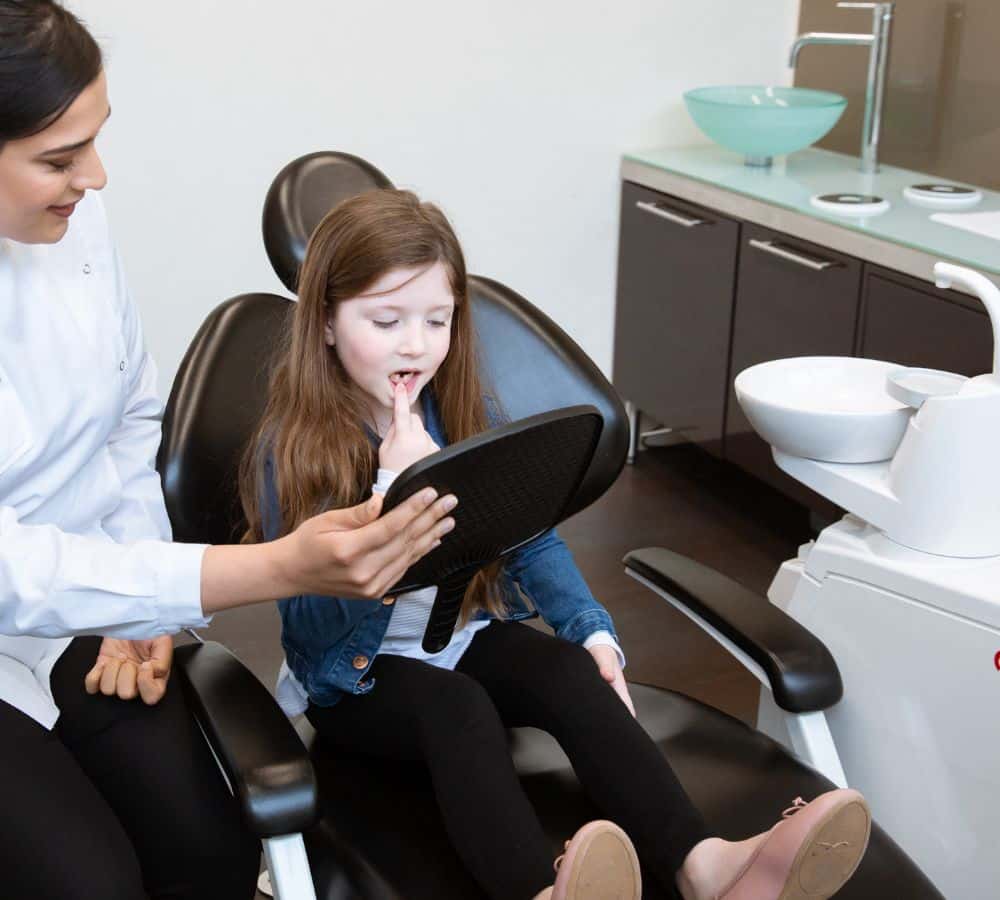
Have your child examined even though the tooth will not be put back. The dentist is checking for things you cannot see: whether neighbouring teeth have been loosened or displaced, whether any root fragment remains in the socket, whether the jaw is injured, and what the likely effect on the permanent tooth might be. This is what counts as a dental emergency — see it the same day, not next week.
That is also the ADA’s position, stated as plainly as it can be: “persons who have suffered oral injury should be promptly assessed by a dentist and be treated and reviewed as recommended by the dentist.” Its policy adds the reason for taking any mouth injury seriously rather than waiting to see: “oral damage is often irreversible, frequently complex, difficult, and costly to repair.”
It is worth knowing that there is an agreed international standard behind what the dentist does next. The ADA directs practitioners to “the International Association of Dental Traumatology (IADT) guidelines for the management of traumatic dental injuries,” while noting that any treatment must comply with local regulation. If you want to ask your dentist what protocol they are following, that is its name.
A paediatric dentist is well suited to this, particularly for a very young or distressed child — see should your child see a specialist paediatric dentist?. Children's Dental Emergencies covers the full range of injuries — teeth pushed in, pushed sideways, broken, or loosened — and what first aid each one needs, and common dental emergencies and what to do covers adults as well.
Seek urgent care if
- The tooth cannot be found and may have been inhaled
- Bleeding does not stop with 10 minutes of gentle pressure
- Your child lost consciousness, is vomiting, or is unusually drowsy after the fall
- The jaw appears deformed, or your child cannot close their teeth together normally
- There are deep cuts to the lips, tongue or face
Any of the last three is a hospital matter rather than a dental one. In a life-threatening emergency call 000. Outside those, Emergency Dentistry is the page to have the number for.
Afterwards
A lost baby tooth generally does not need replacing — but there are a few things to watch:
Space. If the tooth was lost well before it would have fallen out naturally, the neighbouring teeth can drift into the gap. Your dentist will advise whether a space maintainer is warranted. Front teeth are less of a concern here than back teeth; the crowding problems that follow early tooth loss usually start with a lost baby molar. See Children's Braces and Invisalign and Orthodontics.
The permanent tooth. Trauma to a baby tooth can occasionally affect the adult tooth forming beneath it. This may not be apparent for years, which is a good reason to mention the injury at future check-ups. Not every mark on an adult tooth comes from an injury — see chalky teeth.
Discolouration of neighbouring teeth. A tooth that turns grey in the weeks after an accident has had its nerve affected and should be reviewed. A grey baby tooth is not automatically an emergency — many settle and stay in place until they are due to fall out — but it needs looking at rather than watching from home.
Eating and cleaning. Soft food for a few days, and keep brushing the area gently with a soft brush. A sore mouth that goes uncleaned becomes an infected one. See Kids Teeth Cleaning Tips, how to encourage your child to brush and protecting your child from dental disease.
And the tooth fairy still comes. A tooth lost to a fall counts — our resident tooth fairy has seen plenty of them.
What it will cost, if your family is eligible
The visit after an accident is one of the things the Child Dental Benefits Schedule is designed to cover, so it is worth checking before you decide whether to be seen.
Services Australia states that the scheme covers “up to $1,158 for each eligible child over 2 calendar years for basic dental services”, with the cap “indexed yearly on 1 January”. The services it names include check-ups, X-rays, cleaning, fissure sealing, fillings, root canals and extractions — which covers the examination and imaging after a knock, and an extraction if one is needed. It does not cover orthodontic dental work, cosmetic dental work, or any dental services in a hospital, so a facial injury managed at a hospital falls outside it.
A child is eligible if they are “0 to 17 years old for at least one day that calendar year”, “eligible for Medicare”, and “you or they get an eligible payment at least once that calendar year.” There is nothing to apply for: “if your child is eligible we’ll send you a letter.” Services Australia also cautions that “there are some restrictions for basic dental services” and that you “should check with your dentist if there are any item or time restrictions before starting your service.”
If you are reading older material, note that the cap was $1,095 in an earlier period. How the schedule operates explains the rules in more detail, and the Price Guide covers everything outside the scheme.
Preventing the next one
The ADA is direct about where the responsibility sits, recommending public education on “the importance of parental supervision and protective equipment,” and that “appropriate protection should be normalised and expected in the community.” For children old enough to play organised sport, that means a guard — see Sport Mouthguards, remade each season while a child is growing, and what kind of mouthguard should I use? for how the types differ.
There is one structural risk factor a dentist can act on. The ADA notes that “children with prominent front teeth may be a higher risk of injury and may benefit from orthodontic assessment and early treatment to reduce this risk.” If your child’s upper front teeth sit well forward, that is worth raising at the next check-up rather than after the next fall.
Common questions
It has already been half an hour. Have I missed the window?
There is no window, because the tooth is not going back in. That is the single most useful thing to understand in the first few minutes, and it is the opposite of what most people have absorbed from the adult version of this emergency.
For a knocked-out permanent tooth there genuinely is a clock, and it is worth knowing which clock. The International Association of Dental Traumatology's guidance is that the variable is extra-oral dry time — how long the root spends drying in air, not how long since the accident — and that after about 30 minutes of dry time most of the root surface cells are no longer viable. Even then the IADT's position is that “the decision to replant a permanent tooth is almost always the correct decision even if the extra-oral dry time is more than 60 minutes.” A permanent tooth kept wet in milk is in a far better position than one that spent the same period in a tissue.
None of that applies to a baby tooth. The IADT's instruction before any of its replantation steps is to “make sure it is a permanent tooth (primary teeth should not be replanted).” So the urgency here is about getting your child examined, not about racing the tooth back into the socket. Same day, calmly.
Why exactly can it not go back in? The gap looks awful.
Because a replanted baby tooth can cause two problems that the gap does not.
The Victorian Department of Health's Better Health Channel sets both out: trying to replace a baby tooth “might damage the permanent tooth sitting underneath in the gum,” and “the baby tooth could fuse to the bone, causing problems when it's time for it to fall out naturally, and might affect the growth of the adult tooth, bone and gums.”
That second mechanism is the one nobody expects. A baby tooth pushed back into a traumatised socket can knit to the jawbone rather than reattaching normally, and a tooth fused to bone does not shed on cue — which turns a straightforward gap into a considerably more complicated problem several years later. Healthdirect Australia puts the reassuring half of it plainly: the gum heals over time and an adult tooth should come through in its place.
The cosmetic gap is real, and for a front tooth it can last a while. It is still the better of the two outcomes.
Will she need an x-ray, and is that safe for a small child?
Probably, and it is usually the point of the visit rather than an add-on.
A radiograph is how a dentist distinguishes between the three things that look identical from the outside: a tooth that is genuinely gone, a root fragment left behind in the socket, and a tooth that has been driven up into the gum. It is also how injury to the developing adult tooth is assessed. Without it, a good deal of the examination is guesswork.
On the dose: the International Atomic Energy Agency gives the effective dose of an intraoral dental x-ray as 1 to 8 microsieverts, and notes that doses from intraoral dental procedures are “usually less than one day of natural background radiation.” That is the comparison worth holding — a single small dental film sits within the range of what the child receives from the environment anyway in a day.
The principle that still applies is justification: every radiograph should be taken because it will change a decision. You are entitled to ask what this one is for and what it will change. How safe are dental x-rays? goes into the detail.
She is in pain and frightened. What can I give her, and what should I not?
Healthdirect Australia's guidance on dental injury covers the immediate comfort measures: rinse the mouth with salt water, and apply an ice pack if the mouth is swollen. Both are things you can do before you reach a dentist and neither interferes with the examination.
For pain relief, Healthdirect's guidance is to use simple over-the-counter pain relief if it is needed, following the directions on the packet for the child's age and weight, and it flags one specific caution that is worth repeating: do not give aspirin to a child under 12 unless a doctor has told you to, and avoid high doses of aspirin generally after an injury because it can increase bleeding. If you are unsure what is appropriate for your child, ask the pharmacist or your doctor rather than guessing from an adult packet.
Do not put a tablet, or clove oil, against the gum. It does not reach the nerve and it burns the soft tissue, which adds a chemical injury to a physical one.
On the fright rather than the pain: how the next few dental visits are handled matters more than most parents expect, because a bad experience after an accident is one of the more common starting points for lifelong dental fear. Combating dental anxiety in children is worth reading before the appointment rather than after.
Sources for the quoted material on this page
- Australian Dental Association, Policy Statement 2.2.5 — Prevention and Management of Oral Injuries — the high-risk groups, prompt assessment, the IADT guidelines, prominent front teeth, and the prevention statements.
- Services Australia, Child Dental Benefits Schedule — the cap, eligibility, and covered and excluded services.
- International Association of Dental Traumatology, Guidelines for the management of traumatic dental injuries: 2. Avulsion of permanent teeth (Dental Traumatology, 2020) — that primary teeth are not replanted, and the extra-oral dry time framing for permanent teeth.
- Better Health Channel, Victorian Department of Health, Dental injuries — why a baby tooth is not put back, and the risk of it fusing to the bone.
- Healthdirect Australia, Dental injury — salt-water rinse, ice pack, healing of the gum, and the caution on aspirin in children.
- International Atomic Energy Agency — the effective dose range for intraoral dental radiography.
The first-aid rule at the top of this page — not re-implanting a baby tooth — is supported directly by independent guidance. The IADT's avulsion guideline instructs the reader to “make sure it is a permanent tooth (primary teeth should not be replanted)” before following any of its replantation steps, and the Better Health Channel states that knocked-out baby teeth “should not be put back in their socket.” An earlier version of this page recorded that we had no independent citation for the rule; that is no longer the case. Phone a dentist if you are in any doubt about what you are looking at.
Where to go next
- If it turns out to be an adult tooth — What should I do when a tooth is knocked out?. That one is time-critical; act first and read on the way.
- Any other injury to a child's mouth — Children's Dental Emergencies.
- A specialist for a young or distressed child — Paediatric Dentists, and Children's Dentistry generally.
- If the accident has left them frightened of dentists — Dental Anxiety, Combating dental anxiety in children and how Smile Solutions manages a child's dental anxiety.
- Where sensory or additional needs are part of it — Oral health care for children with special needs.
- Getting the first visit right — First Visit to the Dentist and when a child should first see a dentist.
- Preventing the next one — Sport Mouthguards; see should my child wear a mouthguard? and should I wear one while playing sport?. Fissure sealants protect the back teeth from the other common problem.
Practical details
Smile Solutions, Level 1, 220 Collins Street, Manchester Unity Building, Melbourne VIC 3000. Phone 13 13 96, or theteam@smilesolutions.com.au. Monday–Friday 8.00am–6.00pm, Saturday 8.30am–1.30pm, Sunday by appointment. Full details on Contact Us, and the clinicians on Our Team.
Published 1 November 2018. General information only; it does not replace advice from your treating practitioner. For a knocked-out permanent tooth, different advice applies — phone a dentist immediately.
Smile Solutions trades under ABN 28 193 514 103.
Images on This Page
-
https://www.facebook.com/tr?id=800557773428361&ev=PageView&noscript=1
(no alt text)
-
https://www.smilesolutions.com.au/wp-content/uploads/2025/10/calendar_month.svg
(no alt text)
-
https://www.smilesolutions.com.au/wp-content/themes/arcadian-wordpress-theme/assets/images/smile_solutions_logo_white.png
Smile Solutions Logo
-
https://www.smilesolutions.com.au/wp-content/themes/arcadian-wordpress-theme/assets/images/smile_solutions_logo_purple.png
Smile Solutions Logo
-
https://www.smilesolutions.com.au/wp-content/uploads/2023/11/SS-Tooth-1-1-150x150.png
Smile Solutions
-
https://www.smilesolutions.com.au/wp-content/uploads/2018/11/Child-Knocked-Out-Tooth.jpg
My child has a knocked out baby tooth: What do I do?
-
https://www.smilesolutions.com.au/wp-content/uploads/2025/09/Root-Canal-2-300x217.jpg
Root Canal
-
https://www.smilesolutions.com.au/wp-content/uploads/2026/08/Mouth-Breathing-300x270.jpg
Mouth Breathing
-
https://www.smilesolutions.com.au/wp-content/uploads/2025/09/Dental-Crown-at-Smile-Solutions-300x300.jpg
Dental Crown at Smile Solutions
-
https://www.smilesolutions.com.au/wp-content/themes/arcadian-wordpress-theme/assets/images/family_owned_bussiness.png
Family Owned Business
-
https://www.smilesolutions.com.au/wp-content/themes/arcadian-wordpress-theme/assets/icons/icon--phone.svg
Smile Solutions Contact