Paediatric Dentists
What is a paediatric dentist, and does my child need one?
Paediatric dentists are registered specialists focused on treating and managing the dental needs of babies, toddlers and children.
Most children do not need one. Routine check-ups and cleans are appropriately handled by a general dentist or oral health therapist. A paediatric specialist becomes the right choice when the case is complex, or when the child cannot cope with ordinary treatment.
Smile Solutions is at Level 1, 220 Collins Street, Manchester Unity Building, Melbourne CBD. See also Children's Dentistry and should my child see a specialist paediatric dentist.
The qualification
To qualify as a registered specialist paediatric dentist in Australia, a practitioner completes a dental degree followed by a three-year clinical doctorate in children's dentistry, and holds specialist registration with the Dental Board of Australia. “Paediatric dentist” is a protected title.
A large part of that training is not clinical technique. It is child behaviour management — establishing trust in a friendly environment, and communicating in ways a frightened five-year-old can accept. That skill is what allows a paediatric dentist to complete treatment a child might not tolerate elsewhere.
Which clinician does my child need?
| Qualifications | Specialisation | Recommended for | |
|---|---|---|---|
| Paediatric Specialist | Dental degree plus an additional clinical doctorate | Only treats children; specialises in the dental needs of babies, toddlers and young children | Complex or extensive care requiring advanced techniques — treatment under sedation, significant anxiety, behavioural or sensory needs, assessment of tooth and jaw development |
| General Dentist | Dental degree | Treats all patients; may have a special interest in children | Routine check-ups and general treatment; refers to a specialist when needed |
| Oral Health Therapist | Degree or advanced diploma in oral health | Cleaning, preventive treatment and oral health education; may have a special interest in children | Preventive care, professional cleans, oral health education; refers when needed |
Note the difference between “specialises in” and “has a special interest in”. Only the first is a registered qualification you can look up. A general dentist who treats children well is a perfectly good choice for routine care, and usually a less expensive one. See Dentists & Registered Specialists.
Why baby teeth matter
“They fall out anyway” is the most common and most costly misconception in children's dentistry.
Baby teeth are in use for years — the back ones are not replaced until around ten to twelve — and while they are there they do four jobs:
- Chewing, and therefore eating properly.
- Speech. Front teeth shape several sounds as a child learns to talk.
- Holding space. Each baby tooth reserves the room for the adult tooth beneath it. Lose one early and the neighbouring teeth drift into the gap, so the adult tooth arrives with nowhere to go — which is how orthodontic crowding is created years in advance. This is what space maintainers prevent.
- Protecting the adult tooth developing underneath. Untreated decay in a baby tooth can abscess and damage the adult tooth forming below it.
Untreated decay also hurts. Dental pain is a well-recognised cause of disturbed sleep, poor eating and missed school, and children often do not report it clearly — they simply chew on one side, or become irritable.
What paediatric dentists do
Comprehensive dental care for children
Preventative care, treating dental decay, applying fissure sealants, and managing children's dental emergencies including dental trauma and broken or lost teeth. Children's Dental Emergencies and the role of fissure sealants.
Creating positive dental experiences
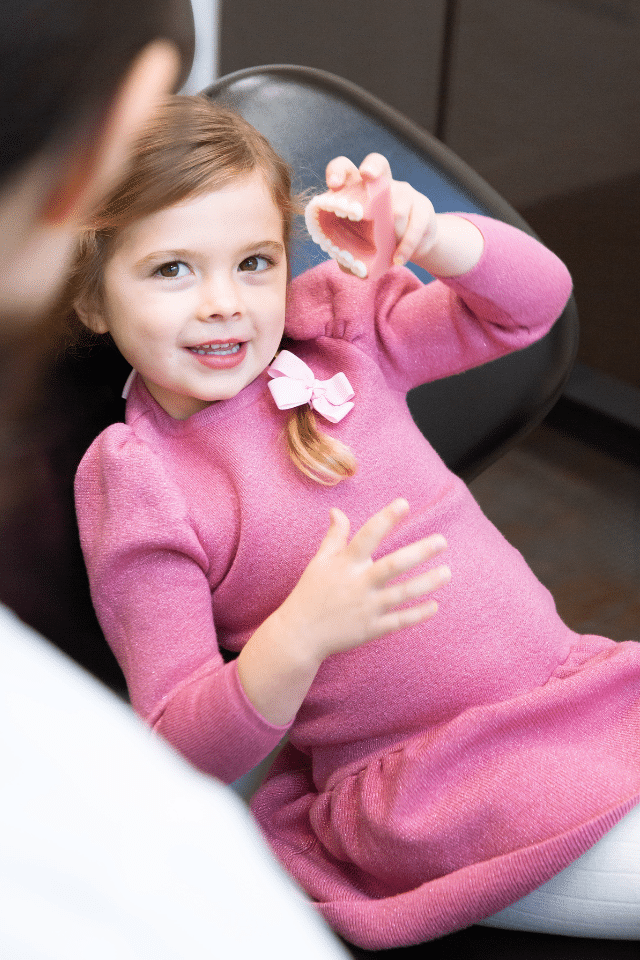
A significant component of paediatric dentistry involves understanding child behaviour and establishing trust through child-friendly communication in a reassuring environment.
We use an approach the team calls “teddy bear therapy” — a cuddly toy to hold during the appointment, children's movies as distraction, and an unhurried pace — to keep the child comfortable.
One thing that helps more than anything the practice does: avoid using the dentist as a threat, and avoid telling a child “it won't hurt” — which introduces the idea that it might. Matter-of-fact and brief works best.
Anxiety and behavioural concerns
If your child has complex dental needs, developmental challenges, behavioural difficulties, or significant anxiety, a paediatric specialist is often the best choice.
Paediatric dentists are specifically trained to support children who feel nervous or overwhelmed, creating a calm, child-friendly environment. Where behavioural approaches are not enough, options include nitrous oxide — which keeps the child awake and responsive — and general anaesthesia administered by a specialist anaesthetist, in clinic or in a private hospital.
General anaesthesia in a child is a medical decision, not a convenience. It requires a pre-anaesthetic assessment, strict fasting, and a responsible adult to take the child home and stay with them; it carries the recognised risks of anaesthesia, which the anaesthetist will discuss with you before you consent. It is used where the amount of treatment, the child's age, or their ability to cope makes awake treatment unsafe or impossible — and the alternatives should be explained to you first. Dental Anxiety and Sleep Dentistry.
How children are actually helped through treatment
The techniques have names, and knowing them makes the appointment easier to support:
- Tell–show–do. Explain in child-appropriate words, demonstrate on a finger or a toy, then do it. The single most effective method there is.
- Distraction — a film, a conversation, something to hold.
- Positive reinforcement, specific rather than general: praise for opening wide, not for “being good”.
- Short appointments first. A ride in the chair and a count of the teeth builds the trust that a filling later depends on.
- Desensitisation visits, where a child comes several times to do progressively more — particularly valuable for autistic and neurodivergent children, alongside sensory adjustments like dimmed lights, no sudden noises and a familiar order of events. See oral health care for children with special needs.
What parents can do: keep your own language neutral, avoid words like needle, drill and hurt, avoid promising rewards that imply an ordeal, book early in the day, bring a comfort object, and let the clinician lead the conversation once you are in the room. See combating dental anxiety in children.
Chalky teeth, and why they need early attention
One condition deserves singling out because it is common, widely missed, and frequently mistaken for poor brushing.
Molar incisor hypomineralisation — “chalky teeth” — is a developmental defect in which the enamel of the first adult molars, and sometimes the front teeth, forms with insufficient mineral. It appears as creamy, yellow or brown patches on newly erupted adult teeth, and the enamel is soft, crumbly and can break down quickly under normal chewing.
Why it matters clinically:
- Those teeth are often very sensitive, sometimes to the point that a child avoids brushing them, which compounds the problem.
- They are notoriously harder to numb, which is one reason an affected child can have a bad first experience and become anxious.
- They decay rapidly, so the window between “it looks a bit chalky” and “it needs a crown” can be short.
If you see chalky or discoloured patches on a newly arrived adult molar or front tooth, have it assessed promptly rather than at the next routine visit. Managed early, treatment is far more conservative. See my child has chalky teeth — now what.
Prevention, by age
- Before teeth arrive — wipe the gums with a clean damp cloth.
- First tooth to 18 months — brush twice daily with a small soft brush and water only, unless your clinician advises otherwise.
- 18 months to 6 years — a pea-sized smear of low-fluoride children's toothpaste, twice daily, and teach the child to spit, not rinse or swallow.
- From 6 years — standard family toothpaste, still supervised.
- Supervise or assist brushing until around 7 or 8. Manual dexterity arrives later than children's confidence does, and the back teeth are the part missed.
- Lift the lip once a month and look at the gum line of the upper front teeth in good light. Early decay shows there first, as a chalky white line, long before a hole appears.
On diet, the rule that matters is frequency, not quantity: each exposure to sugar restarts an acid attack lasting twenty to forty minutes, so constant grazing does more harm than a single serve. Watch the ones that do not look like lollies — juice and cordial sipped through the day, dried fruit, muesli bars, and sweetened medicines taken long-term. See kids' teeth cleaning tips, how to get your child to brush and protecting your child from dental disease.
Two specific risks worth naming. A bottle or sippy cup of anything but water taken to bed bathes the upper front teeth in sugar all night, with saliva at its lowest — the classic cause of early childhood decay. And sharing spoons or cleaning a dummy in your own mouth transfers decay-causing bacteria from adult to child.
Your paediatric dentist
| Clinician | Role | Qualifications |
|---|---|---|
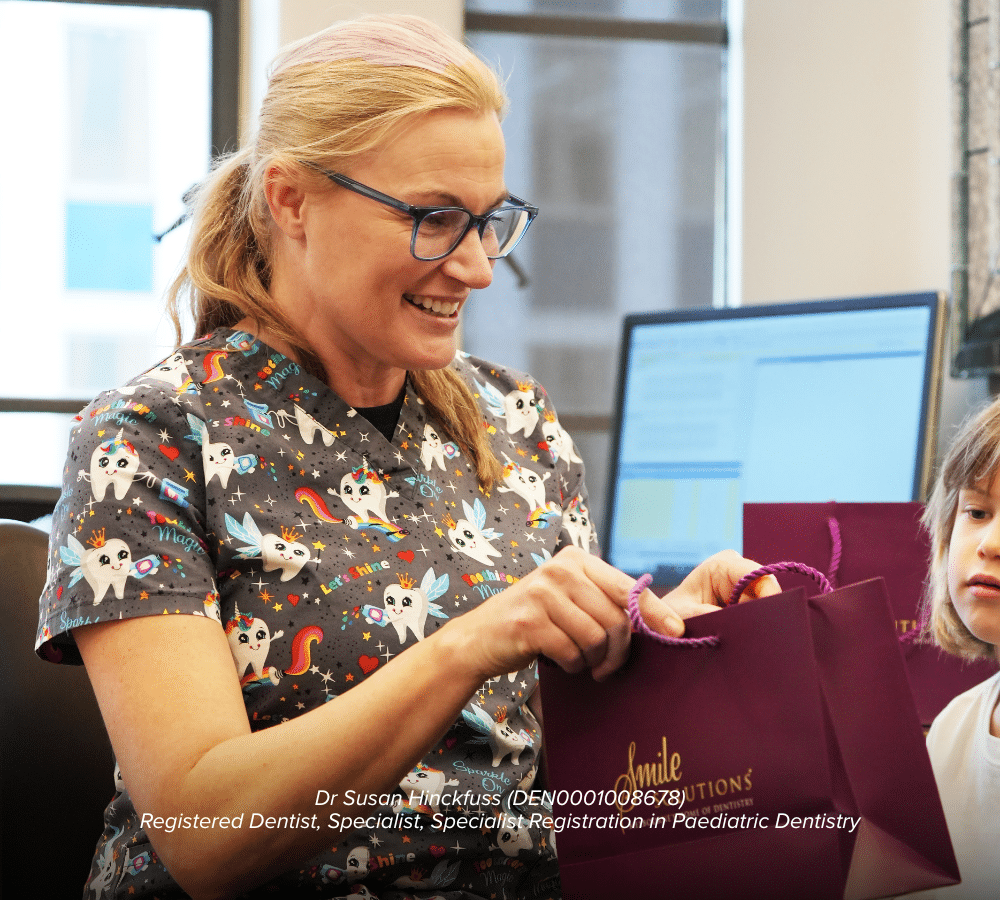
| Dr Susan Hinckfuss | Specialist Paediatric Dentist | BDSc (Melb), DCD (Melb) |
You can verify any clinician free on the AHPRA public register at ahpra.gov.au, or by calling 1300 419 495. See Our Team.
Working with the rest of the team
The paediatric dentists work closely with the practice's general dentists and oral health therapists for routine care, and with specialist orthodontists on early intervention — monitoring growth, guiding jaw development, and identifying developing bite and airway issues during childhood. See Specialist Orthodontists.
Because everyone practises in the same building with shared records, a child's care can be coordinated from their first baby tooth through to adult retention without external referrals. Children's Orthodontics and Specialist Care.
When to bring your child in
- Smile Solutions suggests a first visit from age 3. Worth knowing that the Australian Dental Association and international paediatric bodies recommend a first check-up around the eruption of the first tooth, or by age one — largely to give parents preventive advice before problems start. Either is defensible; earlier is the more cautious course, particularly if there is any family history of early decay. See your child's first visit.
- Orthodontic assessment from age 6–7 — the Australian Society of Orthodontists' recommendation
- Any dental trauma — immediately for a knocked-out or displaced adult tooth. Do not attempt to reimplant a baby tooth; call 13 13 96 and describe what happened
- If your child snores, mouth breathes, or grinds their teeth — and see your GP as well, since snoring in children is often a medical matter
- If a previous dental experience has left them frightened
- Any white, brown or chalky marks on new teeth, which can be early decay or enamel defects
Also worth a call: an adult tooth that has not appeared six months after its partner on the other side; a baby tooth that will not come out while the adult one comes up behind it — usually fine, but worth checking (see my child's loose tooth); a tooth that darkens after a knock; and any swelling of the face or gum, which needs to be seen the same day.
For contact sport, a custom mouthguard is the single most effective protection — the adult front teeth arrive around six to eight and are prominent and vulnerable for years afterwards. See Sports Mouthguards.
Cost and public options
Specialist fees are higher than general practice fees.
Many children aged 0–17 are eligible for the Child Dental Benefits Schedule, which contributes to basic dental services over a two-year period, subject to eligibility and a capped benefit. Victoria also provides free public dental care for children in eligible families through community dental services and the Royal Dental Hospital of Melbourne, and the Royal Children's Hospital treats complex paediatric cases. These are genuine options and worth knowing about. Child Dental Benefit Schedule and how the Child Dental Benefits Schedule works.
Where general anaesthesia is involved, the cost structure changes: there are separate accounts for the dentist, the anaesthetist and the hospital, and private hospital cover rather than dental extras is usually the relevant policy. Ask for all three quoted before the date, and check waiting periods with your fund. See Price Guide and Payment Plans.
Common questions
Does my child need a specialist paediatric dentist?
Many children can be cared for by a general dentist or oral health therapist. Specialist care may help with complex disease, developmental or enamel conditions, significant anxiety, disability, very young children needing treatment, trauma or treatment requiring sedation or general anaesthesia.
When should my child first be assessed?
Professional guidance commonly recommends assessment by age one or within six months of the first tooth appearing. The timing and provider can be adjusted to the child's risk, development and symptoms. Pain, swelling, injury or unusual tooth appearance should be assessed sooner.
What are chalky teeth?
Chalky teeth have areas of poorly formed enamel that can be sensitive, break down or decay more readily. Early assessment helps distinguish an enamel defect from ordinary decay and plan prevention or protection before more structure is lost.
Can treatment be completed while my child is awake?
Often yes. Preparation, gradual familiarisation, simple explanations, shorter visits, behavioural techniques and nitrous oxide can help selected children. The least intensive safe approach should be considered first.
When is general anaesthesia considered?
It may be considered when necessary treatment cannot be completed safely while awake because of age, anxiety, disability, treatment extent or urgency. It requires separate assessment and carries medical risks that the anaesthetist must explain.
Why treat baby teeth if they eventually fall out?
Baby teeth support eating, speech, comfort and space for adult teeth. Untreated disease can cause pain and infection and may make later care more difficult. The treatment choice still considers how close the tooth is to natural loss.
Can the Child Dental Benefits Schedule help with costs?
Eligible children may receive benefits for specified basic dental services, subject to current program rules and limits. Confirm eligibility, covered items and any expected gap before treatment.
What should we change at home?
Advice should match the child's age and decay risk. It commonly includes twice-daily brushing with appropriate fluoride toothpaste, adult supervision until the child has the dexterity to clean reliably, cleaning between teeth where needed and reducing frequent sugar exposure.
Practical details
| Address | Level 1, 220 Collins Street, Manchester Unity Building, Melbourne VIC 3000 |
| Phone | 13 13 96 |
| theteam@smilesolutions.com.au | |
| Monday – Friday | 8.00am – 6.00pm |
| Saturday | 8.30am – 1.30pm |
| Sunday | By appointment |
| Specialist training | Three-year clinical doctorate |
| Referral needed | No |
| Supervise brushing until | About age 7–8 |
| Orthodontic assessment | Age 6–7 |
| Sedation available | Nitrous oxide; general anaesthesia by specialist anaesthetist |
| Parking | Wilsons Parking, Flinders Lane (between Swanston and Russell) |
Paediatric dentistry is one of the thirteen recognised dental specialties in Australia, and specialist registration can be verified free on the AHPRA public register at ahpra.gov.au.
General information only — it is not a diagnosis, a treatment plan, a quote or a promise of any particular clinical outcome, and it does not replace advice from your child's treating practitioner. Whether a child needs specialist care, and which behaviour-management or sedation approach is appropriate, can only be decided after assessment, and children respond differently. Sedation and general anaesthesia are medical procedures carrying risks, discussed with the anaesthetist before consent. Ages and eruption timings given here are typical ranges, not rules, and toothpaste advice should be confirmed with your own clinician for your child. Fees and benefit eligibility are indicative and subject to change; confirm at your consultation.
Smile Solutions trades under ABN 28 193 514 103.
Images on This Page
-
https://www.facebook.com/tr?id=800557773428361&ev=PageView&noscript=1
(no alt text)
-
https://www.smilesolutions.com.au/wp-content/uploads/2025/10/calendar_month.svg
(no alt text)
-
https://www.smilesolutions.com.au/wp-content/themes/arcadian-wordpress-theme/assets/images/smile_solutions_logo_white.png
Smile Solutions Logo
-
https://www.smilesolutions.com.au/wp-content/themes/arcadian-wordpress-theme/assets/images/smile_solutions_logo_purple.png
Smile Solutions Logo
-
https://www.smilesolutions.com.au/wp-content/uploads/2025/11/Smile-Solutions-4.png
Smile Solutions - Melbourne CBD
-
https://www.smilesolutions.com.au/wp-content/uploads/2025/09/Paediatric-Dentistry-Smile-Solutions.png
Paediatric Dentistry Smile Solutions
-
https://www.smilesolutions.com.au/wp-content/uploads/2025/09/Childrens-Orthodontics-at-Smile-Solutions.png
Childrens Orthodontics at Smile Solutions
-
https://www.smilesolutions.com.au/wp-content/themes/arcadian-wordpress-theme/assets/images/family_owned_bussiness.png
Family Owned Business
-
https://www.smilesolutions.com.au/wp-content/themes/arcadian-wordpress-theme/assets/icons/icon--phone.svg
Smile Solutions Contact
-
https://www.facebook.com/tr? id=800557773428361&ev=PageView&noscript=1
(no alt text)
-
https://bat.bing.com/action/0?ti=25148060&tm=gtm002&Ver=2&mid=c3b07821-f3ab-4a76-a4bc-33d3c8a394fb&bo=1&sid=7cb84450ab2811f180731f362f197299&vid=7cb85650ab2811f1a0a797a20d3f7116&vids=1&msclkid=N&pi=918639831&lg=en-US&sw=800&sh=600&sc=24&nwd=1&tl=Paediatric%20Dentist%20Melbourne%20-%20Smile%20Solutions&p=https%3A%2F%2Fwww.smilesolutions.com.au%2Fspecialist-care%2Fpaediatric-dentists%2F&r=&evt=pageLoad&sv=2&cdb=AQAQ&rn=247964
(no alt text)