What chalky teeth are
Chalkiness can occur in both baby teeth and adult teeth.
A chalky tooth is one where the enamel — the outer surface — is whiter than normal, or shows discoloured patches or spots. Those areas may be off-white, yellow or brown.
The colour tells you something. Yellow or brown enamel is usually soft and porous, which makes the tooth sensitive, and prone to breaking down when your child eats. What to do if you suffer from sensitive teeth explains the mechanism behind that sensitivity.
The technical name is molar-incisor hypomineralisation (MIH) — teeth with abnormally low amounts of calcium.
A child may have one tooth affected, or many. Less commonly, every tooth can be affected. The teeth most often involved are the first permanent molars, which arrive at about age six without any baby tooth falling out first — see the order and appearance of baby teeth, which explains why so many parents do not realise those molars are adult teeth at all.
How common, and how serious
Research shows at least one in six children is affected.
That is a striking number for a condition most parents have never heard of.
Affected teeth are more prone to developing decay. And the longer-term consequence is real: many affected children go on to lose their adult molars, and face years of complex and expensive dentistry and orthodontics.
The reason it escalates: porous enamel decays faster, is harder to anaesthetise, and holds fillings less reliably. A chalky molar can need repeated restoration through childhood, with each attempt starting from a weaker foundation. How long do dental fillings last? covers why the quality of the bond decides how long a restoration survives — and porous enamel is exactly the case where that bond is hardest to achieve.
Early identification is what changes that trajectory. When should a child first visit the dentist? and your child's first visit set out when those checks happen.
Why it happens
The tooth was damaged while still developing inside your child's jaw — most likely by a childhood illness.
Teeth take several months to several years to form under the gums. During that development, teeth are at risk of becoming chalky if a child is unwell with a fever.
Sometimes the medications prescribed for the illness — antibiotics, for example — also contribute to hypomineralisation.
Not every child who is unwell develops chalky teeth. Genetics also plays a role, so a child is statistically more likely to be affected if a parent or grandparent had chalky teeth.
The part parents need to hear
A child's diet, dental hygiene and lifestyle are not related to chalky teeth.
This is not a consolation — it is the clinical position. Chalky teeth are caused by a disruption during tooth formation, years before the tooth appears in the mouth. By the time you can see it, the cause is long past.
However, eating well and brushing thoroughly does improve the prognosis of a chalky tooth, because a weakened tooth benefits more than a healthy one from every protective factor available. In practice that means the benefits of fluoride, fissure sealants on the affected molars, kids teeth cleaning tips, and keeping sugar frequency down — how does sugar affect your dental health? and protecting your child from dental disease.
So: the condition is not your fault. Managing it well from here still matters.
What to do if you suspect it
See a paediatric dentist for assessment.
The reason to have it looked at rather than watched: what appears to be chalky white or yellow spots can actually be the beginning of tooth decay rather than a developmental problem. Those two things look similar and need completely different management — can you reverse tooth decay? and the stages of dental decay describe what early decay actually looks like, and how narrow the window is to reverse it.
The Australian Dental Association makes the same argument about timing in general terms: “problems like tooth decay, if picked up early, can be controlled fairly simply (for example with fluoride applications) before they become established and cause trouble. Leaving it till the teeth hurt or break down means simpler interventions are unlikely to work and more complex treatment may be needed.” That applies with more force, not less, to a tooth that is already weak.
A paediatric dentist can advise on managing the problem according to your child's age and stage of dental development — which matters, because the right intervention for a six-year-old differs from the right one for a ten-year-old. Should your child see a specialist paediatric dentist? sets out when a specialist is the better choice.
Paediatric dentistry is one of the 13 dental specialties recognised by the Dental Board of Australia and approved by the Australian Health Workforce Ministerial Council. Specialist registration requires a qualification in the specialty plus “a minimum of two years general dental practice” and all the requirements for general registration — and AHPRA publishes an online register showing each practitioner’s registration status and any specialty they hold, so the title can be checked in a minute. See dentists and registered specialists.
Because treatment on a chalky tooth is harder to numb and more often repeated, anxiety is a real consideration here: combating dental anxiety in children and how Smile Solutions helps manage your child's dental anxiety cover what can be done, including happy gas and, for extensive work, treatment under general anaesthesia.
Most first visits happen too late
This is the practical obstacle to early identification, and the ADA has measured it. Its Children and Young People Oral Health Tracker found that only 56% of children visit the dentist before age 5 — and the first permanent molars, the teeth most often affected by chalkiness, erupt at about six.
Its survey of 25,000 people found parents’ expectations sit well behind the recommendation. Asked when a first dental visit should happen: 5% said before 12 months, 20% at one year, 42% at two, 19% at three and 4% at four or older. Dentists recommend the first visit when an infant’s first tooth or teeth emerge, typically before or around age one.
And the visit, when it comes, is too often prompted by trouble: one third (32%) of parents reported their child’s first visit was for pain or a problem. The ADA also reports that nearly 11 in every 1,000 children aged 5–9 are hospitalised for potentially preventable problems due to dental conditions — rising to 14.3 per 1,000 for Indigenous children.
None of those figures are about chalky teeth specifically. They describe the system a chalky tooth has to be caught by — and a condition that shows up at six, in a population where nearly half have not been seen by five, is a condition that gets found late.
How it is managed
Your dentist will always try to restore the affected tooth where possible.
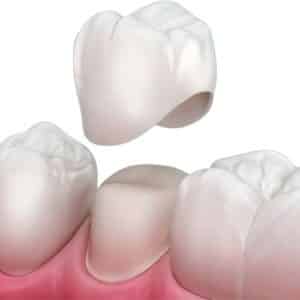
Sometimes this is done with a baby tooth crown, which covers and protects the whole tooth rather than patching one surface — generally more durable on porous enamel than a conventional filling. Dental crowns for children — silver or white? compares the two materials, and notes that a nickel allergy is what decides it in some cases.
If the enamel is severely compromised, the tooth may need to be extracted.
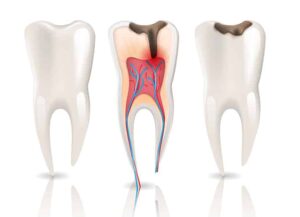
If chalky teeth are sensitive, nerve (pulp) treatment may be needed — the adult equivalent is described under root canal treatment.
Treatment planning is likely to be complex, and to involve several practitioners — including orthodontists and prosthodontists. That coordination is what complex dentistry describes.
The reason a paediatric dentist may involve an orthodontist early: if a first permanent molar has a poor prognosis, the timing of its removal matters enormously. Removed at the right stage of development, the second molar can drift forward into the space and largely replace it. Removed too early or too late, it cannot — and a gap or a longer orthodontic problem follows. Should I pull out my child's loose tooth? covers the same drift principle for baby teeth.
That timing window is the single strongest argument for getting chalky teeth assessed early rather than treating each problem as it arises.
The Chalky Teeth Campaign
The paediatric dental team at Smile Solutions supports the Chalky Teeth Campaign, a worldwide initiative. Parents can visit its website to learn about chalky teeth and how to recognise them.
Common questions
There are white marks on my child's teeth. Is it chalky teeth, early decay, or too much fluoride?
All three look similar to a parent, and they are three completely different things with three different responses. That is the whole argument for having it examined rather than deciding at the bathroom mirror.
- Early decay is the one with a closing window. It can appear as a white area too, and caught early it can often be arrested; left until the tooth breaks down it cannot. See the stages of dental decay.
- Hypomineralisation — chalky teeth — is a defect in how the enamel formed, years before the tooth appeared. Nothing you do now caused it and nothing you do now reverses it; what changes is how well the tooth is protected from here.
- Dental fluorosis is a third thing again. The NHMRC describes it as “caused by a high intake of fluoride from multiple sources during the time when teeth are developing inside the jawbone, usually from birth to six or eight years of age”, appearing as “white lines or areas on the surface of both primary and permanent teeth” and identified after the teeth erupt.
The reassuring part about the third one: the NHMRC records that in Australia, where fluorosis is found, “in most cases it is classified as very mild or mild”, and that “mild to very mild dental fluorosis does not affect the function of the teeth, is not of aesthetic concern to those who have it and is associated with a protective benefit against tooth decay in adult teeth.” Moderate fluorosis is described as very uncommon and severe fluorosis as rare.
What distinguishes them in the chair is the pattern, the surface texture and where on the tooth the marks sit — which is why a photograph taken at the appointment, and compared at the next one, is more useful than any description on a web page.
Should we still be using fluoride toothpaste? Is fluoride not what caused this?
No — and the distinction matters enough to be worth getting right. Fluorosis and hypomineralisation are separate conditions with separate causes. Fluorosis comes from a high fluoride intake from several sources at once while the teeth are forming. Chalky teeth, as set out above, are attributed to disruption during tooth formation, most commonly illness with fever, with a genetic contribution.
A chalky tooth needs more fluoride protection than a normal one, not less, because porous enamel has less of its own defence. Stopping fluoride toothpaste on a hypomineralised molar removes the protection and leaves the defect exactly where it was.
What is worth getting right is the dose. The NHMRC notes that low-fluoride toothpaste for children is now actively promoted “along with public health messages and guidelines about the appropriate use of these products (e.g. use only a small pea-sized amount; encourage children not to swallow toothpaste).” The Australian Dental Association's New South Wales branch adds the supervision point: parents should “assist with brushing children's teeth until age eight.”
Ask at the appointment which toothpaste and which strength, rather than assuming. A child with chalky molars may be advised differently from a sibling without them, and professionally applied fluoride is a separate measure again. See the benefits of fluoride and selecting a toothpaste: fluoride or non-fluoride.
Will the Child Dental Benefits Schedule pay for the treatment?
Partly, for some families — and the gap in what it covers is exactly where chalky teeth get expensive.
Eligibility has three tests, all of which must be met. Services Australia requires the child to be “0 to 17 years old for at least one day that calendar year”, “eligible for Medicare”, and “getting a payment from us at least once a year, or have a parent, carer or guardian getting a payment from us at least once a year.”
The cap is up to $1,158 per eligible child over two consecutive calendar years, and Services Australia notes the cap “is indexed yearly on 1 January”, with the increase applying to a child who received their first eligible service in that calendar year. If you are looking at an older letter or an older balance, the figure for an earlier period was $1,095 — the two are not a contradiction, they are different periods.
What it covers reads almost like a list of chalky-teeth treatment: Services Australia names “check-ups, X-rays, cleaning, fissure sealing, fillings, root canals, extractions.”
What it will not cover is the part that follows a lost molar. The excluded services are “orthodontic dental work, cosmetic dental work, any dental services in a hospital” — so the orthodontic management of a space, and treatment carried out under general anaesthesia in hospital, both fall outside it. That is worth knowing before rather than after. See how does the Child Dental Benefits Schedule operate? and Child Dental Benefits Schedule; published fees are in the price guide.
My younger child has no teeth through yet. Can we stop this happening to them?
Not directly, and any page telling you otherwise is overselling. The damage happens while the tooth is forming inside the jaw, and the identified contributors — illness with fever during those years, some medications given for it, and a genetic tendency — are not things a parent controls through diet or brushing.
What you can control is everything that happens after the tooth appears, and on a weakened tooth that matters more than it does on a sound one. The measures are the ordinary ones: tap water, fluoride toothpaste at the right amount for the age, assisted brushing until around eight, sealants where they are indicated, and keeping the frequency of sugar down rather than only the quantity. See protecting your child from dental disease and the role of fissure sealants in children's teeth.
The one genuinely preventive step is the timing of the first visit. Chalky first molars arrive at about six; the ADA's tracker found only 56% of children are seen before five, and a third of first visits happen because something already hurts. A child already known to the practice at three or four is a child whose six-year molars get looked at the month they appear, rather than two years later. Given the family pattern noted above, a sibling of an affected child has a particular reason to be in that first group.
Related reading
- Children's dentistry — the service page
- Baby teething: signs, symptoms and treatments
- How to encourage your child to brush their teeth
- Oral health care for children with special needs
- How does the Child Dental Benefits Schedule operate?
- Preventing dental decay
- How safe are dental x-rays?
Practical details
Smile Solutions, Level 1, 220 Collins Street, Manchester Unity Building, Melbourne VIC 3000 — getting here. Phone 13 13 96, contact us, or theteam@smilesolutions.com.au. Monday–Friday 8.00am–6.00pm, Saturday 8.30am–1.30pm, Sunday by appointment.
Specialist registration can be verified on the AHPRA register, or by calling 1300 419 495. The practice's registered specialists are identified as such within the full team. Eligible families may be able to use the Child Dental Benefits Schedule; published fees are in the price guide.
Figures on children’s dental visiting and hospitalisation are from the Australian Dental Association’s Consumer Survey and its Australia’s Children and Young People Oral Health Tracker; the specialty and registration details are the Dental Board of Australia’s; the fluorosis and toothpaste statements are the NHMRC’s; and the Child Dental Benefits Schedule figures and conditions are Services Australia’s. None of those publishers is connected with us. The prevalence figure for chalky teeth above is the practice’s own and is not drawn from those sources.
Published 2 December 2018. Presentation, severity and outcomes vary between individuals. General information only; it does not replace advice from your treating practitioner.
Smile Solutions trades under ABN 28 193 514 103.
Images on This Page
-
https://www.facebook.com/tr?id=800557773428361&ev=PageView&noscript=1
(no alt text)
-
https://www.smilesolutions.com.au/wp-content/uploads/2025/10/calendar_month.svg
(no alt text)
-
https://www.smilesolutions.com.au/wp-content/themes/arcadian-wordpress-theme/assets/images/smile_solutions_logo_white.png
Smile Solutions Logo
-
https://www.smilesolutions.com.au/wp-content/themes/arcadian-wordpress-theme/assets/images/smile_solutions_logo_purple.png
Smile Solutions Logo
-
https://www.smilesolutions.com.au/wp-content/uploads/2023/11/SS-Tooth-1-1-150x150.png
Smile Solutions
-
https://www.smilesolutions.com.au/wp-content/uploads/2025/09/Smile-Solutions-Level-10.png
Smile Solutions Level 10
-
https://www.smilesolutions.com.au/wp-content/uploads/2025/09/Root-Canal-2-300x217.jpg
Root Canal
-
https://www.smilesolutions.com.au/wp-content/uploads/2026/08/Mouth-Breathing-300x270.jpg
Mouth Breathing
-
https://www.smilesolutions.com.au/wp-content/uploads/2025/09/Dental-Crown-at-Smile-Solutions-300x300.jpg
Dental Crown at Smile Solutions
-
https://www.smilesolutions.com.au/wp-content/themes/arcadian-wordpress-theme/assets/images/family_owned_bussiness.png
Family Owned Business
-
https://www.smilesolutions.com.au/wp-content/themes/arcadian-wordpress-theme/assets/icons/icon--phone.svg
Smile Solutions Contact
-
https://www.facebook.com/tr? id=800557773428361&ev=PageView&noscript=1
(no alt text)