When should a child first visit the dentist?
When the first tooth becomes visible, or by the first birthday — whichever comes first.
That sounds early, and your child may have very few teeth. The point of the visit is not primarily to examine those teeth. It is to let your child become familiar with the dentist and the dental environment before anything needs doing, and to let the dentist check for early signs of problems. Your child's first visit to the dentist sets out how that appointment runs here, and children's dentistry covers the service as a whole.
That timing is not simply one practice's preference. The Australian Dental Association states that it “recommends children visit the dentist for the first time when the first teeth arrive in their mouth”, and ADA NSW puts it as “their first dental visit should occur when the first baby tooth comes through or by one year of age and at least every 12 months”.
Almost everyone thinks it is later than it is
The ADA's Consumer Survey of 25,000 people asked parents when they believed a child's first dental visit was meant to happen. The answers:
- 5% said before 12 months
- 20% said at 1 year old
- 42% at 2 years old
- 19% at 3 years old
- 4% at 4 years old
So roughly a quarter of parents named the age the profession actually recommends, and the most common answer was a year late. The ADA also reports that one third (32%) of parents said their child's first visit was for pain or a problem — which is the outcome the recommendation exists to avoid.
Two further ADA figures give the size of what is at stake. Its 2024 Children and Young People Oral Health Tracker found that only 56% of children visit the dentist before age 5, and that nearly 11 (10.8) in every 1,000 children aged 5–9 are hospitalised for potentially preventable problems due to dental conditions — rising to 14.3 per 1,000 for Indigenous children. On decay itself, the ADA reports 34% of children aged 5–6 have experienced decay in primary or baby teeth, and 27% aged 5–10 have untreated tooth decay in primary teeth.
Those are national figures from an independent professional body, not this practice's numbers. They are quoted here because they answer the question parents reasonably ask — whether a visit this early is genuinely necessary or simply a dental preference.
Why so early
Getting to know the dentist, and avoiding dental fear
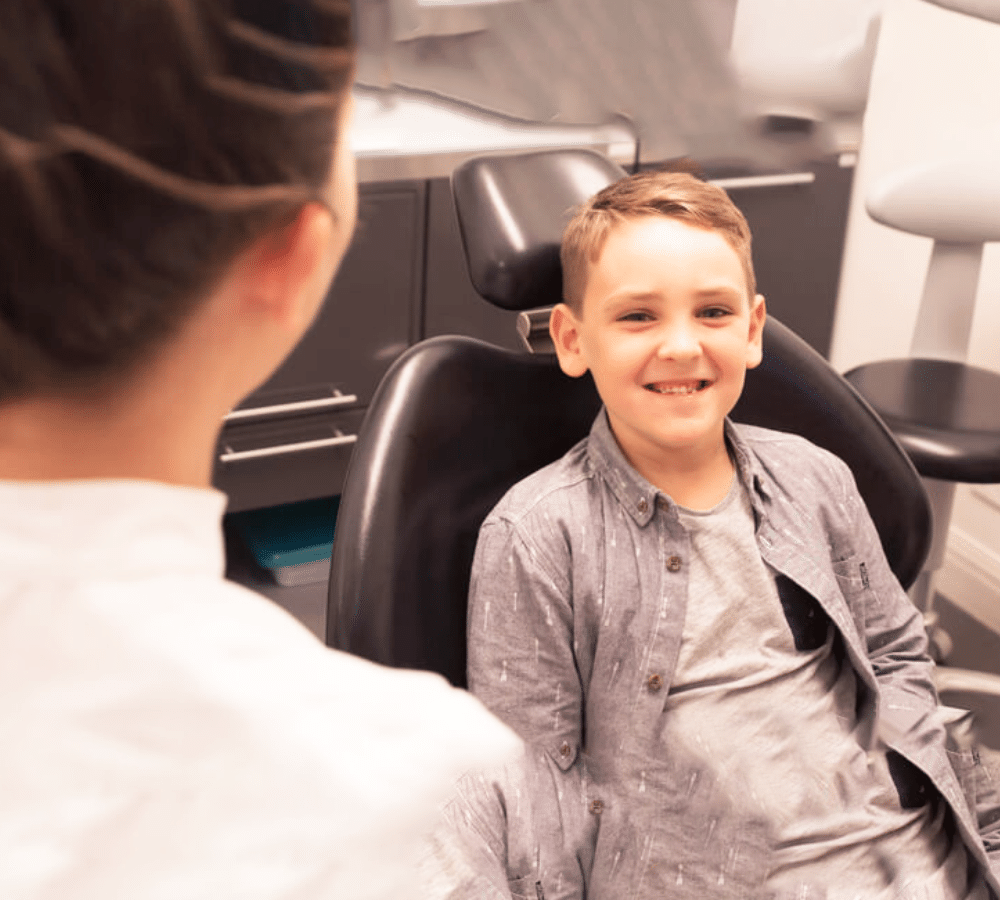
The first visit is meant to be a fun and positive experience, so your child looks forward to coming back. It helps them become comfortable, and want to see the dentist before any dental pain exists.
This is the whole argument, and it is worth stating plainly: a child whose first experience of a dentist is a toothache learns that dentists mean pain. A child who has been five times for nothing in particular learns that dentists are unremarkable. Which of those a person carries into adulthood shapes their dental health for decades, because anxiety is one of the main reasons adults avoid care until it becomes an emergency. Combating dental anxiety in children and how Smile Solutions helps manage a child's dental anxiety go into the practical side.
The ADA's oral health promoter Dr Mikaela Chinotti makes the same point in the survey release: “A first dental visit for a tooth ache may create a negative first experience. We don't want that to be your child's introduction to the dentist. It's important to see the dentist even if you think your child's teeth are healthy.”
Early visits build familiarity with the sights, sounds and smells of the practice. Subsequent visits gradually introduce new things — gentle cleans, low-dose radiographs where required — at the child's own pace. How safe are dental x-rays? answers the question parents usually have about that.
Early detection
The dentist checks the growth and development of your child's teeth, jaws, bite, gums and oral tissues, identifying potential problems early. This includes:
- Variations in the timing or sequence of tooth eruption — see the order and appearance of baby teeth
- Defects in the tooth enamel, which indicate greater susceptibility to decay — everything you need to know about chalky teeth
- Habits that may cause misalignment of the teeth and bite problems — orofacial myofunctional therapy and mouth breathing: the silent habit
- Problems with the gums and tissues, which may affect feeding and cleaning
That enamel point matters more than it sounds. A child with poorly formed enamel is at substantially higher decay risk regardless of how well they brush, and identifying it early means preventive measures can start before the damage does — fissure sealants and protecting your child from dental disease cover what those measures are.
The ADA makes the same argument about timing: problems like tooth decay, picked up early, “can be controlled fairly simply (for example with fluoride applications) before they become established and cause trouble”, whereas leaving it until the teeth hurt or break down means “simpler interventions are unlikely to work and more complex treatment may be needed”.
Advice and anticipatory guidance
Your dentist can tell you what to expect next in your child's dental development — which tooth will erupt next, when the full set of baby teeth should be in, and when to expect a visit from the tooth fairy. Baby teething: signs, symptoms and treatments covers the earliest stage, and should I pull out my child's loose tooth? the one after it.
It is also the best opportunity to ask questions:
- How do I keep my child's teeth and gums clean? — kids teeth cleaning tips and how to encourage your child to brush
- Which foods and drinks should we avoid to prevent decay? — protect your kids from the sugar bandits and how does sugar affect your dental health?
- How do I help my child give up a dummy or thumb sucking?
What is normal, and what is worth a call
The ADA's guidance on the first years is specific enough to be useful as a yardstick:
- Baby teeth often start to appear around 9 months, though the range is 3 to 12 months. If your child has no teeth by 12 months, the ADA advises a check-up with a dentist.
- Teeth arriving in any order is normal, although the middle bottom teeth are often first, and all 20 baby teeth usually arrive by age 3.
- A baby can occasionally be born with a tooth — a natal tooth.
Teething itself can begin as early as 3 months, and the ADA lists the ordinary signs as drooling, rubbing the gums, being more irritable than usual, mouthing objects and biting. What is more useful is the list of things it says should not be attributed to teething straight away: difficulty sleeping, loss of appetite, coughing, rashes, diarrhoea, vomiting, seizures, or a very high fever. Its advice is to see your doctor about those to rule out other illnesses. That is worth knowing, because a genuinely unwell baby is easy to mislabel as a teething baby.
For comfort during teething, the ADA suggests attention and cuddles, teething rings or washcloths that are cold but not frozen, rubbing the back of a cold spoon over the gums, or a dummy. It attaches cautions to two popular remedies: teething gels are washed away by saliva so any effect is brief, it is hard to know how much a baby has swallowed, and a numbed throat is a choking hazard; and amber beaded necklaces or bracelets are a choking hazard and unlikely to help with pain. It also advises never dipping a dummy in a sugary spread such as honey or jam.
There is one check you can do at home between visits. The ADA describes it as lifting the top lip and rolling down the bottom lip to look at the teeth, and making an appointment if you see white, brown or black spots that do not come off — an early sign of decay. It is explicit that this does not replace a check-up by a dentist.
What happens at the first visit
The first visit usually involves a comprehensive check-up, with low-dose radiographs if needed. Some children are more comfortable sitting on a parent's lap in the dental chair; others want their parent close by. If needed, there may be a gentle clean to remove plaque or stains — often with an oral health therapist rather than the dentist; the difference between a dental therapist and a dental hygienist explains who does what.
Tell the dentist about any medical condition or past incident that may affect your child's behaviour and ability to cope. If your child is apprehensive or fearful of new things, everything can be shown and explained beforehand. If they have had a negative medical or dental experience before, there is always the opportunity for them to be in control — asking questions, taking short breaks, and setting the pace or extent of the visit. Oral health care for children with special needs and visiting the dentist: caring for a child with autism set out the adjustments that can be made.
That last point is the single most effective thing in paediatric dentistry. A child who knows they can stop is far more likely to let you continue.
How to prepare
- Make it part of the routine, not a special event — and never a punishment for not looking after their teeth
- Let your child come along when you or an older sibling has a check-up
- Talk about the good things — counting teeth, learning how to look after them
- Avoid words like drill and needle. The dentist will use child-friendly words to explain things. Also avoid reassurance such as promising it will not hurt, which introduces the idea that it might
- Arrive a little early, so your child can get used to the surroundings — getting here
- Encourage and praise them afterwards
One more, for parents who are themselves anxious: children read adult body language accurately. If dental visits make you nervous, it can help to have the other parent bring them, or to say so quietly to the practice beforehand.
After the first visit
Most children are seen every six months. Between visits, the ADA's specifics are worth following closely:
- Start a toothbrush at around 6 months, or when the first tooth arrives — a soft brush, and you do the brushing while letting your child have a turn. Before that, a clean damp washcloth over the gums does the job. See which toothbrushes do dentists recommend?
- Toothpaste from 18 months. Babies do not need it before then, and the habit to build is spitting rather than swallowing — selecting a toothpaste: fluoride or non-fluoride and the benefits of fluoride
- Two minutes is the target, for children and adults alike. The ADA notes that babies and toddlers with only a few teeth do not need that long, provided every surface is reached, and that you can build towards two minutes as more teeth arrive
- Start cleaning between the teeth once two teeth touch side by side — often around age 2. See is flossing really that important?
- Keep helping with brushing. ADA NSW advises parents assist with brushing until age eight; manual dexterity develops later than most parents expect
- Nothing but water in a bottle at night — milk or juice pooling around the teeth overnight is a major cause of early childhood decay. How does tooth decay develop? explains why the frequency matters more than the quantity
If a tooth is knocked out or broken in the meantime, children's dental emergencies has the immediate steps, and emergency dentistry is the route in out of hours.
Common questions
My child will not open their mouth. Is the appointment wasted?
No. Deferring is a documented, legitimate outcome of a visit, not a failure of one. The American Academy of Pediatric Dentistry's behaviour guidance document — a United States guideline, included here because no Australian equivalent could be located, and where it conflicts with Dental Board of Australia or ADA policy the Australian documents govern — lists among the things that must be considered and documented ‘any alternative treatment options including no treatment or deferred care'.
The techniques that get used first are unremarkable and carry no contraindications. Tell-show-do — explain, demonstrate, then do — is listed with the indication ‘use with any patient' and contraindications ‘none'. So is distraction, and the AAPD adds a line worth quoting to any parent watching a difficult appointment: ‘giving the patient a short break during a stressful procedure can be an effective use of distraction before considering more advanced behavior guidance techniques.'
Ask for the hand signal to be set up before anything starts. The AAPD calls this enhancing control — the child is given a signal, such as raising a hand, to interrupt care, and ‘the patient should practice this gesture before treatment is initiated.' A child who knows the stop button works will usually let you keep going.
One honest caveat about all of this. There is no Australian paediatric behaviour-guidance guideline we could locate, and the Cochrane review on non-pharmacological interventions for dental anxiety in children exists only as a protocol with no published results. So none of these techniques comes with a quantified effect size in children. They are the accepted practice; they are not measured the way a drug trial is.
Should the first visit be with a general dentist or a paediatric one?
For a routine first visit around the first tooth or the first birthday, a general dentist or an oral health therapist is the usual route, and that is what the ADA's recommendation describes. Nothing about the age itself requires a referral.
Paediatric dentistry is one of the thirteen dental specialties recognised in Australia. The Dental Board of Australia states that ‘there are 13 dental specialties in Australia which are approved by the Australian Health Workforce Ministerial Council', and paediatric dentistry is among them; a practitioner registered in a specialty must also have completed a minimum of two years of general dental practice.
What changes the answer is the child, not the calendar — significant medical complexity, extensive early decay, a developmental condition, or treatment that cannot be completed safely with the child awake. Should your child see a specialist paediatric dentist? works through those thresholds, and paediatric dentists is the service page.
You can check any practitioner's registration and specialty for yourself on AHPRA's public register before you book.
What about happy gas, sleep dentistry or a general anaesthetic for a small child?
The first thing to know is that none of those consumer terms appears in the policy that governs this. The Australian Dental Association's position on conscious sedation defines four levels, and it is worth asking which one is being proposed:
- Minimal sedation — ‘a drug-induced state of diminished anxiety, during which patients are conscious and respond purposefully to verbal commands or light tactile stimulation', including a single low-dose oral medicine or inhalation of gases.
- Moderate sedation — ‘a drug-induced state of depressed consciousness during which patients retain the ability to respond purposefully to verbal commands and tactile stimulation', and it ‘includes the use of intravenous sedation'.
- Deep sedation — patients ‘are not easily roused and may respond only to noxious stimulation'.
- General anaesthesia — ‘a drug-induced state of controlled unconsciousness' with loss of protective reflexes.
Who may provide which level is a registration matter, not a preference. The ADA's position is that dentists must comply with the Dental Board of Australia's registration standards to practise conscious sedation; that dentists with sufficient training and experience may use minimal sedation; and that moderate sedation is for those who have met the Board's standards and ‘have been endorsed to provide conscious sedation'. Endorsement itself requires ‘a mandatory two-year period as a dentist in general practice'.
On nitrous oxide specifically, there are cautions worth raising before the appointment rather than in the chair. The AAPD's list of situations where it may be contraindicated — and it words this as ‘may include', a list of cautions rather than absolute bars — includes a current upper respiratory tract infection, sinusitis or seasonal allergies that inhibit nasal breathing, recent middle ear infection, ear, nose or throat surgery within the last 14 days, and chronic obstructive lung disease. A blocked nose is the everyday version: the gas is breathed through the nose, so a child with a cold may simply not be able to use it.
The question to ask is which level, by whom, with what endorsement, and what happens if it does not work. Nothing here is a recommendation for your child; that is a decision for the practitioner who assesses them.
My child had a frightening first visit. Have we ruined it?
Almost certainly not, and there is a described technique aimed precisely at this. The AAPD's behaviour guidance document — again, a United States guideline — sets out memory restructuring, in which ‘memories associated with a negative or difficult event (eg, first dental visit, local anesthesia, restorative procedure, extraction) are restructured into positive memories using information suggested after the event has taken place'. It reports that the approach ‘was utilized with children who received local anesthesia at an initial restorative dental visit and showed a change in local anesthesia-related fears and behaviors at subsequent treatment visits'. Its four components are visual reminders, positive reinforcement through verbalisation, concrete examples that encode sensory details, and a sense of accomplishment. In plain terms: revisit what went well, out loud, more than once, rather than never mentioning it again.
The other route back in is systematic desensitisation, which the same document describes as gradual exposure across a series of sessions — reviewing the practice website or a preparation book at home, a parent modelling ‘opening mouth and touching cheek' and practising with a dental mirror, then an office tour outside clinical hours, then a visit that only explores the room, before an appointment with the dentist is attempted.
What is in your hands is the language. Avoid ‘it won't hurt', which plants the idea, and never use the dentist as a consequence for not brushing. See combating dental anxiety in children.
Will anyone hold my child down?
Not without your informed consent, and it is a formal requirement rather than a courtesy. The AAPD's position on protective stabilisation — holding, with or without a device — is that ‘the dentist always should use the least restrictive, but safe and effective, protective stabilization', and that where it is led by the dentist and performed by the dental team it ‘requires informed consent from a parent', with the record documenting both the indication and the consent.
It also draws a distinction that avoids unnecessary alarm: ‘the use of a mouth prop in a compliant child is not considered protective stabilization.' A child who is happily holding a small prop between their teeth is not being restrained.
Because this is a United States guideline, the Australian position is the one that governs here. The document itself says Australian practices should check the position under Australian law and AHPRA guidance rather than relying on its wording. So the practical step is to ask, before treatment begins, what will happen if your child will not stay still — and to say clearly what you are and are not comfortable with.
Related reading
- Should your child see a specialist paediatric dentist?
- Dental crowns for children — silver or white?
- Should my child wear a mouthguard?
- How does the Child Dental Benefits Schedule operate?
- Children's braces and Invisalign
- When should I take my child to an orthodontist?
- Life at the Smile Solutions tooth fairy
Practical details
We have a paediatric dentist and oral health therapists who work with children — the full team is listed by name. If your child needs particular adjustments to manage the appointment, tell reception in advance: contact us.
Specialist registration can be verified on the AHPRA register, or by calling 1300 419 495. Registered specialists at the practice are identified as such.
On cost: eligible families may be able to use the Child Dental Benefits Schedule. Services Australia states that a child is eligible where they are between 0 and 17 years old for at least one day that calendar year, and that the scheme covers up to $1,158 for each eligible child over 2 consecutive calendar years, with the cap indexed yearly on 1 January. Because it is indexed, older material quotes a lower figure — the ADA's consumer page, for instance, still gives $1,095 — so check the current cap rather than relying on a published number. Published practice fees are in the price guide.
Smile Solutions, Level 1, 220 Collins Street, Manchester Unity Building, Melbourne VIC 3000. Phone 13 13 96, or theteam@smilesolutions.com.au. Monday–Friday 8.00am–6.00pm, Saturday 8.30am–1.30pm, Sunday by appointment.
Published 18 January 2021. General information only; it does not replace advice from your treating practitioner. Figures attributed to the Australian Dental Association, ADA NSW, the Dental Board of Australia, the American Academy of Pediatric Dentistry and Services Australia are those publishers' own and are current only as at the dates they published them.
Smile Solutions trades under ABN 28 193 514 103.
Images on This Page
-
https://www.facebook.com/tr?id=800557773428361&ev=PageView&noscript=1
(no alt text)
-
https://www.smilesolutions.com.au/wp-content/uploads/2025/10/calendar_month.svg
(no alt text)
-
https://www.smilesolutions.com.au/wp-content/themes/arcadian-wordpress-theme/assets/images/smile_solutions_logo_white.png
Smile Solutions Logo
-
https://www.smilesolutions.com.au/wp-content/themes/arcadian-wordpress-theme/assets/images/smile_solutions_logo_purple.png
Smile Solutions Logo
-
https://www.smilesolutions.com.au/wp-content/uploads/2023/11/SS-Tooth-1-1-150x150.png
Smile Solutions
-
https://www.smilesolutions.com.au/wp-content/uploads/2025/09/Childrens-Dentistry-Smile-Solutions.png
Children's Dentistry Smile Solutions
-
https://www.smilesolutions.com.au/wp-content/uploads/2025/09/Root-Canal-2-300x217.jpg
Root Canal
-
https://www.smilesolutions.com.au/wp-content/uploads/2026/08/Mouth-Breathing-300x270.jpg
Mouth Breathing
-
https://www.smilesolutions.com.au/wp-content/uploads/2025/09/Dental-Crown-at-Smile-Solutions-300x300.jpg
Dental Crown at Smile Solutions
-
https://www.smilesolutions.com.au/wp-content/themes/arcadian-wordpress-theme/assets/images/family_owned_bussiness.png
Family Owned Business
-
https://www.smilesolutions.com.au/wp-content/themes/arcadian-wordpress-theme/assets/icons/icon--phone.svg
Smile Solutions Contact
-
https://www.facebook.com/tr? id=800557773428361&ev=PageView&noscript=1
(no alt text)