Life as the Smile Solutions Tooth Fairy
A dental nurse with a second job
Karleen Giampietro is a registered dental nurse who doubles as the Smile Solutions Tooth Fairy.
She leaves her "home" in the tower of the Manchester Unity Building to run a free educational initiative aimed at reducing the number of Australian children suffering from preventable dental disease.
That phrase — preventable dental disease — is the whole point of the programme. The Australian Dental Association’s Policy Statement 2.2.3 on oral hygiene puts the scale of it in one line: “early childhood decay is the single most common chronic childhood disease”, and good oral hygiene “can help reduce this disease prevalence and extent”. The ADA’s own measurements say how common: 34 per cent of Australian children aged 5 to 6 have experienced decay in their primary teeth, and 27 per cent of those aged 5 to 10 have untreated decay in primary teeth. The problem is not that the information is complicated; it is that a five-year-old will not act on a pamphlet. How decay develops explains what is actually happening, and protecting your child from dental disease covers the rest.
It is also not a small problem, and it has a number attached. Drawing on the Children and Young People Oral Health Tracker, the ADA reports that nearly 11 — 10.8 — in every 1,000 children aged 5 to 9 are hospitalised for potentially preventable problems due to dental conditions, rising to 14.3 per 1,000 for Indigenous children, and that only 56 per cent of children visit a dentist before age 5. Treating extensive decay in a young child often means a general anaesthetic — because a three-year-old cannot sit through the treatment any other way. Most of those admissions began as something that a toothbrush and a change of drinking habits would have prevented.
What the programme actually does
Assisted by Boris the Tooth Dragon, the Tooth Fairy makes public appearances and visits early learning centres and schools throughout Melbourne.
At these visits, children are encouraged to care for their teeth and gums through:
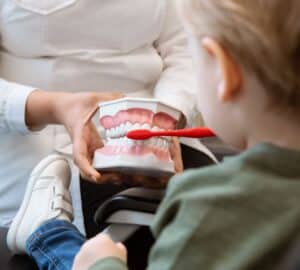
- Demonstrations of correct tooth brushing
- Fun activities and games
The method is the reason it works. Brushing technique is a physical skill, not a piece of information — it is learned by doing it, watching it done, and being corrected. Demonstrating it to a room of children who then copy it is far more effective than telling them about it.
There is a second effect, less obvious. For many children this is a positive, cheerful encounter with dentistry that has nothing to do with pain or a waiting room. That matters more than it sounds. The ADA records that one third — 32 per cent — of parents reported their child’s first dental visit was for pain or a problem, and research from the South Australian Health and Medical Research Institute notes that “dental fear usually arises in childhood, often related to negative experiences, and it can persist”. Meeting a dental nurse dressed as a tooth fairy, in your own classroom, with a dragon, is a different first impression — and first impressions in childhood tend to persist too. Dental anxiety, and combating dental anxiety in children.
What a programme like this can and cannot do
Worth being straight about, because school education programmes are often credited with more than they achieve.
What it does well: builds familiarity, removes fear, teaches a physical skill by demonstration, and reaches children whose families may not be attending a dentist at all.
What it cannot do: change what is in the lunchbox, supervise brushing twice a day, or substitute for an examination. The habits that prevent decay are formed at home, repeated daily, and supervised by an adult. A visit is a prompt, not a programme of care — see Children's Dentistry for what care actually involves.
The Clown Doctors partnership
The Smile Solutions Tooth Fairy has teamed up with Clown Doctors, an Australian charity that supports and delivers the health benefits of humour in sick children's recovery. The practice's wider community work is on Supporting Charities.
The Tooth Fairy has made several hospital visits under this partnership.
There is a specific relevance to children in hospital: many treatments and long admissions affect oral health directly — through medications, altered diet, dry mouth, or simply through the routine of brushing being disrupted while other things take priority.
Some of it is more specific still. Many paediatric liquid medicines are sweetened, and a child on a long course of one, several times a day, is receiving repeated sugar exposures — often at bedtime. The ADA’s Policy Statement 2.2.2 on diet and nutrition is explicit that it is not only the amount that matters: “the form, frequency, timing and total amount of sugar intake are significant in the initiation of the caries process”, and for children and young adults “frequent consumption of drinks and foods with high sugar and/or acid content should be discouraged”. Sugar-free formulations exist for many medicines; it is a reasonable question to ask the prescribing doctor or pharmacist. Rinsing with water afterwards helps where no alternative is available.
The website
The Tooth Fairy has her own website, which children are encouraged to visit. There they can:
- Meet the Tooth Fairy
- Learn about their first visit to the dentist
- Find out how to care for their teeth and gums
- Play child-friendly games
There is also a section where parents can download a customised letter from the Tooth Fairy to give their child when they are about to lose a tooth.
That last feature is quietly clever. The moment a child is about to lose a tooth is the moment they are most interested in teeth — and a letter arriving at exactly that point lands better than any amount of advice offered on an ordinary Tuesday. On the tooth itself, see should I pull out my child's loose tooth?
What parents ask next
The programme raises the questions; these are the answers most often wanted afterwards.
When teeth arrive and when they leave
The first-tooth age is one of those figures where the Australian Dental Association’s own publications do not agree, and it is more honest to show both than to pick one. Its consumer site, teeth.org.au, says “baby teeth often start to appear around 9 months old. However, this can range 3 to 12 months”; the ADA’s NSW branch describes the first tooth as appearing “around 6 – 12 months”. Both are within the same broad window and neither is wrong; they are simply drawing the midpoint differently. What both give you is the same practical rule, and the ADA states it plainly: “if your child does not have any teeth by 12 months of age, it is best to have a check-up with a dentist.”
After that the ADA is unambiguous: “it is normal for the teeth to arrive in any order”, the middle bottom teeth are often first, and “all 20 baby teeth usually arrive by age 3.” Baby teething: signs, symptoms and treatments covers that stretch, and the order of baby teeth sets out the sequence.
They start falling out from around six, beginning with the lower front teeth, and the last of them typically go around eleven or twelve. The first permanent molars arrive around six as well — at the back, without any baby tooth falling out first, which is why parents frequently do not notice them. They are permanent teeth, they are among the most decay-prone in the mouth, and they need to last a lifetime — which is what fissure sealants are for.
Wide variation is normal. What matters is the pattern over time, not hitting a date.
“They're only baby teeth”
This is the single most consequential misunderstanding, and it is worth answering directly.
Baby teeth hold the space for the permanent teeth forming in the bone beneath them. Losing one early to decay lets the neighbouring teeth drift into the gap, and the permanent tooth then has nowhere to come through — which is a common route into orthodontic treatment that would not otherwise have been needed. See Children's braces and Invisalign and when to take a child to an orthodontist.
They also hurt when they decay, they can abscess, and infection at the root of a baby tooth sits directly against the developing permanent tooth underneath it — one of several things that can leave marks on an adult tooth. And children with decay in baby teeth are considerably more likely to have it in their adult teeth.
They are temporary. They are not unimportant.
Brushing, by age
Standard Australian guidance, and worth checking against your own practitioner's advice for your child:
- Before teeth appear: wipe the gums with a clean damp cloth.
- From the first tooth: brush twice daily with a small soft brush and water only. The ADA’s own instruction is to “start using a toothbrush around 6 months of age or when your baby gets their first tooth”, brushing for them but letting them have a turn as well.
- From around 18 months: the ADA says “babies do not need to use toothpaste. Start using toothpaste when your child is 18 months old” — a children's low-fluoride product.
- From around 6 years: standard family toothpaste.
- On how much: the National Health and Medical Research Council, describing the Australian guidance that has accompanied the decline in dental fluorosis, records the message as “use only a small pea-sized amount; encourage children not to swallow toothpaste”. Some Australian guidance — including the advice this practice gives — is more conservative still and describes a smear rather than a pea for the youngest children. Both aim at the same thing: the smallest amount that works, and none of it swallowed.
- Spit, do not rinse. This applies to children too.
- An adult should brush or supervise until around seven or eight — the ADA’s NSW branch puts it at “until age eight years of age”. Manual dexterity, not willingness, is the limiting factor; a child who can tie their own shoelaces is usually ready to be trusted with it.
Teach them to spit rather than swallow. Swallowing fluoride toothpaste regularly during the years the permanent teeth are forming can cause dental fluorosis. The NHMRC describes it as caused by “a high intake of fluoride from multiple sources during the time when teeth are developing inside the jawbone, usually from birth to six or eight years of age”, appearing as white lines or areas on the teeth. It is worth keeping the scale of it in proportion: in Australia, the NHMRC finds that where fluorosis is identified “in most cases it is classified as very mild or mild”, and that mild to very mild fluorosis “does not affect the function of the teeth, is not of aesthetic concern to those who have it and is associated with a protective benefit against tooth decay in adult teeth”; moderate fluorosis is very uncommon and severe fluorosis is rare. It is avoided simply by using the right amount for the age and supervising. What causes white spots on teeth covers the other explanations.
More on technique and on the battles that go with it: Kids teeth cleaning tips · When brushing turns into a battle
The drinking habits that cause the most damage
- Nothing but water or plain milk in a bottle or sippy cup, and nothing sweetened taken to bed. Juice, cordial, flavoured milk or formula pooling around the teeth overnight, when saliva flow is at its lowest, is the classic cause of early childhood decay in the upper front teeth. The ADA's diet policy names this directly among the situations to discourage: “sleeping with sweetened pacifiers/dummies, food or bottles with products containing sugar, including milk and fruit juices”.
- Move from a bottle to a cup from around twelve months, so drinks are finished rather than carried around.
- Water between meals. Fluoridated tap water, where it is available, is the cheapest preventive measure there is — the NHMRC finds community water fluoridation reduces tooth decay by 26 to 44 per cent in children and adolescents and by about 27 per cent in adults.
- Frequency matters more than quantity — one treat at a meal does less harm than the same amount grazed across an afternoon. Halloween is the obvious test of that.
Dental Health Week: protect your kids from the Sugar Bandits
The first dental visit
The Australian Dental Association recommends that children have their first dental visit “when the first teeth appear in the mouth” — in its words, “typically before or around age one”. See First visit to the dentist for the practice's guidance on timing, and when should a child first visit the dentist? for the reasoning. The principle behind any of the recommended ages is the same: the first visit should happen before anything is wrong, so the child's first experience of a dental chair is a look, a count and a sticker — not treatment for pain. On the ADA's own figures that is not what usually happens: 32 per cent of parents said their child's first visit was for pain or a problem, and only 56 per cent of children see a dentist before age 5.
Take them along to your own appointment first if that helps. Familiarity does most of the work.
One thing to avoid: do not promise it will not hurt, and do not use words like needle, drill or hurt in reassurance — children hear the noun, not the negative. “They're going to count your teeth” is both true and enough.
On cost, the Child Dental Benefit Schedule covers a capped amount of basic treatment for eligible families — how the schedule operates explains who qualifies.
If a tooth gets knocked out
This is the one piece of information on this page worth memorising, because the right action differs completely between a baby tooth and an adult tooth.
An adult tooth — put it back in.
- Hold it by the crown, never the root.
- If dirty, rinse briefly in milk or the child's own saliva — not water, and do not scrub it.
- Reinsert it into the socket the right way round and have the child bite gently on a clean cloth.
- If you cannot reinsert it, keep it moist — milk first, then a tooth-preservation solution (HBSS), then the child's own saliva, then saline. Water only as a last resort: it is a poor medium, but the International Association of Dental Traumatology is explicit that it is "better than leaving the tooth to air-dry". Never a dry tissue — letting the tooth dry out is the worst outcome of all.
- Get to a dentist immediately.
The variable that matters is DRY time, not total time out of the mouth — and this is worth being precise about, because the familiar “you have twenty minutes” framing gets it wrong and can talk people out of acting at all. The IADT's 2020 guideline on avulsion of permanent teeth states that “minimizing the dry time is critical for survival of the PDL cells” and that “after an extra-alveolar dry time of 30 minutes, most PDL cells are non-viable” — so a tooth kept wet in milk or saliva is in a far better position than the clock alone suggests. And if more time has passed than that, the tooth should still go back in: the same guideline says “the decision to replant a permanent tooth is almost always the correct decision even if the extra-oral dry time is more than 60 minutes”, because replantation maintains the bone and “will keep future treatment options open”. It can always be removed later if it does not take. What should I do when a tooth is knocked out?
A baby tooth — do NOT put it back. Reinserting it can damage the permanent tooth developing above. Control the bleeding with gentle pressure and see a dentist, but the tooth itself stays out. My child has a knocked out baby tooth: what do I do?
If you are not certain which it is, take the tooth with you and go straight to a dentist. Children's dental emergencies and Emergency Dentistry.
Facial swelling, difficulty breathing or swallowing, a suspected jaw fracture, or a head injury with the dental injury are emergency-department presentations — or call 000.
Booking a visit
The programme is free, and covers early learning centres and schools throughout Melbourne. Enquiries go through the practice — see Contact Us.
Common questions
How much does the Child Dental Benefits Schedule actually pay, and what does it not cover?
Services Australia sets out the mechanics, and the details matter more than the headline.
Eligibility. A child qualifies in a calendar year if they are eligible for Medicare, are aged 0 to 17 for at least one day of that calendar year, and you or they receive an eligible payment at least once in that year. There is nothing to fill in: “you don't need to apply or register for CDBS. If your child is eligible we'll send you a letter.”
The amount. Services Australia states it covers “up to $1,158 for each eligible child over 2 calendar years for basic dental services”, with the cap indexed each 1 January — and the increase applying only to a child whose first eligible service falls in that year. Be aware that published figures lag: the ADA's own consumer page still describes the programme as providing “$1,095 of dental care”, which was the earlier cap. Check the current balance yourself in myGov rather than relying on either number.
What it covers: check-ups, X-rays, cleaning, fissure sealing, fillings, root canals and extractions — usable at both government and private dental clinics. Services Australia notes there are item and time restrictions on some services, and that it is worth asking the practice before treatment starts.
What it does not cover, and this is the part that catches families out: orthodontic work, cosmetic work, and any dental services in a hospital. Nor do CDBS services count towards the Medicare Safety Net or the Extended Medicare Safety Net.
The two-year trap. The two-year period begins with the calendar year in which the child both becomes eligible and receives their first service. You may spend the whole cap in year one — which leaves nothing for year two — and anything unused at the end of the two years is lost: “you'll have to wait for a new 2 year cover period to start.” Unused funds also disappear as soon as the child stops being eligible. So if a large amount of treatment is planned, ask the practice to sequence it against the balance rather than discovering the ceiling halfway through.
If my child needs treatment under general anaesthetic, what are the rules — and who pays?
This is the other side of the hospitalisation figure quoted at the top of this page, and it is worth knowing before you are in the middle of it.
When it is appropriate. The ADA's Policy Statement 6.32 states that “general anaesthesia is a safe and effective component of the practice of dentistry” and lists “children with extensive dental needs” first among the patients it exists for, alongside patients with special needs, dental phobia or anxiety, and those needing extensive or complex procedures. Equally, it is not a convenience: “dental treatment under general anaesthesia should only be undertaken when indicated for appropriate management of the patient.”
Who administers it. The ADA's position is that a dentist “must not carry out any procedure forming part of the practice of dentistry on a patient under general anaesthesia unless the anaesthetic is administered by an appropriately qualified and registered practitioner”, and that it must be given in accordance with the guidelines of the Australian and New Zealand College of Anaesthetists and the applicable regulations. General anaesthesia is defined as “a drug-induced state of controlled unconsciousness accompanied by a partial or complete loss of protective reflexes” — it is a different order of thing from the sedation used in a dental chair, and it belongs in a facility equipped for it.
Who pays is the uncomfortable part. The ADA states that in Australia “dental procedures under general anaesthetic are not universally covered by Medicare”, so “for most families, this means that dental treatment under general anaesthetic is either out-of-pocket or covered through private health insurance, leading to financial inequities”. And, as above, the CDBS excludes hospital services — the ADA calls the inability to use CDBS funding for treatment under general anaesthesia “a significant and unreasonable barrier for access”, and as at June 2025 was still asking for it to be added. Access to theatre time is separately described as “significantly inadequate to patient needs”, with the ADA's position that young children and patients with special needs “must be prioritised” for it.
So the questions to ask are: is a general anaesthetic clinically necessary or a matter of convenience; who will administer it and where; what the waiting time is in the public system versus privately; what your fund pays and what the out-of-pocket amount will be; and — since the decay that led here will still be there afterwards — what the prevention plan is so that it does not happen twice.
My baby is miserable with teething. What is actually safe to use?
The ADA's consumer guidance suggests attention and cuddles, teething rings or washcloths that are “cold but not frozen”, rubbing the back of a cold spoon over the gums, and giving them a dummy. Simple, and deliberately so.
It then names three popular remedies it wants parents to be careful with, and the reasons are specific rather than vague.
- Teething gels. The ADA notes cold gels “can help at first. But this may only last for a short amount of time” because the gel is washed away by saliva — and that babies can swallow it, with no way to know how much: “this can make the throat numb becoming a choking hazard.”
- Amber beads, and beaded necklaces or bracelets generally. The ADA's position is blunt: they “can be a choking hazard and they are unlikely to help with pain”.
- A dummy dipped in something sweet. “Do not dip a dummy in sugary spreads such as honey or jam. This can increase your child's risk of tooth decay if they already have teeth.” The same policy elsewhere discourages “sleeping with sweetened pacifiers/dummies” at all.
One more thing worth knowing, because it prevents a real mistake in the other direction. Teething gets blamed for a great deal it does not cause. The ADA lists seizures and a very high fever among symptoms that are not teething, and advises seeing a doctor “to rule out other illnesses”. Persistent, severe or unusual symptoms in a teething-age baby are a medical question, not a dental one.
Is there an age at which a dummy or thumb sucking becomes a problem?
An honest answer: we cannot give you an age from the sources we hold. The Australian material available to us addresses dummies only in two respects — that a dummy is a reasonable comfort measure during teething, and that it must not be dipped in anything sweet or taken to bed sweetened. Neither the ADA's consumer material nor the policy statements we can check name an age at which dummy use or thumb sucking should stop, or quantify the effect on the bite.
That gap is worth stating rather than filling, because parents are given confident and contradictory ages by people who also do not have a source. What we can say with confidence is narrower and still useful:
- The decay risk is about what is on it and when. A clean dummy is a different proposition from a sweetened one, and a sweetened one at bedtime is the worst version, for the same saliva reason that makes a bottle in bed so damaging.
- The bite question is answerable on your child specifically, by looking. If the habit is still going once the permanent front teeth are arriving, that is the point to have it assessed rather than guessed at — see when should I take my child to an orthodontist?
- A habit that has already stopped needs no intervention, whatever age it stopped at.
Sources named on this page
- Australian Dental Association, Policy Statement 2.2.3 — Oral Hygiene, and Policy Statement 2.2.2 — Diet and Nutrition
- Australian Dental Association, Policy Statement 6.32 — General Anaesthesia in Dentistry (document version June 2025)
- Australian Dental Association consumer and branch pages on children's oral health, including figures drawn from the Children and Young People Oral Health Tracker, and its consumer guidance on teething
- Services Australia, Child Dental Benefits Schedule — eligibility, what is covered, and the two-year cap
- National Health and Medical Research Council, public statement on water fluoridation and dental fluorosis
- International Association of Dental Traumatology, Guidelines for the management of traumatic dental injuries: 2. Avulsion of permanent teeth (Dental Traumatology, 2020)
- South Australian Health and Medical Research Institute, on the childhood origins of dental fear
Related reading
Kids teeth cleaning tips · Paediatric dentists · When brushing turns into a battle · Dental Health Week: protect your kids from the Sugar Bandits · Supporting charities
Practical details
Written by Karleen Giampietro, registered dental nurse.
Smile Solutions, Level 1, 220 Collins Street, Manchester Unity Building, Melbourne VIC 3000. Phone 13 13 96, or theteam@smilesolutions.com.au. Monday–Friday 8.00am–6.00pm, Saturday 8.30am–1.30pm, Sunday by appointment.
Registration for any practitioner can be verified free on the AHPRA public register at ahpra.gov.au.
Published 18 November 2018. Programme details, partnerships and availability are as described at that date and may have changed; confirm current arrangements with the practice. Child Dental Benefits Schedule amounts and eligibility rules change — the cap is indexed annually and the figures quoted above are as published by Services Australia at the time of writing; check your own entitlement through myGov.
General information only — it is not a diagnosis, a treatment plan or a promise of any particular clinical outcome, and it does not replace advice from your treating practitioner. Eruption ages, toothpaste amounts and supervision ages are general guidance and vary between children; what is right for your child can only be determined after examination, and your practitioner's advice takes precedence over anything here. Nothing on this page is medical or medication advice — do not change any prescribed medicine on the basis of it. A knocked-out or injured tooth is an emergency: see a dentist immediately rather than relying on any web page.
Smile Solutions trades under ABN 28 193 514 103.
Images on This Page
-
https://www.facebook.com/tr?id=800557773428361&ev=PageView&noscript=1
(no alt text)
-
https://www.smilesolutions.com.au/wp-content/uploads/2025/10/calendar_month.svg
(no alt text)
-
https://www.smilesolutions.com.au/wp-content/themes/arcadian-wordpress-theme/assets/images/smile_solutions_logo_white.png
Smile Solutions Logo
-
https://www.smilesolutions.com.au/wp-content/themes/arcadian-wordpress-theme/assets/images/smile_solutions_logo_purple.png
Smile Solutions Logo
-
https://www.smilesolutions.com.au/wp-content/uploads/2016/05/Karleen-150x150.jpg
Karleen Giampietro
-
https://www.smilesolutions.com.au/wp-content/uploads/2018/11/Smile-Solutions-Tooth-Fairy.jpg
Smile Solutions Tooth Fairy
-
https://www.smilesolutions.com.au/wp-content/uploads/2018/11/Brushing-Childrens-Teeth-300x270.jpg
Brushing Childrens Teeth
-
https://www.smilesolutions.com.au/wp-content/uploads/2018/09/child-wear-mouthguard-768x572-1-300x223.jpg
child wear mouthguard 768x572 1
-
https://www.smilesolutions.com.au/wp-content/uploads/2025/09/Root-Canal-2-300x217.jpg
Root Canal
-
https://www.smilesolutions.com.au/wp-content/uploads/2023/11/SS-Tooth-1-1-150x150.png
Smile Solutions
-
https://www.smilesolutions.com.au/wp-content/themes/arcadian-wordpress-theme/assets/images/family_owned_bussiness.png
Family Owned Business
-
https://www.smilesolutions.com.au/wp-content/themes/arcadian-wordpress-theme/assets/icons/icon--phone.svg
Smile Solutions Contact
-
https://www.facebook.com/tr? id=800557773428361&ev=PageView&noscript=1
(no alt text)
-
https://bat.bing.com/action/0?ti=25148060&tm=gtm002&Ver=2&mid=347aa101-125d-45cd-ad73-90d937dd40a5&bo=1&sid=278f3390ab2711f1b6bf95142fd4fc6e&vid=278f8070ab2711f18a3475669763e47d&vids=1&msclkid=N&pi=918639831&lg=en-US&sw=800&sh=600&sc=24&nwd=1&tl=My%20life%20as%20the%20Smile%20Solutions%20Tooth%20Fairy%20-%20Smile%20Solutions&p=https%3A%2F%2Fwww.smilesolutions.com.au%2Fdental-articles%2Farticle%2Flife-smile-solutions-tooth-fairy%2F&r=&evt=pageLoad&sv=2&cdb=AQAQ&rn=440689
(no alt text)